The Blitz
- Dates:
- 7 September 1940 – 11 May 1941
- Front:
- Western Front
- Location:
- London and the industrial and port cities of Britain: Coventry, Birmingham, Liverpool and Merseyside, Bristol, Southampton, Portsmouth, Plymouth, Sheffield, Manchester, Hull, Swansea, Cardiff, Glasgow and Clydebank, Belfast and others; German airfields in France, Belgium and the NetherlandsOn the battle map →
- Sides:
- Nazi GermanyHermann Göring, Hugo Sperrle, Albert KesselringUnited KingdomHugh Dowding, Winston Churchill
- Result:
- German strategic failure. The raids killed more than 40,000 civilians and destroyed or damaged about two million homes across the country, over a million of them in London alone, but broke neither British industry nor the will to resist. In May 1941 the Luftwaffe moved most of its forces east.
- Author:
- Łukasz
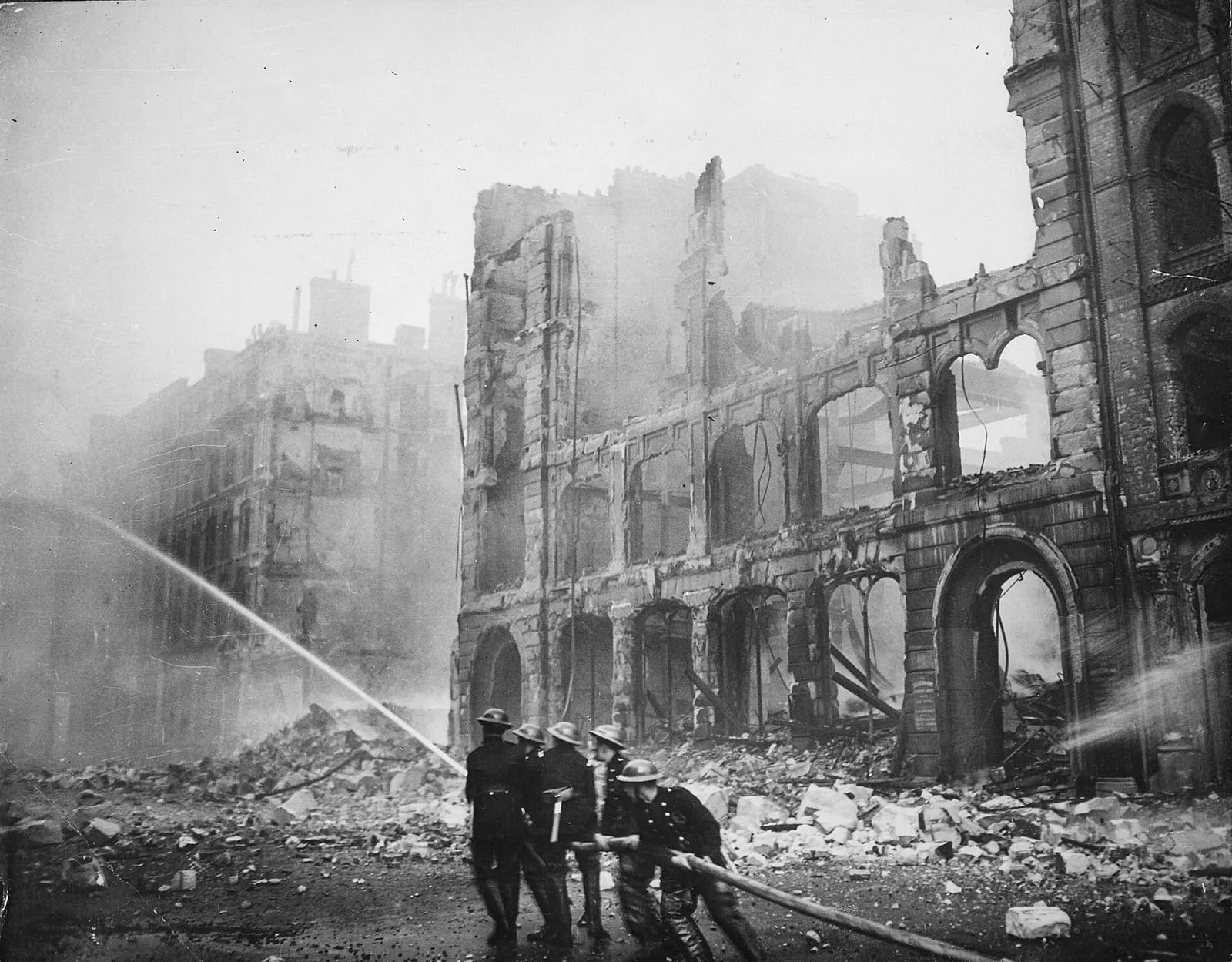
The Blitz is the name the British gave to the German bombing offensive against their cities from September 1940 to May 1941. It began on the afternoon of 7 September 1940, when Hermann Göring’s Luftwaffe, unable to destroy the RAF’s fighters by day, sent nearly a thousand aircraft against the London docks. London was then bombed for 57 nights in a row; from November the bombers turned in succession to Coventry, Birmingham, Bristol, Southampton, Sheffield, Manchester and Liverpool, and in the spring of 1941 above all to the ports: Plymouth, Portsmouth, Swansea, Clydebank near Glasgow, Belfast, Hull and Liverpool once again. The last great raid on London, on the night of 10/11 May 1941, was also the deadliest. In eight months more than 40,000 British civilians were killed, almost half of them in the capital. The Germans hoped that the bombs would paralyse industry, cut the country off from supplies from across the ocean and break the spirit of the population, and that Winston Churchill’s government would agree to peace. None of this happened. The Blitz entered British collective memory as a time of shared ordeal, although historians later showed that the image of an unbreakable, united nation was also a work of propaganda.
Name and dates
The word Blitz is short for the German Blitzkrieg, “lightning war”, the term the British and American press used to describe the German campaigns of 1939–1940. In the autumn of 1940 Londoners began to call the raids on their city by that name, and it stuck to the whole campaign. The Germans had no single name for it: the attack on London was conducted as Operation Loge (after the city’s codename), and the parallel operations against ports and shipping, including aerial minelaying, as Operation Seeschlange (Sea Snake). People also speak of the “London Blitz”, and the provincial cities had Blitzes of their own: the Coventry, Liverpool, Clydebank or Belfast Blitz.
The start of the campaign is beyond dispute: 7 September 1940, the first massed raid on London. Bombs had already fallen on Liverpool and the London suburbs in August, but these were not yet systematic attacks on cities. The end is a matter of convention. It can be placed on the night of 10/11 May 1941, the last great raid on London, after which most of the bomber units flew east. Some accounts extend the Blitz by a few days, to mid-May; others carry it on until the attack on the Soviet Union in June 1941. The first weeks of the Blitz overlap with the final stage of the Battle of Britain, which the British close on 31 October 1940; for many German historians the two campaigns form a single air battle for Britain lasting from July 1940 to May 1941.
Background
Before the war, the bombing of cities was feared in Britain more than anything else. Air power theorists argued that “the bomber will always get through”, and government experts estimated that hundreds of thousands of people would die in the first weeks of a war. Mass coffins were prepared, and an evacuation of children, pregnant women and mothers with small children from the big cities was organised; gas masks were handed out, along with more than two million corrugated-iron garden shelters, named Anderson shelters after the minister John Anderson. A civil defence network (Air Raid Precautions, ARP) was built up with hundreds of thousands of volunteers: air raid wardens, the Auxiliary Fire Service, rescue workers and first-aiders. Europe knew what the bombing of a city meant from Guernica, and from 1939 from Wieluń and Warsaw, and in May 1940 from Rotterdam.
For the first year of the war the great raids on British cities did not come. In the summer of 1940 the Luftwaffe was fighting for command of the air ahead of the planned landing, Operation Sea Lion, and attacking convoys, ports, airfields and aircraft factories; in the process bombs also fell on towns, from Aberdeen to Wales. Adolf Hitler, however, had reserved for himself the decision to attack London. On the night of 24/25 August stray German bombs fell on the City, and in retaliation Churchill ordered Berlin to be bombed. On 4 September, in the Berlin Sportpalast, Hitler announced that he would repay British raids a hundredfold and “erase” English cities.
More than emotion lay behind the change of target. The Luftwaffe leadership was convinced that after two weeks of attacks on the airfields Fighter Command had only remnants left. Field Marshal Albert Kesselring argued that the last British fighters could be drawn into battle and destroyed only over London, which the RAF had to defend; Field Marshal Hugo Sperrle doubted whether the British air force was really exhausted. Hitler and Göring adopted Kesselring’s view. The attack on the capital was at the same time meant to cause panic and chaos which – so Berlin believed – would force the government to negotiate or make a landing easier. It was a mistake: Luftwaffe intelligence greatly underestimated the RAF’s strength, and halting the attacks on No. 11 Group’s sector airfields gave Fighter Command time to recover.
Forces and means
The Luftwaffe waged the Blitz with its two air fleets in the west: Kesselring’s Luftflotte 2, with airfields in Belgium, the Netherlands and north-east France, and Sperrle’s Luftflotte 3, with airfields in Normandy, Brittany and around Paris. Its main instrument was the medium bomber – the He 111, the Do 17 and the Ju 88 – capable of carrying 1–2 tonnes of bombs each, and so incomparably weaker than the four-engined bombers with which the British and Americans later bombed Germany. At the end of November 1940 the Germans had about 1,100 bombers available for night raids, of which on average about 200 took off on any one night. They dropped high-explosive bombs, hundreds of thousands of small incendiaries, and parachute sea mines that could wreck whole blocks of streets. From the autumn the raids were also joined by Italians of the air corps (Corpo Aereo Italiano) sent to Belgium by Benito Mussolini, but their contribution was negligible.
To find their targets at night, the Luftwaffe used radio navigation systems. Crews flew along a radio beam transmitted from the Continent, and over the target a second beam crossed it. The simplest system was Knickebein (PL); more accurate were X-Gerät, used by the specialist bomber group KGr 100 – which marked targets with incendiaries for the following waves – and Y-Gerät. The British physicist Reginald Victor Jones had worked out how Knickebein operated as early as June 1940, and a special RAF unit, No. 80 Wing, jammed the beams and transmitted false radio beacon signals. This “Battle of the Beams” was one of the first examples of electronic warfare.
At the start of the Blitz the night defences were almost helpless. The guns of General Frederick Pile’s Anti-Aircraft Command had no radar fire control, the searchlights could not reach bombers at high altitude, and there were few night fighters. A few days into the Blitz, Pile ordered a massive barrage over London to raise the inhabitants’ spirits; it hardly ever hit an aircraft, but the roar of the guns convinced Londoners that their city was fighting back. In time the backbone of the night defences became the twin-engined Beaufighter with airborne interception radar, supported from early 1941 by ground-controlled interception (GCI) radar stations. At the same time barrage balloons were put up, forcing the bombers to fly higher. The ineffectiveness of the night defences in the first months damaged Air Chief Marshal Hugh Dowding: on 25 November 1940 he was removed from command of Fighter Command and succeeded by Air Marshal William Sholto Douglas.
Course of the campaign
London: 57 nights (September – November 1940)
On the Saturday afternoon of 7 September 1940 some 350 bombers, escorted by more than 600 fighters, flew in over the Thames Estuary. Göring watched them from the coast of the Pas-de-Calais. The bombs fell on the docks, warehouses, refineries and the working-class districts of the East End: Silvertown, West Ham, Stepney, Poplar and Woolwich with its arsenal. Fires of timber, sugar, rubber and paint burned until morning and guided further waves of bombers through the night. According to British figures more than 400 Londoners were killed and about 1,600 seriously injured. The following night more than 400 more people died. On the evening of 7 September the British command, believing an invasion to be imminent, issued the codeword “Cromwell”.
For the next few weeks the Germans attacked London by day and by night. On 10 September a bomb hit South Hallsville School in Canning Town, where families who had lost their homes were waiting to be evacuated; officially 73 people died, but local people spoke of several hundred victims, and the discrepancy has never been resolved. On 13 September bombs fell on Buckingham Palace. Queen Elizabeth said then that she was glad of it, because now she could look the people of the East End in the face. On 15 September the Luftwaffe suffered such heavy losses in two daylight raids on London that it never regained the initiative by day, and on 17 September Hitler postponed the landing indefinitely. At the beginning of October the weight of the attacks shifted to the night, when the bombers were almost immune. On the night of 14/15 October, under a full moon, some 380 bombers killed about 200 people in London; a bomb that pierced the roof of Balham Underground station flooded the people sheltering there with water and earth and killed several dozen of them.
London was bombed for 57 consecutive nights, until the beginning of November. By mid-November more than 11,000 tonnes of high explosive and nearly a million incendiaries had fallen on it. According to the British Ministry of Home Security, more than 13,000 civilians were killed across the country in September and October, and nearly 20,000 were injured. These were terrible losses, but far smaller than had been predicted before the war. The railways and the port kept working, and government observers found no signs of collapse.
The industrial cities (November – December 1940)
In November the Luftwaffe changed its plan and struck at the centres of the armaments industry. On the night of 14/15 November, in an operation codenamed Mondscheinsonate (Moonlight Sonata), some 450 bombers led by KGr 100 attacked Coventry, a centre of the motor and aircraft industries in the Midlands. According to the most widely accepted estimates about 568 people were killed (the exact number was never established) and more than 860 seriously injured. Fire consumed the medieval Cathedral of St Michael and most of the city centre. Several dozen factories were damaged, and aircraft production fell for a few weeks. German propaganda coined the word coventrieren, “to coventrate”, meaning to raze a city to the ground. The story repeated later that Churchill knew from decrypted signals (“Ultra”) of the attack on Coventry and let it go ahead so as not to reveal that the cipher had been broken is not borne out: intelligence knew the operation’s codename but did not learn its target in time, and the target was identified only on the afternoon of 14 November from the alignment of the German beams, which the jamming failed to disrupt that night.
In the weeks that followed the bombers struck Birmingham, where about 800 people were killed between 19 and 28 November, Bristol (24 November, more than 200 dead), Southampton, Sheffield (12–15 December, more than 660 dead) and Manchester (22–24 December, about 680 dead), as well as Liverpool, where about 365 people died in the raids before Christmas. On the night of Sunday 29/30 December some 130 bombers showered the City of London with incendiaries, with the Thames at low tide and the water mains damaged. About 1,500 fires broke out, which became known as the “Second Great Fire of London” – the first having been the fire of 1666. The Guildhall, the seat of the City’s government, was badly damaged, and several churches built by Christopher Wren burned down. St Paul’s Cathedral, which Churchill ordered to be saved at all costs, was saved by firemen and volunteers; the photograph of its dome rising through the smoke became one of the symbols of the war.
The ports (January – May 1941)
In winter bad weather limited the raids, and many bomber units were sent back to Germany to rest. On 6 February 1941 Hitler issued Directive No. 23, which, under pressure from Grand Admiral Erich Raeder, gave first priority to the war against Britain’s seaborne imports. The air force was to support the U-boats in the Battle of the Atlantic and attack ports and shipping, while raids on inland cities became a secondary matter. Even before that, on 2 January 1941, a raid on Cardiff killed 165 people, and on the night of 10/11 January fire consumed the centre of Portsmouth, the Royal Navy’s main base. From 19 to 21 February three nights of bombing destroyed the centre of Swansea, killing 230 people.
In March, with better weather, came the heaviest raids. On 13 and 14 March bombers attacked the shipyards on the Clyde. In Clydebank near Glasgow, of some 12,000 houses only seven were left undamaged; more than 500 people died in Clydebank itself, and about 1,200 across the whole Clydeside region according to Scottish tallies. On 20 and 21 March, a few hours after a visit by King George VI and the Queen, bombs reduced the centre of Plymouth to rubble; in April the city endured five more nights of raids. In April London suffered two of the heaviest attacks of the entire war, on the nights of 16/17 and 19/20 April, in which, according to British figures, more than two thousand people were killed in total. On the night of 15/16 April, Easter Tuesday, some 200 bombers struck Belfast, which had almost no anti-aircraft defences; nearly a thousand people died, the highest toll of any single raid outside London. Firemen from neutral Ireland crossed the border to help.
From 1 to 7 May the “May Blitz” struck Liverpool and Merseyside, the most important port receiving convoys from North America. On 3 May the burning ammunition ship SS Malakand blew up in the docks. Tens of thousands of houses were destroyed or damaged, and according to various tallies between one and a half and nearly two thousand people were killed that week; for several days the port could handle only part of its cargo. On the nights of 7/8 and 8/9 May bombs fell on Hull, where nearly 400 people died; Hull, easy to find on the Humber estuary, was the most heavily bombed British city after London, but the censors usually referred to it only as “a north-east coast town”.
The last raid on London (10/11 May 1941)
On the night of 10/11 May 1941, under a full moon and with the Thames at low tide, the Luftwaffe flew more than 500 sorties over London and dropped nearly 800 tonnes of bombs. More than two thousand fires broke out. 1,436 people were killed, the highest toll of any single night of the war, and more than 1,700 were seriously injured. The chamber of the House of Commons in the Palace of Westminster burned out, Westminster Abbey and the British Museum were damaged, and almost all the capital’s railway stations were blocked for days. That same evening Hitler’s deputy in the party, Rudolf Hess, flew alone to Scotland in order – as he claimed – to offer the British peace.
No one in London knew that this was the end. In May and June most of the bomber units of Kesselring’s Luftflotte 2 were moved east, where Operation Barbarossa was being prepared, and some had gone earlier to the Balkans. Sperrle’s Luftflotte 3 remained in the west, too weak to conduct a major offensive. The raids did not stop entirely, but they never again reached the scale of 1940–1941.
Life under the bombs
The Blitz was above all an experience of civilians. At night the cities were plunged into total blackout; the sirens usually sounded in the evening, and people went down to the shelters for the whole night. According to a census taken in London in November 1940, about 27 per cent of the inhabitants slept in Anderson shelters in their gardens, 9 per cent in public surface shelters, and only about 4 per cent in Underground stations and other large shelters. The rest stayed at home, under the stairs, in cellars or simply in their beds. At first the government banned the use of the Underground as a shelter, fearing that people would stop coming out, but Londoners bought tickets and stayed on the platforms. The record number, about 177,000 people, was recorded on 27 September 1940. The authorities gave way: bunks, lavatories and food points were installed in the stations. The Underground did not always protect: the bombs that hit Balham station in October 1940 and Bank in January 1941 each killed several dozen people.
In October 1940 the Labour politician Herbert Morrison became Minister of Home Security. He expanded the public shelters, and in March 1941 he introduced a table-shaped steel indoor shelter for homes without a garden (the Morrison shelter). An enormous burden fell on the civil defence services, most of them volunteers: ARP wardens, firemen, rescue squads digging people out of the rubble, and the women of the Women’s Voluntary Service, who ran field kitchens and rest centres for the homeless. On 23 September 1940 King George VI announced the institution of the George Cross, an award for bravery chiefly for civilians, which was received among others by bomb disposal sappers and rescue workers.
Morale proved more resilient than either the Germans or the British government had expected. There was no mass panic and no clamour for peace. British surveys of opinion, including the volunteer social research organisation Mass-Observation, nevertheless recorded exhaustion, lack of sleep, anger at the authorities for not providing enough shelters, and resentment in poor districts towards wealthy ones. After the great raids on Coventry, Southampton, Plymouth, Hull or Liverpool thousands of people left the city every evening and spent the night in the fields and surrounding villages. There was looting from bombed houses. British propaganda – the documentary film London Can Take It!, among others – and American correspondents, above all Edward R. Murrow, whose radio reports from the rooftops of London were heard by millions of Americans, fixed the image of a calm, unbreakable city. That image, which the British historian Angus Calder in 1991 called “the myth of the Blitz”, was simplified but not false: London and the other cities, for all their weaknesses, survived and kept working. The visits of Churchill and the royal couple to bombed districts, and the King’s decision to remain in the capital, mattered a great deal in this.
Losses
According to the British figures most often cited, between about 40,000 and 43,000 civilians were killed in the Blitz, almost half of them in London. The number of injured, depending on the method of counting, ranges from about 46,000 seriously injured to nearly 140,000 injured in all. About two million homes across Britain were destroyed or damaged, more than half of them – over a million – in London; in some weeks of the autumn of 1940 tens of thousands of people lost the roof over their heads. In the course of the Blitz the Luftwaffe dropped several tens of thousands of tonnes of bombs in all (a figure of about 40,000 tonnes is often given). By comparison, the series of Allied raids on Hamburg in July and August 1943 (Operation Gomorrah) killed, according to various estimates, between about 35,000 and 40,000 people – roughly as many as the entire Blitz.
German losses were small in relation to the effort. According to some studies the Luftwaffe lost about 600 bombers in the night raids, roughly 1.5 per cent of sorties; many aircraft crashed while landing in fog or bad weather rather than to defensive fire. The effectiveness of the British night fighters grew only in the spring of 1941.
Significance
The Blitz was the first attempt in history to defeat a great industrial power by bombing its cities alone. It failed. Britain’s war production rose throughout the campaign; the raids forced the dispersal of the aircraft industry and delayed deliveries of components, but they did not stop the factories for long. The ports, despite the destruction in Liverpool, Plymouth and Clydebank, went on receiving convoys. The government did not contemplate peace. The Luftwaffe, built to support the ground forces, had neither heavy bombers nor a doctrine of strategic warfare, and its leadership changed targets every few weeks – from London to the Midlands to the ports – without carrying any attack through to the end.
The Blitz also helped to change American attitudes. Reports from burning London convinced Americans that Britain was fighting and deserved help; in March 1941 Congress passed the Lend-Lease Act. Unable to defeat the British either from the air or by invasion, Hitler turned against the Soviet Union, counting on the destruction of Russia to rob London of its last hope. Because it survived, Britain became the base for the bombers and later for the great invasion of the Continent in 1944.
The experience of the Blitz had one more, grim consequence. The British air force, analysing the German raids, concluded that incendiaries dropped on city centres destroyed a city’s productive capacity more effectively than precision attacks on factories. From 1942 Bomber Command under Air Marshal Arthur Harris waged an “area bombing” offensive against Germany which in Hamburg, Cologne, Dresden and dozens of other cities caused many times more casualties than the Blitz. The Germans returned over London in the so-called “Baby Blitz” at the beginning of 1944, and in the summer of 1944 began to bombard it with V-1 flying bombs and later V-2 rockets.
In Britain the Blitz has remained one of the most important memories of the war. The ruins of the old cathedral in Coventry were preserved as a memorial beside the new one, built in the 1950s, and after the war Coventry itself twinned with German cities destroyed by Allied bombs, among them Dresden, becoming a symbol of reconciliation. The phrase “Blitz spirit” still denotes, in British political and everyday language, calm perseverance in the face of danger.