Germany
Hugo Sperrle
Commander of the Condor Legion (1936–1937), commander of Luftflotte 3 (1938–1944), Generalfeldmarschall (1940)
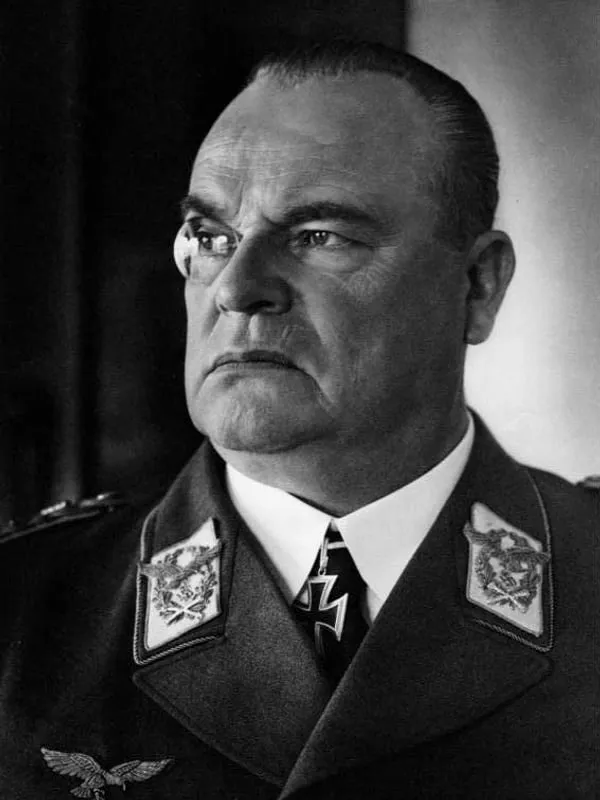
- Born:
- 7 February 1885, Ludwigsburg (Württemberg, German Empire)
- Died:
- 2 April 1953, Munich
- Author:
- Łukasz
- Photo:
- autor nieznany, CC BY-SA 3.0 DE, Wikimedia Commons

Hugo Sperrle was one of the founders of German military aviation between the wars and the first commander of the Condor Legion, which Hitler sent in 1936 to help General Francisco Franco. Under his command the German airmen in Spain progressed from defeats over Madrid to mastery of the air. It was also under his command that Guernica was bombed, turning the Legion into a symbol of air warfare against civilians. Hitler later used Sperrle’s bulk and reputation to intimidate opponents: in February 1938 Sperrle sat at the table while the Austrian chancellor was being forced into concessions. During the Second World War he commanded Luftflotte 3 in the west for five years – from the victorious French campaign and the Battle of Britain to helplessness in the face of the Allied landings in Normandy. After the war the court at Nuremberg acquitted him.
Early life and the First World War
He was born on 7 February 1885 in Ludwigsburg in Württemberg, the son of a brewery owner. In 1903 he joined the 126th Württemberg Infantry Regiment as an officer cadet and served in the infantry for more than ten years. When the First World War broke out, he trained as an aerial observer and joined the Imperial German Army Air Service. He flew as an observer, then as a pilot in reconnaissance units. He was promoted to captain at the end of 1914, and in December 1915 he took command of a field aviation unit. In February 1916 he was badly injured but survived an air crash, returning to duty a few months later. He ended the war as commander of the air units of the 7th Army. He was no fighter ace, but an able staff officer and an organiser of reconnaissance aviation. His decorations included both classes of the Iron Cross and the House Order of Hohenzollern with Swords.
The secret air force of the Weimar Republic
After the war Sperrle joined the Freikorps (PL) and in 1919 commanded a volunteer air unit on Germany’s eastern frontier during the border conflicts with Poland. He then moved to the Reichswehr. The Treaty of Versailles had forbidden Germany a military air force, but General Hans von Seeckt kept within the 4,000-strong officer corps of the 100,000-man army a group of experienced airmen who, under cover of other posts, prepared for the rebuilding of air power. Sperrle was one of them. He served on the staff of the military district in Stuttgart and then at the Reichswehr Ministry, where from 1925 to 1929 he worked in the secret air staff, succeeding Helmuth Wilberg as its head in 1927. According to some sources he visited the secret German flying school at Lipetsk in the Soviet Union, which operated thanks to military cooperation between the Reichswehr and the Red Army. At the end of the 1920s he returned to the infantry and commanded a battalion, and from the autumn of 1933 a regiment.
After Hitler came to power, his experience became very valuable. The air force being built by Hermann Göring’s new Reich Air Ministry was still secret, its units hidden behind civilian names. In the spring of 1934 Sperrle transferred to the air force and took command of the first air division, which brought together most of the existing squadrons. He took part in the disputes over the choice of aircraft and was a sharp critic of Dornier’s unsuccessful bombers. When Hitler revealed the existence of the Luftwaffe in March 1935, Sperrle became one of its most important commanders. On 1 October 1935 he was promoted to Generalmajor and took command of the air district in Munich.
Commander of the Condor Legion
After the outbreak of the Spanish Civil War German transport aircraft ferried Franco’s troops from Morocco to Spain, and a small group of German airmen fought alongside the Nationalists. In the autumn of 1936, when Soviet fighters appeared over Madrid, Hitler and Göring decided to send a self-contained air formation to Spain. Sperrle, who used the pseudonym “Sander” in Spain, was chosen to command it. He left Germany on 31 October 1936 and reached Seville via Rome on 5 November. The Condor Legion, initially some 4,500 men strong, had a bomber group of Junkers Ju 52s, a fighter group of Heinkel He 51s, reconnaissance, anti-aircraft artillery and signals units. From January 1937 Sperrle’s chief of staff was Wolfram von Richthofen, who directed day-to-day operations.
The first months were hard for the Legion. The obsolete Ju 52s and He 51s were no match for the Soviet I-15 and I-16 fighters, and the raids on Madrid and on Republican ports and airfields proved indecisive. Sperrle demanded modern aircraft from Berlin and from the spring of 1937 began to receive them: He 111 and Do 17 bombers and Bf 109 fighters. Together with Richthofen he developed cooperation between aircraft and ground troops, including the direction of aircraft by liaison officers attached to units at the front. The Germans frequently quarrelled with Franco, whom they considered too slow, but kept a free hand in the use of the Legion. On 1 April 1937 Sperrle was promoted to Generalleutnant.
In the spring of 1937 the Legion supported the Nationalist offensive in the Basque Country. On 26 April 1937 its aircraft, together with Italian ones, bombed Guernica. The attack was planned by Richthofen’s staff, whose diary names the roads and a bridge on the Basque troops’ line of retreat as the target. The bombing nevertheless burnt out the town centre and, according to modern research, killed between about 150 and 300 people. Historians still argue over whether the Germans also intended to terrorise the population. Nothing suggests that anyone in the Legion’s command cared about the fate of civilians, and Sperrle, as commander, bore responsibility for the whole operation. He was never called to account for it. In the summer of 1937 the Legion, now equipped with the new aircraft, won air superiority over Brunete and supported the capture of Santander and Asturias.
Sperrle became embroiled in a bitter conflict with the German ambassador to Franco, General Wilhelm Faupel, over matters including the economic terms of German aid. The dispute was so serious that Hitler recalled them both. On 30 October 1937 Sperrle handed over command to General Hellmuth Volkmann and returned to Germany, where on 1 November he was promoted to General der Flieger.
An instrument of intimidation
At the beginning of February 1938 Sperrle took command in Munich of an air group command, which in 1939 became Luftflotte 3. On 12 February 1938 Hitler summoned him to the Berghof, where he was receiving the Austrian chancellor Kurt Schuschnigg. Sperrle, together with Generals Wilhelm Keitel and Walter von Reichenau, took no part in the talks, but his mere presence was meant to remind the visitor of what Germany was threatening. Heavily built, with a monocle and a stern expression, he looked menacing; according to one account Hitler himself described him and Reichenau as his most brutal-looking generals. A month later, during the Anschluss, his aircraft dropped leaflets over Vienna and occupied Austrian airfields. During the Sudeten crisis his units were made ready to attack Czechoslovakia, and after the Munich Agreement they landed at airfields in the occupied Sudetenland. The Luftwaffe, which had won fame in Spain, had become in Hitler’s hands an instrument of the politics of intimidation.
The Second World War
In September 1939, when Germany attacked Poland, Luftflotte 3 remained in the west, covering the border with France. In May 1940, with nearly 1,800 aircraft, Sperrle supported the advance of Gerd von Rundstedt’s Army Group A through the Ardennes. His bombers attacked airfields, railway junctions and French positions on the Meuse, contributing to the breakthrough at Sedan. For the French campaign he received the Knight’s Cross, and on 19 July 1940, along with a group of the most senior commanders, the baton of a Generalfeldmarschall.
In the Battle of Britain Luftflotte 3 operated from western France alongside Albert Kesselring’s Luftflotte 2. Sperrle, like the other commanders, underestimated the strength of Britain’s fighter force. From the autumn of 1940 his bombers attacked London and Britain’s industrial cities by night. When most of the Luftwaffe was moved east in 1941, Sperrle became the senior air commander in the west. His dwindling forces defended occupied France, Belgium and the Netherlands against Allied air raids and in 1942 carried out reprisal raids on Britain’s historic cities. Sperrle settled into the Luxembourg Palace in Paris and became notorious for his love of luxury and good food.
On 6 June 1944, the day of the Normandy landings, he had only a few hundred serviceable aircraft against thousands of Allied ones. His air force barely managed to hinder the invasion and within two weeks had lost most of its machines. Hitler and Göring blamed him for the defeat. On 23 August 1944, on the eve of the liberation of Paris, Sperrle was relieved of his command and remained in the reserve until the end of the war. Even so, Hitler gave him a costly present for his sixtieth birthday in February 1945.
Trial and final years
On 1 May 1945 Sperrle was taken prisoner by the British. An American tribunal at Nuremberg tried him together with a dozen or so other commanders in the so-called High Command Trial, one of the Nuremberg trials held after the main trial of the major war criminals. In October 1948 he was acquitted, one of only two defendants to be so, the other being Admiral Otto Schniewind. In June 1949 a denazification tribunal in Munich also cleared him, having established that he had not been a member of the Nazi Party (NSDAP). He spent his last years in obscurity in Bavaria. He died during an operation in Munich on 2 April 1953 and was buried in Thaining.
Significance
Sperrle belonged to the generation of officers who during the Weimar years secretly preserved the flying skills of the Imperial army and helped Göring build the Luftwaffe. In Spain, under his command, the Germans tested in combat for the first time the new aircraft, tactics and methods of cooperation with ground troops that in 1939–1940 gave them the advantage over Poland and France. He also left behind Guernica – a foretaste of the bombing of Warsaw, Rotterdam and Coventry. Hitler used him as a living threat against Austria and Czechoslovakia, and during the war his air fleet travelled the road from triumph in 1940 to impotence in 1944. The court absolved him of criminal responsibility, but history remembers him above all as the commander whose airmen razed Guernica.
Sources
Commanded in battles
(03)Mentioned in battles
(02)Often appears with
People who appear in the same events.