United Kingdom
George VI
Duke of York (1920–1936), King of the United Kingdom and the Dominions (1936–1952), last Emperor of India (1936–1947)
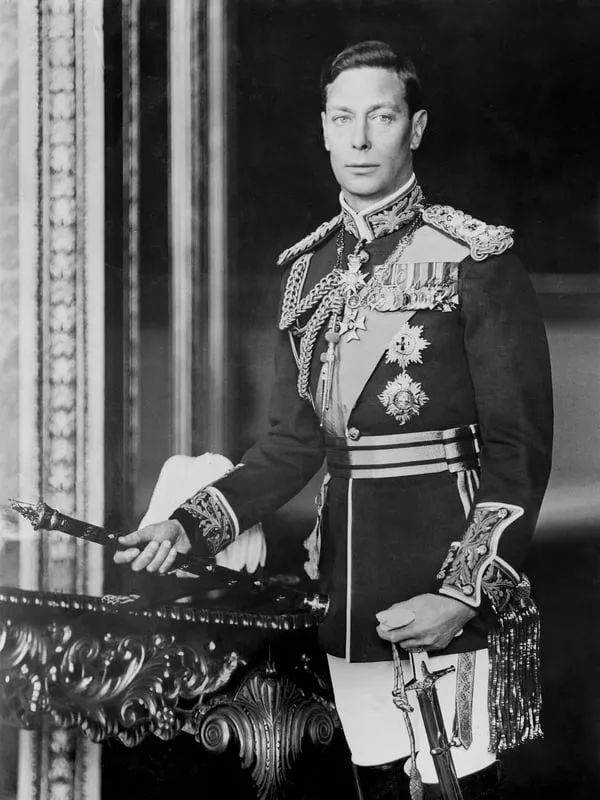
- Born:
- 14 December 1895, Sandringham (Norfolk, United Kingdom)
- Died:
- 6 February 1952, Sandringham (Norfolk, United Kingdom)
- Author:
- Łukasz
- Photo:
- Matson Photo Service, domena publiczna, Wikimedia Commons

George VI was never meant to be king and never wanted to be one. The second son of George V, the shy, sickly, stammering Prince Albert spent forty years in the shadow of his elder brother, the dazzling Prince of Wales. When Edward VIII abdicated in December 1936, the crown fell to him unexpectedly, at a time of crisis in public confidence in the monarchy and of a growing threat of war. As a constitutional monarch he supported the policy of appeasing Hitler pursued by Neville Chamberlain, and in September 1938 he appeared with him in public on his return from Munich. During the Second World War, when he refused to leave bombed London, he and his wife became symbols of British endurance. He restored the prestige of the Crown that his brother had damaged and guided it from Empire to Commonwealth.
The second son
Albert Frederick Arthur George was born on 14 December 1895 at York Cottage on the Sandringham estate, on the anniversary of the death of his great-grandfather, Prince Albert, in whose honour he was named. In the family he was called Bertie. He was a fearful and frequently ill child. He suffered from stomach complaints, wore painful splints to correct his knock knees and, being left-handed, was forced to write with his right hand. He stammered from an early age. His father was stern and demanding towards his sons, and his mother, Queen Mary, was cold.
Like his father, Albert went into the navy. He was educated at the colleges at Osborne and Dartmouth, where he did very poorly in his final examinations. In 1913 he became a midshipman in the battleship HMS Collingwood. During the First World War, despite stomach ulcers and an appendix operation, he served in her as an officer in a gun turret at the Battle of Jutland in 1916 and was mentioned in dispatches. Illness prevented his return to sea. In 1918 he transferred to the air service and in the last weeks of the war served on the staff of General Trenchard’s Independent Air Force in France. In 1919 he became the first member of the royal family to qualify as a fully certified pilot of the Royal Air Force.
Duke of York
After a year studying history and economics at Cambridge, Albert was created Duke of York in June 1920. He concerned himself mainly with industry and working people. He visited mines and factories, was president of the Industrial Welfare Society, which promoted better working conditions, and in 1921–1939 organised summer camps that brought together boys from public schools and from working-class families. He was known as “the Industrial Prince”. In 1926 he even played in the doubles at Wimbledon.
On 26 April 1923, in Westminster Abbey, he married Lady Elizabeth Bowes-Lyon, the daughter of a Scottish aristocrat, who had twice turned down his proposals. Marriage to a woman from outside the reigning houses was unusual at the time. It proved a very happy one, and the energetic and cheerful Elizabeth was her husband’s greatest support. They had two daughters: Elizabeth, born in 1926, and Margaret, born in 1930. The family lived in London, far from high politics.
The Duke’s greatest problem was his stammer. His speech at the closing of the British Empire Exhibition at Wembley in 1925 turned into an ordeal for him and his listeners alike. From 1926 he was treated by the Australian speech therapist Lionel Logue, whose breathing exercises helped him largely to master the impediment. In 1927 the Duke opened Parliament in Australia’s new capital, Canberra, and delivered his speech without much difficulty. The stammer never entirely disappeared, however, and every public appearance cost him a great deal of effort. This aspect of his life was brought to a wide audience by the 2010 film The King’s Speech.
An unwanted crown
On 20 January 1936 George V died and Edward VIII became king. The old king had made no secret of his wish that the throne should pass to Albert and his elder daughter. When in November 1936 Edward resolved to marry Wallis Simpson, Albert, as heir to the throne, watched the crisis with horror. After a conversation with his mother he wrote that he had broken down and wept “like a child”. On 10 December he witnessed his brother signing the instrument of abdication, and on 11 December, when the abdication took effect, he himself became king. He took the name George VI to emphasise continuity with his father’s reign. In London it was whispered that he would not be equal to his duties, and some even suggested that the throne should pass to his younger brother, the Duke of Kent, though there is no evidence that the government seriously considered this. The new king’s first act was to give his brother the title of Duke of Windsor. The coronation took place on 12 May 1937, the date previously set for Edward’s. George VI later wrote that he had taken over “a rocking throne” and tried to make it steady again.
In the shadow of war
Two weeks after the coronation the Prime Minister, Stanley Baldwin, stepped down, and Neville Chamberlain took his place. As a constitutional monarch the King supported his Prime Minister’s policy, and by conviction he also shared his determination to avoid war at almost any price. When on 30 September 1938 Chamberlain returned from Munich with the agreement that handed the Sudetenland to Germany, the King and Queen invited him onto the balcony of Buckingham Palace to receive the cheers of the crowd together. It was an unprecedented event: the balcony was reserved for the royal family, and appeasement had its opponents in Parliament. The historian and politician John Grigg later called it the most unconstitutional act by a British monarch in the twentieth century.
In May and June 1939 George VI and his wife visited Canada and the United States. He was the first reigning British monarch to set foot in North America. In Canada he appeared as King of Canada, which underlined the independence of the Dominions. In the United States he was the guest of President Franklin Delano Roosevelt at the White House and at his estate at Hyde Park, where he ate hot dogs with him. The visit was meant to weaken American isolationism, and the friendship formed with Roosevelt at that time mattered during the war years.
The King at war
On 3 September 1939, the day war was declared on Germany, George VI broadcast to the peoples of the Empire. He spoke slowly and with effort, but without stumbling. In May 1940, after Chamberlain’s fall, he would have preferred to entrust the premiership to Lord Halifax, but accepted Winston Churchill. In time a close bond developed between King and Prime Minister. For more than four years they met every week for a private lunch, and the King’s diary is the only record of those conversations.
The royal family did not leave London or the country, although they often spent the nights at Windsor. The princesses remained in Britain. On 13 September 1940, during the Blitz, two German bombs exploded in the courtyard of Buckingham Palace while the King and Queen were inside. The Queen remarked that she was glad they had been bombed, because now she could look the people of the devastated East End in the face. The royal couple visited bombed cities, factories and military units. In September 1940 the King instituted the George Cross for civilian heroism, and in April 1942 he awarded it to the whole of bombarded Malta. The governments and monarchs of occupied Europe found refuge on British soil, and the King kept in touch with their leaders, among them the Prime Minister of the Polish government-in-exile, General Władysław Sikorski. In August 1942 his younger brother, the Duke of Kent, was killed in an air crash. George VI visited the troops in France in December 1939, in North Africa and Malta in June 1943, in Normandy a few days after the Allied landings in June 1944, and in Italy. On 8 May 1945, VE Day, the crowds outside Buckingham Palace chanted “We want the King!”, and the King invited Churchill onto the balcony.
From Empire to Commonwealth
After the war George VI’s reign coincided with the break-up of the Empire. In August 1947 India and Pakistan became independent, and in June 1948 the King relinquished the title of Emperor of India, of which he was the last holder. In 1949 the leaders of the Commonwealth countries recognised him as its Head, which allowed republics to remain members as well. Burma and Ireland left the Commonwealth.
War and heavy smoking ruined the King’s health. In 1949 he underwent an operation for circulatory problems in his leg, and in September 1951, after cancer was discovered, his left lung was removed. Princess Elizabeth took on more and more of his duties. On 31 January 1952 the King saw her off at the airport as she set out on a tour of Africa and Australia. He died in his sleep at Sandringham during the night of 5–6 February 1952 of a coronary thrombosis. He was 56. He was buried in St George’s Chapel at Windsor. His daughter succeeded him as Elizabeth II.
Significance
George VI was not an outstanding politician and did not try to be one. His public support for the Munich Agreement remains the most controversial moment of his reign. His achievement lay elsewhere: after his brother’s abdication he restored the monarchy’s dignity and the trust of his subjects, and during the war, by staying in London and sharing dangers and privations with the people, he became, alongside Churchill, one of the symbols of British resistance. For a Britain fighting alone in 1940–1941 it mattered that the throne was occupied by a man of duty, and not by his brother, on whom the Nazis had pinned hopes of a compromise peace.
Sources
Mentioned in battles
(04)Often appears with
People who appear in the same events.
On the timeline
(49)The 40 most important of 49 events. All tagged “George VI” (7) →
1936
1937
1939
September
- 03
- Key eventBritain and France declare war on GermanyOn 3 September 1939 Britain at 11 a.m. and France at 5 p.m. found themselves at war with Germany. Warsaw cheered, but no real help arrived.
- Chamberlain’s War CabinetOn 3 September 1939 Chamberlain formed a nine-man War Cabinet with Churchill at the Admiralty, conscription for men aged 18–41 began and Gort took over the BEF.