United States
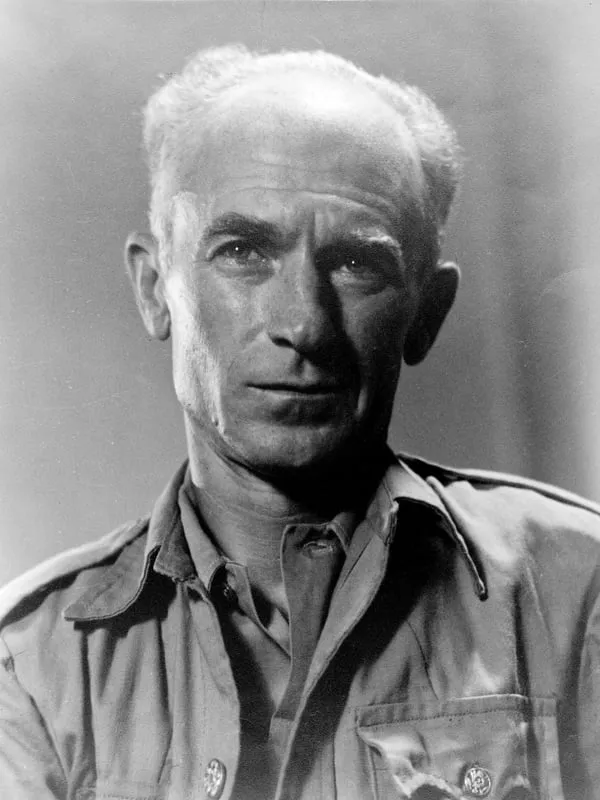
Ernie Pyle
Reporter and columnist for the Scripps-Howard chain (1923–1945), roving reporter (1935–1940), war correspondent in Europe (1940–1944) and the Pacific (1945)
- Born:
- 3 August 1900, A farm near Dana, Indiana (United States)
- Died:
- 18 April 1945, Ie Shima, near Okinawa (Japan)
- Author:
- Łukasz
- Photo:
- Milton J. Pike, domena publiczna, Wikimedia Commons

Ernest Taylor “Ernie” Pyle was the most popular American war correspondent of the Second World War. He wrote not about strategy or generals but about ordinary infantrymen – what they ate, where they slept, how they were afraid and how they died. His columns, distributed by the Scripps-Howard syndicate, were printed in 1945 by some 400 daily and 300 weekly newspapers across the United States, and millions of families read them like letters from the front. He reported on the Blitz in London and on the fighting in North Africa, Italy and Normandy, won the Pulitzer Prize in 1944, and in April 1945 was killed by a Japanese machine-gun bullet on the small island of Ie Shima off Okinawa. For the chronicle of the war he is more than a reporter: it was he, to a large extent, who shaped the image of the American soldier – “G.I. Joe” – that has endured in American memory.
From an Indiana farm to the newsroom
He was born on 3 August 1900 on a farm near the small town of Dana in Vermillion County, Indiana, the only child of William and Maria Pyle. His father was a tenant farmer, and the boy, who hated farm work, dreamed from childhood of going out into the world. Towards the end of the First World War, in October 1918, he enlisted in the Naval Reserve, but the war ended before he had finished his training.
In 1919 he began studying at Indiana University in Bloomington. The university did not yet offer a journalism degree, so formally he studied economics, but in practice he lived for the student newspaper, the Indiana Daily Student, on which he rose to editorial posts. In 1922 he interrupted his studies for a semester to sail with friends to the Far East – to Japan, Shanghai, Hong Kong and Manila. He never graduated: one semester short of his degree, in 1923, he took a job as a reporter on a newspaper in La Porte, Indiana, and a few months later moved to Washington, to the Washington Daily News, owned by the Scripps-Howard chain. He stayed with that publisher for the rest of his life.
In 1925 he married Geraldine “Jerry” Siebolds. It was a difficult marriage – both drank, and Jerry struggled with depression all her life – but Pyle remained devoted to her, and in his writing she appeared as “the girl who rides with me”. Before that became a formula, the couple drove right across the United States in a Model T Ford in 1926.
The first aviation columnist and roving reporter
In 1928 Pyle began writing a regular aviation column in the Washington Daily News – according to his biographers the first of its kind in the American press. He knew the pilots, flew with them and wrote about people rather than machines; among those he interviewed was Amelia Earhart. From 1932 to 1935 he was managing editor, but desk work did not suit him.
The breakthrough came in 1935. While recovering from a bad bout of influenza, Pyle travelled west with his wife and described the journey in a series of articles that readers liked so much that Scripps-Howard made him a “roving reporter”. For the next few years he travelled around the United States, Canada, Alaska, Hawaii, Mexico and Central and South America, writing six columns a week about the people he met along the way – farmers, gold prospectors, fishermen, Dust Bowl settlers, patients at the leper colony on Molokai. By his own reckoning he crossed the country in every direction dozens of times, wearing out several cars and typewriters. It was then that he developed the style that later made him famous: simple, conversational, written in the first person, alert to detail and free of pathos. In 1940 he and his wife built a modest house in Albuquerque, New Mexico – the only place he ever regarded as home.
London on fire
At the end of 1940 Pyle volunteered to go to Britain. He reached London in December, at the height of the Blitz, the German bombing offensive that had begun on 7 September 1940. During the night of 29–30 December he watched from a balcony the great incendiary raid on the City – his description of London burning, with the dome of St Paul’s Cathedral silhouetted against the glow, is among the most frequently quoted texts of the period. He wrote about people in the shelters and Underground stations, about firemen and ordinary Londoners, not about politics; like the radio broadcasts of Edward R. Murrow, his columns brought the plight of the British home to a still neutral America. His pieces from this trip were published in 1941 in the book Ernie Pyle in England.
After his return in March 1941 he spent a long time looking after his wife, whose condition was deteriorating. In April 1942 the couple divorced – Pyle hoped the shock would persuade Jerry to seek treatment – and in March 1943, when he was already in Africa, they remarried remotely, by proxy.
North Africa: Here Is Your War
In June 1942, after the United States had entered the war, Pyle went to Britain as a war correspondent, and in November, some two weeks after the Operation Torch landings, he reached Oran in Algeria. It was in North Africa that his method took shape: instead of staying in the press camps attached to headquarters, he lived for weeks with a single unit – infantry, artillerymen, engineers, airmen, even the staff of field hospitals – slept in foxholes, ate tinned rations with the soldiers and wrote down their names and home towns, which readers back home particularly valued. He was fondest of the infantry, because, as he wrote, they were “at the very bottom” – the most exhausted and the least appreciated.
He witnessed the American defeat at the Kasserine Pass in February 1943 and did not hide from his readers that the American army was only just learning how to fight a war. He then accompanied it to the end of the Tunisian campaign in May 1943. He became friends with many officers, among them Omar Bradley, whom he described as a commander who cared for his men. A collection of his African columns was published in 1943 under the title Here Is Your War and became a bestseller.
In the summer of 1943 Pyle covered the invasion of Sicily, but in September, exhausted, he returned to America. By then he was famous: he was welcomed home as a hero, and he found the attention, the interviews and the banquets hard to bear.
Italy and the death of Captain Waskow
In the autumn of 1943 he went to Italy, where the American Fifth Army was fighting its way through the mountains south of Monte Cassino. He wrote about the mud, the cold, the mules carrying supplies up mountain paths, and the men who stayed in the front line for weeks on end. In December 1943, near San Pietro Infine, he watched soldiers bringing the bodies of the dead down the mountain at night, tied across the backs of mules. Among them was Captain Henry T. Waskow of the 36th Infantry Division, a company commander, whose men came up one by one to his body to say goodbye. The column “The Death of Captain Waskow”, published on 10 January 1944, is regarded as Pyle’s most famous piece and one of the most celebrated pieces of war reporting in the history of the American press; many newspapers ran it on the front page.
From Italy Pyle also wrote a column proposing that infantrymen fighting at the front should receive extra pay, just as airmen received flight pay. Congress took up the idea and in 1944 passed a combat pay supplement, popularly known as the “Ernie Pyle bill”. In the spring of 1944 Pyle covered the fighting in the Anzio beachhead, where he narrowly escaped death when a German bomb destroyed the villa occupied by the correspondents. In April 1944 he left Italy for England.
Normandy, the Pulitzer and Brave Men
In May 1944, while preparing in England for the invasion, he was awarded the Pulitzer Prize for correspondence. He was among the small group of journalists chosen to accompany the first wave of the invasion; he went ashore on Omaha Beach on 7 June, the day after the Normandy landings. His columns from the beach – about abandoned equipment, personal belongings washed up by the sea and the “long thin line of personal anguish”, as he called the debris strewn across the sand – conveyed the cost of victory to his readers better than any military communiqué.
Throughout the summer he accompanied the American First Army fighting in the Normandy hedgerows. On 25 July 1944, at the start of Operation Cobra, he was caught under bombs from American aircraft that had mistakenly fallen on their own troops near Saint-Lô, killing, among others, General Lesley McNair; Pyle described the raid as the most terrifying experience of the entire war. In August he witnessed the liberation of Paris. There he decided he had had enough. In September he wrote to his readers that his spirit was wobbly and his mind weary, and that one more sight of a dead man would break him. He returned to Albuquerque. At the end of 1944 a collection of his columns from Sicily, Italy and France, Brave Men, was published and became another bestseller; Hollywood was also preparing a film based on his writing, The Story of G.I. Joe, with Burgess Meredith as Pyle.
The Pacific
Pyle hesitated for a long time, but a sense of duty towards the soldiers fighting Japan won out. In January 1945 he set out for the Pacific. He sailed on the aircraft carrier USS Cabot and visited Guam and Saipan. His first columns from the Pacific drew criticism: he wrote that sailors lived more comfortably than the infantry in Europe, which the navy and many readers took badly. He himself admitted that at heart he remained with the soldiers in Europe; he wrote about the Japanese with the estrangement and hostility typical of the American press of the time.
On 1 April 1945 he went ashore with the Marines during the landing on Okinawa, which opened the Battle of Okinawa, the last great campaign of the Pacific War. A few days later President Franklin Delano Roosevelt died, and Harry Truman took office.
Death on Ie Shima
On 17 April 1945 Pyle arrived with the 305th Infantry Regiment of the 77th Infantry Division on Ie Shima, a small island with an airfield west of Okinawa, where the Americans had landed the day before and which they had not yet cleared of Japanese soldiers. The next day, 18 April, he was driving in a jeep with the regimental commander, Lieutenant Colonel Joseph B. Coolidge, towards a new command post when, near the village of Ie, the vehicle came under fire from a Japanese machine gun. Those in the jeep jumped into a ditch. According to Coolidge’s account, when Pyle raised his head a moment later to look around, another burst struck him in the left temple, just below his helmet; Ernie Pyle’s death was instantaneous.
He was buried in his helmet in a makeshift cemetery on Ie Shima, between an infantry private and a combat engineer. Soldiers of the 77th Division erected a memorial on the spot where he died, with the inscription: “At this spot the 77th Infantry Division lost a buddy, Ernie Pyle, 18 April 1945”. President Truman declared that no man in this war had so well told the story of the American fighting man as American fighting men wanted it told; General Dwight Eisenhower said that the soldiers in Europe had lost “one of our best and most understanding friends”; and Eleanor Roosevelt devoted her newspaper column to him. On his body – according to his biographers – was found the draft of a column prepared for the end of the war in Europe, in which he wrote of “dead men by mass production” and asked that the dead not be forgotten amid the joy of victory.
Significance
In July 1945 the American government posthumously awarded Pyle the Medal for Merit, and in 1983 the Purple Heart, a rare decoration for a civilian. In 1949 his remains were moved to the National Memorial Cemetery of the Pacific in Honolulu. Jerry Pyle died in November 1945, a few months after her husband. The film The Story of G.I. Joe was released in the summer of 1945, and in 1946 a collection of his last columns, Last Chapter, was published. His house in Albuquerque became a branch of the city’s public library, and his family home, moved to Dana, a museum bearing his name.
His significance lies in the fact that he showed the war from a “worm’s-eye view”, as he himself put it – from the level of the foxhole, not the staff map. He wrote under military censorship and did not reveal everything he saw; his writing built morale and the image of the quiet, decent American soldier that survived in post-war memory. Yet he did not hide exhaustion, fear and death, and by writing about the fallen by name he reminded his readers that every victory has its dead. He was killed a few weeks before the end of the war in Europe, one of more than 12,000 Americans who died in the fighting for Okinawa and the surrounding islands.
Sources
Mentioned in battles
(01)Often appears with
People who appear in the same events.