- Category:
- Military operations
- Front:
- Western Front
- Date:
- 14 November 1940
- Author:
- Natalia
- Battle:
- The Blitz
- Tags:
- United Kingdom, Luftwaffe, RAF, Winston Churchill
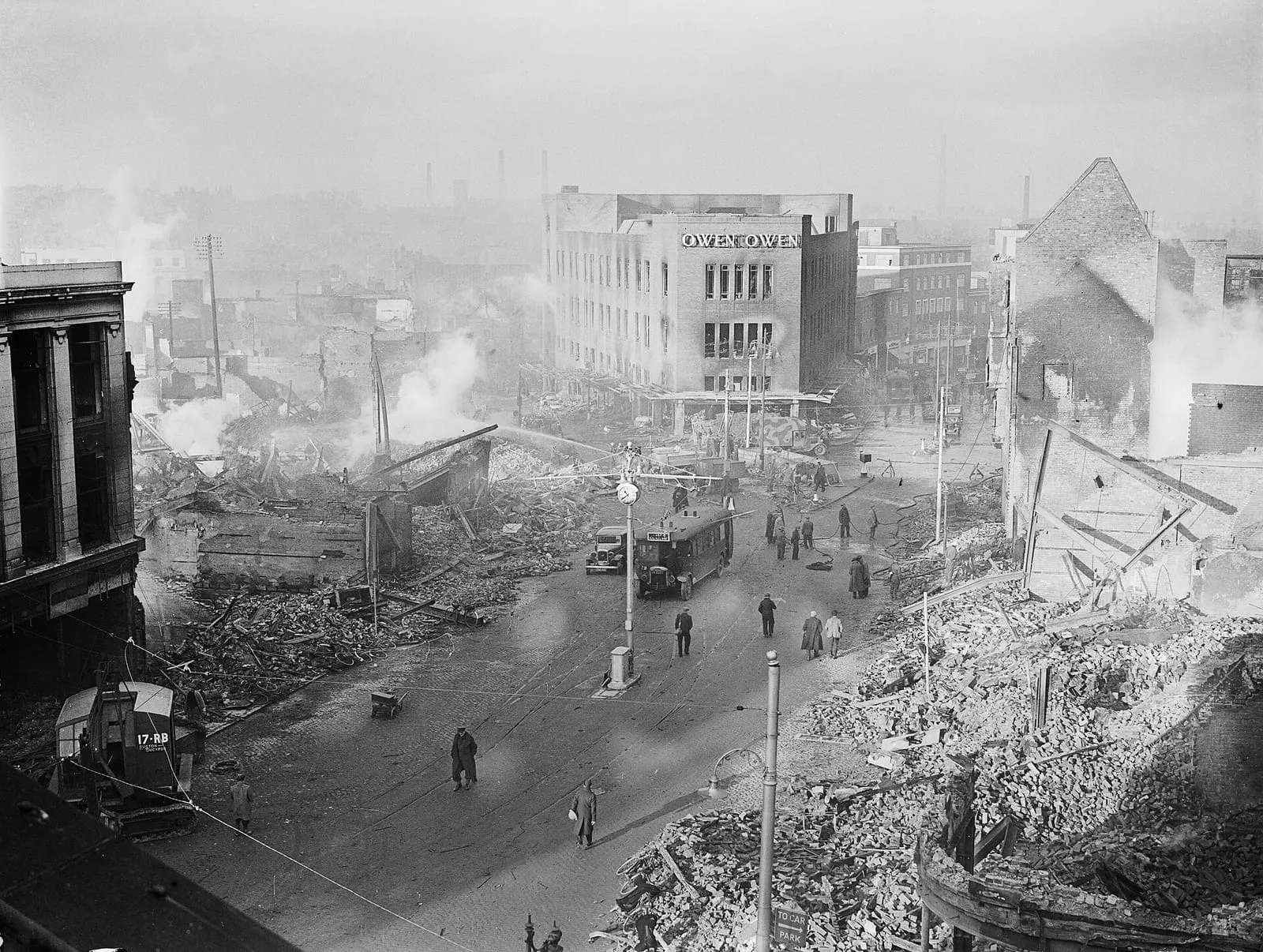
On Thursday 14 November 1940, at a quarter past seven in the evening, the first German bombers appeared over Coventry, an industrial city in the English Midlands. For the next eleven hours, under an almost full moon, wave after wave of aircraft dropped high-explosive bombs, parachute mines and tens of thousands of incendiaries on the city. When the all-clear sounded on the morning of 15 November (hence the date given in many accounts: the night of 14 to 15 November), Coventry’s medieval centre was a sea of rubble and smouldering fires, and of St Michael’s Cathedral only the outer walls and the tower remained. According to the most frequently cited figures, some 568 people were killed and more than 860 seriously injured. It was the heaviest and most concentrated raid any British city had suffered up to that day, and the first great blow of a new phase of the Blitz, in which the Luftwaffe shifted the weight of its attacks from London to the industrial centres and ports of the provinces.
A city of factories
In 1940 Coventry had, by various estimates, from about 230,000 to over 300,000 inhabitants. In the Middle Ages it had been one of the richest towns in England, a centre of the cloth trade, and it had kept into the twentieth century a dense network of narrow streets lined with timber-framed houses, churches and guildhalls. From the late nineteenth century it also became the capital of the British cycle industry, and then of the motor industry. Daimler, Humber, Hillman, Standard, Triumph, Rover and Armstrong Siddeley had works there, alongside factories making machine tools, components, aero engines and instruments. After the outbreak of war almost all of them worked for the armed forces, above all for the air force. Many workshops stood in the same streets as workers’ homes and city-centre shops. The British historian Frederick Taylor has observed that, under the meagre laws of war of the time, Coventry was a legitimate target for air attack. Yet the same pattern of building meant that an attack on the factories was bound to devastate the residential districts and the historic centre as well.
The city was no newcomer to air warfare. Between August and October 1940 the Luftwaffe attacked it more than a dozen times, usually with small forces. According to local tallies, 176 people were killed in 17 raids. By then many residents had learned to leave the city at night for the surrounding villages and towns. These nightly journeys (trekking) saved many lives in November.
“Moonlight Sonata”
From 7 September the German bombers’ main target had been London, bombed almost every night for nearly two months, with tragedies such as the disaster in the shelter at Balham station. At the beginning of November the Luftwaffe command, headed by Reichsmarschall Hermann Göring, changed its plan. Since the night raids had not broken the capital and the invasion had been postponed until the spring, the bombs were now to strike the armaments industry, above all aircraft production, and the ports through which supplies arrived from across the ocean. The first great operation of this kind was planned in the Midlands. Its code name, “Mondscheinsonate” (Moonlight Sonata), referred to the full moon that was to light up the targets in mid-November. According to documents intercepted by the British, the operation covered several targets in the region, each with a code name: Coventry was “Korn”, Birmingham “Regenschirm” (umbrella) and Wolverhampton “Einheitspreis” (uniform price).
German propaganda later presented the raid as reprisal for the British bombing of Munich at the time when Adolf Hitler was addressing party veterans there on the anniversary of the Munich Putsch (on the night of 8 to 9 November, according to most accounts). Preparations for great raids on industrial cities had, however, been under way before that, and the operation sprang from the Luftwaffe’s new strategy, not from an act of improvised revenge.
The main burden of the attack fell on Field Marshal Hugo Sperrle’s Luftflotte 3, supported by units of Field Marshal Albert Kesselring’s Luftflotte 2. According to German figures, 515 bombers were committed to the operation, mainly Heinkel He 111s, Junkers Ju 88s and Dornier Do 17s from airfields in northern France, Belgium and the Netherlands. The key role fell to a small unit, Kampfgruppe 100 (KGr 100), the only one whose Heinkels carried X-Gerät equipment. This was a radio guidance system far more accurate than the older Knickebein (PL): a director beam from a transmitter in France led the aircraft over the target, and three cross beams intersecting it at set distances started a clock that itself determined the moment of release. When properly set up, the error was about a hundred metres at a range of over three hundred kilometres. The KGr 100 crews were to arrive first and mark the target with flares and incendiaries, and the following waves, without special equipment, were to bomb on the glow of the fires. It was the first trial on such a scale of the method that the RAF later developed as the “pathfinder” technique.
What the British knew
British intelligence knew that something was afoot. Since the autumn of 1939 the physicist Reginald Victor Jones of Air Ministry intelligence, who had started with the Oslo Report, had been tracking German bomber guidance systems. In the summer of 1940 his team had learned to jam Knickebein, and in the autumn it came upon the X-Gerät beams. On 6 November one of KGr 100’s Heinkels came down in shallow water off the shore near Bridport in Dorset. The aircraft sank while being hauled out, but some of the waterlogged equipment was recovered. Examining it, however, took time.
On the night of 10 to 11 November the codebreakers at Bletchley Park read an Enigma-encrypted Luftwaffe message in which the name “Mondscheinsonate” appeared, together with code words intended for the crews. The message gave neither a date nor a place. It listed targets identified by numbers and code names, and since the British had recently captured a German map showing targets in the London area, Air Ministry analysts concluded that it referred to a new, exceptionally heavy attack on the capital or its surroundings. On 11 and 12 November, however, indications pointing to the Midlands came in: another message contained beam settings for the Wolverhampton, Birmingham and Coventry area, and a captured German airman was overheard telling a comrade that a great raid on Birmingham and Coventry was planned for the full moon, between 15 and 20 November. From 13 November to the morning of 15 November there was a break in the reading of Luftwaffe messages. The British command prepared a countermeasures plan code-named “Cold Water”: jamming the beams, bomber attacks on airfields and transmitters in France, and reinforced night fighters. It was to be put into effect as soon as the listening service established over which city the German beams intersected.
In the afternoon of 14 November, at about three o’clock according to most accounts, aircraft and listening stations detected that the X-Gerät beams were crossing over Coventry. “Cold Water” was set in motion. Almost everything failed. The British jamming transmitters, known as “Bromide”, were broadcasting on the wrong modulation frequency: measurements had indicated 1,500 hertz, whereas the German receivers worked at 2,000 hertz and had a filter that let only that tone through. The error came to light only after the equipment from Bridport had been examined, and it was put right a few days after the raid. RAF bombers attacked German airfields and transmitters on the Channel coast, but to little effect, and the night fighters, which according to British tallies flew over a hundred sorties that night, could scarcely find the enemy in the dark. Coventry’s anti-aircraft artillery, 24 heavy guns and a dozen or so light ones, fired more than 6,700 rounds and, according to most sources, shot down one bomber.
Night over the city
At 7.05 p.m. the sirens wailed, and at about 7.20 the Heinkels of KGr 100 appeared over the city. Thirteen aircraft of the unit dropped flares and incendiaries on the centre, lighting up the target for the following waves. These came in at intervals throughout the night, from different directions. The first dropped mainly high-explosive bombs and parachute mines. They tore off roofs, broke up the streets and severed water and gas mains and electricity and telephone cables. The next waves showered the city with incendiary bombs, magnesium and oil, which fell through the broken roofs into the buildings. This order of attack was deliberate: the fires were to break out when the fire brigade no longer had water, communications or passable streets.
At about eight in the evening incendiaries first set fire to the roof of St Michael’s Cathedral, a great Gothic parish church of the fourteenth and fifteenth centuries raised to cathedral status in 1918. The Provost, Richard Howard, and a few volunteer firewatchers put out the first fires, but further hits started new ones, and no water came from the empty hydrants. Before midnight the whole cathedral was ablaze. Only the stone tower and spire, almost 90 metres high, and the outer walls survived. At the same time more than two hundred other fires were burning in the city centre. The fire brigade headquarters was hit, the telephones stopped working and crews were sent out blind. Teams set off to help from Birmingham and later from further afield, but many could not get through the rubble and craters. In some quarters of the centre the fire grew into an area conflagration that contemporaries compared to a firestorm.
The raid reached its peak at around midnight. The bombers flew a shuttle: some crews dropped their bombs, returned to France and came back again. The attack was therefore spread over many hours and had lulls that allowed rescuers to carry out the injured. According to the British official history, some 450 aircraft bombed the target; the rest turned back or attacked alternative targets. About 500 tons of high explosive were dropped, including some 50 parachute mines, and nearly 900 incendiary containers, holding some 30,000–36,000 bombs in all. The all-clear was sounded at 6.15 a.m. on 15 November.
The morning of 15 November
In the morning the residents emerging from the shelters did not recognise their city. The medieval centre, with its churches, guildhalls and timber-framed houses, had for the most part ceased to exist. According to British tallies more than 4,300 homes were destroyed, and about two-thirds of the city’s buildings were damaged. Hospitals, churches, shops and public buildings were hit. There was no water, gas or electricity, the trams stopped running and the telephones were silent. Bodies were dug out of the rubble for many days.
The number of casualties was never established precisely. The figures most often cited are the official ones: 568 killed, 863 seriously injured and 393 slightly injured. Some studies give ranges from about 380 to over 550 dead, because some bodies could not be identified and victims from neighbouring places were counted in different ways. Given the scale of the destruction, the number of dead was relatively small. Several factors contributed: many residents spent their nights outside the city, the lulls between waves allowed people to be evacuated from burning districts, and the public shelters – in which, according to local figures, some 33,000 people took refuge – for the most part held.
The Germans were chiefly after the factories, and these suffered badly. According to British assessments, roughly a third of the city’s industrial plants were destroyed or severely damaged, another third seriously damaged and the rest lightly damaged. Among those burned out were the works of Daimler, Humber and Hillman, Alfred Herbert’s machine-tool factory, a dozen or so plants working for the aircraft industry and two naval ordnance stores. The effect on production, however, proved temporary. Most of the key production had already been moved to so-called shadow factories in the suburbs and the surrounding area, machinery in wrecked workshops could often be repaired, and the workers came back as soon as power and water were restored. According to British figures, aircraft production in Coventry fell for a few weeks, and within a few months most plants had regained their former output. Reconstruction was directed by a committee under the industrialist William Rootes, owner of the Humber and Hillman works, set up by the Ministry of Aircraft Production of Max Aitken, Lord Beaverbrook.
The King among the ruins
For the first days after the raid the city was in chaos. Many families had lost their homes, and thousands of people left Coventry in the evenings to spend the night in nearby villages, in churches, barns and fields. Troops helped clear the rubble and defuse unexploded bombs. Researchers from Mass-Observation, who arrived in Coventry the day after the raid, recorded a depression and exhaustion far deeper than in London: in a small city the destruction touched almost everyone.
On 16 November King George VI came to Coventry. For several hours he walked among the ruins, talking to residents, rescue workers and the city authorities, and stood in the ruins of the cathedral, where a plaque now commemorates the visit. On 20 November the first mass funeral of the victims took place at the London Road cemetery: 172 people were laid in a communal grave. Three days later, on 23 November, another 250 were buried. In all, more than 800 victims of the raids on Coventry of 1940–1942 lie in the communal graves of that cemetery.
In the ruins of the cathedral the stonemason Jock Forbes found two charred roof beams that had fallen in the shape of a cross, and bound them together. Provost Howard had a cross made from three medieval nails from the roof timbers. The charred cross and the cross of nails became symbols of the city. As early as his BBC radio broadcast at Christmas 1940, Howard said that Coventry would not seek revenge but wanted, after the war, to build a kinder world together with its former enemies. The words “Father Forgive” were later inscribed on the wall behind the altar in the ruins.
“Coventrate”
German propaganda proclaimed the raid a great success. Soon the verb coventrieren, to “coventrate” – to destroy a city from the air as Coventry had been destroyed – appeared in the German language of propaganda. The word was attributed to the propaganda minister Joseph Goebbels, though his authorship is uncertain. In Britain and the United States, on the other hand, Coventry became a symbol of German barbarity: this time the censors did not hide the scale of the destruction, because pictures of the ruined cathedral affected public opinion, especially in America, more powerfully than any speech. For the British it was a shock comparable to what the people of Warsaw had experienced a year earlier, and those of Rotterdam in May 1940.
The myth of the sacrificed city
In 1974 Frederick Winterbotham, a wartime air intelligence officer who had distributed the information from Bletchley Park, published The Ultra Secret, the first widely known account of the breaking of Enigma. In it he wrote that Prime Minister Winston Churchill knew from decrypted messages (the so-called Ultra material) that the target of the raid would be Coventry, and forbade any warning to the city so that the Germans would not guess that their cipher had been broken.
Historians and participants in the events rejected this version. Peter Calvocoressi, who headed the section at Bletchley Park that analysed Luftwaffe messages, wrote that Ultra “never mentioned Coventry”, and that Churchill, far from weighing whether to save the city or the cipher, was convinced the raid would fall on London. R. V. Jones likewise stated that the messages to the German X-Gerät transmitting stations had not been read in time, and that he had not known the target would be Coventry. The messages, declassified from the 1970s and fully available in the British National Archives since 1996, confirm their version. The order read on 11 November gave the code names of the targets but not their names or dates, and “Korn” was identified as Coventry only after the war. Between 13 November and the morning of 15 November Bletchley Park read no Luftwaffe messages at all, so on the day of the raid there was no new information to act on. On the afternoon of 14 November Churchill was leaving London for Ditchley, a country house near Oxford, but after reading a report of an expected heavy raid he turned back to the capital, convinced that it would be the target.
Coventry was identified as the target only on the afternoon of 14 November, from the setting of the beams. The population was not given any special warning, because the alarm was sounded at every raid in any case, and evacuating a large city in a few hours was impossible. Coventry was not sacrificed. Technology and intelligence failed.
Place in the war
The Coventry raid opened a new phase of the Blitz. In the following weeks the Luftwaffe struck other industrial centres and ports in the same way: Birmingham on the night of 19 to 20 November and on the following nights; Bristol, Southampton, Liverpool, Sheffield and Manchester in November and December; and in 1941 Plymouth, Portsmouth, Clydebank, Belfast and Hull. The British meanwhile corrected the error in jamming X-Gerät, and as early as the raids on Birmingham the improved jammers began to divert some of the bombs from their targets. Coventry endured two more heavy raids, on the nights of 8 to 9 and 10 to 11 April 1941, in which some 450 people were killed, and a last, minor attack in August 1942. In all, the raids killed more than 1,200 people in the city.
The raid was also a lesson for both sides. The combination of target-marking aircraft with radio navigation, high-explosive bombs that broke open roofs and water mains, and masses of incendiaries became the model for later raids on cities. In December 1940 the British War Cabinet agreed, in response to Coventry, to Bomber Command’s first raid deliberately aimed at the centre of a German city: Mannheim, on the night of 16 to 17 December. The British and American raids of 1943–1945, carried out by hundreds of heavy bombers in waves lasting a quarter of an hour or so, killed many times more people in Hamburg, Dresden and other German cities than the entire Blitz.
After the war Coventry chose the path of reconciliation. As early as 1942 its people sent messages of solidarity to besieged Stalingrad, and in 1944 the two cities were twinned, one of the first such partnerships. In 1947 Provost Howard visited devastated Kiel, the beginning of a friendship between the two cities sealed by a formal partnership in 1967. In 1959 Coventry was twinned with Dresden. Crosses of nails from the cathedral ruins were sent to, among other places, Berlin’s Kaiser Wilhelm Memorial Church, and the ruin of the old cathedral was preserved as a memorial. Beside it a new cathedral was built to a design by Basil Spence; its foundation stone was laid by Queen Elizabeth II in 1956. It was consecrated in May 1962, and for the occasion Benjamin Britten composed his War Requiem.
Sources
Meanwhile
(04)Elsewhere, within a week.
- 15 November 1940 · PolandThe Warsaw Ghetto is sealedOn the night of 15–16 November 1940 the Germans sealed the Warsaw Ghetto. Some 400,000 Jews were walled off; hunger and smuggling became daily life.
- 12 November 1940 · DiplomacyMolotov in BerlinOn 12–14 November 1940 Molotov discussed dividing the world with Hitler and Ribbentrop in Berlin. He pressed on Finland, Bulgaria and the Straits, in vain.
- 12 November 1940 · AfricaThe Free French take GabonThe surrender of Port-Gentil on 12 November 1940 ended the Gabon campaign. The Free French had taken Vichy's last colony in French Equatorial Africa.
- 16 November 1940 · BalkansBritish aid to GreeceOn 16 November 1940 a convoy with some 4,000 airmen and soldiers reached Piraeus. Churchill sent RAF units from Egypt despite Wavell’s and Longmore’s fears.
Related events
(04)The same battle, people or subject.
- 7 September 1940 · Western FrontThe Blitz beginsOn 7 September 1940 the Luftwaffe struck London's docks instead of RAF airfields. More than 400 people were dead by morning. So began the Blitz.
- 25 August 1940 · Western FrontThe first RAF raid on BerlinAfter bombs hit the City of London on the night of 24/25 August 1940, Churchill ordered a strike on Berlin. The raid of 25/26 August did little damage.
- 19 February 1941 · Western FrontThe Swansea Three Nights’ BlitzFrom 19 to 21 February 1941 the Luftwaffe bombed Swansea on three nights running. About 230 people died and the Welsh port’s town centre ceased to exist.
- 19 March 1941 · Western FrontThe London raid of 19 MarchOn the night of 19–20 March 1941 the Luftwaffe made its heaviest raid on London since the start of the year. British figures put the dead at about 750.