- Category:
- Military operations
- Front:
- Pacific
- Date:
- 20 October 1944
- Author:
- Łukasz
- Battle:
- Battle of Leyte
- Tags:
- United States, Japan, Philippines, Douglas MacArthur
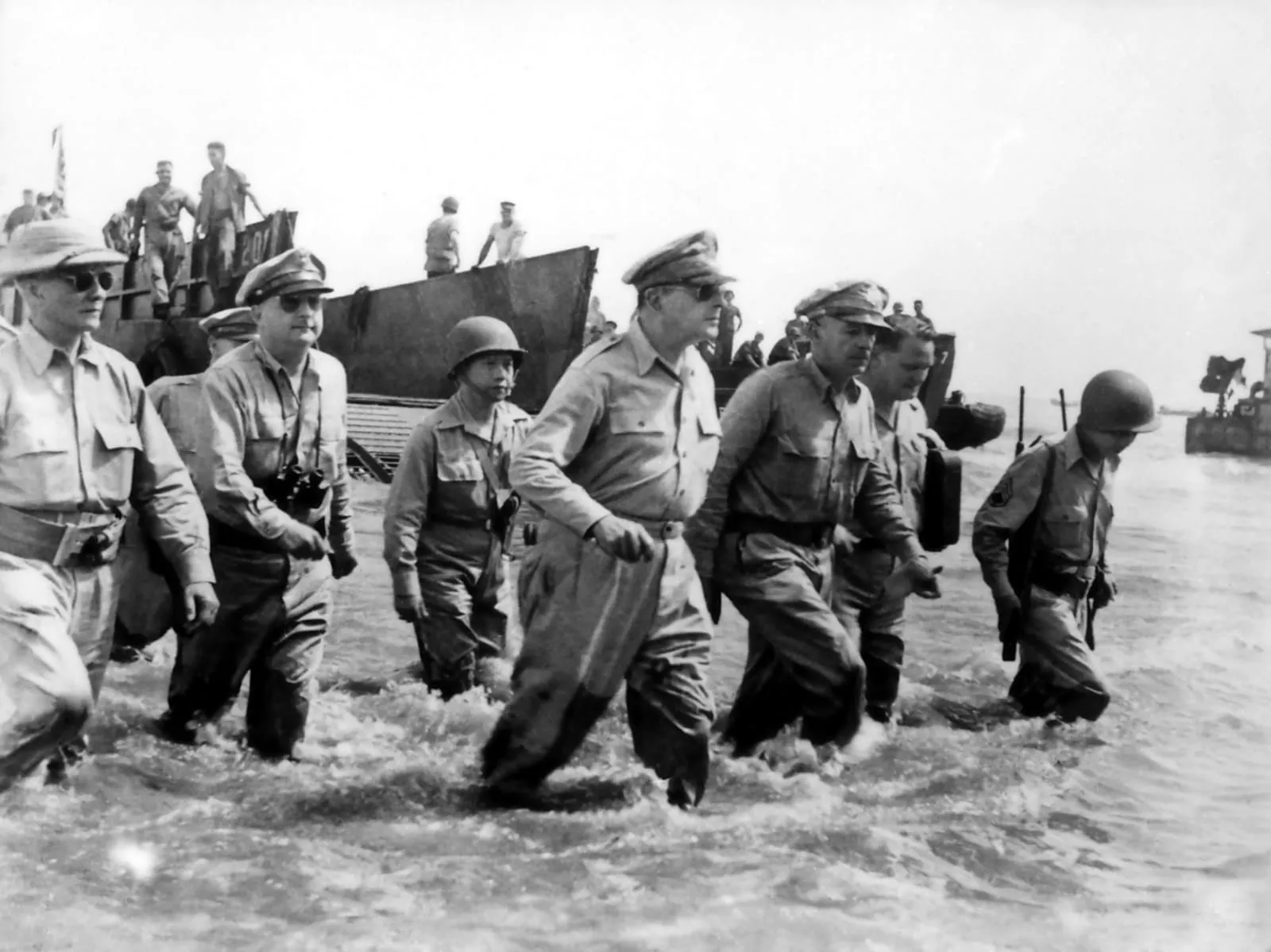
On the morning of 20 October 1944, after four hours of naval bombardment, the first waves of American infantry reached the beaches on the east coast of Leyte, one of the islands of the central Philippines, at 10 a.m. On the northern sector, between the airfield near Tacloban and the mouth of the Palo River, X Corps came ashore; a few dozen kilometres further south, around the small town of Dulag, XXIV Corps landed. Both belonged to Lieutenant General Walter Krueger’s Sixth Army. A few hours later, at around 1.30–2 p.m., General Douglas MacArthur stepped off a landing craft and waded knee-deep through the water onto the beach known as Red Beach, near the town of Palo. Two and a half years after he had left the Philippines on the President’s orders and promised in Australia that he would return, he made a radio address to the Filipinos that began with the words: “People of the Philippines, I have returned.”
Popular summaries state that on this day the Battle of Leyte began, that American troops landed on the island and that MacArthur came ashore announcing, “I have returned.” That is correct. Two points are worth adding, however. The Leyte operation had begun three days earlier, on 17 October, when Rangers seized the islets at the entrance to Leyte Gulf – and it is from that day that the battle itself is usually dated. Nor were the Americans the only ones fighting: from the very first hours they were helped by Filipino guerrillas, who had been waging war against the occupier on the island since 1942.
The road back
In the spring of 1942 the Philippines fell. On the orders of President Franklin Delano Roosevelt MacArthur left the archipelago, and on arriving in Australia declared that he would return. His soldiers remained in the Philippines: the defenders of Bataan surrendered in April, and on 6 May General Jonathan Wainwright surrendered the fortress of Corregidor to General Masaharu Homma. From then on, returning to the Philippines was for MacArthur a matter of both strategy and honour – his own and America’s. He repeatedly said that the United States had a moral obligation to liberate the archipelago as quickly as possible for the sake of the Filipinos who had fought at its side.
Over the next two years his forces advanced along New Guinea, while in parallel Admiral Chester Nimitz’s forces fought their way through the islands of the central Pacific. In the summer of 1944, after the capture of the Marianas, there was still disagreement in Washington and in the Pacific about the onward route to Japan: some admirals wanted to bypass the Philippines and strike at Formosa, while MacArthur insisted on liberating the archipelago. The Joint Chiefs of Staff directed him to prepare first a landing on Mindanao and then one on Leyte, at that time scheduled for 20 December.
The plan changed in September. The carriers of Admiral William Halsey’s Third Fleet, striking at the Philippines, met surprisingly weak resistance from Japanese air power. On 13 September Halsey proposed abandoning the intermediate objectives and striking at Leyte at once. MacArthur was then sailing on a cruiser to Morotai under radio silence, so his chief of staff, General Richard Sutherland, gave consent in his name. The Joint Chiefs of Staff, who happened to be meeting in Quebec, on 15 September – according to the US official history, within an hour and a half of receiving the reply – brought the Leyte landing forward by two months, to 20 October, and cancelled the operations against Mindanao and Yap. XXIV Corps, hitherto earmarked for Yap, was diverted to Leyte, while the landing on Peleliu went ahead because it was too far advanced to be called off.
Leyte was chosen for several reasons. The island lies in the middle of the archipelago, between Luzon and Mindanao, and to the east it opens onto a deep gulf that could accommodate a huge invasion fleet. Along the east coast ran a road and the flat Leyte Valley, where the Japanese had already built several airfields. The Americans intended to turn them into a base from which land-based aircraft would cover the further thrust against Luzon. Leyte also had more than 900,000 inhabitants, mostly farmers and fishermen, many of whom supported the guerrillas.
The Japanese wait on Luzon
The Philippines were irreplaceable for Japan. Through the archipelago and the surrounding seas ran the routes by which oil, rubber and other raw materials travelled to the home islands from Borneo, Sumatra and Malaya. Losing the Philippines meant cutting Japan off from its southern conquests. For this contingency Imperial General Headquarters had prepared plans for a “decisive battle” codenamed Shō-Gō (“Victory”); the first variant covered the Philippines. The army, land-based aviation and the whole of the remaining fleet were to join battle in it.
In the Philippines the commander was Field Marshal Hisaichi Terauchi, head of the Southern Army, with his headquarters in Manila. The defence of the archipelago itself was entrusted to the Fourteenth Area Army, command of which was taken over at the beginning of October by General Tomoyuki Yamashita, the conqueror of Malaya and Singapore, whom Tōjō had kept away from the main fronts in Manchuria for two years. Yamashita believed that the decisive land battle should be fought on Luzon, the largest and most important island, where he could concentrate the most troops. The central and southern islands, Leyte included, were defended by his subordinate Thirty-Fifth Army under Lieutenant General Sōsaku Suzuki, with headquarters on Cebu.
On Leyte itself stood Lieutenant General Shirō Makino’s 16th Division – the same division that had landed on Luzon in December 1941 and fought on Bataan. American intelligence estimated the Japanese forces on the island at about 20,000 men. Makino deployed them inland, on the hills above the beaches and around the airfields in the Leyte Valley, reckoning that he could not withstand naval gunfire on the coast.
In the days before the landing the Japanese command was labouring under an illusion. Between 12 and 16 October aircraft from Halsey’s carriers struck at Formosa, and Japanese air units, which lost several hundred aircraft in these clashes, reported sinking many American carriers and battleships. In reality two cruisers had been damaged. Tokyo celebrated a victory, and some staff officers came to believe that the American fleet had been weakened. That conviction weighed on the decisions taken after the landing on Leyte.
The Rangers and the invasion fleet
Two great fleets were heading for Leyte Gulf. The landing force was carried by Vice Admiral Thomas Kinkaid’s Seventh Fleet, under MacArthur’s command, while Halsey’s Third Fleet, under Nimitz, covered it from a distance. The literature usually states that more than 700 warships and auxiliary vessels took part in the operation, together with some 200,000 soldiers of the Sixth Army, more than 100,000 of whom landed in the first days. The covering force included Australian ships, and the whole operation was to be protected by aircraft from escort carriers until airfields for General George Kenney’s land-based aircraft had been established on the island.
On 17 October, in difficult weather, a minesweeping group entered the gulf, followed by ships carrying Lieutenant Colonel Henry Mucci’s 6th Ranger Battalion. The Rangers – soldiers of the US Army Rangers special units – landed on the islets of Suluan and Dinagat at the entrance to the gulf. On Suluan they scattered a small Japanese detachment and destroyed a radio station; Dinagat proved undefended, and the third islet, Homonhon, they took without a fight the next day. On the islets they set up navigation lights for the transports, while frogmen surveyed the approaches to the beaches. The report from the station on Suluan, sent before it was destroyed, was the Japanese command’s first indication of the invasion. On 18 October Admiral Soemu Toyoda, commander of the Combined Fleet, ordered Operation Shō-1 to begin.
A-Day
The day of the landing was designated A-Day. From dawn on 20 October battleships, cruisers and destroyers shelled the coast, and aircraft from the escort carriers bombed Japanese positions. At 10 a.m. four divisions went ashore. In the north Major General Franklin Sibert’s X Corps landed on a stretch of some six kilometres between the airfield near Tacloban and the Palo River: on the right the 1st Cavalry Division, fighting as infantry, and on the left the 24th Infantry Division. About 24 kilometres to the south Major General John R. Hodge’s XXIV Corps put ashore the 96th Infantry Division and the 7th Infantry Division around San José and Dulag. Separately, one regiment of the 24th Division landed in the Panaon Strait at the southern tip of the island to close the entrance to Sogod Bay.
Resistance on the beaches was weaker than expected. The soldiers struggled more with the swamps behind the narrow strip of sand than with enemy fire. Within an hour the beachheads in most sectors were deep enough for heavy equipment to be unloaded. Things were hardest in the 24th Division’s sector, where fire from the surrounding hills damaged several landing craft and forced later waves to be diverted elsewhere. By evening the 1st Cavalry Division had taken the airfield near Tacloban, the 24th Division Hill 522, which dominated the beaches, and the 7th Division Dulag and its airfield, while the 96th Division had closed up to Catmon Hill, from which the Japanese had been shelling the landing craft. That day General Makino moved his command post from Tacloban inland to Dagami. According to the US official history, the Sixth Army’s losses on A-Day were 49 killed, 192 wounded and six missing. During the night the Japanese counter-attacked the 24th Division’s beachhead without success.
“I have returned”
MacArthur watched the landing from the deck of the light cruiser Nashville. In the afternoon, once the 24th Division’s sector was reasonably secure, he went down into a landing craft. He was accompanied by, among others, the President of the Philippines, Sergio Osmeña, who had taken office in August after the death of Manuel Quezon, the Filipino brigadier general and journalist Carlos Romulo, General Kenney and his chief of staff Sutherland. The landing craft grounded in the shallows a few dozen metres from the shore, and the beachmaster, busy with unloading, would not let it into the crowded landing area. MacArthur therefore had the ramp lowered, and he and his companions covered the last stretch wading through the water. The photograph of this moment, taken by the army photographer Gaetano Faillace, went round the American press and became one of the best-known images of the Pacific War. Accounts often hint at a suspicion that the scene was staged; most biographers believe, however, that MacArthur simply did not wait for a gangway and only later appreciated the propaganda power of the image.
On the beach, in the rain, he spoke into the microphone of a portable radio set. The signal went via a field transmitter aboard the Nashville, which relayed it on several short-wave frequencies listened to by guerrillas throughout the archipelago. The broadcast was introduced with the words “This is the Voice of Freedom” – the name of the station run by the defenders of Bataan and Corregidor in 1942. MacArthur’s staff had in fact recorded the speech in advance, at the end of September in Brisbane, in case the equipment on the beach failed. It opened with the words “People of the Philippines, I have returned”, and went on to say that by the grace of Almighty God American forces once again stood on Philippine soil, consecrated by the blood of both peoples. MacArthur announced the destruction of every vestige of Japanese rule and the restoration of the Filipinos’ freedom, presented Osmeña, standing beside him, as the lawful president, and called on his listeners to rally to him and to let the unconquerable spirit of Bataan and Corregidor lead them on. Finally he addressed the population directly: when his troops arrived, they were to strike at the occupier “in the name of your sacred dead”.
The speech was a carefully prepared political act. The return promised in Australia was not merely a slogan for MacArthur: on it he based his standing with the Filipinos and American public opinion, and Osmeña’s presence at his side was meant to show that it was the lawful government of the Commonwealth of the Philippines that was returning to the islands, not a foreign administration. At the time the formally independent Second Philippine Republic of President José P. Laurel, established by the Japanese in 1943, still existed on the islands. MacArthur’s critics, Americans among them, later reproached him for the first person singular in the key sentence; for many Filipinos, however, listening to him in secret by their radio sets, the words “I have returned” were above all the fulfilment of a promise made in 1942.
The guerrillas and the population
The Americans did not come to Leyte blind. A guerrilla movement had been active on the island since 1942; in 1943 it was united under the command of Colonel Ruperto Kangleon, a former officer of the Philippine Army, whom MacArthur’s headquarters recognised as commander of the district. His forces, a few thousand strong, sent reports by radio on Japanese dispositions, airfields and fortifications. After the landing the guerrillas served as guides and scouts, attacked Japanese posts and retreating units, and later took over some security duties in the rear.
For the island’s inhabitants the Americans’ return meant both hope and new danger. The years of occupation had brought requisitioning of food, forced labour and reprisals for supporting the guerrillas. Now the villages along the coast and in the Leyte Valley found themselves in the line of fire, and artillery fire and air raids did not spare their homes. Many inhabitants fled into the mountains; others greeted the soldiers on the roads. When the 1st Cavalry Division took Tacloban, the provincial capital, on 21 October, crowds poured into the streets.
Japan’s response
In Manila and Tokyo the landing on Leyte was seen as the opportunity for the decisive clash that had been awaited for months. The illusory victory off Formosa led some staff officers to believe that the Americans had put their landing force ashore without adequate cover. According to the US official history and post-war Japanese accounts, Yamashita opposed moving the decisive land battle to Leyte, but on 22 October Field Marshal Terauchi, in line with the wishes of Imperial General Headquarters, ordered him to send reinforcements there. Over the following weeks division after division was shipped in through the port of Ormoc on the island’s west coast, although American aircraft sank many convoys on the way.
At the same time the fleet set out. From the Lingga anchorage off Sumatra, via Brunei on Borneo, came the main force of Vice Admiral Takeo Kurita with the super-battleships Yamato and Musashi, and from Japanese waters the carriers of Vice Admiral Jisaburō Ozawa, which were to serve as bait to draw Halsey’s Third Fleet away to the north. The target was the invasion fleet in Leyte Gulf. In those same days Vice Admiral Takijirō Ōnishi, who had just taken command of naval aviation in the Philippines, formed the first units of suicide pilots, later known as kamikaze. On 21 October a Japanese aircraft, probably deliberately, crashed into the superstructure of the Australian heavy cruiser Australia in Leyte Gulf, killing among others her captain.
Its place in the war
The landing on Leyte began the liberation of the Philippines and the largest land campaign of the Pacific War. It brought in its wake two battles on a scale none of the planners had foreseen. At sea, on 23–26 October, came the Battle of Leyte Gulf – the largest naval battle of the Second World War, in which the Imperial Navy lost the ability to conduct major operations, and in which on 25 October organised kamikaze attacks sank an American ship for the first time. On land, instead of a few weeks of fighting, there followed two months of struggle in torrential monsoon rains, on the mountain ridges above the Ormoc Valley and around airfields that proved almost useless in the mud. The Japanese shipped several tens of thousands of soldiers to the island, and on 7 December the Americans landed near Ormoc.
MacArthur announced the end of organised resistance on Leyte on 25 December, and the next day General Robert Eichelberger’s Eighth Army took over the mopping-up of the island from the Sixth Army; 31 December is usually taken as the official end of the battle, although fighting against scattered units went on until the spring of 1945. According to American estimates between some 49,000 and 60,000 Japanese were killed, while American losses amounted to about 3,500 killed. The number of civilian victims cannot be given precisely. The defeat on Leyte wrecked Yamashita’s plan to defend Luzon with his full strength: Japan lost its best units and most of its air power on an island he himself had not wanted to defend. On 15 December the Americans landed on Mindoro, on 9 January 1945 in Lingayen Gulf on Luzon, and in February the Battle of Manila began, in which some 100,000 civilians died. The photograph of the general wading through the water at Red Beach and the words “I have returned” have remained a symbol of liberation in the Philippines; at the landing site near Palo a monument commemorating the scene stands today.
Sources
Meanwhile
(04)Elsewhere, within a week.
- 21 October 1944 · Western FrontThe capture of AachenOn 21 October 1944, after three weeks of fighting and shelling, Colonel Gerhard Wilck surrendered Aachen – the first large German city taken by the Allies.
- 23 October 1944 · DiplomacyThe recognition of de Gaulle's governmentOn 23 October 1944 the USA, Britain, the USSR and Canada formally recognised de Gaulle's administration as the Provisional Government of the French Republic.
- 23 October 1944 · BalkansThe liberation of Novi SadOn 23 October 1944 Yugoslav Partisans, followed by Red Army soldiers, entered Novi Sad, the capital of Bačka, which Hungary had seized in 1941.
- 16 October 1944 · Eastern FrontThe attack on East PrussiaOn 16 October 1944 the 3rd Belorussian Front began the Gumbinnen–Goldap operation – the first attempt to take East Prussia, halted before Gumbinnen.
Related events
(04)The same battle, people or subject.
- 23 October 1944 · PacificThe Battle of Leyte Gulf beginsThe Battle of Leyte Gulf began on 23–24 October 1944. US submarines sank two of Kurita's heavy cruisers, and Halsey's aircraft sank the battleship Musashi.
- 12 October 1944 · PacificThe raids on FormosaOn 12–16 October 1944 Halsey's carriers crushed Japanese air power over Formosa. Tokyo announced 11 carriers sunk – in reality, not one.
- 15 December 1944 · PacificThe landing on MindoroOn 15 December 1944 the Americans landed unopposed near San Jose on Mindoro. Airfields on the island were to cover the coming invasion of Luzon.
- 9 January 1945 · PacificAmericans in Lingayen GulfOn 9 January 1945 Krueger’s Sixth Army landed almost unopposed in Lingayen Gulf on Luzon. Kamikazes kept attacking the ships of the invasion fleet.