- Category:
- Diplomacy
- Date:
- 4 February 1945
- Author:
- Łukasz
- Tags:
- Soviet Union, United Kingdom, United States, Poland
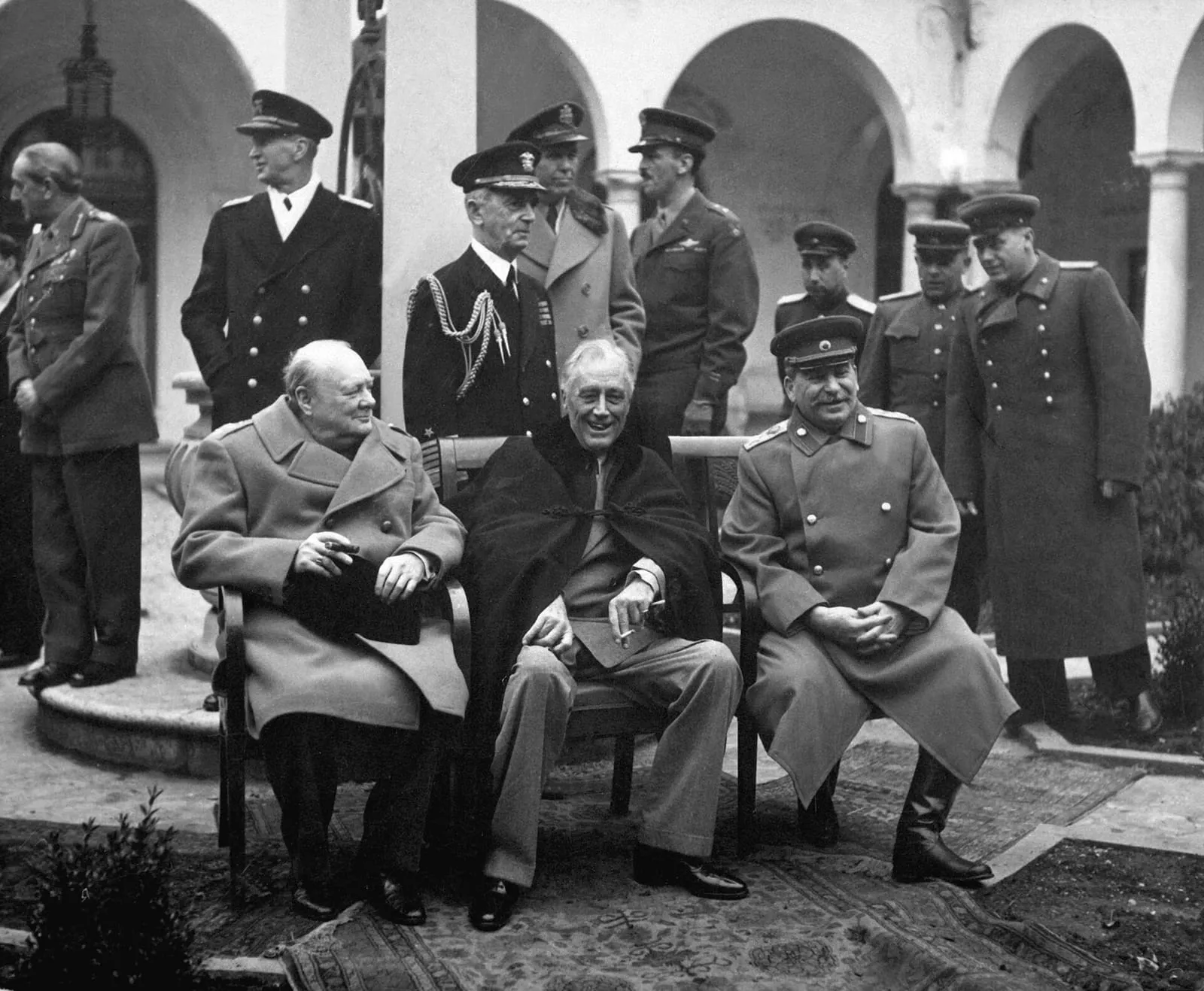
At five o’clock in the afternoon of 4 February 1945, in the Livadia Palace, the former summer residence of the tsars near Yalta in the Crimea, the President of the United States, Franklin Delano Roosevelt, the British Prime Minister, Winston Churchill, and the Soviet leader, Joseph Stalin, met for their first plenary session. So began the Yalta Conference, called the Crimea Conference in Soviet documents and known by the code name Argonaut in the correspondence of the Western Allies. It lasted until 11 February and was the second meeting of the three, after Tehran. The leaders gathered in the Crimea at a time when the Red Army already stood on the Oder, some 70 kilometres from Berlin, and the Western armies were beating off the last German attacks after the battle in the Ardennes.
Chronicles often sum up the conference by saying that its main subject was the division of the world into “spheres of influence”. This is a simplification. No document dividing Europe into spheres was signed at Yalta – the talks dealt with specific matters: the occupation, reparations and future of Germany, the borders and government of Poland, the rules of the future United Nations Organisation, the Soviet Union’s entry into the war against Japan, a declaration on liberated Europe and the repatriation of prisoners. The notion of “Yalta” as a symbol of the division of the continent into two blocs is a later interpretation – though, as the following years showed, not an unfounded one.
The road to the Crimea
The idea of a second meeting of the Big Three arose in the summer of 1944. Roosevelt suggested Scotland, Malta or Athens, but Stalin declared that his doctors advised against long journeys and that directing the war did not allow him to leave the country. In the end the Crimea, liberated from the Germans in the spring of 1944, was agreed upon. For the ailing President, who had been sworn in for a fourth term on 20 January, this meant a voyage across the Atlantic to Malta in the cruiser USS Quincy, followed by a flight to the Saki air base and a drive of several hours across a peninsula ravaged by war.
The British and American chiefs of staff had been meeting on Malta since 30 January, and on 2 February Roosevelt and Churchill joined them (the Malta Conference). During the night of 2/3 February several dozen aircraft took off from Luqa airfield carrying delegations totalling some 700 people. On 3 February the two leaders were welcomed at Saki by Vyacheslav Molotov. That same day American bombers carried out one of the heaviest raids on Berlin, partly in order to support the Soviet offensive.
Roosevelt stayed in the Livadia Palace, where the plenary sessions were also held – so the President, paralysed since the 1920s, did not have to travel to the talks. The British were accommodated in the Vorontsov Palace at Alupka, and the Soviet delegation occupied the Yusupov Palace at Koreiz.
The delegations included the foreign ministers – the American Secretary of State Edward Stettinius, the British Foreign Secretary Anthony Eden and Molotov – as well as the President’s adviser Harry Hopkins, the ambassador in Moscow Averell Harriman and the President’s chief of staff, Admiral William Leahy. The military were there too: General George Marshall and Admiral Ernest King, Field Marshal Alan Brooke, Marshal of the RAF Charles Portal and Admiral Andrew Cunningham, and on the Soviet side the Deputy Chief of the General Staff, General of the Army Aleksei Antonov.
The first days: the war and Germany
Before the first session, on the afternoon of 4 February, Stalin paid calls on Churchill and Roosevelt. At Stalin’s request Roosevelt chaired all eight plenary sessions. In the mornings the foreign ministers and the chiefs of staff held their own meetings.
The first day was devoted to the military situation. General Antonov described the course of the January offensive, in which the Red Army had advanced from the Vistula to the Oder and seized bridgeheads on its western bank. He asked the Western Allies to prevent the transfer of German divisions from the west and from Italy to the east, and for air attacks on communication centres, naming Berlin and Leipzig among others. Marshall spoke of plans to cross the Rhine. The chiefs of staff agreed on an exchange of information and a bomb line between the air forces – the war in Europe, it was thought, would last at least several more months.
From 5 February the talks turned to Germany. The leaders confirmed the demand for unconditional surrender and approved the division of Germany into occupation zones, worked out earlier in the European Advisory Commission in London, with joint administration of Berlin. Churchill secured a role for France: it was to receive a zone carved out of the British and American areas and a seat on the Allied Control Council. Stalin at first objected, and Roosevelt hesitated, as he had announced that American troops would be withdrawn from Europe within two years. France, however, was not invited to the Crimea, which Charles de Gaulle took as a humiliation.
The protocol recorded that the powers would take such steps, including “the complete disarmament, demilitarisation and dismemberment of Germany”, as they deemed necessary. A committee in London was to study how the partition might be carried out – after a few months the plan was quietly dropped. Reparations provoked a sharp dispute. The Soviet delegation, in which the matter was handled by Ivan Maisky, demanded 20 billion dollars, half of it for the USSR, in the form of dismantled plant, current deliveries and German labour. Churchill, mindful of the consequences of reparations after the First World War, refused to name any sum. A reparations commission was set up in Moscow, and the protocol recorded that the Americans and the Russians accepted the figure of 20 billion dollars as a “basis for discussion”, while the British held that no figures should be mentioned until the commission had done its work.
The United Nations Organisation
Roosevelt attached the greatest importance to building the new international organisation. The Dumbarton Oaks Conference in the autumn of 1944 had left two matters unresolved: the voting procedure in the Security Council and the Soviet demand that all sixteen union republics should become members of the organisation. At Yalta Stalin accepted the American formula under which the permanent members of the Security Council would have a veto on substantive but not procedural matters, and a party to a dispute would not vote on its peaceful settlement. Molotov reduced the demand to two or three republics, and Roosevelt and Churchill agreed to support the admission of the Ukrainian and Byelorussian SSRs. It was decided to convene a founding conference in San Francisco on 25 April 1945 and to invite the states that had signed the Declaration by United Nations and those that declared war on the common enemy by 1 March 1945. This condition explains the wave of declarations of war on Germany in the second half of February.
The Polish question
No subject took up as much time at Yalta as Poland: it came up at seven of the eight plenary sessions. No representative of the Polish state sat at the table. Britain and the United States still recognised the Polish government in London, headed since November 1944 by Tomasz Arciszewski. In January the USSR had recognised the Provisional Government of the Republic of Poland, formed on 31 December 1944 out of the Polish Committee of National Liberation; after the Red Army’s entry into Warsaw it moved from Lublin to the capital on 1 February. The whole of Poland within its pre-war borders was already, or would soon be, under the control of Soviet troops.
The question of the eastern border had in effect been settled at Tehran, and during the Moscow Conference in October 1944 Molotov had revealed this to Prime Minister Stanisław Mikołajczyk. On 6 February Roosevelt proposed that Poland should at least keep Lwów (Lviv) and the nearby oilfields, and Churchill said that Poland was a matter of honour for Britain, since the British had gone to war in her defence. Stalin replied with a long speech: for Russia, Poland was not only a question of honour but also one of security, because twice in thirty years German invasions had passed through her on their way east. The Curzon Line, he said, had been drawn by Curzon and Clemenceau, and he could not be “less Russian” than they were. He did not give up Lwów.
In the end it was agreed that Poland’s eastern border would follow the Curzon Line, with digressions in Poland’s favour of five to eight kilometres in some places. Wilno (Vilnius), Lwów and nearly half of the pre-war territory of the Republic went to the USSR. In the north and west Poland was to receive “substantial accessions of territory”, but their extent was left open. Molotov proposed a border on the Oder and the Lusatian Neisse. Churchill warned against moving millions of Germans and, according to the British record, remarked that it would be a pity to stuff the Polish goose so full of German food that it got indigestion. Roosevelt did not support the Neisse line either. It was agreed that the opinion of the new Polish government would be sought on the accessions, and that the final delimitation of the western border would await the peace conference.
The longest dispute was over the government. The British and Americans wanted a new government formed with politicians from both Poland and the emigration; Stalin defended the Lublin government, which, he argued, kept order behind the front, unlike the Home Army, which he accused of killing Soviet soldiers. The compromise of 10 February stated that the Provisional Government functioning in Poland would be “reorganised on a broader democratic basis” by including democratic leaders from Poland itself and from abroad, and would take the name of the Provisional Government of National Unity. This government was to pledge itself to hold “free and unfettered elections” as soon as possible, on the basis of universal suffrage and secret ballot, in which all democratic and anti-Nazi parties could take part. Consultations on the matter were to be conducted in Moscow by a commission made up of Molotov, Harriman and the British ambassador, Archibald Clark Kerr. Stalin gave assurances that elections could be held within a month.
Admiral Leahy recalled years later that he had told Roosevelt the formula on the government was so elastic that the Russians could stretch it all the way from Yalta to Washington without ever technically breaking it. The President is said to have replied that he knew it, but that it was the best he could do for Poland at that time.
The secret Far Eastern agreement
For the Americans the Soviet Union’s entry into the war against Japan mattered as much as Europe. The chiefs of staff feared that an invasion of the Japanese home islands would cost hundreds of thousands of casualties, and they wanted the Red Army to tie down the Japanese Kwantung Army in Manchuria. Stalin had promised as much at Tehran and in Moscow in October 1944; at Yalta he set his conditions. On 8 February he discussed them in private with Roosevelt, and on 11 February the three leaders signed a secret agreement. The USSR undertook to declare war on Japan within two or three months of Germany’s surrender. In return it was to regain the southern part of Sakhalin and receive the Kuril Islands; the status quo in Outer Mongolia was to be preserved; the port of Dairen was to be internationalised, with the “pre-eminent interests” of the USSR safeguarded; and Port Arthur was to be leased as a Soviet naval base. The Chinese Eastern Railway and the South Manchurian Railway were to be operated by a joint Soviet-Chinese company.
The provisions concerned, to a large extent, the territory of China, an ally that had not been consulted. Roosevelt undertook to obtain the consent of Chiang Kai-shek, who learned of the agreement only in June. The text, kept in a White House safe, was published in February 1946. It restricted Chinese sovereignty in Manchuria, whose return to China had been announced at Cairo in November 1943.
The Declaration on Liberated Europe and other matters
On American initiative the Declaration on Liberated Europe was adopted. The three powers undertook to assist jointly the peoples liberated from German occupation and the former Axis satellites in forming interim governments “broadly representative of all democratic elements” and in holding free elections as soon as possible, in accordance with the principles of the Atlantic Charter. The declaration, however, provided for no means of supervision and remained a set of principles that each of the powers interpreted in its own way.
On Yugoslavia it was recommended that the agreement between Josip Broz Tito and the prime minister of the government-in-exile, Ivan Šubašić, be put into effect. The foreign ministers were to consider the Soviet demand for a revision of the Montreux Convention on the Turkish Straits, while the question of Iran was left unresolved.
On 11 February bilateral agreements – American-Soviet and British-Soviet – were signed on the repatriation of prisoners of war and civilians liberated by Allied forces. The Western Allies were counting on the swift return of their own soldiers from German camps in the east. The agreements also became the basis for the forcible handing over to the USSR of its citizens, including those who did not want to go back, such as soldiers of collaborationist formations, forced labourers and émigrés (later, among others, in Operation Keelhaul).
The talks ended on 11 February. The communiqué was published the following day, while the Far Eastern provisions and some of the agreements on reparations and the United Nations remained secret.
The Polish reaction
The Provisional Government and the parties that supported it welcomed the decisions. On 13 February 1945 the Polish government in London issued a statement declaring that the decisions of the “Three-Power Conference” had been prepared and taken without the participation, authorisation or even knowledge of the Polish government, which it regarded as a violation of the letter and spirit of the Atlantic Charter. These decisions, the statement said, “cannot be recognised by the Polish Government and cannot bind the Polish Nation”, and the Polish nation would regard the severance of the eastern half of its territory through the imposition of the Curzon Line as a new partition of Poland, this time carried out by Poland’s allies. President Władysław Raczkiewicz and Arciszewski’s government held to this position, while Mikołajczyk and some of the émigré politicians concluded that they had to seek a place in the new government.
The army reacted most sharply. Major General Władysław Anders, commander of the Polish II Corps in Italy, in which many soldiers from the eastern borderlands served who had been deported deep into the USSR in 1940–1941, regarded the decisions as a betrayal. According to his memoirs he considered withdrawing the corps from the front, and in a conversation with Churchill in London at the end of February he was told that Britain had enough troops and could do without the Poles. In the end the corps remained at the front and in April 1945 fought for Bologna; from February to May Anders served as acting Commander-in-Chief in place of General Tadeusz Bór-Komorowski, who was in captivity.
In Poland itself, on 21 February 1945 at Podkowa Leśna, the Main Commission of the Council of National Unity, the underground parliament, protested against the one-sidedness of decisions that imposed new and unjust sacrifices on Poland, “the first in the world to take up the fight against Hitlerism”. At the same time, however, it resolved to comply with them, seeing this as the only chance of saving independence and sparing the nation further destruction. Its chairman, Kazimierz Pużak, called the Yalta resolutions “the nightmare of a new Holy Alliance”.
The “Yalta betrayal” and the debate over its assessment
In Polish memory, especially in the emigration, the term “the Yalta betrayal” took root: the allies for whose cause Poland had fought since 1939 had, without her participation, handed half her territory to the USSR and agreed to a government dominated by communists, contenting themselves with a promise of elections whose fulfilment they were unable to enforce. Roosevelt’s critics in the United States saw Yalta in a similar light during the Cold War, and in 2005, in a speech in Riga, President George W. Bush placed it alongside Munich and the Molotov–Ribbentrop Pact as an example of a wrong done to small nations.
Other historians – among them Serhii Plokhy, author of a study of the conference published in 2010 – point out that in February 1945 the Red Army already occupied almost all of Poland and most of Central Europe, and that the Western Allies had no means of forcing concessions from Stalin short of going to war with him. From this point of view Yalta did not create the division of Europe but recorded a situation created by the positions of the armies, and in return Roosevelt obtained what he cared about most: agreement on the rules of the United Nations and Soviet participation in the war against Japan. The two views need not be mutually exclusive: Stalin’s overwhelming military superiority in Central Europe was a fact, but the Western leaders accepted formulas they knew to be imprecise and presented them publicly as a guarantee of Poland’s freedom.
The conference’s place in the war
Yalta was the high point of the Big Three’s cooperation and at the same time the beginning of its break-up. Immediately after the conference optimism prevailed in the West: on his return to Washington Roosevelt presented the results to Congress on 1 March as the end of the policy of spheres of influence and the balance of power, and Churchill defended them in the House of Commons, where at the turn of February and March 25 members, mostly Conservatives, supported an amendment criticising the decisions on Poland. As early as March the Molotov–Harriman–Clark Kerr commission became deadlocked over whom to invite to the consultations, and near Warsaw the NKVD arrested the leaders of the Polish Underground State, who had been invited to talks by “General Ivanov” – in reality General Ivan Serov – which led to the Trial of the Sixteen in June 1945. Roosevelt died on 12 April, and his successor, Harry Truman, inherited a growing dispute over the implementation of the agreements.
The San Francisco Conference opened as planned on 25 April, and the Charter of the United Nations, with the veto of the permanent members of the Security Council, was signed in June. Poland, although one of the signatories of the Declaration by United Nations, had no representative in San Francisco, because the powers could not agree which government represented it. After talks in Moscow the Provisional Government of National Unity was formed on 28 June 1945, with Mikołajczyk as deputy prime minister, and on 5 July Britain and the United States recognised it, withdrawing recognition from the government in London. The promised “free and unfettered elections” were not held until January 1947, and they were rigged.
In the Far East the USSR kept its commitment to the day: on 8 August 1945, three months after Germany’s surrender, it declared war on Japan, occupying Manchuria, southern Sakhalin and the Kurils. The dispute over the southern Kurils still divides Russia and Japan today. German affairs were taken over by the Potsdam Conference in the summer of 1945, which placed the German lands east of the Oder and the Lusatian Neisse under Polish administration. The name of the Crimean resort became political shorthand for the whole post-war order – the “Yalta order” – which lasted until 1989.
Sources
Meanwhile
(04)Elsewhere, within a week.
- 3 February 1945 · PacificThe Battle of Manila beginsOn 3 February 1945 US cavalry drove into Manila and freed the internees at Santo Tomás. Japanese sailors held the city for a month, murdering civilians.
- 2 February 1945 · PacificThe destruction of the Singapore dockIn early February 1945 B-29s from India sank the great floating dock at the Singapore naval base, depriving the Japanese fleet of another base.
- 31 January 1945 · PacificThe opening of the Stilwell RoadAt the end of January 1945 the Ledo Road joined the Burma Road. The first convoy from India drove into China and the land blockade of China was broken.
- 31 January 1945 · PacificThe landings at Zambales and NasugbuOn 29 January 1945 XI Corps landed unopposed in Zambales to seal off Bataan; on 31 January the 11th Airborne Division came ashore at Nasugbu, south of Manila.
Related events
(04)The same battle, people or subject.
- 30 January 1945 · MediterraneanThe Malta ConferenceOn 30 January 1945 British and American chiefs of staff met on Malta to agree the plan for the attack on Germany before Yalta. Roosevelt joined on 2 February.
- 18 June 1945 · PolandThe Trial of the SixteenOn 18–21 June 1945 a Soviet military court in Moscow tried the leaders of the Polish Underground State, seized by deceit, including Okulicki and Jankowski.
- 17 July 1945 · DiplomacyThe Potsdam Conference beginsOn 17 July 1945 Truman, Churchill and Stalin opened the last Big Three conference at Cecilienhof Palace in Potsdam, devoted to Germany and Poland.
- 9 October 1944 · DiplomacyThe Moscow Conference of 1944On 9 October 1944 Churchill flew to Moscow. Talks with Stalin brought the percentages agreement on the Balkans, a clash over Poland and a pledge on Japan.