1944–1945: The liberation of Western Europe
Battle of Aachen
- Dates:
- 2–21 October 1944
- Front:
- Western Front
- Location:
- Aachen and its surroundings in the Rhineland (Germany): the valley of the river Wurm north of the city (Rimburg, Palenberg, Übach, Alsdorf, Bardenberg), the hills to the east of it (Verlautenheide, Crucifix Hill, the Ravelsberg), Würselen and the city itself with the Lousberg hillOn the battle map →
- Sides:
- United StatesCourtney Hodges, Charles Corlett, Joseph Lawton CollinsNazi GermanyFriedrich Köchling, Gerhard Wilck
- Result:
- American victory. XIX and VII Corps of the First Army broke through the Siegfried Line north and east of Aachen and on 16 October closed the ring on the Ravelsberg hill near Würselen. The 26th Infantry Regiment of the 1st Division took the ruined city in a week of street fighting, and on 21 October Colonel Gerhard Wilck surrendered the garrison. Aachen was the first large German city captured by the Allies, but the three-week battle tied down the First Army and did not open the road to the Rhine.
- Author:
- Natalia
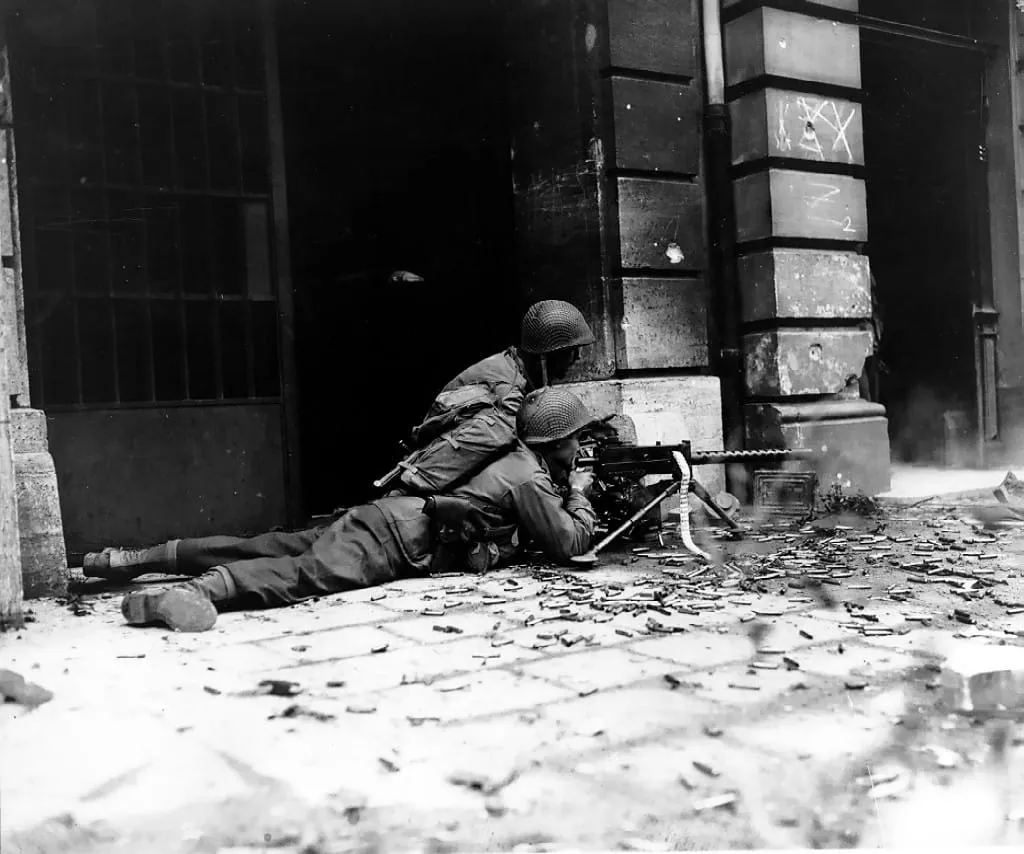
The Battle of Aachen was the first major battle fought by the Western Allies on German soil. From 2 to 21 October 1944 two corps of General Courtney Hodges’s US First Army fought their way through the fortifications of the Siegfried Line from the north and the east to encircle Aachen and then – contrary to their original intention – to take it in street fighting. The city, once the capital of Charlemagne, had little industrial importance, but it was a symbol for Nazi propaganda, and Adolf Hitler ordered it to be defended to the last soldier. The surrender of its commandant, Colonel Gerhard Wilck, on 21 October gave the Americans the first large city of the Reich – in ruins and almost deserted.
Name and dates
In both Polish and American literature the name “Battle of Aachen” has become established. It is taken to have begun on 2 October 1944, when the US XIX Corps attacked the Siegfried Line on the river Wurm north of the city, and to have ended on 21 October, the day the garrison surrendered. German historiography distinguishes from it the so-called first Battle of Aachen in mid-September, when General Joseph Lawton Collins’s VII Corps first attacked the fortifications south and east of the city and became bogged down near Stolberg.
The standard account of the battle is the US official history – Charles B. MacDonald’s volume The Siegfried Line Campaign (1963). Casualty figures depend on the time frame and the area that each author takes the battle to cover.
Background
In September 1944 the pursuit of the shattered German armies, which after the Battle of Normandy had carried the Allies across France and Belgium to the frontier of the Reich, lost momentum. Supplies were still being brought from the Normandy beaches and from Cherbourg, and Antwerp could not receive ships as long as the Germans held the banks of the Scheldt estuary. General Dwight Eisenhower gave priority in supplies to Field Marshal Bernard Montgomery’s northern wing, and the airborne landing and advance in the Netherlands ended in defeat at Arnhem. The First Army, part of General Omar Bradley’s 12th Army Group, reached the Siegfried Line in mid-September, but a shortage of fuel and ammunition halted it in the belt of fortifications around Aachen. On its southern flank American troops liberated Luxembourg and crossed the German border in the Eifel.
Aachen lay in the so-called Aachen Gap – the most convenient passage from Belgium and the Netherlands to the Cologne Plain, towards the Rhine and the Ruhr. Beyond the city the ground was flat and well suited to motorised troops, but in front of it ran two belts of the Siegfried Line: bunkers, anti-tank obstacles, minefields and ditches, reinforced by the buildings of mining towns and villages. Before the war Aachen had about 165,000 inhabitants. After the turmoil of September – when Party officials fled, abandoning the evacuation Hitler had ordered, and the commander of the 116th Panzer Division, Lieutenant General Gerhard von Schwerin, tried to halt it and was relieved of his command for doing so – fewer than 20,000 civilians remained in the city, according to MacDonald.
On the German side the Aachen sector was defended by Lieutenant General Friedrich Köchling’s LXXXI Army Corps, part of General Erich Brandenberger’s Seventh Army and of Field Marshal Walter Model’s Army Group B; the Western Front as a whole was once again commanded by Field Marshal Gerd von Rundstedt. The lull in the second half of September allowed the Germans to man the bunkers and rebuild some of their units. At the end of the month the exhausted 116th Panzer Division was relieved in the city itself by Colonel Gerhard Wilck’s newly formed 246th Volksgrenadier Division (PL); north of Aachen stood the 183rd Volksgrenadier Division and the 49th Infantry Division, and to the east and south-east the 12th Infantry Division. Many of these units consisted of barely trained recruits, convalescents, and airmen and sailors transferred to the infantry, and the corps was short of tanks. The city’s commandant until about 12 October was Colonel Leyherr, and after that Wilck himself. The claim made in some accounts that Wilck had already replaced Schwerin in mid-September is not consistent with the US official history.
Hodges did not want to storm Aachen. The First Army’s plan was one of encirclement: General Charles Corlett’s XIX Corps was to break through the Siegfried Line north of the city, on the river Wurm between Rimburg and Marienberg, with General Leland Hobbs’s 30th Infantry Division, after which the 2nd Armored Division was to pass through the gap, while the 29th Infantry Division pinned the Germans down with feint attacks on the left flank. The 30th Division was then to turn south towards Würselen. From the other side, General Clarence Huebner’s 1st Infantry Division of VII Corps, which since September had stood in a semicircle south and east of the city, was to strike north through Verlautenheide and the Ravelsberg hill. The gap between the two divisions was a few kilometres as the crow flies; the city itself was to be occupied by small forces once it had been cut off. More than 70 per cent of the 1st Division’s men were fresh replacements, trained in the rear in the second half of September.
2–7 October: the breakthrough on the Wurm
The 30th Division’s attack was postponed many times because of rain and low cloud. From the end of September the artillery methodically shelled the bunkers that had been located, and at 9 a.m. on 2 October medium bombers and fighter-bombers of the Ninth Air Force appeared over the fortifications on the Wurm. The air attack proved almost useless: some groups failed to hit their designated areas at all, and the napalm bombs did not set the wet woods alight. General Corlett then ordered the artillery to draw on the stocks set aside for repelling counter-attacks, and within a dozen or so hours the battalions of XIX Corps fired 18,696 rounds.
On a narrow front of barely one and a half kilometres between Marienberg and Rimburg the infantry crossed the river on footbridges, and behind them assault teams with flamethrowers and demolition charges approached the bunkers from the rear and from the side of the embrasures. The 117th Regiment on the left broke through the first belt of fortifications and by evening had entered the mining town of Palenberg, where the fighting went from house to house; the 119th Regiment on the right was held up in front of the castle at Rimburg and ended the day in a shallow bridgehead. The Germans of the 183rd Volksgrenadier Division and the 49th Infantry Division were taken by surprise – Köchling had expected the main blow south-east of the city, and the 29th Division’s feint attacks had misled the commanders of both divisions. The first night counter-attack, delayed by American fire, collapsed.
At midday on 3 October Combat Command B of General Ernest Harmon’s 2nd Armored Division crossed the bridges near Marienberg and drove into Übach, a cramped bridgehead under a hail of German artillery fire. Rimburg also fell that day. For the next three days Köchling threw at the bridgehead whatever he had to hand: units of the 183rd and 49th Divisions, sub-units of the 246th Division, two assault gun brigades and engineer battalions. Counter-attacks on Übach were beaten off with difficulty, and according to MacDonald about two-thirds of the losses suffered by American tank crews and infantry in those days were caused by German artillery. Even so, the Americans widened the breach. On 5 October Combat Command B took the hills north of Übach, and the 119th Regiment took Merkstein-Herbach. On 6 October the tanks captured Beggendorf and pushed on towards Baesweiler, cutting the road from Aachen to Linnich, and the division’s Combat Command A also joined the pursuit. That same day Field Marshal Model arrived at the command post of LXXXI Corps.
On 7 October the 117th Regiment took Alsdorf almost without a fight, and the 30th Division drew near to Merkstein and Kerkrade on the Dutch border; it was now less than five kilometres from Würselen, where it was to link up with VII Corps. The bridgehead was already nearly ten kilometres long and more than seven deep – the belt of the Siegfried Line north of Aachen had been broken. It cost the 30th Division and the 2nd Armored Division more than 1,800 killed, wounded and missing, including about 200 killed; Combat Command B alone lost 52 medium tanks. The events around Alsdorf convinced the American commanders that the time had come to settle the matter of Aachen.
8–16 October: closing the ring
On 8 October the Germans made their first major counter-attack on the northern bridgehead. Mobile Regiment von Fritzschen, with the 108th Panzer Brigade, about twenty assault guns and two infantry battalions, struck at Alsdorf and Mariadorf. An American platoon was cut off and two assault guns got into the streets of Alsdorf, but the town was not retaken, and the attackers lost about 500 men. Before dawn on the same day the 1st Infantry Division set off from the other side. Its 18th Regiment captured Verlautenheide, in the afternoon Crucifix Hill, and during the night of 9–10 October – without firing a shot – the Ravelsberg hill above the road to Jülich. On Crucifix Hill Captain Bobbie E. Brown, wounded three times, personally destroyed three bunkers and was awarded the Medal of Honor for it. The village of Haaren on the eastern edge of the city also passed into American hands. Between the Ravelsberg and the positions of the 30th Division, however, there remained a corridor several kilometres wide through Würselen, along which the Germans supplied the garrison.
On 10 October three envoys of the 1st Division under a white flag handed the Germans General Huebner’s ultimatum: if the city did not surrender within 24 hours, it would be bombed and shelled. The commandant, Colonel Leyherr, refused, citing Hitler’s order to defend Aachen to the last soldier. On 11 October, after the deadline had passed, some 300 fighter-bombers of IX Tactical Air Command dropped more than 60 tons of bombs on targets on the edge of the city, and the artillery of VII Corps and the 1st Division fired nearly 4,900 rounds. The air attacks were repeated on 12 and 13 October; after that Aachen became a secondary target for the air forces, but the artillery fire continued. Around 12 October command in the city was taken over by Colonel Wilck, commander of the 246th Division, who set up his headquarters in the Hotel Quellenhof in the Farwick Park.
Meanwhile Model, with Rundstedt’s agreement, threw his reserves into the gap. On 11 October the headquarters of General Georg Keppler’s I SS Panzer Corps arrived, and with it the 116th Panzer Division (about 11,500 men but only 41 tanks) and the 3rd Panzergrenadier Division (PL), as well as an ad hoc SS battle group under Diefenthal and a battalion of the 1st SS Panzer Division Leibstandarte SS Adolf Hitler (Battle Group Rink), which went into the city itself. The 116th Panzer Division, sometimes wrongly described as an SS division, was a Wehrmacht formation.
In the north General Hobbs’s 30th Division, now facing south, fought its way yard by yard through Bardenberg and northern Würselen. By 11 October it had cleared Bardenberg, defended by the remnants of the 108th Panzer Brigade, and on 12 October it beat off a heavy counter-attack by the 60th Panzergrenadier Regiment of the 116th Division, but between 13 and 15 October it was bogged down in the streets of Würselen, where German tanks fired from behind the walls of houses. Hodges pressed Corlett, and Corlett pressed Hobbs; battalions of the 29th Division were assigned to help. In the east, on 15 and 16 October, the 3rd Panzergrenadier Division attacked the positions of the 1st Division’s 16th and 18th Regiments near Verlautenheide and on Crucifix Hill. Some tanks broke through the American lines, but artillery and aircraft smashed the attack; in two days the division lost about a third of its front-line soldiers, and more than 250 German dead were counted in front of the positions of a single company.
On 16 October Hobbs bypassed the resistance in Würselen by attacking from another direction across the Wurm. At 4.15 p.m. two scouts of the 119th Regiment, Privates Evan Whitis and Edward Krauss, made their way under fire to the men of the 18th Regiment on the Ravelsberg. The ring around Aachen closed after nine days of fighting – not in Würselen itself but on the hill to its south-east. Since 2 October the 30th Division had lost 2,020 men.
13–21 October: the fighting in the city and the surrender
The assault on the city itself began on 13 October, even before the ring was closed. General Huebner, who needed most of the 1st Division’s strength to repel counter-attacks on the hills, could commit only two battalions of Colonel John F. R. Seitz’s 26th Infantry Regiment. Wilck had about 5,000 men in the city – mainly from his own division, but also fortress units, dismounted sailors and airmen and 125 policemen – but only a few tanks. The defenders, however, had on their side the maze of streets of the old town, the cellars and sewers, and the huge concrete air-raid shelters.
Lieutenant Colonel Derrill Daniel’s 2nd Battalion combed the city centre on a front nearly two kilometres wide, while Lieutenant Colonel John Corley’s 3rd Battalion attacked northwards towards the Lousberg and Salvatorberg hills and the Farwick Park. Daniel divided his men into small assault teams; each platoon was accompanied by a tank or tank destroyer, which fired on a building before the infantry went in. The soldiers blasted their way through walls from house to house so as not to go out into the streets under fire, threw grenades into cellars, and checkpoints fixed each day – crossroads and larger buildings – allowed the companies to keep in contact. A self-propelled 155 mm gun, which demolished whole tenement blocks at close range, made an enormous impression on both sides. The Germans emerged from sewers and cellars behind the Americans, so the Americans removed the civilians from every block they took and left no one behind them. Progress was measured in the number of houses captured.
On 15 October the 3rd Battalion took the Kurhaus in the Farwick Park, but a sharp counter-attack, supported by an SS battalion brought into the city, drove it back from in front of the Hotel Quellenhof. Rundstedt reminded Wilck “with the greatest emphasis” that he was to defend the city to the last man. Collins sent Seitz reinforcements: two battalions of the 3rd Armored Division (Task Force Hogan) and a battalion of the 110th Infantry Regiment of the 28th Division, which filled the gap between the battalions of the 26th Regiment. On 18 October Second Lieutenant William Ratchford’s platoon broke into the Quellenhof and, after a grenade fight at the entrances to the cellars, forced the defenders to surrender. On 19 October the Salvatorberg and the Lousberg fell. That day Wilck, who had moved his command post to a shelter on the Lousbergstraße, issued an order of the day: the defenders were to fight “to the last man, the last shell, the last round, in accordance with the Führer’s orders”. On 20 October the Americans captured the fortified building of the Technical University and pushed the last Germans back into the western suburbs.
On 21 October Wilck, cut off from most of his units – with communications broken, he knew the whereabouts of only about 500 soldiers – decided to give up. At 12.05 p.m. he surrendered in the shelter on the Lousbergstraße, and the surrender was accepted at Corley’s headquarters by the 1st Division’s assistant commander, Brigadier General George A. Taylor. By evening the Americans, combing every district, had gathered about 1,600 prisoners. Popular accounts say that the last of the garrison surrendered in the Hotel Quellenhof; according to the US official history, the hotel had fallen three days earlier and Wilck capitulated in the shelter.
Losses
Figures for the losses vary according to how the battle is defined. According to the US official history, the 30th Infantry Division with its attached units lost about 3,000 killed, wounded and missing from 2 October, and the 1st Division about 800 up to 16 October. The two battalions of the 26th Regiment that fought in the city lost 498 men, including 75 killed and 9 missing. The two divisions together reported nearly 11,700 prisoners (the 30th Division about 6,000, the 1st Division 5,637, of whom 3,473 were taken in Aachen itself). According to their own reports, the Germans lost 45 tanks. Studies that define the battle more broadly give a total of more than 7,000 American casualties (including about 2,000 killed) and, on the German side, about 5,000 killed and wounded and about 5,600 prisoners. Several German divisions, among them the newly formed Volksgrenadier divisions and the 3rd Panzergrenadier Division, came out of the battle badly mauled.
There is no reliable account of civilian losses. Of about 165,000 pre-war inhabitants, fewer than 20,000 remained in the city in October; they survived the fighting in cellars and shelters, and the Americans led them out of every district they captured to camps outside the combat zone. After the battle most of the city’s buildings lay in ruins – some studies estimate the destruction at about 85 per cent. The cathedral, with Charlemagne’s Palatine Chapel, was damaged but survived.
Significance
Aachen was the first large German city taken by the Western Allies, and its fall was of symbolic significance: the old capital of Charlemagne’s empire, which Nazi propaganda presented as the cradle of the Reich, was not held, although Hitler and Rundstedt had demanded that it be defended to the last soldier. At the same time the battle dispelled American hopes of a quick advance to the Rhine. Fighting on their own soil, the Germans proved far more tenacious than during the August retreat through France, and breaking through the fortifications and taking the ruined city cost the First Army three weeks and thousands of soldiers. The street fighting established the American method of storming towns – small assault teams working closely with tanks and a heavy gun firing at close range, and blasting through walls instead of advancing along the streets.
Aachen also became the first place where the Americans began to exercise military government over a German population. On 31 October they appointed a local lawyer, Franz Oppenhoff, as mayor; on 25 March 1945 he was murdered by an SS unit sent on Heinrich Himmler’s orders and infiltrated behind the front line as part of Operation Carnival.
The capture of the city did not open the road to the Rhine. The First Army turned east and south-east, where the Battle of the Hürtgen Forest had been under way since mid-September, and the dams on the Roer, from which the Germans could flood the valley in front of advancing troops, became one of the American command’s main problems for the whole winter. The November offensive of the First and Ninth Armies from the Aachen area reached the Roer only in December, and on 16 December the Germans launched the Ardennes offensive. Halting the Allies before the Siegfried Line in the autumn had given the Germans time to assemble reserves for it. The Americans crossed the Roer only in February 1945, after capturing the dams.