1943–1944: The Central Pacific offensive
Battle of Guam (1944)
- Dates:
- 21 July – 10 August 1944
- Front:
- Pacific
- Location:
- Guam in the Mariana Islands (a United States territory, occupied by Japan from December 1941) – the beaches near Asan and Agat on the west coast, the Orote peninsula with its airfield and Apra Harbor, the Fonte plateau, Mount Barrigada and Mount Santa Rosa, and the Mataguac caves in the north of the islandOn the battle map →
- Sides:
- United StatesRaymond Spruance, Richmond Kelly Turner, Roy GeigerJapanTakeshi Takashina, Hideyoshi Obata
- Result:
- United States victory. The end of organised resistance was announced on 10 August 1944. By August 1945 some 18,400 Japanese dead and about 1,250 prisoners had been counted; according to official tallies the Americans lost about 1,750 killed and died of wounds and about 6,000 wounded.
- Author:
- Natalia
Name and dates
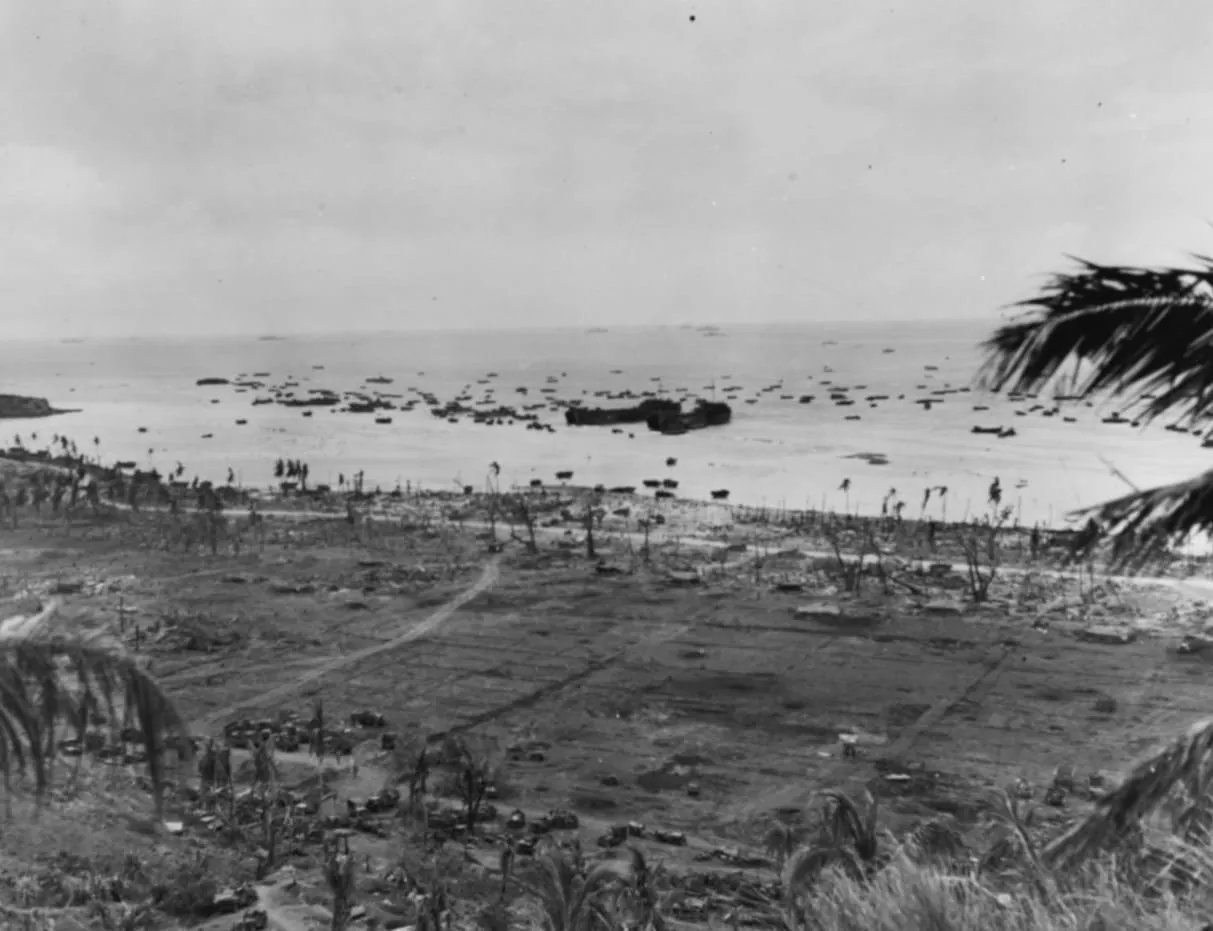
The Battle of Guam is the name given to the American recapture of Guam, the largest island of the Marianas, between 21 July and 10 August 1944. It was the third and final part of Operation Forager – the campaign for the Mariana Islands – following the Battle of Saipan; in parallel, from 24 July, fighting went on for neighbouring Tinian. In American plans Guam bore the code name Stevedore, and to distinguish it from D-Day on Saipan the day of the landing was designated W-Day.
The battle is taken to have begun on the morning of 21 July, when the 3rd Marine Division and the 1st Provisional Marine Brigade landed on two stretches of the west coast, near the villages of Asan and Agat. The bombardment of the island from sea and air, however, had been going on since 8 July, and the first air raids had struck it in June. The end is taken to be 10 August, when the landing force commander, Major General Roy Geiger, announced that organised Japanese resistance had ceased. The date is a convention: that same day American troops came upon the Mataguac caves, where the last Japanese headquarters was holding out, and its commander, Lieutenant General Hideyoshi Obata, did not die until 11 August. Thousands of scattered soldiers hid in the jungle for months afterwards, and the last of them emerged in 1972.
For the island’s inhabitants it meant the end of an occupation that had lasted more than two and a half years. The anniversary of the landing, 21 July, is celebrated on Guam as Liberation Day.
Background
Guam had belonged to the United States since 1898, when it was seized during the Spanish–American War. Spain sold the remaining islands of the Marianas to Germany, and after the First World War they passed under Japanese mandate administration. American Guam, run by the US Navy and almost unfortified, thus lay in the very heart of Japanese Micronesia. According to American figures, in 1941 it had about 23,400 inhabitants, of whom some 21,500 were Chamorros, the indigenous people of the archipelago, who had the status of US nationals without full citizenship rights. Most of them lived in the capital, Agana (Hagåtña).
On 10 December 1941, three days after the attack on Pearl Harbor, the Japanese seized Guam after a brief fight with a garrison of about 400 sailors and Marines. The Americans were shipped off to camps in Japan. For the first months the island, renamed Ōmiya-jima, was governed by the Japanese navy. The Chamorros were allowed to stay on their farms, but the use of English was banned, the schools taught Japanese, and the occupiers seized land and resources, fixed an artificially low exchange rate for the dollar against the yen and forced the population to work. Countryside and town alike lived in want, and hiding the American sailors who had evaded capture in 1941 was punishable by death: five of the six fugitives were caught and executed, while the sixth, George Tweed, was hidden by the islanders until July 1944.
At the beginning of 1944, as the American offensive in the central Pacific drew nearer, the army returned to Guam and the occupation became much harsher. Schools were closed and gatherings banned. Men, women and children from the age of 12 had to work on building airfields, fortifications and hundreds of cave shelters. When the invasion became certain in June 1944, the Japanese began herding the population – between 10,000 and 15,000 people, according to various estimates – into camps in the interior of the island, the largest of them in the Manenggon valley. People walked there carrying only what they could hold and lived in the open, without enough food and without sanitation. Paradoxically, the relocation spared many of them from the bombing and the fighting on the coast, though that was not its purpose.
The last weeks of the occupation brought atrocities. On 12 July Japanese soldiers beheaded the Catholic priest Father Jesús Baza Dueñas, a highly respected leader of the local community, who had earlier been tortured to extract information about Tweed’s hiding place, together with his nephew and two other men (Tweed had already been taken off the island by an American destroyer on 10 July). On 15 July, in the Merizo district, soldiers picked out thirty of the villagers – teachers, a municipal official, parents of sons serving in the American forces – and, on the pretext of a work detail, led them to Tinta cave, where they threw in grenades and bayoneted the survivors. According to Guampedia, fourteen people survived by feigning death. The next day, in similar circumstances, thirty men were killed in Faha cave; there, no one survived. On 20 July men from Merizo attacked the Japanese soldiers’ quarters in the village and killed almost all of them. Similar killings took place elsewhere on the island in July and August, among other places near Yigo. Historians and the American commission that examined Guam’s war claims estimate the number of Chamorros who died over the whole occupation at more than a thousand; some estimates are higher.
Plans and forces
The Marianas had played no great part in pre-war American plans for a war with Japan, but in 1943 both the navy and the air force came to need them. The Chief of Naval Operations, Admiral Ernest King, saw them as the key to Japan’s lines of communication, and the air planners saw bases from which the new Boeing B-29 Superfortress bombers could reach Japan. After the swift capture of the Marshall Islands, the US Joint Chiefs of Staff on 12 March 1944 directed Admiral Chester Nimitz to seize the Marianas, with a target date of 15 June. Saipan and Tinian, lying closer to Japan, were better suited to bomber airfields, but Guam, with its water supplies and the best anchorage in the archipelago at Apra Harbor, was the most valuable as a fleet base. Saipan came first because aircraft based there could cover the other islands.
The operation was directed by the commander of the Fifth Fleet, Admiral Raymond Spruance, and the amphibious forces by Vice Admiral Richmond Kelly Turner. The Southern Attack Force (Task Force 53), charged with taking Guam, was led by Rear Admiral Richard Conolly, nicknamed “Close-in Conolly” because already in the Marshalls he had made his ships bombard the shore from the shortest possible range. The ground forces consisted of Major General Roy Geiger’s III Amphibious Corps: Major General Allen Turnage’s 3rd Marine Division and Brigadier General Lemuel Shepherd’s 1st Provisional Marine Brigade (the 4th and 22nd Marines), together with the corps artillery and two defence battalions. The plan called for simultaneous landings on either side of the Orote peninsula – the division in the north, between Adelup Point and the village of Asan, the brigade in the south, near Agat – followed by the envelopment of the peninsula with its airfield and of Apra Harbor from two sides.
On the Japanese side, for most of the occupation Guam was held by a naval garrison of about 150 men. It was reinforced only in 1944. Lieutenant General Takeshi Takashina’s 29th Infantry Division was transferred from the Kwantung Army in Manchuria. On the way, on 29 February, the American submarine Trout sank the transport Sakito Maru with more than 4,000 troops aboard; about 1,600 were rescued from the sinking ship, and Trout herself was lost with all hands, sunk by the escort. The main body of the division reached Guam in March. That same month some 4,700 soldiers from other Kwantung Army divisions arrived, from whom Major General Kiyoshi Shigematsu’s 48th Independent Mixed Brigade and the 10th Independent Mixed Regiment were formed. The navy had about 5,000 men on the island in ground and construction units and about 2,000 in air units, which fought as infantry once their aircraft had been destroyed. According to a post-war American assessment, Guam was defended in July 1944 by about 18,500 troops, supported by several dozen tanks.
They were commanded by Takashina, but his superior was also on the island: Lieutenant General Hideyoshi Obata, commander of the Thirty-First Army, which was responsible for the defence of the whole of the Marianas. He had been returning from an inspection of Palau to his headquarters on Saipan when the Americans landed there, and he was stranded on Guam. Takashina concentrated his defence around the airfields, in the Agana area and on the beaches of the west coast, and when in early July he became certain where the landing would come, he drew in units from the rest of the island. As on Saipan, the Japanese intended to stop the enemy on the beach and throw him back into the sea with counter-attacks.
Postponement and the longest bombardment
The landing on Guam was provisionally set for 18 June, three days after the landing on Saipan. Vice Admiral Marc Mitscher’s carriers had been attacking the island since 11 June, and battleships had begun shelling it. The plan, however, soon fell apart. The Saipan garrison proved much stronger than expected and the reserve 27th Infantry Division had to be committed there, while the Japanese fleet was approaching from the west. On 16 June Spruance postponed the landing on Guam and sent Conolly’s transports away to the east, clear of the expected battle. The Marines spent the following weeks crammed aboard ship.
After the Battle of the Philippine Sea, won on 19–20 June, the threat from the Japanese fleet was over. On 3 July Spruance held a conference on the new date. The experience of Saipan, and documents captured there that allowed a more accurate assessment of the Guam garrison, convinced the commanders that more troops were needed. It was decided to wait for the whole of Major General Andrew Bruce’s Army 77th Infantry Division, a formation without combat experience, brought from Hawaii. The date was set for 25 July, and when the division reached Eniwetok atoll four days earlier than expected, it was brought forward to 21 July. In all, some 37,000 sailors and Marines and about 19,000 Army troops were bound for Guam – roughly three times as many as the defenders. King and Nimitz were unhappy with the delay, because the troops were losing condition aboard ship, but it also brought an advantage: time for a longer preparatory bombardment than before any other landing in the Pacific.
From 8 July the ships of Rear Admiral C. Turner Joy, and then ever more battleships, cruisers and destroyers, shelled the island day after day, supported by carrier aircraft. Conolly personally directed the bombardment from the command ship Appalachian, and targets were assigned each morning on the basis of fresh aerial photographs. According to American tallies, in the thirteen days before the landing more than 28,000 shells of 127 to 406 mm calibre and more than a thousand tons of bombs and rockets fell on Guam. The fire destroyed many of the coastal and anti-aircraft guns, though – as 21 July would show – not all of them. In mid-July frogmen of the underwater demolition teams (UDT) reconnoitred the beaches and blew up obstacles on the reef: some 300 log cribs filled with stones were removed off Agat, and some 640 off Asan.
The landing (21 July)
On the morning of 21 July the ships opened fire at 5.30 a.m., and hundreds of carrier aircraft appeared over the shore. Behind gunboats firing rockets at the beaches came armed amphibians, and behind them waves of infantry in tracked LVT amphibian tractors, the only vehicles that could cross the reef. Later waves transferred at the reef from landing craft to the returning tractors. The first vehicles reached the beaches at Asan at 8.28 a.m.
In the north the 3rd Marine Division landed in a natural amphitheatre whose slopes and both flanks – the headlands closing off the beaches, which the troops called the “Devil’s Horns” – the Japanese held under crossfire. Despite the bombardment, mortars and artillery opened up, and several tractors were lost to the fire. Before noon the 3rd Marines took Chonito Cliff, burning out cave positions with flamethrowers and tank fire, but in the centre they were held up below a hill later named Bundschu Ridge after a company commander who was killed trying to take it. The 21st Marines pushed into the Asan river valley, and the 9th Marines took Asan Point. According to American figures, the day cost the division 105 killed, 536 wounded and 56 missing.
In the south, at Agat, the 22nd and 4th Marines of the 1st Provisional Brigade met heavier fire on the approach – a dozen or more amphibians were destroyed in the first waves alone, and the brigade as a whole lost 24 tractors that day – but behind the beaches the ground was gentler, and the low hills and open fields allowed tanks to operate. The brigade took the ruined village of Agat and Hill 40. Help came from the 77th Division’s 305th Infantry Regiment, which, however, had no amphibians: its boats grounded on the reef, and the soldiers waded ashore waist-deep, stumbling into holes in the bottom. That evening General Shepherd reported to Geiger: “Own casualties about 350. Enemy’s unknown. Critical shortage of fuel and ammunition of all kinds. I think we’ll manage.”
Supply was the landing’s greatest problem from the first day. Ships could come no closer than the reef, several hundred metres offshore, so everything had to be transferred to amphibians, tracked tractors and cranes mounted on barges or on the reef itself. About a fifth of the corps’ troops were engaged in unloading. By nightfall both beachheads extended from a few hundred metres to two kilometres inland.
That night the Japanese attacked, as expected. In the south the 38th Infantry Regiment struck Hill 40, which a company of the 4th Marines twice lost and retook, while small groups carrying demolition charges infiltrated as far as the beaches and the artillery positions; towards morning a column of Japanese tanks was smashed by bazookas and Shermans. The regiment was almost wiped out, and its commander, Colonel Tsunetarō Suenaga, was killed. In the north, counter-attacks by the 48th Mixed Brigade and the 10th Mixed Regiment inflicted heavy losses on the Marines but failed to drive them off the hills they had taken.
The fight for the beachheads and the night counter-offensive (22–26 July)
Over the following days both beachheads expanded slowly and laboriously. In the north, on the night of 22/23 July, the 321st Independent Infantry Battalion counter-attacked – according to an American study, of its 488 men about fifty were still alive in the morning. The 3rd Marines, who had already lost more than six hundred men in the fighting for Bundschu Ridge, took it on 23 July after a massive bombardment; it turned out that most of the defenders had withdrawn. The fighting moved on to the road leading up Mount Tenjo and to the Fonte plateau, where Takashina had his command post.
In the south Shepherd’s brigade took the unoccupied Mount Alifan on 22 July, and on 23 and 24 July the remaining regiments of the 77th Division came ashore and took over the defence of the eastern part of the beachhead. The 22nd Marines fought their way through the rice paddies at the neck of the Orote peninsula, where tanks bogged down in the mud, and on 24 July took the village of Atantano, cutting off the peninsula with its airfield and garrison.
Takashina then resolved to do what the remnants of the Saipan garrison had done less than three weeks earlier: launch a night attack with all his forces. On the night of 25/26 July his troops struck from the Fonte plateau and Mount Mangan at the positions of the 3rd Division, and from the Orote peninsula at the brigade’s lines. In the north the Japanese exploited a gap between two regiments held by a reconnaissance detachment of just twenty-five men, and infiltration groups got as far as the rear, near the divisional field hospital, where they were beaten off by men of the medical battalion. In the south the banzai charge from Orote collapsed under the fire of the brigade, corps and 77th Division artillery, which according to American figures fired some 26,000 shells that night; in the morning more than four hundred bodies lay in front of the Marine positions.
The offensive ended in disaster. According to American estimates it cost the Japanese about 3,500 men, and three battalions ceased to exist. The commanders of the 18th Infantry Regiment, the 10th Mixed Regiment and the naval garrison were killed, and on 26 July, when tanks attacked his position on Mount Mangan, so was General Shigematsu. Between 25 and 27 July the 3rd Marine Division lost 166 killed, 645 wounded and 34 missing. Obata reported to Imperial General Headquarters that his forces had lost more than 80 per cent of their strength, “for which I sincerely apologise”.
Orote, the junction of the beachheads and the death of Takashina (26–31 July)
After the failure of the night offensive Takashina concluded that the island could not be held and decided to withdraw the remnants of his forces into the mountains and jungle of central and northern Guam, to delay the Americans there for as long as possible. He did not have time to carry this out: on 28 July, while leaving his command post on the Fonte plateau, he was killed by machine-gun fire. Obata took over command of the defence. The 3rd Marine Division assaulted the plateau, defended from a network of bunkers, caves and trenches, for three days and took it at a cost of more than a hundred killed and wounded. On 28 July men of the 9th Marines who had taken Mount Chachao saw 77th Division infantry on neighbouring Mount Tenjo; that afternoon the two beachheads linked up.
Meanwhile the 4th and 22nd Marines of Shepherd’s brigade were clearing the Orote peninsula. It was held mainly by naval personnel, with improvised minefields made from aircraft bombs, bunkers of concrete and palm logs, and camouflaged mortar and machine-gun positions. The Marines advanced with the help of Marine and Army tanks. At about 4 p.m. on 29 July a patrol with tanks reached the very tip of the peninsula, and Shepherd declared it captured. Many of the defenders took their own lives; others tried to swim across the bay and were killed or captured. According to American figures, taking Orote cost the brigade 115 killed, 721 wounded and 38 missing; up to 2,500 Japanese died there.
That same day, at 3.30 p.m., the American flag was raised once more over the ruins of the Marine barracks on Orote. Spruance, General Holland Smith, Geiger and Shepherd watched the ceremony. “On this hallowed ground,” Shepherd said, “you officers and men of the First Marine Brigade have avenged the loss of our comrades who were overcome by a numerically superior enemy three days after Pearl Harbor.” On 30 July the first navy aircraft landed on the hastily repaired airfield, and artillery spotter planes soon began operating from it.
The fighting also brought the camps for the civilian population to an end. Patrols of the 77th Division, led by Chamorro guides, established that the main Japanese forces had gone north. On 31 July the division’s troops reached the main camps in the interior; the guards had been killed or had fled. Thousands of exhausted people began streaming through the American lines, and relief supplies for civilians, stowed deep in the holds, reached the shore late. According to American figures, by mid-August some 18,000 Chamorros were in refugee camps, many of them malnourished, sick or wounded.
The pursuit to the north and the end of Obata (31 July – 11 August)
On 31 July Geiger advanced north with two divisions: the 3rd Marine Division on the left and the 77th Division on the right. That day the Marines entered the ruins of Agana, and on 1 August they took the unfinished Tiyan airfield. From then on the main enemy was the terrain: the north of the island is a limestone plateau covered in dense jungle, crossed by few roads; the maps were inaccurate, and the rainy season turned the dirt tracks into mud. Units lost touch with one another, and groups of Japanese slipped through the gaps between them.
Obata set up his main line of defence around Mount Barrigada. The fighting for it lasted from 2 to 4 August, and once it was over the Japanese front fell apart. From 7 August Shepherd’s brigade came back into the line on the left flank to close the widening front. That day the 77th Division’s 307th Infantry Regiment took the village of Yigo, and on 8 August it captured the fortified Mount Santa Rosa, where Obata had intended to fight his last battle. On 10 August Geiger announced that organised resistance on the island had ceased. That same day the cruiser Indianapolis entered Apra Harbor with Nimitz and the Commandant of the Marine Corps, General Alexander Vandegrift, aboard.
The last Japanese headquarters, however, was still holding out. On 10 August a battalion of the 306th Infantry Regiment came upon the caves below Mount Mataguac and, after a clash in which it lost eight killed and seventeen wounded, pulled back for the night. The caves housed Obata’s headquarters, and he sent a final message to Tokyo: “The holding of Guam has become hopeless. (…) My only concern is that the news of our honourable deaths on Guam may shake the people at home.” The next day the soldiers returned with tanks and blew in the cave entrances with demolition charges. Obata died on 11 August; according to American studies he took his own life during this last fight.
Losses
According to American tallies, by 10 August the Marine Corps (including the naval personnel attached to it) had lost 1,190 killed, 377 died of wounds and 5,308 wounded; the Army 177 killed and 662 wounded; and the Navy a dozen or more killed and several dozen wounded ashore and afloat. That gives a total of about 1,750 killed and died of wounds and about 6,000 wounded. On 12 August Japanese losses in the battle itself were estimated at more than 11,000 killed. By the end of August 1945, after months of sweeps, some 18,400 Japanese dead and about 1,250 prisoners had been counted; the garrison had thus been almost entirely wiped out. According to American estimates about 600 civilians were also killed in the fighting – quite apart from the victims of the occupation and the July massacres.
Significance
Guam was the first American territory to return to United States rule in this war. Together with Saipan, taken on 9 July, and Tinian, it breached the “absolute national defence sphere” drawn up by Tokyo in September 1943. The fall of Saipan had already cost Hideki Tōjō power in July, when his government resigned on 18 July.
The island quickly became one of the largest bases of the Pacific War. Seabees and Army engineers rebuilt Apra Harbor and the airfields, and in January 1945 Nimitz’s advanced headquarters moved here from Pearl Harbor. From February 1945 B-29s flew against Japan from North Field and Northwest Field in the north of the island; North Field is today’s Andersen Air Force Base. Guam’s hospitals received the wounded from Iwo Jima, and by August 1945 more than 200,000 American servicemen were stationed on the island.
A team of Japanese officers who re-examined the course of the battle on the spot in 1962 concluded that the mistakes had been reinforcing the island too late, splitting the defence between two distant sectors and, above all, the costly counter-offensives that hastened the garrison’s collapse. The Japanese army drew the lesson from the Marianas that instead of trying to throw a landing back into the sea it should defend in depth, in caves and bunkers, which made the fighting on Peleliu, Iwo Jima and Okinawa far longer and bloodier. Geiger, for his part, regarded landing on two widely separated beaches as a mistake, and he did not repeat it.
The war on Guam did not end on 10 August. The Thirty-First Army’s chief of staff, General Yoshitomo Tamura, took his own life on 22 August, and stragglers hid in the jungle for years – some surrendered only after Japan’s capitulation. The last of them, Shōichi Yokoi, was found in January 1972 after 28 years in hiding and became one of the best-known examples of Japanese holdouts after the war. After the war Guam was the venue for the trials of Japanese war criminals from all over Micronesia, and in 1950 the Chamorros were granted full American citizenship. The memory of the occupation, the marches to the camps and the Merizo massacres remains alive on the island, where Liberation Day is celebrated every 21 July.