- Category:
- Military operations
- Front:
- Pacific
- Date:
- 21 July 1944
- Author:
- Natalia
- Battle:
- Battle of Guam (1944)
- Tags:
- United States, Japan, civilians, Raymond Spruance
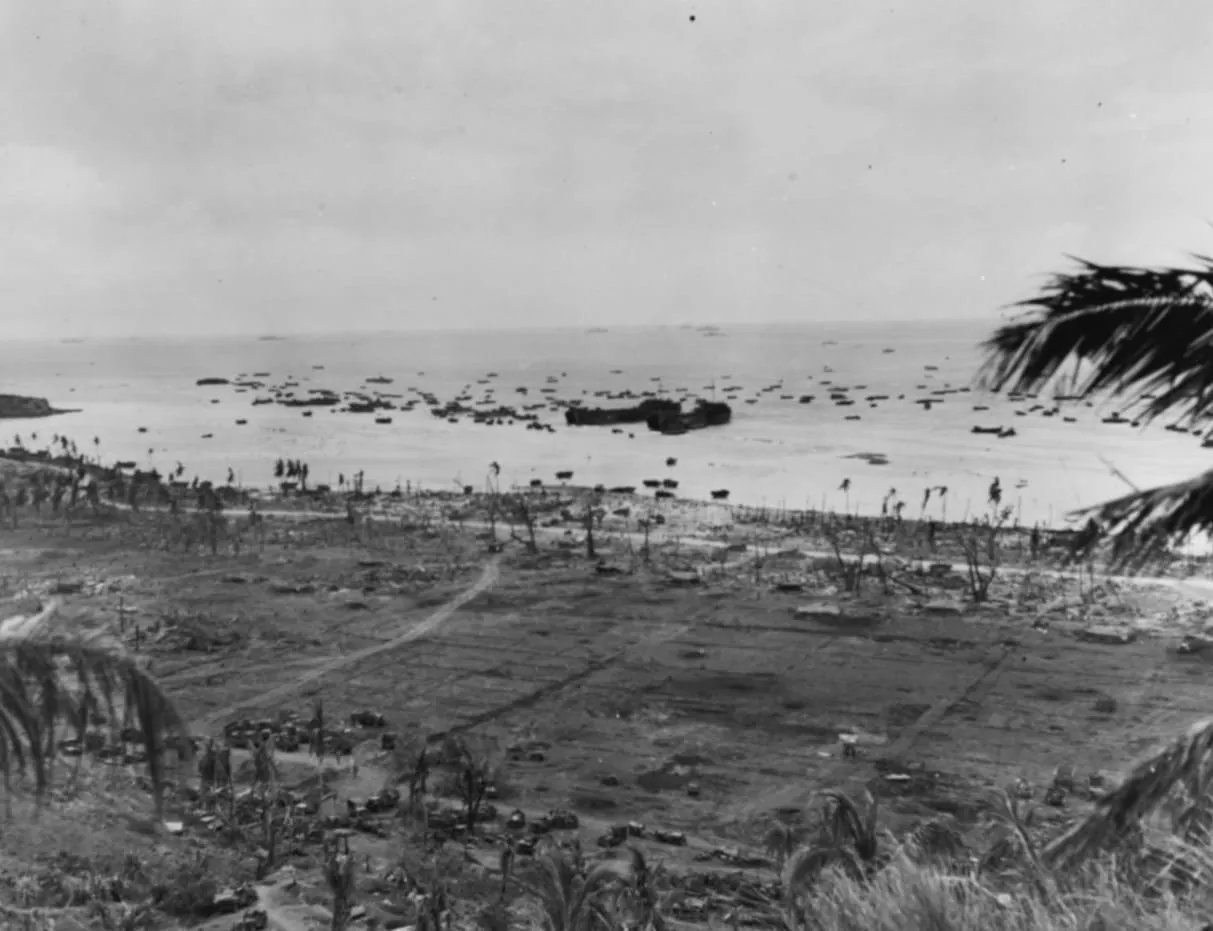
At 8.28 a.m. on 21 July 1944 the first American amphibious tractors reached the beaches on the west coast of Guam, the largest island of the Marianas. North of the Orote Peninsula, near the village of Asan, the 3rd Marine Division came ashore; south of it, near Agat, the 1st Provisional Marine Brigade. In the afternoon the first battalions of the US Army’s 77th Infantry Division also began landing on the Agat beaches. The Americans were returning to an island the Japanese had seized on 10 December 1941 – the first United States territory to be retaken from the enemy in this war. The landing was preceded by almost two weeks of naval and air bombardment, which American studies describe as the longest before any landing on a Pacific island.
Popular chronologies say simply that “US Marines land on Guam”. This is true but incomplete: an Army infantry regiment also came ashore on the first day, and the 77th Division then played a full part in the fighting for the island.
An island under occupation
Guam had belonged to the United States since the Spanish–American War of 1898, whereas the rest of the Marianas – Saipan, Tinian, Rota – passed into German hands in 1899 and, after the First World War, to the Japanese South Seas Mandate. The island was home to more than 20,000 Chamorros, the indigenous people of the Marianas, who had lived for four decades under an American naval administration. After taking the island the Japanese renamed it Ōmiya-jima (“Great Shrine Island”), and its capital, Agana, Akashi.
For the first months the island was ruled by the army, and from 1942 by the navy. The occupiers meant to keep Guam permanently and pursued a policy of Japanisation: they banned the use of English, introduced the yen, made Japanese a school subject and required the inhabitants to bow to Japanese soldiers. They confiscated cars, radios and cameras, rationed food and increasingly forced the islanders to work on airfields and fortifications. The Kempeitai, the Japanese military police, interrogated and tortured anyone suspected of contact with the Americans – searching with particular ferocity for George Tweed, a US Navy radioman who, with the help of the Chamorros, stayed in hiding on the island throughout the occupation.
At the beginning of 1944, when Army units arrived on the island, the regime grew sharply harsher. The schools were closed, and men, women and children over the age of 12 were driven to work long hours in the fields and on the construction of airfields, defensive positions and cave shelters. In the last weeks before the landing the Japanese removed between 10,000 and 15,000 Chamorros – the figures given in the literature – to camps in the jungle in the centre and south of the island, the largest of them in the Manenggon valley. People went there with whatever they could carry, and in the camps there was a shortage of shelter, food and water.
In those same days there were killings. On 12 July Japanese officers beheaded the Catholic priest Jesús Baza Dueñas, one of the leaders of the Chamorro community, who had earlier been tortured during the search for Tweed; his nephew and two other men died with him. On 15 July soldiers from the garrison at Merizo led 30 selected inhabitants – among them teachers, the village commissioner and parents whose sons were serving in the US forces – to a cave near Tinta, threw grenades at them and finished them off with bayonets; according to Guampedia, an encyclopedia published on Guam, fourteen survived by pretending to be dead. The next day another 30 men were murdered at nearby Faha; none survived. According to the same sources, on 20 July the people of Merizo attacked the quarters of the Japanese soldiers in their village and killed almost all of them. According to the findings of the American commission examining the war claims of Guam’s inhabitants (the Guam War Claims Review Commission, 2004), more than 1,100 Chamorros died during the occupation – murdered, dead of exhaustion or killed in the fighting.
A landing postponed by a month
The plan for Operation Forager, approved by the US Joint Chiefs of Staff in March 1944, envisaged attacking Guam a mere three days after Saipan – on 18 June. The island was of special importance: Saipan and Tinian lay closer to Japan and were better suited to airfields for the B-29, but it was Guam that had the best anchorage, Apra Harbor, and water supplies – and so the conditions for building a large fleet base. The task was given to the III Amphibious Corps of Marine Major General Roy Geiger: the 3rd Marine Division of Major General Allen Turnage and the 1st Provisional Brigade of Brigadier General Lemuel Shepherd. The landing force at sea was commanded by Rear Admiral Richard Conolly; above him stood Vice Admiral Richmond Kelly Turner and Lieutenant General Holland Smith, and in overall command was the commander of the Fifth Fleet, Admiral Raymond Spruance.
Everything changed after the landing on Saipan on 15 June. The island’s garrison proved almost twice as large as expected, the reserve – the 27th Infantry Division – had to go ashore, and American submarines detected the Japanese fleet heading for the Marianas. On 16 June Spruance cancelled the Guam landing and sent the transports east, away from the expected battle. Victory in the Battle of the Philippine Sea on 19–20 June removed the threat from the sea, but the fighting on Saipan was still going on, and Japanese documents captured there showed that Guam was defended by far more troops than had been thought. At a conference on 3 July it was decided that the whole of Major General Andrew Bruce’s 77th Infantry Division, summoned from Hawaii, was needed for the landing. The date was set for 25 July, and when the division reached Eniwetok ahead of time it was brought forward to 21 July. Admiral Chester Nimitz and Admiral Ernest King were unhappy with the delay: the Marines spent several weeks aboard crowded transports, losing condition.
Guam’s defences were the work of the last few months. For most of the occupation the island had been guarded by only a few hundred sailors. At the beginning of 1944 Lieutenant General Takeshi Takashina’s 29th Division was transferred there from Manchuria (one of its transports, the Sakito Maru, was torpedoed and sunk on the way by an American submarine), and in March came the units from which Major General Kiyoshi Shigematsu’s 48th Independent Mixed Brigade was formed. On the navy’s side there were some 5,000 men of ground units and 2,000 aviation personnel. Also on the island was the commander of the 31st Army, responsible for the defence of all the Marianas, Lieutenant General Hideyoshi Obata, who after an inspection of Palau had not managed to return to his headquarters on Saipan. According to American studies the garrison numbered about 18,500 men in July; the Americans sent more than 55,000 soldiers and Marines against them.
The longest preparatory bombardment
The delay had one advantage. Ships and aircraft had been shelling Guam since the strikes on the Marianas in mid-June, and from 8 July the bombardment became systematic. Conolly, known in the navy as “Close-in Conolly” for his liking for shelling the shore at short range, chose targets every morning on the basis of fresh aerial photographs. Over 13 days six battleships, cruisers and destroyers fired – according to American tallies – several tens of thousands of shells of between 127 and 406 mm calibre at the island, and carrier aircraft dropped more than a thousand tons of bombs and rockets. The official historians of the US Marine Corps judged this the longest preparatory bombardment before a landing on an island in the whole Pacific war; it destroyed most of the Japanese coastal guns sited in open emplacements, though not those hidden in caves.
On 10 July the destroyer USS McCall took George Tweed off the shore – two days before the execution of Father Dueñas, who died not knowing that the man being hunted was already safe. In the last days before the landing, frogmen of the underwater demolition teams spent several nights surveying the reefs and blowing up obstacles: according to American reports they removed some 300 obstacles in front of the Agat beaches and 640 in front of the Asan beaches. They were mostly wooden cribs filled with stones; few mines and little barbed wire were found.
Asan: an amphitheatre under fire
On 21 July the ships opened fire at 5.30 a.m., and from 6.15 a.m. carrier aircraft circled over the beaches. Landing craft gunboats raked the shore with rockets, followed by armoured amphibian tractors and then by the tractors carrying the Marines. Amphibious tracked vehicles – LVTs – were the only ones that could cross the coral reef surrounding the island; later waves had to transfer to them from landing boats at the edge of the reef, several hundred metres from the shore.
In the north the 3rd Marine Division landed between Adelup Point and Asan Point, on a beach closed off inland by a chain of hills and cliffs – the men later called it the amphitheatre. Despite the bombardment, Japanese mortars and guns opened up at once and destroyed several tractors. On the left flank the 3rd Marine Regiment had taken Chonito Cliff and Adelup Point by noon, burning the defenders out of caves with flamethrowers and tank fire. In the centre Captain Geary Bundschu’s company was pinned down below a rocky ridge later named after him; more than half its men were killed or wounded, and Bundschu himself was killed in a second attack that evening. The 21st Regiment on the right forced its way into the Asan river valley, and the 9th Regiment took Asan Point. The first day cost the division 105 killed, 536 wounded and 56 missing.
Agat: the southern beachhead
In the south the 4th and 22nd Marine Regiments landed on the beaches between Agat and Bangi Point. Japanese fire here was at first heavier – according to reports ten tractors were destroyed in the first waves, and a dozen or more were lost during the day to gunfire, on the reef and through breakdowns – but the ground behind the beaches was low and open, good for tanks. The 4th Regiment cleared Bangi Point and Hill 40, and the 22nd Regiment took the ruined village of Agat.
In the afternoon the 305th Infantry Regiment of the 77th Division began coming ashore. The division had no amphibious tractors of its own, so the soldiers, put off their boats at the edge of the reef, waded to the shore in water up to their waists, stumbling into deep holes in the coral; the last battalion reached land only during the night. By nightfall the beachheads of both groups extended between 1.2 and 2 kilometres inland. At 6.30 p.m. General Shepherd reported to Geiger: “Own casualties about 350. Enemy unknown. Critical shortage of fuel and ammunition of all types. I think we can manage.”
Supply became the greatest problem of the first days. Landing ships could come no closer than the reef, so stores were transferred to amphibian tractors and DUKW amphibious trucks with the help of cranes mounted on the reef and on barges; roughly a fifth of the whole corps was at work unloading.
Nights of counter-attacks
Takashina, in line with the Japanese doctrine of the time, wanted to drive the invaders into the sea. On the very first night in the south a battalion of the 38th Infantry Regiment attacked Hill 40, which K Company of the 4th Marines twice lost and retook, while small parties carrying explosives infiltrated as far as the coast road and the artillery positions. At about 2.30 a.m. a column of Japanese tanks drove onto the American positions and was destroyed by a bazooka team and Shermans called up to help. In the morning some 600 bodies of Japanese soldiers were counted; the regimental commander, Colonel Tsunetarō Suenaga, had been killed. In the north the Japanese tried night after night to push the Marines off the hills they had taken.
The heaviest blow came on the night of 25–26 July, when Takashina threw almost all his forces from the Fonte plateau and Mount Mangan into a coordinated attack on the 3rd Division, while on the Orote Peninsula the remnants of the 38th Regiment and naval units launched a banzai charge against the 22nd Marines. In the south the attack was stopped by massed artillery fire – according to American figures 26,000 shells were fired that night – while in the north Japanese groups broke through as far as a field hospital, where they were beaten off by the staff of a medical battalion. The counter-attack cost the Japanese – by American estimates – some 3,500 dead in the north and more than 400 on Orote; among the dead were General Shigematsu and most of the regimental and battalion commanders. Obata reported to Tokyo that the attack had failed and that his forces had lost more than 80 per cent of their strength. From then on the Japanese went over to the defensive in the interior of the island.
Place in the war
The counter-attack broke the defence of Guam. Takashina decided to withdraw the remnants of his troops to the north and fight a delaying action there, but on 28 July he was killed by machine-gun fire; Obata took over command. The same day the two beachheads linked up; on 29 July the Marines completed the capture of the Orote Peninsula and its airfield, and the American flag was raised again over the former Marine barracks. On 31 July the Americans entered the ruins of Agana, and after fighting around Mount Barrigada on 2–4 August the Japanese line fell apart. On 10 August Geiger declared organised resistance at an end; the next day Obata – according to American accounts – committed suicide in his command post in the caves below Mount Mataguac. The fighting cost the Americans – according to official figures – some 1,750 killed and died of wounds and about 6,000 wounded. The Americans put Japanese losses at about 11,300 dead by 12 August 1944; by August 1945, including groups broken up later, some 18,400 dead had been counted, and about 1,250 men had been taken prisoner. The last of the soldiers hiding in the jungle, Sergeant Shōichi Yokoi, was found only in January 1972 – one of the best-known cases of Japanese holdouts after the war.
For the Chamorros the landing meant the end of the occupation, but not the end of their suffering. Thousands of people emerged from the jungle camps malnourished and sick; in mid-August some 18,000 of the island’s inhabitants were in American refugee camps, and by American estimates about 600 civilians were killed during the fighting. Nimitz proclaimed 21 July Liberation Day, which is still celebrated on Guam. After the war 144 defendants accused of crimes committed in Micronesia stood before a naval tribunal on Guam; thirteen were hanged. The people of Guam received United States citizenship only in 1950.
Guam was the third island of the Marianas to be fought over in the summer of 1944 – after Saipan, where the fighting ended on 9 July – and three days after Guam the Marines landed on neighbouring Tinian. The loss of Saipan, the first breach in the “absolute national defence sphere”, had already cost Hideki Tōjō the premiership; his government resigned on 18 July. From the recaptured islands American aircraft could reach the heart of Japan: airfields for B-29 bombers were built on Guam, and Apra Harbor became one of the largest fleet bases in the Pacific. In January 1945 Nimitz moved his forward headquarters to Guam, from where he directed the last campaigns of the Pacific war – for Iwo Jima and Okinawa.
Sources
Meanwhile
(04)Elsewhere, within a week.
- 19 July 1944 · MediterraneanThe capture of LivornoOn 19 July 1944 troops of the US 34th Infantry Division entered Livorno. The Germans had pulled out overnight, leaving a wrecked and mined port.
- 23 July 1944 · PolandThe Lwów uprisingOn 23 July 1944 the Home Army and the Red Army fought the Germans in Lwów. The city fell on 27 July; days later the NKVD arrested the Home Army commanders.
- 24 July 1944 · Western FrontOperation CobraOn 24 July 1944 bombs from Operation Cobra's first raid fell on Americans near Saint-Lô. On 25 July First Army attacked; on 28 July it took Coutances.
- 24 July 1944 · PolandThe liberation of MajdanekDuring the fighting for Lublin, Soviet soldiers entered the abandoned camp at Majdanek. Its gas chambers and crematorium were left almost intact.
Related events
(04)The same battle, people or subject.
- 10 August 1944 · PacificThe end of the fighting on GuamOn 10 August 1944 the Americans declared organised resistance on Guam at an end. The next day General Obata died in the Mataguac caves.
- 1 August 1944 · PacificThe end of the fighting on TinianOn 1 August 1944 the Americans declared Tinian taken. Almost the entire garrison was killed, and the island became one of the largest B-29 bases.
- 19 June 1944 · PacificThe Battle of the Philippine SeaOn 19–20 June 1944 the US Task Force 58 shattered Ozawa's carrier air groups west of the Marianas. Japan lost three carriers and several hundred aircraft.
- 15 June 1944 · PacificThe landing on SaipanOn 15 June 1944 two US Marine divisions landed on Saipan. That evening American submarines sighted the Japanese fleet heading for the Marianas.