1943–1944: The Central Pacific offensive
Battle of Saipan
- Dates:
- 15 June – 9 July 1944
- Front:
- Pacific
- Location:
- Saipan in the Mariana Islands (the Japanese South Seas Mandate, today the Northern Mariana Islands) – the west-coast beaches near Charan Kanoa, Aslito airfield in the south, Mount Tapotchau in the centre of the island, Garapan and Tanapag in the west, and the northern tip of the island with Marpi PointOn the battle map →
- Sides:
- United StatesRaymond Spruance, Richmond Kelly Turner, Holland SmithJapanYoshitsugu Saitō, Chūichi Nagumo
- Result:
- United States victory. The island was declared secured on 9 July 1944. The Japanese garrison of about 30,000 men was almost entirely wiped out; according to various tallies the Americans lost about 3,400 killed and more than 13,000 wounded. Several thousand civilians also died, many of whom took their own lives at the northern tip of the island.
- Author:
- Łukasz
Name and dates
The Battle of Saipan is the name given to the fighting for Saipan, one of the islands of the Marianas in the central Pacific, from 15 June to 9 July 1944. It was the first part of the American Operation Forager, whose aim was to capture Saipan, Tinian and Guam. The battle began on the morning of 15 June, nine days after the Allied landings in Normandy, when two Marine divisions landed on the island’s west coast. It is taken to have ended on 9 July, when Vice Admiral Richmond Kelly Turner announced that the island had been secured and Marine units reached the northern tip of Saipan. Scattered groups of Japanese soldiers nevertheless hid in caves and jungle for many months afterwards; the last of them, Captain Sakae Ōba’s unit, did not lay down its arms until 1 December 1945.
Saipan was the first island in the Pacific where the Americans fought among a large Japanese population, and the first place where the war reached territory that the Japanese regarded as part of their own state. The battle therefore has a second, tragic side: the deaths of thousands of civilians, including the mass suicides on the cliffs of Marpi Point in the last days of the fighting.
The Battle of Saipan is closely bound up with the Battle of the Philippine Sea (19–20 June 1944), which the Japanese fleet fought in an attempt to repel the invasion. Its outcome sealed the island’s fate, because it left the defenders of Saipan with no hope of relief.
Background
Saipan has an area of about 120 square kilometres. The Spanish took the Marianas in the 16th century; after losing the war with the United States in 1898 they ceded Guam to the Americans and in 1899 sold the rest of the archipelago to Germany. In the autumn of 1914 the islands were occupied by Japan, which after the First World War governed them as a League of Nations mandated territory. Saipan became the administrative centre of the Marianas and one great sugar-cane plantation: cane covered about 70 per cent of the island and was carried by a narrow-gauge railway running round the coast. Estimates of the civilian population range from 26,000 to 30,000 – above all Japanese settlers, many of them from Okinawa, together with Koreans and the indigenous Chamorros and Carolinians. The largest settlements were the administrative capital Garapan, Charan Kanoa with its sugar mill, and the port of Tanapag, all on the west coast. In December 1941 the force that captured American Guam set out from Saipan.
The island bore no resemblance to the flat atolls of the Gilbert and Marshall Islands. It has a volcanic core surrounded by limestone, and in its centre rises Mount Tapotchau (about 470 metres), from which a jagged ridge full of caves, ravines and scrub runs northwards. The southern part of the island is flat; here lay Aslito airfield, the main airfield in the Marianas.
From 1943 Admiral Ernest King, Commander-in-Chief of the US Fleet, had pressed for a strike on the Marianas. In his view their capture would cut the routes from Japan to the western Pacific and might lure the Japanese fleet into a decisive battle. He was backed by General Henry Arnold, commander of the Army Air Forces, whose interest lay in the new B-29 Superfortress heavy bombers: from the Marianas they could reach Tokyo and most of Japan’s industrial centres. General Douglas MacArthur preferred to concentrate forces on the advance along New Guinea towards the Philippines, but at the Cairo Conference in November 1943 the Combined Chiefs of Staff agreed to both offensives. The swift capture of the Marshall Islands and the raids on Truk allowed the timetable to be brought forward: on 12 March 1944 the US Joint Chiefs of Staff set the Marianas landing for 15 June. In February carriers struck the Marianas for the first time and photographed the islands from the air.
For Japan the Marianas lay within the “absolute national defence sphere” drawn up in September 1943 – a line to be held at all costs. Losing them meant that B-29s would be able to reach the home islands. The Japanese navy planned for an attack on this line to bring about the decisive battle: the land-based aircraft of Vice Admiral Kakuji Kakuta’s First Air Fleet, headquartered on Tinian, were to wear down the American carriers, and Vice Admiral Jisaburō Ozawa’s Mobile Fleet would finish the job.
Forces and plans
Operation Forager as a whole was directed by Admiral Raymond Spruance, commander of the Fifth Fleet, who answered to Admiral Chester Nimitz. The landings were commanded by Vice Admiral Richmond Kelly Turner, who also personally led the Northern Attack Force bound for Saipan. The ground forces were under Lieutenant General Holland Smith, commander of the V Amphibious Corps, a veteran of Tarawa and the Marshalls, known for his temper as “Howlin’ Mad”. Allotted to Saipan were Major General Thomas Watson’s 2nd Marine Division and Major General Harry Schmidt’s 4th Marine Division, while the Army’s 27th Infantry Division under Major General Ralph Smith formed the reserve for the whole operation. More than 60,000 troops were earmarked for the assault. The invasion fleet numbered over 500 warships and other vessels; the Marine divisions sailed from Hawaii in the second half of May and assembled at Eniwetok atoll on 7–8 June, while the 27th Division came by way of Kwajalein. Cover was provided by Vice Admiral Marc Mitscher’s Task Force 58 with 15 carriers.
American intelligence put the Saipan garrison at 15,000–18,000 men. In reality there were almost twice as many – about 30,000–32,000 according to American studies, including some 6,000 naval personnel. The backbone of the defence was Lieutenant General Yoshitsugu Saitō’s 43rd Division and the 47th Independent Mixed Brigade. Formally the islands came under Lieutenant General Hideyoshi Obata’s Thirty-First Army, but Obata was returning from an inspection of Palau and was stranded on Guam when the invasion came, so command on Saipan passed to Saitō as the senior army officer. Also on the island was Vice Admiral Chūichi Nagumo, the commander at Pearl Harbor and Midway, now head of the Central Pacific Area Fleet – a post of great prestige but little real strength. The army and navy had no unified command and often acted independently.
The Japanese reinforced the island in haste, and American submarines sank many of the transports. Of the seven ships carrying the 43rd Division, five went down; most of the men were rescued, but they lost much of their weapons and equipment. Cement and steel for the fortifications also went to the bottom. The Japanese command did not expect an invasion before the autumn, so in June the defences were unfinished. In line with the doctrine of the time, the defence was meant to smash the landing on the beaches. The defenders’ main strength proved to be their artillery – several dozen guns and howitzers sited on the hills above the beaches, with targets registered in advance using marker flags. There were also about 80 tanks on the island, more than the Americans had met anywhere in the Pacific before.
Preparation and landing (11–15 June)
The struggle for Saipan began in the air and at sea. On the afternoon of 11 June more than 200 Hellcats from Mitscher’s carriers caught the Japanese airfields on Saipan and Tinian by surprise, and over the following days aircraft bombed targets across the Marianas and set fire to the cane fields in the south of Saipan. Kakuta’s land-based air force, on which the Japanese plan depended, was largely destroyed before the naval battle had even begun. On 13 June Vice Admiral Willis Lee’s seven fast battleships opened fire on the island, but their crews had not been trained in shore bombardment and, fearing mines, fired from long range. They wrecked much of Garapan and Charan Kanoa but barely touched the fortifications. The next day Rear Admiral Jesse Oldendorf’s old battleships, whose crews were practised at such work, joined the bombardment; they destroyed many anti-aircraft positions, but most of the beach defences also survived. On news of the bombardment Admiral Soemu Toyoda, Commander-in-Chief of the Combined Fleet, on 13 June suspended Operation Kon – the relief of embattled Biak – and ordered readiness for the decisive battle under Plan A-Go, and the Mobile Fleet set out for the Marianas.
The landing began at about 8.40 a.m. on 15 June. Several hundred amphibian tractors and amphibious tanks headed simultaneously for the beaches on either side of Charan Kanoa: the 2nd Marine Division for the Red and Green beaches north of the town, the 4th Division for the Blue and Yellow beaches south of it. Within about 20 minutes some 8,000 men were ashore. The beaches themselves were defended only by trenches and a few bunkers, but on the hills behind them the Japanese artillery lay in wait, and it shelled the crowded beaches and the reef all day. Many tractors were hit and some units landed in the wrong places. By evening about 20,000 Americans were on the island, but the beachhead was only some 9 kilometres wide and less than a kilometre deep – about two-thirds of what had been planned – and a gap yawned between the divisions north of Charan Kanoa. Losses on the first day exceeded 2,000 killed and wounded.
On 15 June, shortly after the landing, Toyoda ordered the operation to begin, repeating Admiral Heihachirō Tōgō’s signal at Tsushima: “The fate of the Empire rests upon this one battle; let every man do his utmost.” Late in the afternoon of 15 June the American submarine Flying Fish sighted Japanese carriers emerging from the San Bernardino Strait in the Philippines, and that night Seahorse reported a second force approaching from the south. Spruance now knew that the Japanese fleet was heading for the Marianas.
During the night of 15/16 June Saitō threw his troops into a series of counter-attacks intended to drive the Americans into the sea. The attacks were poorly coordinated, and warships lit up the battlefield with star shells; all were beaten off, with heavy Japanese losses.
The south of the island and the battle at sea (16–20 June)
On 16 June Holland Smith put ashore two regiments of the 27th Infantry Division, originally intended as the reserve for the whole operation, and the landing on Guam planned for 18 June was postponed. The Marines widened the beachhead and closed the gap between the divisions. On the night of 16/17 June Saitō tried again: some 35 tanks and a thousand men struck the northern flank of the beachhead. This is sometimes described as the largest Japanese armoured attack of the Pacific War, but it was poorly coordinated with the infantry – Nagumo’s sailors, who were supposed to take part, never joined in. Bazookas, anti-tank guns, Shermans and self-propelled howitzers destroyed most of the Japanese tanks.
Over the following days the 2nd Marine Division pushed north towards Garapan and Mount Tapotchau, while the 4th Division and the 27th Division turned east and south. On 18 June troops of the 27th Division took Aslito airfield, which the defenders had abandoned as they fell back onto the Nafutan peninsula in the south-eastern corner of the island. The same day the 4th Division reached the east coast on Magicienne Bay and cut the island in two. The airfield, later renamed Isely Field, received its first American P-47 fighters on 22 June, and they went straight into action supporting the infantry. More than a thousand Japanese were trapped on the Nafutan peninsula – Holland Smith reckoned them at a few hundred – and the fighting for this scrap of land dragged on for over a week.
Meanwhile the island’s fate was being decided at sea. On 17 June the transports finished unloading the most urgent supplies and withdrew to the east, and Spruance positioned Task Force 58 west of the Marianas, without straying too far from the beachhead. On 19 and 20 June Vice Admiral Ozawa’s Japanese Mobile Fleet – nine carriers and about 450 carrier aircraft – clashed with 15 American carriers. Japanese naval aviation suffered so crushing a defeat that the Americans called the first day of the battle the “Great Marianas Turkey Shoot”; submarines sank the carriers Taihō and Shōkaku, and aircraft sank Hiyō on 20 June. Ozawa withdrew with what was left. The defenders of Saipan did not learn of this at once, but from that moment they could no longer count on reinforcements, supplies or relief.
By 19 June the Japanese forces on the island had been reduced by roughly half, while the Americans had already suffered more than 6,000 killed and wounded. Saitō began pulling the rest of his men back to a new line across the middle of the island, and Holland Smith committed the last regiment of the 27th Division.
“Death Valley” and the quarrel of the two Smiths (21–30 June)
Saitō’s new line ran from Garapan on the west coast across the southern slopes of Tapotchau to Magicienne Bay in the east. The Japanese held most of the high ground, from which they could watch every enemy movement, and the terrain, riddled with caves and scrub, favoured the defence. On 22 June three American divisions went over to the attack: the 2nd Marine Division on the left towards Garapan and the summit, the 4th Division on the right along the east coast. That evening the 27th Division (less the regiment fighting on Nafutan) was ordered into the centre, into the most difficult ground between them.
On 23 June its attack, which started late, stalled in front of a valley at the foot of Tapotchau and a low ridge on its eastern side, held according to American estimates by about 4,000 Japanese. The soldiers named these places “Death Valley” and “Purple Heart Ridge” – after the decoration awarded to the wounded. The Marine divisions on the flanks kept advancing, the American line bent into a horseshoe, and their exposed flanks forced them to halt.
On 24 June Holland Smith, long dissatisfied with the 27th Division, relieved its commander, Major General Ralph Smith, with the approval of Turner and Spruance. Major General Sanderford Jarman stood in temporarily, and on 28 June Major General George Griner took command. The sacking of an Army general by a Marine general set off one of the bitterest inter-service disputes of the war. Holland Smith accused the division of lacking aggression and moving too slowly; the Army command in Hawaii, under Lieutenant General Robert Richardson, regarded the decision as unjust and convened a board, which found that Holland Smith had been entitled to relieve his subordinate but had not fully understood the 27th Division’s situation or the difficulties of the terrain. The dispute spilled over into the American press and continued long after the war; historians still judge it differently. After the fighting in the Marianas ended, Holland Smith took command of Fleet Marine Force, Pacific, and never again led Army divisions in battle.
Despite the change of commander, the fighting for Death Valley went on for six more days. In the meantime the Americans had built up enormous firepower: P-47s were operating from Aslito, the corps artillery was pounding Japanese positions with 155 mm guns, and from 24 June the warships returned from the Battle of the Philippine Sea. In his reports Saitō singled out naval gunfire as the greatest obstacle – it could fall from any direction, and star shells robbed the Japanese of the cover of night. Caves were cleared with flamethrowers and demolition charges, or their entrances were simply blown in. Messages were passed in code by Navajo Marine signallers, whose language the Japanese could not understand.
On 25 June the 2nd Marine Division took the summit of Tapotchau, the key observation point in the centre of the island, and the 4th Division seized the Kagman peninsula in the east. On the night of 26/27 June some 500 Japanese broke out of the Nafutan peninsula towards Aslito airfield; they destroyed one aircraft but were wiped out by Marine reserve units. On 27 June the Thirty-First Army staff reported to Tokyo that the island could not be held in the face of the enemy’s superiority in artillery, at sea and in the air, and that the troops were short of food and water – some had not drunk for three days and were living on snails and leaves. On 30 June the 27th Division at last took Death Valley and Purple Heart Ridge and linked up with the Marine divisions. The defensive line across the middle of the island had been broken. American casualties had now reached about 11,000 killed and wounded.
The pursuit to the north and the gyokusai (1–9 July)
Saitō intended to form a final line of defence from Tanapag in the west across the middle of the island to the east coast, but his army was disintegrating. Some men fell back northwards, some hid in caves, others fought where they stood. On 2–4 July the 2nd Marine Division took the ruins of Garapan and its harbour, and on 4 July the 27th Division reached the west coast south of Tanapag, cutting the line of retreat from the town. On 5 July the 27th Division ran into stiff resistance in a narrow ravine north of Tanapag, which the soldiers called “Harakiri Gulch”, while the 4th Marine Division advanced rapidly northwards. Saitō’s headquarters, hidden in a cave near the village of Makunsha on the west coast, had been under artillery fire for days and finally came within range of American machine guns.
On 6 July Saitō judged the situation hopeless. He ordered the remnants of his forces to carry out a gyokusai – a final suicidal attack in which they were to kill as many of the enemy as possible and die. He set the attack for the following dawn and entrusted its leadership to the division’s chief of staff, Colonel Takuji Suzuki. According to survivors’ accounts, Saitō ate a last meal and committed seppuku, and his adjutant finished him off with a pistol shot; sources differ as to whether this happened on 6 or 7 July. At about the same time Vice Admiral Nagumo, the commander whose carriers had attacked Pearl Harbor, also took his own life. The Americans found Saitō’s body on 11 July and buried it with military honours.
At 4 a.m. on 7 July at least 3,000 men – by some estimates more than 4,000 – surged south across the Tanapag plain. They included soldiers, sailors, wounded men still able to walk and some civilians; besides rifles, grenades and a few tanks, some carried nothing but bayonets lashed to poles. It was the largest attack of its kind in the Pacific War. At about 4.45 a.m. its main mass struck two battalions of the 27th Division’s 105th Infantry Regiment, which were pushed forward and isolated from the rest of the troops. Both battalions were overrun, losing some 900 killed and wounded – nearly 80 per cent of their strength. The wave rolled on through the positions of two Marine artillery batteries, where the gunners fired their howitzers over open sights, and was halted only before noon on a hastily formed line near the village of Tanapag. Fighting with scattered groups went on until evening. Three soldiers of the 105th Regiment were posthumously awarded the Medal of Honor for that day.
On 8 July the shattered 27th Division was withdrawn into reserve, and the 2nd Marine Division mopped up the Tanapag plain. The 4th Division advanced on Marpi Point, the northern tip of the island. On the evening of 9 July it reached the shore, and Turner announced that Saipan had been secured. On the second day of the battle he had expected to take the island within a week – it took 24 days.
The civilians and Marpi Point
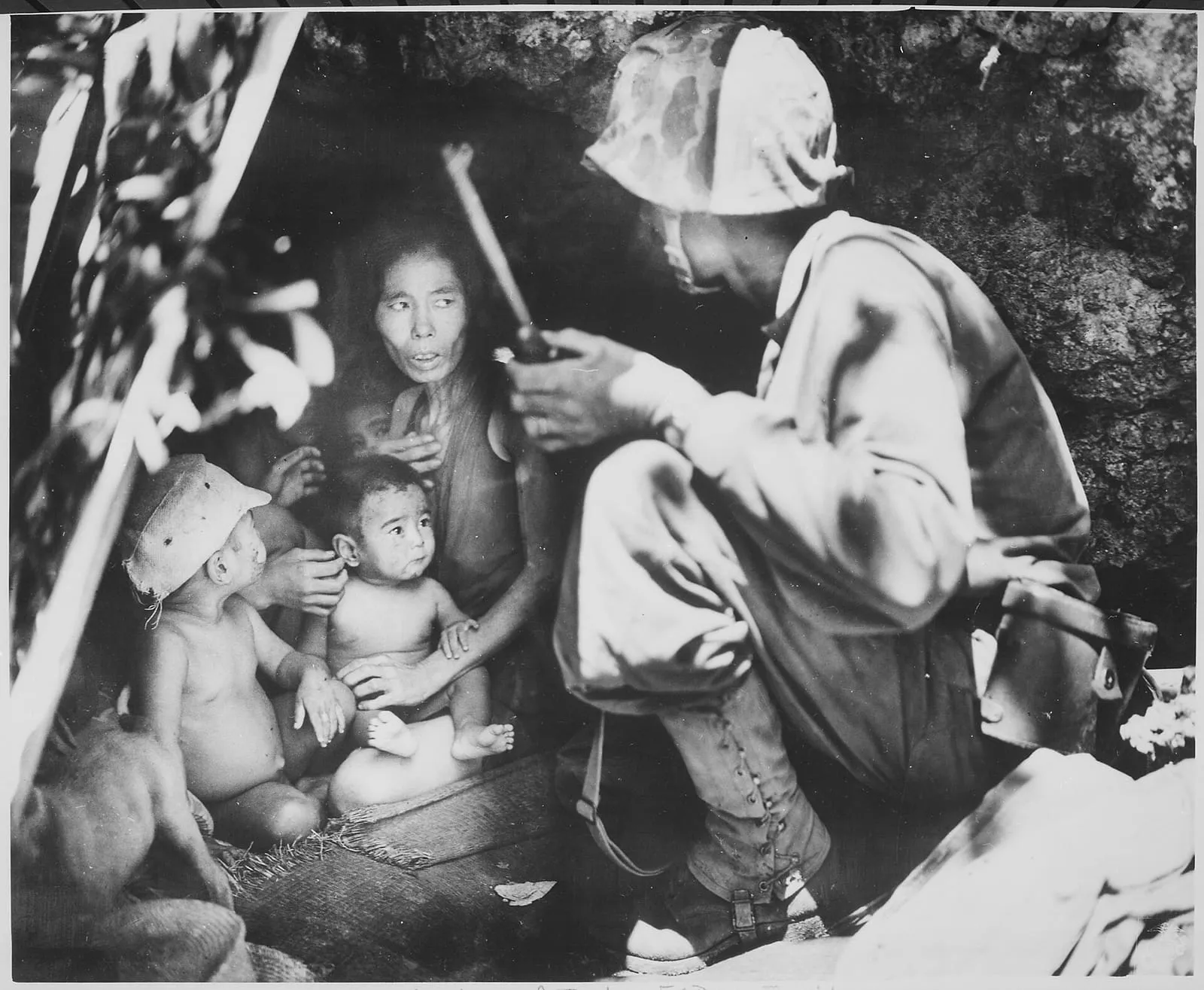
On Saipan, for the first time in the Pacific War, the Americans fought among thousands of Japanese civilians. Many were killed by bombs, by artillery and naval gunfire, and in crossfire. Others hid in caves and shelters which could not be told apart from Japanese fighting positions from the outside and which were cleared with grenades, demolition charges and flamethrowers. Early in the battle thousands of people managed to surrender, but once the fighting moved into the hills of the north this became ever harder: in the dense terrain soldiers struggled to distinguish civilians from combatants, and people trying to give themselves up risked death at the hands of either side. Many believed that the Japanese fleet would come to their rescue. For years propaganda had drummed into them that the Americans tortured, raped and murdered prisoners, and Japanese soldiers often forbade civilians to surrender or forced them to die.
In the final days of the battle, and after 9 July as well, hundreds of people – about a thousand, according to the most commonly cited estimates – took their own lives at the northern tip of the island. Some threw themselves from a high inland escarpment later named Suicide Cliff, others from the seaside rocks of Marpi Point, which the Americans called Banzai Cliff. Parents killed their children and whole families blew themselves up with grenades; some victims were pushed by others or by soldiers. Men of the 4th Marine Division who witnessed it, as well as the interpreters calling through loudspeakers for people to surrender, described these scenes as the most terrible of the entire war. The number of suicides is uncertain and estimates vary widely – from several hundred to several thousand.
In all, an estimated 8,000 to 10,000 civilians died during the battle and shortly afterwards – according to some studies, about 40 per cent of the island’s inhabitants. The Americans placed some 14,000 survivors in an internment camp at Susupe. The scenes on Saipan, reported by American correspondents, confirmed the US command in its belief that an invasion of Japan would be extraordinarily bloody for the civilian population as well.
Losses
The Japanese garrison – about 30,000 soldiers and sailors – was almost entirely wiped out. Around 1,700 men were taken prisoner, roughly half of them Korean labourers. Of the approximately 71,000 American troops who took part in the fighting on the island, between about 3,100 and 3,400 were killed or died of wounds, according to various tallies, and more than 13,000 were wounded – some 16,500 in all, or over 20 per cent, a proportion similar to Tarawa. It was the bloodiest battle in the Pacific for the Americans up to that time.
Significance
Saipan was the first breach in Japan’s “absolute national defence sphere” and one of its heaviest defeats. The landing coincided with the first B-29 raid on the home islands – on the night of 15/16 June bombers flying from Chengdu in China attacked the steelworks at Yawata – but the real prize was the Marianas, from which B-29s could reach most Japanese cities without depending on supplies flown over the Himalayas. Construction of a heavy-bomber airfield at Aslito began as early as 24 June, while the fighting was still going on. The other islands of the archipelago fell that summer: the Americans landed on Guam on 21 July and on Tinian on 24 July. On 24 November 1944 the first B-29 mission against Tokyo took off from Saipan, and in 1945 the Marianas were the base for the bombing offensive that burned out most of Japan’s cities; the aircraft carrying the atomic bombs to Hiroshima and Nagasaki took off from Tinian.
In Japan the fall of Saipan reverberated more widely than any earlier defeat. Even after the Battle of the Philippine Sea, Emperor Hirohito demanded a plan to retake the island, and only in the second half of June did he accept that it was lost. The government admitted to its citizens for the first time that the war was going badly and, fearing air raids, ordered the compulsory evacuation of hundreds of thousands of children from the big cities to the countryside. Court circles and some commanders who believed the war could no longer be won turned against Prime Minister Hideki Tōjō; on 18 July 1944 his cabinet resigned, and General Kuniaki Koiso became the new prime minister. After the war many Japanese commanders pointed to Saipan as the turning point – Vice Admiral Shigeyoshi Miwa is said to have remarked: “Our war was lost with the loss of Saipan.”
The battle also had consequences for American planning. The heavy losses – and a ratio in which every seven Japanese killed cost one American dead and several wounded – became one of the bases for calculating casualties in future operations, right up to the estimates for the invasion of Japan. The Japanese drew their own conclusion: on Peleliu, Iwo Jima and Okinawa they abandoned beach defence and massed charges in favour of a prolonged defence inland, intended to bleed the enemy as heavily as possible. The deaths of civilians on Saipan, for their part, foreshadowed the tragedy that befell the people of Okinawa in 1945.