1940–1942: Fighting against Vichy France
Battle of Madagascar
- Dates:
- 5 May – 6 November 1942
- Front:
- Africa
- Location:
- Madagascar (a Vichy French colony): the naval base and bay of Diego Suarez (now Antsiranana) with Antsirane at the northern tip of the island, the ports of Majunga, Tamatave and Tuléar, the capital Tananarive (now Antananarivo) and the roads south through Fianarantsoa to Ambalavao and Ihosy; also the waters of the Mozambique Channel and MayotteOn the battle map →
- Sides:
- United Kingdom, South Africa and the British East African coloniesRobert Sturges, Edward Neville Syfret, William PlattVichy FranceArmand Annet
- Result:
- Allied victory. On 7 May the British took the Diego Suarez base, and after the September offensive the whole island. On 6 November Governor-General Annet accepted an armistice. Madagascar passed under British administration and, from the beginning of 1943, under the authority of Free France.
- Author:
- Łukasz
The Battle of Madagascar was the longest, and the last major, campaign in which the British fought the forces of Vichy France. It began on 5 May 1942 with a landing at the northern tip of the island, in an operation codenamed Ironclad, and ended half a year later in the mountains of southern Madagascar, when Governor-General Armand Annet, pursued by African riflemen and South African armoured cars, at last asked for an armistice. The objective was not the island itself but what sailed past it: the route round the Cape of Good Hope, along which reinforcements travelled to Egypt, Iraq and India. In London it was feared that after the fall of Singapore the government of Marshal Philippe Pétain would hand Madagascar’s ports over to the Japanese, just as in 1941 it had handed them Indochina. Those fears proved exaggerated, but the campaign secured the western Indian Ocean for the rest of the war. It was also the first major British amphibious operation since Gallipoli in which the navy, the army and the air arm acted together.
Name and dates
English-language literature speaks of the Battle of Madagascar or the Madagascar campaign; French literature most often of Operation Ironclad or the Battle of Diego Suarez, although the latter name usually refers only to the fighting in May. The whole campaign is commonly described as the Battle of Madagascar. It fell into two clearly separate phases. The first was Operation Ironclad, the capture of the Diego Suarez base (now Antsiranana) between 5 and 7 May 1942. After a four-month pause, filled with negotiations with Annet and minor clashes, came the second phase: Operation Stream-Line-Jane (also written Streamline Jane), which began with a landing at Majunga on 10 September and turned into a long pursuit to the south of the island.
The battle is taken to have begun on 5 May, the day of the landing, and to have ended on 6 November 1942, when an armistice was signed in the small town of Ambalavao and the fighting ceased. The sources give different dates here: Annet’s envoys approached the British on 5 November, and that date often appears as the day of the surrender, while according to some studies the governor himself gave himself up to the British near Ihosy only on 8 November, the day the Allies landed in North Africa. The battle is also taken to include the Japanese midget submarine attack on Diego Suarez Bay on 30 May and the occupation of Mayotte (2 July) and the Comoros (September), which formed part of the same operation.
Background
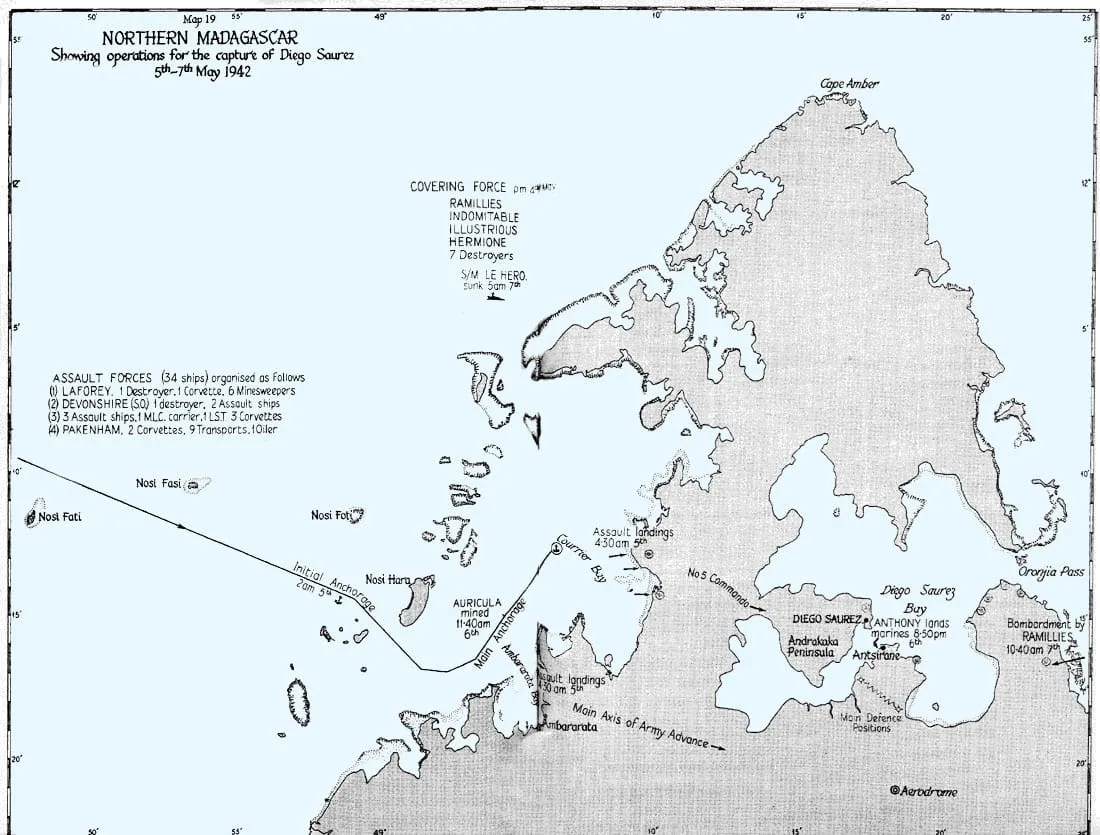
Madagascar, the fourth-largest island in the world, had been a French colony since the 1890s. Its greatest military asset was Diego Suarez Bay at the northern tip of the island: a vast, sheltered anchorage with a narrow entrance on the east, the Oronjia Pass, and a naval base at Antsirane on the peninsula between its inlets. The French had had their eye on it as early as the 1880s as a coaling station on the way to Indochina. In 1942 it was defended by several coastal batteries and a line of land fortifications facing west.
After France’s defeat in June 1940 the administration of Madagascar declared for the government at Vichy, despite the appeals of General Charles de Gaulle. From 1941 the governor-general was Armand Annet, previously governor of French Somaliland and Dahomey. He had about 8,000 troops under his command (other estimates speak of 9,500–11,000), three-quarters of them Malagasy riflemen, together with Senegalese soldiers and Europeans. About 35 aircraft were stationed on the island, mainly Morane-Saulnier MS.406 fighters and Potez 63 bombers, and there were a few warships in its ports: an armed merchant cruiser, sloops (avisos) and five submarines.
The British began to think about the island in the autumn of 1941. On 27 November the Chiefs of Staff considered whether Vichy might hand Madagascar over to Japan or allow it to set up bases there. On 16 December de Gaulle proposed to Winston Churchill a Free French expedition to the island. The Prime Minister refused: troops and ships were lacking, and a joint expedition with the Gaullists reminded him of the failure at Dakar in September 1940. The plan, named Bonus, was shelved.
The Japanese offensive changed the situation. After the fall of Singapore and Java, Japanese submarines operated freely in the Indian Ocean, and the German navy was urging its ally to strike at the shipping routes in its western part. On 27 March 1942 in Berlin the chief of staff of the Seekriegsleitung (Naval War Staff), Vice Admiral Kurt Fricke, named Ceylon, the Seychelles and Madagascar as objectives more important than Australia; the Japanese promised to send several submarines and armed merchant cruisers west, but did not reveal their plans regarding Madagascar. On 12 March Churchill had approved the operation, with the express proviso that the Free French would take no part in it. The Japanese carrier raid into the Indian Ocean in April, which drove Admiral James Somerville’s Eastern Fleet back to Kilindini near Mombasa, dispelled any remaining doubts.
On 14 March Force 121 was formed. The land forces were commanded by Major General Robert Sturges of the Royal Marines, who in May 1940 had led the occupation of Iceland, and the naval forces by Rear Admiral Edward Neville Syfret, commander of Force H from Gibraltar. The core of the assault troops was the 29th Independent Infantry Brigade and No. 5 Commando, followed by the 17th and 13th Brigades of the 5th Infantry Division, which was on its way to India. The ships were drawn from Force H, the Home Fleet and the Eastern Fleet: the battleship Ramillies, the carriers Illustrious and Indomitable, two cruisers, a dozen or more destroyers, corvettes and minesweepers – more than 50 warships and merchant vessels in all, among them the Polish transport Sobieski. The troops sailed from Scotland on 23 March and assembled at Durban. There the Prime Minister of South Africa, Jan Smuts, warned that Diego Suarez alone would not seal off the island, since the ports of Majunga and Tamatave would remain; the Chiefs of Staff agreed with him, but had no troops for anything more. On 25 and 28 April two convoys, a slow one and a fast one, left Durban and joined up at sea on 3 May.
Course of events
Operation Ironclad: the landing (5 May)
On the night of 4/5 May the force approached the west coast of Cape Amber, through minefields and reefs where the French had not expected to see any fleet. About an hour and a half before dawn the first landing craft carrying the 29th Brigade and No. 5 Commando reached the shores of Courrier Bay and Ambararata Bay, west of Diego Suarez – the side from which the defences were weakest. The commandos surprised the sleeping coastal batteries and took them almost without a fight. Subsequent waves landed the 17th Brigade and later the 13th. A feint landing was staged on the east coast to divert attention.
At dawn carrier aircraft appeared over the base. Fairey Swordfish and Albacore torpedo bombers sank the armed merchant cruiser Bougainville and the submarine Bévéziers in the bay, while the sloop D’Entrecasteaux, whose accurate fire was hampering the advance, was attacked and ran aground. Other aircraft bombed Arrachart airfield, destroying or damaging several fighters and bombers on the ground – about a quarter of the Vichy air force on the island. Martlet fighters from Illustrious covered the beaches. One Swordfish that was dropping leaflets calling for surrender was shot down and its crew taken prisoner. The corvette Auricula struck a mine and sank the following day.
The call to surrender, delivered to the French in the morning, was rejected. The defence of Diego Suarez was directed by the base commander, Captain Paul Maerten, and the commander of the land forces on the island, and from Vichy came an order from Admiral François Darlan: defend the honour of the flag and “make the English pay dearly”. The 17th Brigade, pushing through mangroves and dense bush, took the town of Diego Suarez on the western shore of the bay. The 29th Brigade, with a few Valentine and Tetrarch tanks, advanced on Antsirane and, after a march of more than thirty kilometres in which it overcame weak resistance with the bayonet, came up against the main fortifications. These were trenches, two redoubts and bunkers, flanked on both sides by swamps, which the British called the “Joffre Line”. Intelligence had known almost nothing about them.
The assault on Antsirane (6–7 May)
On the morning of 6 May a frontal attack on the French line broke down. The British lost several tanks, and by evening only two of the twelve they had brought to the island were still serviceable. A battalion of the South Lancashire Regiment worked its way round the positions through the swamps and came out in the rear of the defences, taking the radio station and the barracks and capturing about 200 prisoners, but after its own radio set failed it lost contact with the brigade and had to withdraw. French bombers tried to attack the beaches, and carrier fighters shot down two of them, while aircraft from Illustrious attacked the submarine Le Héros, which sank on the morning of 7 May. The French defence was holding out more stubbornly than anyone in London had expected.
A single ship broke the deadlock. On the evening of 6 May the old destroyer Anthony, in a heavy sea, steamed at full speed through the narrow entrance to the bay under fire from the batteries and came alongside the quay at Antsirane. She landed 50 Royal Marines from Ramillies and then put back out to sea. This handful of men, as a British account put it, caused a commotion in the town “out of all proportion to their numbers”: they seized the artillery command post, the barracks and the naval depot. At the same time the 17th Brigade broke through the defensive line in a night attack and entered the town. Antsirane capitulated during the night of 6/7 May, and Captain Maerten surrendered together with most of the garrison.
On 7 May fighting continued for the fortifications on the Oronjia peninsula, which surrendered in the afternoon when threatened by the guns of Ramillies. That day Martlet fighters shot down three French Moranes; in one of them died Jean Assollant, the aviator who in 1929 had been among the first Frenchmen to fly the Atlantic. On 8 May the destroyers Active and Panther sank the submarine Monge, which had tried to torpedo Indomitable. The base was in British hands. Some of the Vichy troops, however, withdrew southwards, and Annet, who was in the capital, Tananarive, had no thought of surrendering.
The Japanese midget submarines (30 May)
The fears that had given rise to the operation were not wholly imaginary. On 29 May the Japanese submarines I-10, I-16 and I-20 appeared off Diego Suarez; a fourth, I-18, damaged by storms, arrived too late. A reconnaissance seaplane from I-10 flew over the bay and spotted Ramillies at anchor. It was itself seen, so the battleship shifted her berth, but did not leave the bay. The following afternoon I-16 and I-20 launched two two-man midget submarines of the Kō-hyōteki type. On the evening of 30 May one of them slipped into the bay and, despite depth charges dropped by the corvettes, fired both its torpedoes. The first hit Ramillies in the forward part of the hull and damaged her seriously; the second sank the tanker British Loyalty (later raised). The battleship was escorted to Durban and then to Plymouth, and was out of the war for almost a year.
The crew of the midget submarine, Lieutenant Saburō Akieda and Petty Officer Masami Takemoto, beached their craft and set off on foot inland across Cape Amber, towards the point where their mother submarine was to pick them up. They gave themselves away by buying food in a village, and on 2 June they were killed in a skirmish with a Royal Marines patrol, in which one Briton also died. The second midget submarine was lost at sea. The Japanese expedition did not end with this attack: in June and July the same submarines and armed merchant cruisers sank, according to various tallies, about twenty merchant ships in the Mozambique Channel and off East Africa. For the British this was proof that holding Diego Suarez alone was not enough.
A four-month stalemate (May – September)
After the capture of the base a strange state of suspension settled over the island. The British held the northern tip with the bay; Annet held the rest of the island with Tananarive, Majunga and Tamatave. There were minor patrol clashes between the lines, and carrier-borne and land-based aircraft struck at Vichy airfields; on 15 May three bombers were destroyed at Majunga airfield. At the same time the two sides were negotiating through envoys, chiefly over whether Annet would agree to some form of arrangement that would leave him the administration of the island in return for a guarantee that its ports would not be used by the Japanese. Annet played for time. From Vichy, where Pierre Laval had been in power since April, he received orders to defend the island for as long as possible by every means, and without the government’s consent he could promise nothing. As historians describe it, the two sides were simply stringing each other along.
Meanwhile the make-up of the British forces was changing. At the end of May responsibility for Madagascar was transferred to East Africa Command under Lieutenant General William Platt, the victor of Keren. The 13th Brigade sailed for India in May and the 17th Brigade in June. In their place came African and South African troops: on 8 June the 22nd East African Brigade with battalions of the King’s African Rifles, on 24 June the 7th South African Motorised Brigade, and in August the 27th Brigade from Northern Rhodesia. On 2 July a small detachment took the island of Mayotte, with its important radio station, without loss, surprising the sleeping defenders.
Smuts pressed for the whole island to be taken, and during the summer he persuaded London. The sinkings in the Mozambique Channel, the suspicion that ports on the west coast might serve the Japanese as supply points, and the fruitless talks with Annet settled the matter. On 11 August Platt received approval to conquer the rest of the island. The operation was to be completed before the rainy season, which from November turned Madagascar’s roads into mud.
Stream-Line-Jane: Majunga, Tamatave and Tananarive (10–25 September)
Platt’s plan had three parts. “Stream” was the landing at Majunga (Mahajanga) on the west coast, “Line” the advance from Majunga to the capital, and “Jane” the landing at Tamatave (Toamasina) on the east coast. The ships were once again provided by Syfret, by now a vice admiral.
Before dawn on 10 September the 29th Brigade landed at Majunga, led by the men of No. 5 Commando. Under machine-gun fire they forced their way on to the quay, seized the post office, cutting communications with the capital, and took the residence of the provincial governor, over which the British flag was raised. On the same day smaller detachments occupied the island of Nosy Be and put a force ashore near Morondava. The 22nd East African Brigade passed through the port of Majunga and, with South African armoured cars in the lead, set off along the road to Tananarive.
The advance turned out to be more of an obstacle race than a battle. The French seldom resisted for more than a few hours, but they blocked the road with hundreds of barricades of trees and stones and blew up bridges. At the second bridge on the road to the capital the charges failed: the central span dropped by less than a metre and vehicles could still cross. When the French realised their mistake, they sent a Potez bomber, which missed the bridge. On 17 September Annet opened talks on a ceasefire, but they quickly broke down. On 23 September British and African troops entered Tananarive almost without a fight. Annet had already withdrawn south to Fianarantsoa.
On 18 September “Jane” began. In a heavy swell the landing craft of the first wave were approaching Tamatave when the coastal batteries opened fire on them. The cruiser Birmingham replied with salvoes, and within a few minutes a white flag was flying on shore. Battalions of the South Lancashire Regiment and the Royal Welch Fusiliers advanced inland from Tamatave and on 25 September, near Moramanga, linked up with the King’s African Rifles coming from the capital. On the same day the British landed in the Comoros. On 29 September two companies of the Pretoria Highlanders, supported by Birmingham and Royal Marines, took the port of Tuléar (Toliara) in the south-west, at the other end of the island, without a fight. It was the only amphibious landing by South African troops in the war. The British also took the port of Fort Dauphin (Tôlanaro) on the south-eastern tip.
The pursuit of Annet and the armistice (October – November)
Although at the end of September the Allied command considered the campaign as good as won, Annet, with a few thousand troops, continued to withdraw southwards along the only road across the highlands. He had a few aircraft left; on 8 October a British raid on the airfield at Ihosy destroyed four of them, and the last serviceable Morane fighter went on strafing South African troops until 21 October. He was pursued by two African brigades with South African armoured cars and artillery.
The last serious engagement was fought on 18 October in the Andramanalina valley, in a bend of the Mangarahara river, where the Vichy forces had prepared an ambush. The King’s African Rifles battalions split into two columns, worked round the bend and came out in the French rear. The ambush turned into an encirclement, and about 800 Vichy soldiers laid down their arms. At the end of October African and South African troops entered Fianarantsoa, the last large town in Vichy hands, but Annet once again managed to withdraw, this time to the area of Ihosy, about 160 kilometres further south.
He could flee no further. On 5 November his envoys approached the British to ask for terms. The next day, 6 November 1942, an armistice was signed at Ambalavao and the fighting ceased. According to some sources Annet himself came over to the British two days later, on 8 November, when the Allies were already landing in Morocco and Algeria. The campaign, planned to last a few weeks, had lasted exactly six months. De Gaulle’s biographer Julian Jackson observed that in 1942 the French held out longer in Madagascar than they had against the Germans in France in 1940.
Losses
Casualty figures vary according to the source and to whether they cover only the fighting or disease as well. According to figures given in British literature, 109 British soldiers and sailors were killed and 283 wounded in the three days of Operation Ironclad; the September–October campaign added about 30 killed and 90 wounded. French tallies give for the whole campaign on the British side about 107 killed and 280 wounded, and about 620 men in total if the sick and those who died of disease are included. Malaria and other tropical diseases put many times more soldiers out of action than bullets did, especially in the African units marching across the highlands. The Royal Navy lost the corvette Auricula and, for almost a year, the battleship Ramillies; the tanker British Loyalty was also sunk.
Vichy losses are estimated at about 150 killed and 500 wounded, and for May alone, according to some sources, at about 700 killed and wounded. The Vichy air force on the island was almost entirely destroyed, and the navy lost the armed merchant cruiser Bougainville, the submarines Bévéziers, Le Héros and Monge, and the sloop D’Entrecasteaux. French sources state that of about 1,200 Frenchmen taken prisoner, some 900 later joined the Free French forces. The Japanese lost two midget submarines and their crews.
Significance
The campaign settled a question that in the spring of 1942 had been giving British staff officers sleepless nights. Post-war research does not suggest that the Japanese navy planned to seize Madagascar, but after May 1942 it could not have done so even had it wished to. Diego Suarez became a base for escort vessels and patrol aircraft, and the island’s ports secured the route round Africa, along which throughout 1942 reinforcements travelled to the Eighth Army in Egypt, to India and to the Persian Corridor, through which aid flowed to the USSR. German and Japanese submarines continued to appear in the Mozambique Channel for a long time, but no longer with any support on land.
For the British it was also a school of amphibious warfare. Ironclad was the first large landing on a defended coast since Gallipoli and the first operation of this war in which the navy, the army and carrier aviation worked to a common plan. The lessons of Courrier Bay – with landing craft, communications and cooperation with aircraft – were applied in November 1942 to the much larger landing in North Africa, Operation Torch. The historian Robert Paxton saw Madagascar as a trial run in which the Allies tested how Vichy would react to an invasion of its empire.
Politically, the campaign left its mark on both sides of the French quarrel. The Vichy government used it in its propaganda as further proof of British rapacity, after Mers-el-Kébir, Dakar and Syria. De Gaulle, who had deliberately not been forewarned, learned of the landing on 5 May from a journalist and regarded it as an assault on French sovereignty. He ostentatiously sought Moscow’s support, and his relations with London deteriorated badly for several months. The British, who after taking the island governed it through their own military administration, eventually gave way. In December 1942 agreement was reached on handing over the island, and de Gaulle appointed General Paul Legentilhomme as high commissioner; he took over the government at the beginning of 1943. At the same time Réunion (at the end of November 1942) and French Somaliland (in December 1942) went over to Free France, so that the whole French empire on the Indian Ocean was now on the Allied side.
Annet was taken prisoner and after the war, in 1947, was sentenced in France to national degradation (indignité nationale). For the Malagasy themselves the war was above all a display of the weakness of colonial France, defeated before their eyes by a foreign army made up largely of Africans. Some historians believe this contributed to the outbreak of the great Malagasy uprising of 1947, bloodily suppressed by the French, and to the path that led the island to independence in 1960. In the history of the war itself, the Battle of Madagascar closed the period of armed clashes between the British and Vichy: two days after the armistice at Ambalavao Operation Torch began, after which the Germans occupied southern France and Marshal Pétain’s state lost the last vestiges of its independence.