United Kingdom
James Somerville
Commander of Force H (1940–1942), Commander-in-Chief, Eastern Fleet (1942–1944), head of the British Admiralty Delegation in Washington (1944–1945), admiral of the fleet
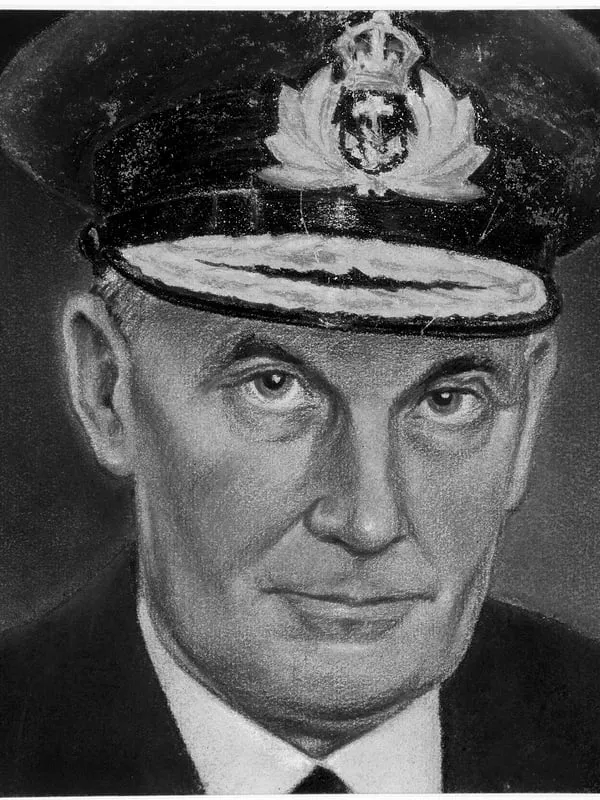
- Born:
- 17 July 1882, Weybridge (England)
- Died:
- 19 March 1949, Dinder (England)
- Author:
- Natalia
- Photo:
- William Timym, domena publiczna, Wikimedia Commons

Sir James Fownes Somerville was one of the most experienced British admirals of the Second World War and also the man who was handed its most thankless task. A wireless communications specialist who had been retired before the war on account of supposed tuberculosis, he returned to service in 1939 and in the summer of 1940 took command of the new Force H at Gibraltar. On 3 July 1940, on Winston Churchill’s orders, his ships opened fire on the French fleet at Mers-el-Kébir, killing nearly 1,300 sailors of a recent ally. He went on to command in the western Mediterranean, covered the convoys to Malta, took part in the hunt for the Bismarck and in 1942–1944 led the Eastern Fleet in the Indian Ocean. He ended the war as head of the British naval mission in Washington and an admiral of the fleet.
Early life and the First World War
He was born on 17 July 1882 at Weybridge in Surrey, the second son of Arthur Fownes Somerville, a lawyer and later a judge at Wells, and Ellen, née Sharland, who came from Tasmania. The family seat was Dinder House in Somerset. Through his paternal grandmother Somerville was descended from the Hood family, which had given the Royal Navy several admirals and whose name was later borne by the battlecruiser in which he hoisted his flag in 1940.
In January 1897 he joined the training ship Britannia at Dartmouth as a cadet. He served as a midshipman in cruisers in the Channel and the Pacific, was promoted lieutenant in 1904 and in 1907 went to the torpedo school HMS Vernon at Portsmouth. There he took up the new technology that was to shape his career: wireless telegraphy. He was among the first officers in the Royal Navy to grasp the possibilities of radio, and in the following years he became one of the navy’s leading communications specialists.
In the First World War he served as a wireless officer, first in the Grand Fleet and then as fleet wireless officer of the Mediterranean Fleet. In the battleship Queen Elizabeth, the battlecruiser Inflexible and the cruiser Chatham he took part in the naval support of the Gallipoli campaign. At the end of 1915 he was promoted to commander, and in 1916 he was awarded the Distinguished Service Order (DSO). In 1913 he had married Mary Main; they had a daughter and a son.
Between the wars
After the war Somerville served on the staff of the battleships of the Mediterranean Fleet, and on 31 December 1921 he was promoted to captain. At the Admiralty he was assistant director and, from 1925, director of the signals division; he was flag captain to Admiral John Kelly in the battleships Warspite and Barham, lectured at the Imperial Defence College and commanded the heavy cruiser Norfolk. In 1932 he took over the naval barracks at Portsmouth as a commodore, in 1933 he became a rear admiral and in 1934 Director of Personal Services at the Admiralty. He was then concerned with the sailors’ living conditions, which after the mutiny of Home Fleet crews at Invergordon in 1931 had become a matter of the first importance for the Admiralty.
In 1936 he took command of the destroyer flotillas of the Mediterranean Fleet. During the Spanish Civil War his ships evacuated refugees and British subjects, and he himself commanded an international squadron off Majorca when the Republicans were threatening to bombard Palma. In September 1937 he became a vice admiral, and in 1938 Commander-in-Chief of the East Indies Station, flying his flag in the Norfolk. Early in 1939 doctors diagnosed him with tuberculosis. The diagnosis proved mistaken, but Somerville had to go ashore and was placed on the retired list. In June 1939 he was knighted as a Knight Commander of the Order of the Bath.
Return to service and Dunkirk
On the outbreak of war the Admiralty recalled him to service by special arrangement. He worked on the development of shipborne radar, where his knowledge of communications was invaluable. In May 1940, when German forces had cut off the British Expeditionary Force at Dunkirk, he went to Dover to assist Admiral Bertram Ramsay. According to his biographers, during Operation Dynamo he stood in for Ramsay in directing the evacuation while the latter rested, and crossed to the French coast himself to assess the situation. The competence he showed settled his return to full service.
Mers-el-Kébir
After the Franco-German armistice the Admiralty formed a new squadron at Gibraltar, Force H, which was to take the place of the French fleet in the western Mediterranean. At the end of June 1940 Somerville was given command of it, and on 30 June he hoisted his flag in the battlecruiser Hood. His first task, however, was not to strike at the Italians but Operation Catapult: to compel Admiral Marcel Gensoul’s French squadron at Mers-el-Kébir, near Oran, to join the British, to sail out of the Germans’ reach or to scuttle itself – and, if it refused, to destroy it.
Somerville, like most of his officers and like Admiral Andrew Cunningham at Alexandria, considered the use of force against recent allies a mistake and proposed further negotiation. Churchill wrote to him that he had been charged with “one of the most disagreeable and difficult tasks that a British admiral has ever been faced with”. On 3 July his envoy, Captain Cedric Holland, negotiated with the French all day, and Somerville extended the ultimatum several times. When London, alarmed by an intercepted signal about French reinforcements, ordered him to settle the matter, Force H opened fire. The battleship Bretagne blew up and the Dunkerque and Provence were run aground, but the Strasbourg managed to slip away, and Somerville broke off the pursuit in the evening. On 6 July aircraft from the Ark Royal attacked the Dunkerque once more.
The admiral carried out the order but did not approve of it. In letters to his wife he called the operation “the biggest political blunder of modern times” and wrote that everyone felt “deeply ashamed”. He also admitted that he had not been as ruthless as he might have been. Some politicians in London held it against him that he had let the Strasbourg escape.
Force H
A few days later Force H put to sea to divert the Italians’ attention during the Battle of Calabria with an air raid on Sardinia. From August 1940 Somerville’s flagship was the battlecruiser Renown, and his squadron, with the aircraft carrier Ark Royal, became one of the hardest-worked in the Royal Navy. It escorted convoys and ferried aircraft to besieged Malta, attacked Italian airfields and ports, and in September 1940 some of its ships took part in the failed British–Gaullist expedition to Dakar.
On 27 November 1940, while covering a convoy, Somerville clashed with the Italian fleet in the Battle of Cape Spartivento. The Italians withdrew, and the admiral, unwilling to leave the convoy unprotected, did not pursue them far. Churchill was furious and, before the ships had even returned to harbour, sent Admiral of the Fleet Lord Cork to Gibraltar to investigate. The board of inquiry found that Somerville had acted correctly. On 9 February 1941 his ships bombarded Genoa, one of the boldest undertakings of Force H.
In May 1941 Force H was summoned into the Atlantic to join the hunt for the German battleship Bismarck, which had sunk the Hood. On the evening of 26 May Swordfish torpedo bombers from the Ark Royal hit the Bismarck in the stern and jammed her rudders, allowing the battleships of the Home Fleet to catch her and sink her the next day. In the summer and autumn of 1941 Somerville took further large convoys through to Malta. In November 1941 the German submarine U-81 sank the Ark Royal, with the loss of only one sailor. For his service with Force H Somerville was appointed a Knight Commander of the Order of the British Empire in October 1941.
The Eastern Fleet
After the Japanese sank the battleships Prince of Wales and Repulse in December 1941 and after the fall of Singapore, Somerville became commander of the reconstituted Eastern Fleet in the Indian Ocean in March 1942, and on 6 April he was promoted to admiral. His fleet was numerous but consisted largely of old, slow battleships. At the beginning of April 1942 Vice Admiral Chūichi Nagumo’s Japanese carrier force burst into the Indian Ocean (the Indian Ocean raid). Japanese aircraft bombed Colombo and Trincomalee and sank the cruisers Dorsetshire and Cornwall, the aircraft carrier Hermes and many merchant ships. Somerville, forewarned by intelligence, sought a night engagement, but in the end withdrew his main force and moved the fleet’s base to Kilindini near Mombasa in Kenya. In this way he preserved his carriers and battleships, although his caution was criticised by the American admiral Ernest King.
For most of 1942–1943 the Eastern Fleet, weakened by the departure of ships for the Mediterranean, covered the convoys and sea routes to India and the Middle East. Only in 1944, with reinforcements and the American aircraft carrier Saratoga, did it go over to the offensive. Somerville’s aircraft attacked Sabang in Sumatra in April 1944 and Surabaya in Java in May, in the Dutch East Indies. Serving in his fleet at the time was the French battleship Richelieu, the same ship the British had torpedoed at Dakar in July 1940. In August 1944 Somerville handed over command to Admiral Bruce Fraser.
Washington and the last years
From October 1944 he headed the British naval mission in Washington. He proved a skilful diplomat and managed to win over even King, known for his distrust of the British, which eased co-operation between the two navies in the last year of the war against Japan. On 8 May 1945, VE Day, he was promoted to admiral of the fleet. He was also awarded the Grand Cross of the Order of the Bath and of the Order of the British Empire, the Dutch Order of Orange-Nassau and the American Legion of Merit.
After the war he returned to his native Somerset, where in 1946 he became Lord Lieutenant of the county. He died of a heart attack on 19 March 1949 at Dinder House in Dinder and was buried in the village churchyard.
Significance
Somerville belonged to the generation of officers who brought the Royal Navy into the age of radio and radar, and in the war he commanded on three oceans. Yet his memory has been dominated by a single afternoon hour off Oran. For the French his name long remained a byword for British ruthlessness, although the admiral himself had opposed the operation and carried it out without the zeal Churchill expected of him. Mers-el-Kébir showed that in July 1940 an isolated Britain was ready to strike even at a former ally to prevent the balance of power at sea from shifting. Somerville’s later service, from the Malta convoys and the hunt for the Bismarck to keeping the Eastern Fleet in being during the worst period of the war against Japan, has led British historians to rank him among the ablest naval commanders of the war.
Sources
Commanded in battles
(02)Mentioned in battles
(02)Often appears with
People who appear in the same events.