France
François Darlan
Chief of the Naval Staff (1937–1939), Commander-in-Chief of the Marine nationale (1939–1940), Minister of Marine (1940–1942), Vichy Deputy Prime Minister (1941–1942), High Commissioner in North Africa (1942)
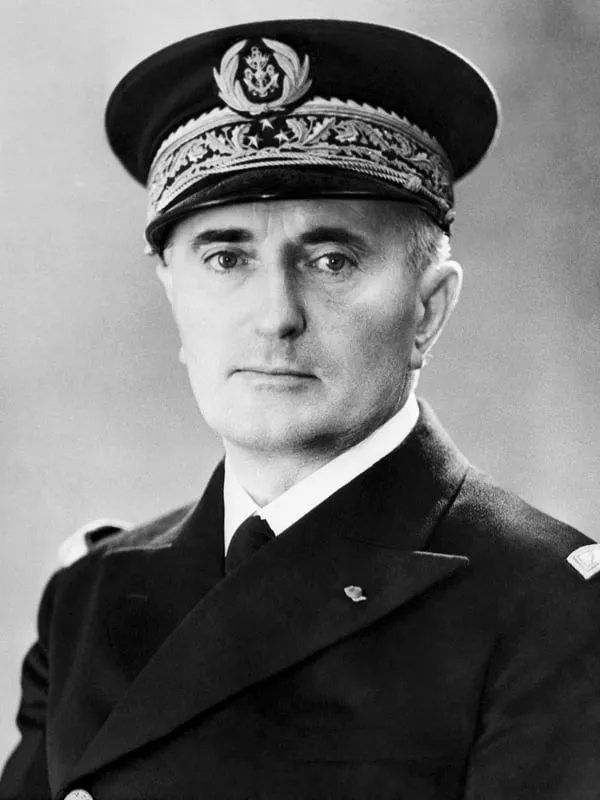
- Born:
- 7 August 1881, Nérac (France)
- Died:
- 24 December 1942, Algiers (French Algeria)
- Author:
- Natalia
- Photo:
- autor nieznany, domena publiczna, Wikimedia Commons

François Darlan was the most important French naval officer of his generation and one of the most ambiguous figures of the Second World War. In the 1930s he built the fleet with which France entered the war as Europe’s second naval power, and he prepared it above all for a war against Italy. After the defeat of 1940 he did not take it to England, although he had earlier threatened to do so. He joined Marshal Pétain’s government, supported the armistice and, after the British attack on Mers-el-Kébir, became an enemy of his former allies. In 1941–1942 he led the Vichy government and pursued a policy of collaboration with the Third Reich, including military concessions that the Germans accepted with suspicion. In November 1942, finding himself by chance in Algiers when the Allies landed, he concluded an agreement with the Americans that brought French North Africa over to the Allied side. A few weeks later he was shot dead by a young assassin.
A family of sailors and politicians
Jean Louis Xavier François Darlan was born on 7 August 1881 in Nérac in the Lot-et-Garonne department. His father, Jean-Baptiste Darlan, a lawyer and mayor of the town, was a republican deputy and in the 1890s minister of justice. François lost his mother in early childhood. His father’s family had a seafaring tradition: his great-grandfather had served as a gunner aboard the Redoutable at the Battle of Trafalgar, something Darlan himself liked to recall and which Churchill years later pointed to as the source of his dislike of the English. He grew up in a republican, secular and Freemasonic milieu, and his career found a patron in his father’s friend, the long-serving minister of marine Georges Leygues.
In 1899 he entered the naval officers’ school, the École navale, and in 1902–1904, and again after a gunnery course at Toulon, he served on cruisers in the Far East. Before 1914 he was an instructor aboard the training cruiser Jeanne d’Arc.
The First World War and a career in ministerial offices
Paradoxically, Darlan spent the war of 1914–1918 on land. As a naval gunner he commanded batteries of long-range guns manned by sailors, fighting on the Meuse, in Alsace, at Verdun, in Champagne and in Flanders, and in 1916 he set up naval batteries at Salonika. He was twice mentioned in army dispatches, and towards the end of the war he was promoted to commander. After the war he commanded the French flotilla on the Rhine, then served again in the Far East and directed the school for naval pilots.
The turning point came in 1926, when Leygues, back at the Ministry of Marine, took him onto his staff. Darlan was deputy head and then head of the military staff of successive ministers almost without a break until 1934, and he rose quickly: to rear admiral in 1929 and to vice admiral in 1932. In 1930 he represented the navy at the London Naval Conference, where, together with the French delegation, he rejected the Italian demand for naval parity and defended France’s right to a navy stronger than Italy’s. His opponents mocked a career made in ministerial corridors, repeating that Darlan had “never known the sea”. From 1934 to 1936, however, he commanded the Atlantic Squadron at Brest.
Builder of the fleet
In October 1936 the Popular Front government of Léon Blum chose him, over the heads of more senior admirals, as Chief of the Naval Staff. He took up the post on 1 January 1937 together with the rank of admiral. Blum valued his republican convictions and the fact that, unlike his predecessor, who favoured rapprochement with Italy, he regarded Fascist Italy as France’s principal enemy at sea. Darlan worked well with both Blum and Édouard Daladier and knew how to make use of his political connections. He pushed through successive shipbuilding programmes, which added further battleships, cruisers, large destroyers and submarines to the series of modern Dunkerque- and Richelieu-class battleships already begun. He built around himself a network of devoted officers, known in the navy as “Darlan’s friends”.
His strategy was Mediterranean. France, with a smaller population than Germany, needed soldiers from North Africa and therefore safe routes across the western Mediterranean. Darlan assumed that in a new war Italy would side with Germany, and after the conclusion of the Pact of Steel in May 1939 this was taken for granted in Paris and London. In the winter of 1938–1939, when the Fascists were demanding Corsica, Nice and Tunisia, he proposed that in the event of war Italy’s communications with Libya be cut and its ports bombarded. On 6 June 1939 he was given the rank of Admiral of the Fleet, created especially for him so that he could deal on equal terms with the British First Sea Lord. In August 1939 he agreed a division of tasks with Admiral Dudley Pound: the French fleet was to concentrate on the Mediterranean, while the British took on the North Sea and most of the Atlantic. In 1939 the Marine nationale was the fourth-largest navy in the world, although it lacked aircraft carriers and naval aviation.
The Phoney War
When war broke out Darlan became Commander-in-Chief of the French naval forces. His ships escorted convoys, provided three of the eight hunting groups formed against German raiders and carried the Bank of France’s gold overseas. The admiral believed that the blockade of Germany had become full of holes since the Molotov–Ribbentrop Pact had given the Reich access to Soviet raw materials. He was one of the chief advocates of an expedition to Scandinavia to cut Germany off from Swedish iron ore, and he won Daladier over to it. He also supported the plans for an attack on the Soviet oilfields of the Caucasus, considered after the Soviet attack on Finland, and in January 1940 he and Gamelin were instructed by the prime minister to study the possibility of striking at Baku and intercepting Soviet tankers in the Black Sea. He attended meetings of the Supreme War Council, including that of 28 March 1940, at which France and Britain pledged not to conclude a separate peace.
June 1940
The German offensive of May 1940 shattered the French army, but the fleet remained intact. As late as 3 June Darlan was declaring that in the event of capitulation he would take the ships out and fight under the British flag. When Italy entered the war on 10 June, his squadron from Toulon bombarded the Ligurian coast on 14 June. At Briare, at the conference with Winston Churchill held after the government had left Paris, he gave his word on 12 June that no French warship would fall into German hands.
At Bordeaux his position quickly changed. On 15 June the cabinet voted for Camille Chautemps’s proposal to ask the Germans for their armistice terms. Darlan concluded that Britain would lose anyway and feared that without an armistice Hitler would march through Franco’s Spain into North Africa. He did not accept British consent to an armistice on condition that the fleet be sent to British ports, because, as he put it, that would leave France defenceless. On the evening of 16 June Paul Reynaud resigned, and President Albert Lebrun entrusted the government to Marshal Philippe Pétain, who asked the Germans for an armistice. Darlan took the post of minister of marine in the new government. His attitude weighed heavily on the country’s fate: without the fleet there could be no question of carrying the fight on from Africa, and according to French historians, as early as 14 June he had refused to send ships from Toulon to Bordeaux to collect the troops Reynaud wanted to evacuate to North Africa. Churchill later wrote that had Darlan gone over to England at that moment, he would have become the leader of the Free French, “a de Gaulle raised to the tenth power”.
On 18 June at Bordeaux Darlan gave his word of honour to Pound and to the British First Lord of the Admiralty that the fleet would not be handed over to the Germans. He ordered the ships in the Atlantic ports to sail for Africa and, in secret instructions, directed that they be scuttled if anyone tried to seize them. The armistice of 22 June provided for the disarmament of the fleet under German and Italian supervision. The British did not believe that Darlan, even if sincere, would be able to keep his word, and they regarded his explanations of the armistice terms as evasive. On 3 July 1940 the Royal Navy attacked the French squadron at Mers-el-Kébir (Operation Catapult); nearly 1,300 French sailors were killed. Darlan, who was in his native Nérac that day, regarded it as betrayal. He demanded retaliation, even a naval war with Britain; Pétain is said to have restrained him with the words “one defeat is enough”. The government confined itself to breaking off diplomatic relations and a token air raid on Gibraltar.
Head of the Vichy government
After the fall of Pierre Laval on 13 December 1940, Darlan became Pétain’s closest collaborator. On 25 December he met Adolf Hitler, and in February 1941 he replaced Pierre-Étienne Flandin as deputy prime minister, in effect head of the government of Vichy France. He concentrated in his hands the navy, foreign affairs, the interior and information, later also national defence, and was designated as the Marshal’s successor. He did not believe in Pétain’s “National Revolution”, but he did believe in a German victory. He held that France had to secure the best possible place in a Reich-dominated Europe by offering Germany cooperation in exchange for an easing of the armistice terms, the return of prisoners of war and the preservation of the colonial empire.
His government intensified the persecution of the Jews. In March 1941 the General Commissariat for Jewish Affairs was created under Xavier Vallat, and on 2 June 1941 a second, harsher Statute on Jews was issued and a census of Jews ordered; in the summer the “Aryanisation” of Jewish businesses began. Darlan himself distinguished between “old French Israelites”, whom he wished to spare, and foreign Jews, whose fate did not trouble him, and he treated the Jewish question as a bargaining chip in negotiations with the Germans.
He went furthest in the spring of 1941. When the anti-British Rashid Ali al-Gaylani seized power in Iraq, Darlan allowed Luftwaffe aircraft to land in Syria and handed over weapons from French depots to the Iraqis. On 11 May he met Hitler at Berchtesgaden, and at the end of May he agreed in Paris with Ambassador Otto Abetz the so-called Paris Protocols, which gave Germany bases at Aleppo, Bizerte and Dakar in return for minor concessions. Opposition from General Maxime Weygand prevented their ratification, but the concessions in Syria had already provoked the British and Free French Syrian campaign of June and July 1941, in which Frenchmen fired on Frenchmen. On 29 July 1941 Darlan’s government agreed to a joint defence of French Indochina with Japan, which opened southern Indochina to the Japanese. Under German pressure Weygand was recalled from Africa in November 1941. On 1 December Darlan and Pétain met Hermann Göring, and on 10 December the admiral held talks in Turin with Galeazzo Ciano, who noted his hatred of England in his diary.
Hitler, however, did not trust France and did not want it as an ally. Darlan set more and more conditions, refused to send French workers to the Reich and, after the German setbacks before Moscow, began cautiously to seek contact with the Americans. The Germans demanded Laval’s return, and on 18 April 1942 Laval once again became head of the government. Darlan remained Commander-in-Chief of the Vichy armed forces and Pétain’s designated successor.
Algiers, 1942
On 5 November 1942 Darlan flew to Algiers, where his son Alain lay in hospital with polio. On the night of 7–8 November the Allies began landing in French North Africa (Operation Torch). Members of the Algiers resistance, working with the Americans, held the city for a few hours and detained Darlan and General Alphonse Juin. Freed by the gendarmerie, the admiral at first ordered resistance and asked Vichy for Luftwaffe support, but on the evening of 8 November he agreed to a ceasefire in Algiers and, on 10 November, under pressure from General Mark Clark, to a ceasefire throughout North Africa. Vichy disowned him, but on 11 November the Germans occupied the hitherto unoccupied part of France, which released many officers from their dilemma of loyalty.
The Allied commander-in-chief, General Dwight Eisenhower, recognised Darlan as head of the French administration in Africa. On 14 November the admiral proclaimed himself High Commissioner, ostensibly acting in the name of the “captive” Marshal, and General Henri Giraud took command of the troops. French West Africa, with Dakar, also came over to the Allies. Darlan’s calls for the fleet at Toulon to sail for Africa went unheeded by its commander, Admiral Jean de Laborde. When the Germans tried to seize the ships on 27 November, their crews, in accordance with instructions issued by Darlan himself in 1940, scuttled them. The promise of June 1940 was thus kept: no major French warship fell into German hands.
The “Darlan deal” caused a storm. Charles de Gaulle and the Free French were outraged, and the British and American press asked whether the Allies were fighting fascism only to hand power to collaborators. President Franklin Delano Roosevelt called it “a temporary expedient, justified solely by the stress of battle”, and Churchill defended it at a secret session of the House of Commons, arguing that it mattered a great deal to a soldier whether a Frenchman was shooting at him or at the enemy. Darlan governed North Africa by Vichy methods: he kept the anti-Jewish laws in force, did not restore citizenship to the Jews of Algeria and held political prisoners in camps in southern Algeria.
On 24 December 1942 the twenty-year-old Fernand Bonnier de La Chapelle, who belonged to the royalist and Gaullist circle of Algiers conspirators, shot Darlan at the seat of the High Commission. The admiral died the same day in the Maillot military hospital. The assassin was tried summarily and executed by firing squad on 26 December; in 1945 a court in Algiers rehabilitated him. The investigation pointed to a conspiracy by supporters of the pretender to the throne, the Count of Paris. The hypothesis of British inspiration, popular in part of the literature, found no confirmation in the investigation files discovered in 2016. Darlan was succeeded by Giraud. He was buried in Algiers, and in 1964 his remains were moved to the military cemetery at Mers-el-Kébir, beside the sailors killed in July 1940.
Assessment
Darlan left behind a fleet that in 1939 was among the finest in French history, and the memory of a politician who treated that fleet as a bargaining chip. His decisions of June 1940 ensured that France did not continue the war from Africa, and his policy of 1941–1942 made Vichy a partner of Germany, offering it bases, weapons and complicity in the persecution of the Jews. To the British he was a byword for untrustworthiness, to the Gaullists a traitor, and to some naval officers the man who had kept his word over the fleet. The American historian of Vichy, Robert Paxton, rejects the image of Darlan as a hidden ally of the Allies: in November 1942 he changed sides only when Germany’s defeat in Africa had become evident and he himself was in American hands. The British politician Harold Macmillan summed him up in the words: “once bought, he stayed bought”.
Sources
Commanded in battles
(01)Mentioned in battles
(04)Often appears with
People who appear in the same events.
On the timeline
(50)The 40 most important of 50 events. All tagged “François Darlan” (5) →
1939
1940
1941
1942
April
May
August
September
October
November
- 08
- Key eventThe landings in North AfricaOn 8 November 1942 more than 70,000 American and British troops landed in Morocco and Algeria. The Vichy French resisted at Casablanca and Oran.
- The Algiers putschOn the night of 7/8 November 1942 some 400 underground volunteers seized Algiers for several hours and detained General Juin and Admiral Darlan.
- 10
- Operation AntonOn the evening of 10 November 1942 Hitler ordered the occupation of unoccupied France. On 11 November the Germans marched in, and the Italians from the east.
- Darlan and the armistice in North AfricaOn 10 November 1942 Admiral Darlan, under pressure from General Clark, ordered the Vichy forces in North Africa to stop fighting. Oran surrendered the same day.