United States
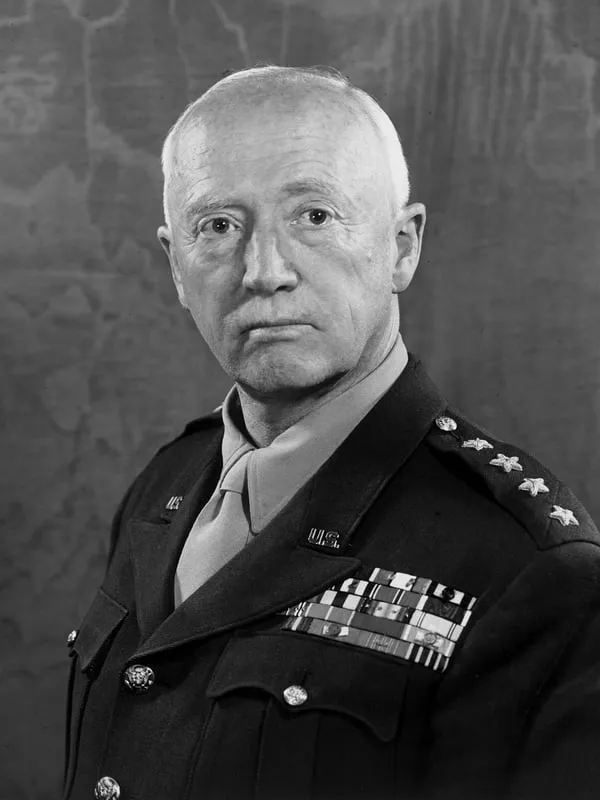
George S. Patton
Commander of the Western Task Force (1942), II Corps (1943), the Seventh Army (1943) and the Third Army (1944–1945), general (1945)
- Born:
- 11 November 1885, San Gabriel (California, United States)
- Died:
- 21 December 1945, Heidelberg (Germany)
- Author:
- Łukasz
- Photo:
- Robert F. Cranston / Harry Warnecke, CC0, Wikimedia Commons

George Smith Patton was the most colourful and most controversial American commander of the Second World War. A cavalryman, fencer and Olympian, in 1918 he was one of the first Americans to lead tanks into battle, and in 1944–1945 his Third Army crossed France and Germany faster than any other Allied army. He believed in reincarnation and that he had been born for war; he swore, delivered theatrical speeches and carried ivory-handled revolvers. His impulsive outbursts cost him his command more than once, and his statements in the last months of his life, antisemitic ones among them, cast a shadow over his memory.
Family and West Point
He was born on 11 November 1885 in San Gabriel, California, into a wealthy family with military traditions. His grandfather, a colonel in the Confederate army, was killed in 1864 at the Third Battle of Winchester, and young George grew up on stories of the Civil War, dreaming of military glory. For a long time he could not read or write; historians suspect that he was dyslexic. After a year at the Virginia Military Institute he moved to West Point. Poor marks in mathematics forced him to repeat his first year, and he did not graduate until 1909, 46th out of 103. He was commissioned into the cavalry.
In 1910 he married Beatrice Ayer, the daughter of a rich Boston industrialist, with whom he had three children. The wealth of both families allowed him to live in style, play polo, keep horses and build up connections in Washington. In 1912 he represented the United States at the Olympic Games in Stockholm in the first-ever Olympic modern pentathlon and finished fifth. His weakest event was the shooting, although it is still argued whether one of his bullets did not simply pass through a hole made by an earlier one. After the Games he studied fencing in France, wrote a new manual of sabre combat and designed the Model 1913 cavalry sabre, known as the “Patton sabre”.
Mexico and the Great War
In 1916 he took part in General John Pershing’s expedition into Mexico, whose aim was to capture Pancho Villa after his raid on the American town of Columbus. On 14 May 1916 he led ten soldiers and two guides in three motor cars to a ranch where Julio Cárdenas, one of Villa’s commanders, was hiding. Cárdenas and two of his men were killed in the shoot-out. It was the first US Army action to use motor vehicles, and the press made a hero of the young lieutenant.
When the United States entered the war in 1917, Patton sailed to France on Pershing’s staff. In the autumn he volunteered for the newly forming tank arm, the first American officer to join it. At Bourg near Langres he organised a tank school, and in March 1918 he personally unloaded the first French Renault FT tanks from the railway wagons. In September 1918 his light tank brigade fought at Saint-Mihiel and then in the Meuse–Argonne offensive. On 26 September near Cheppy, while leading a group of soldiers forward in an attack, he was badly wounded in the thigh. For that day he received the Distinguished Service Cross. He returned to duty at the end of October, by then a colonel, but too late to fight again: the armistice came on 11 November 1918, his 33rd birthday.
Between the wars
After the war Patton for a time commanded a tank brigade at Camp Meade, where he became friends with Dwight Eisenhower, five years his junior. Both men wrote articles on the future of armour. The National Defense Act of 1920, however, abolished the independent Tank Corps and handed the tanks over to the infantry. Patton, who had no wish to become an infantryman, returned to the cavalry and for the next two decades followed the usual path of a staff officer: the Command and General Staff School at Fort Leavenworth, the Army War College, and staff service in Hawaii (where he met Omar Bradley) and in Washington. He reverted in rank to captain and was not promoted to colonel again until 1938.
In July 1932, as a major in the 3rd Cavalry Regiment, he took part in clearing a camp of war veterans in Washington – the so-called Bonus Army, who were demanding early payment of the bonuses they had been promised. The operation was commanded by General Douglas MacArthur. Cavalry and infantry, using tear gas, drove thousands of people out of the city. Among the veterans was Joe Angelo, the soldier who had rescued the wounded Patton at Cheppy in 1918. Patton believed that the order had to be carried out, although according to his biographers he understood the veterans’ grievances.
Only the fall of France in 1940 convinced the US Army that it needed large armoured formations. Patton, then commanding the 3rd Cavalry Regiment at Fort Myer, was given an armoured brigade in the new 2nd Armored Division; in the autumn of 1940 he became a brigadier general, and in April 1941 a major general and commander of the whole division. His tanks distinguished themselves in the great manoeuvres in Tennessee, Louisiana and the Carolinas in 1941. In January 1942 he took over I Armored Corps and set up a desert training centre in the deserts of California and Arizona, where he prepared troops for fighting in Africa.
North Africa
In the summer of 1942 Eisenhower brought him in to plan the invasion of North Africa. Patton commanded the Western Task Force, which sailed from Virginia straight to the coast of Morocco. On 8 November 1942 his troops landed at Fedala, Mehdia and Safi and, after three days of fighting with Vichy forces, surrounded Casablanca, whose French garrison accepted a ceasefire on 11 November. Patton then organised the port of Casablanca and in January 1943 hosted the conference of Roosevelt and Churchill, for whose security his troops were responsible.
After the defeat at the Kasserine Pass Eisenhower removed General Lloyd Fredendall and on 6 March 1943 gave Patton command of the battered II Corps. On 12 March Patton was promoted to lieutenant general. Within ten days he imposed strict discipline on the corps, and on 17 March he went over to the attack: his infantry took Gafsa without a fight, and on 23 March the 1st Infantry Division beat off an attack by the German 10th Panzer Division at El Guettar. It was the Americans’ first clear success against the Wehrmacht, although the corps’ further attacks stalled in the mountains. On 15 April Patton handed over command to Bradley and returned to planning the invasion of Sicily.
Sicily and the slapping incidents
On 10 July 1943 the Seventh Army – as I Armored Corps had been renamed – landed in Sicily around Licata and Gela (Operation Husky). General Bernard Montgomery’s plan gave the main task to the British Eighth Army, with the Americans covering its flank. Patton would not accept this role. When the British were held up before Catania, his troops swept through the western part of the island, took Palermo on 22 July and then advanced along the north coast, entering Messina on 17 August, a few hours ahead of the British. The fighting on the island ended the same day.
The success was overshadowed by two scandals. On 14 July soldiers of the 45th Infantry Division shot several dozen (70–75, according to various findings) Italian and German prisoners near Biscari airfield. The sergeant and the captain tried for this argued in their defence that they had acted in the spirit of a speech in which Patton, before the invasion, had called for ruthlessness towards the enemy; the general himself denied ever having ordered the killing of prisoners. Far more notorious, however, was the slapping incident. On 3 and 10 August, in two field hospitals, Patton struck two soldiers being treated for battle fatigue and abused them as cowards. Eisenhower reprimanded him and ordered him to apologise to the men, to the hospital staff and to the troops. When the story reached the American press in November 1943 it caused an uproar. Patton was left without an assignment for several months, and command of the American ground forces in the invasion of France went to his former subordinate Bradley.
A fictitious army and the Third Army
The Germans rated Patton highly and did not believe that the Allies had sidelined him. Allied command exploited this in Operation Fortitude: in the spring of 1944 Patton was presented as commander of the non-existent First US Army Group, which was supposedly going to land in the Calais area. At the same time, and this time for real, he was training the Third Army in England. He came close to losing his post once more when, in April 1944 at Knutsford, he said that after the war the world would be ruled by the British and the Americans. According to some accounts he left out the Russians; according to others he mentioned them too – even the first press reports differed on this point.
The Third Army went into action in France on 1 August 1944, after the breakthrough of Operation Cobra. Within a few weeks its armoured columns overran most of Brittany, closed the Falaise pocket from the south, crossed the Seine and reached the Meuse, where at the end of August they ran out of fuel, which the high command was directing mainly to the north; they reached the Moselle in September. In the autumn the Third Army bogged down in rain-soaked Lorraine, and the Battle of Metz dragged on until December at heavy cost. Critics accused Patton of needlessly attacking the forts instead of bypassing them.
His greatest success came during the German Ardennes offensive. At the conference at Verdun on 19 December 1944 he announced that within a few days he would turn part of his army from the Saar to the north and strike the flank of the German salient. The plan, prepared in advance by his staff, was carried out: on 26 December the spearhead of the 4th Armored Division reached the encircled town of Bastogne. In 1945 the Third Army fought its way through the Eifel, crossed the Rhine at Oppenheim on the night of 22–23 March, and then advanced through central Germany into Bavaria, Austria and Czechoslovakia. A failure along the way was the raid by Captain Abraham Baum’s task force at the end of March on the Oflag near Hammelburg, where Patton’s son-in-law was held; most of its men were killed or captured. In April Patton, together with Eisenhower and Bradley, visited the liberated camp at Ohrdruf; on 14 April he was promoted to full (four-star) general, and on 6 May his troops took Pilsen. Eisenhower would not let him go on to Prague.
Bavaria and death
After Germany’s surrender Patton became military governor of Bavaria. He soon came into conflict with his superiors. He considered denazification too rigorous and kept former members of the Nazi Party in administrative posts, and in September 1945, at a press conference, he compared Nazis to members of American political parties. He said openly that sooner or later it would be necessary to fight the Soviet Union. At the same time he was in charge of camps for displaced persons, which also held Holocaust survivors. Earl Harrison’s report to President Truman sharply criticised conditions in these camps, and in his diary Patton wrote about the Jewish survivors of the camps in openly antisemitic terms, denying them their humanity. His biographers agree that these entries are the darkest page of his life. At the end of September Eisenhower took Bavaria away from him, and on 7 October the Third Army. Patton took over the Fifteenth Army, a headquarters engaged mainly in writing the history of the war.
On 9 December 1945, the day before he was due to go home on leave, the car in which he was travelling to a hunt collided with a military lorry near Mannheim. Patton suffered a broken neck and was paralysed. He died in hospital in Heidelberg on 21 December 1945. In accordance with his wishes he was buried among soldiers of the Third Army at the American military cemetery at Hamm in Luxembourg. His memoirs appeared in 1947 under the title War As I Knew It.
Significance
Patton was one of the few Allied commanders whom the Germans regarded as their equal. He understood that armour is most effective in pursuit, before the enemy can dig in on a new line, and he could pass his own energy and self-confidence on to his soldiers. His staff could plan quickly, as the Third Army’s turn towards Bastogne showed. Historians criticise him, however, for being less effective in slow, positional fighting, as at Metz, for treating allies and the air forces with contempt, and for a temperament and tongue that repeatedly harmed the army he served. In Tunisia, in the spring of 1943, he showed for the first time that he could rebuild a beaten force in a short time and lead it to victory. In the United States he became a legend, fixed in the public mind by the 1970 film Patton, with George C. Scott in the title role.
Sources
Commanded in battles
(07)- 8–16 November 1942Operation TorchMediterranean
- 17 November 1942 – 13 May 1943Tunisian campaignMediterranean
- 10 July – 17 August 1943Allied invasion of SicilyMediterranean
- 6 June – 30 August 1944Battle of NormandyWestern Front
- 27 September – 13 December 1944Battle of MetzWestern Front
- 16 December 1944 – 25 January 1945Battle of the BulgeWestern Front
- 7–31 March 1945The Rhine crossingsWestern Front
Mentioned in battles
(06)Often appears with
People who appear in the same events.
On the timeline
(69)The 40 most important of 69 events. All tagged “George S. Patton” (23) →
1932
1942
1943
1944
April
May
July
August
September
- 10
- The liberation of LuxembourgOn 10 September 1944 the US 5th Armored Division entered Luxembourg City. The Germans left without a fight, and Prince Felix returned with the Americans.
- The armies meet near DijonOn 10–12 September 1944 the forces from Provence linked up in Burgundy with Patton's Third Army. The Allied front now ran from the Channel to Switzerland.