1941–1944: The Continuation War
Continuation War
- Dates:
- 25 June 1941 – 19 September 1944
- Front:
- Scandinavia
- Location:
- The Finnish–Soviet borderlands from the Gulf of Finland to the Barents Sea; the main fighting on the Karelian Isthmus, in Ladoga Karelia and in Soviet East Karelia (Petrozavodsk, the Svir river), in Lapland towards Murmansk and Kandalaksha, and around the Hanko baseOn the battle map →
- Sides:
- FinlandCarl Gustaf MannerheimSoviet UnionKirill Meretskov, Leonid Govorov
- Result:
- Soviet victory. The Moscow Armistice restored the 1940 frontier; Finland ceded Petsamo, leased out Porkkala and paid reparations, but kept its independence.
- Author:
- Natalia
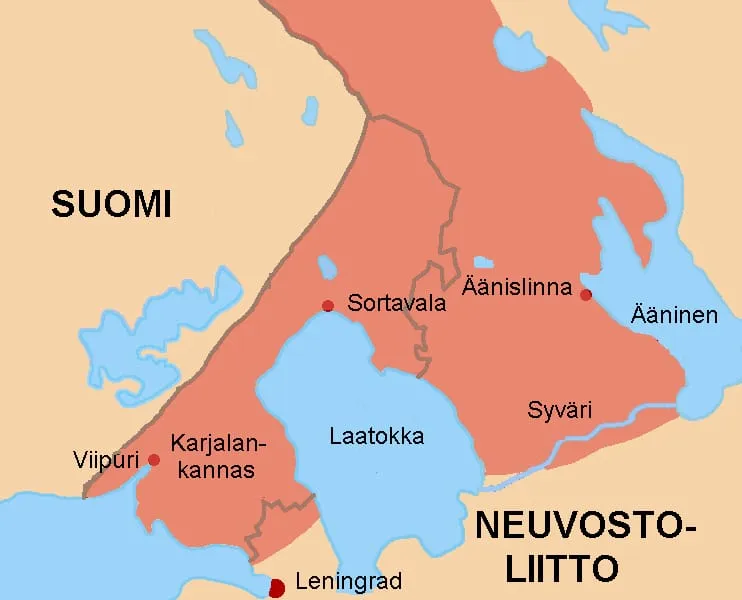
The Continuation War was Finland’s second war with the Soviet Union during the Second World War. It began three days after the German invasion of the USSR: on 25 June 1941, after Soviet air raids on Finnish airfields and towns, the government in Helsinki declared that the country was in a state of war. Finland, which fifteen months earlier under the Moscow Peace Treaty had been forced to give up Karelia with Viipuri (Vyborg), now fought alongside the Third Reich, although it concluded no alliance with it and called itself merely its “brother-in-arms”. In the summer of 1941 the Finnish army under Marshal Carl Gustaf Mannerheim recovered the lost territories, then advanced into Soviet East Karelia, took Petrozavodsk and reached the Svir river. In the north German troops, together with the Finns, tried in vain to reach Murmansk. From December 1941 the front stood still for two and a half years. In the summer of 1944 a great Soviet offensive took Viipuri and Petrozavodsk from the Finns but did not break the Finnish army. On 19 September 1944 Finland signed an armistice in Moscow that cost it territory, reparations and a war with its former German ally, but saved its independence.
Name and dates
The name “Continuation War” (Finnish jatkosota, Swedish fortsättningskriget) was put into circulation by the Finnish government at the very beginning of the fighting. It was meant to persuade the public that the country was waging a continuation of the defensive Winter War, not a new war at Hitler’s side, and that it was fighting solely for its own aims. Soviet and Russian historiography speaks of the “Soviet–Finnish War of 1941–1944” and treats it as part of the Great Patriotic War, that is, the war of the USSR against Germany and its allies.
The war is taken to have begun on 25 June 1941. That morning Soviet aircraft bombed targets throughout southern and central Finland, and the Prime Minister, Jukka Rangell, declared in parliament that Finland was at war with the Soviet Union. The date is, however, to some extent a convention. From 21–22 June German aircraft and warships were already operating against the USSR from Finnish waters and airfields, the Finns had moved troops onto the demilitarised Åland Islands, and Soviet aircraft first attacked targets in Finland as early as 22 June. Russian studies emphasise these earlier events and point to 29 June, when the first land offensive against the USSR was launched from Finnish territory: the German-Finnish attack in Lapland. The great Finnish offensive in Karelia began only on 10 July.
The war is regarded as having ended on 19 September 1944, when the armistice was signed in Moscow. The guns had fallen silent earlier: the Finns ceased fire on 4 September at 8 a.m., the Red Army a day later. The war was formally closed only by the peace treaty signed in Paris on 10 February 1947.
Background
The Moscow Peace Treaty of 12 March 1940 ended the Winter War but did not bring Finland security. The country lost about a tenth of its territory, including the Karelian Isthmus, Viipuri and the shore of Lake Ladoga, and more than 400,000 inhabitants of Karelia had to abandon their homes. The Hanko peninsula at the entrance to the Gulf of Finland became a Soviet naval base with a garrison of about 25,000 men. The Finns called the fifteen months between the wars the “Interim Peace” (välirauha). During this time Moscow made one demand after another: it insisted on the demilitarisation of the Åland Islands, the right to move troops by rail to Hanko and a share in the nickel mines at Petsamo, which the Red Army had occupied during the Winter War and had to return after the peace. It also opposed plans for a Finnish-Swedish defensive alliance and supported the Finnish communists. When the Red Army occupied Estonia, Latvia and Lithuania in June 1940, and the USSR annexed them in August, Helsinki feared that Finland would be next.
The West could no longer help. After the German attack on Norway and the fall of France, Finland was cut off from trade with Britain, and the only great power able to support it was the Reich. From the summer of 1940 Adolf Hitler, who was already preparing for war with the USSR, changed his policy towards the Finns. In August Germany agreed to sell them arms, and on 22 September 1940 the two sides concluded an agreement on the transit of German troops through Finland to northern Norway. In November Vyacheslav Molotov, in Berlin, pressed to know whether the USSR could “settle the Finnish question” as it had the Baltic one, and was told that Germany would not agree to a new war in the north. A month later Directive No. 21 provided for Finland’s participation in Operation Barbarossa: its army was to tie down Soviet forces by attacking on both sides of Lake Ladoga, while German units from Norway struck from Lapland at Murmansk.
The Finnish leaders – President Risto Ryti, Mannerheim and a narrow circle of politicians – conducted their talks with the Germans in secret from most of the government and parliament. In January 1941 the Chief of the Finnish General Staff, Erik Heinrichs, held talks in Berlin with Franz Halder. On 25–28 May in Salzburg and Berlin, and on 3–6 June in Helsinki, officers of the two armies agreed the timing of the Finnish mobilisation and the division of tasks, although the Germans did not reveal the exact date of the attack. The Finns stipulated that they would not open hostilities themselves and would enter the war only if attacked. At the beginning of June German units intended for the offensive in Lapland began to arrive in Finland by sea, and from 9–10 June Finland called up reservists; general mobilisation was proclaimed on 17 June.
Historians have argued for decades over how to judge these decisions. The old Finnish thesis of a country swept along by events like driftwood carried by a river current has given way to the view that the leaders in Helsinki deliberately prepared a joint war with Germany, though according to most scholars they had no real alternative. The main aim was to recover the lands lost in 1940. Part of the elite, however, including Ryti himself, hoped for more: a Greater Finland that would include Soviet East Karelia, inhabited by Karelians related to the Finns, and even the Kola Peninsula.
Forces and plans
In June 1941 Finland mobilised between 475,000 and 500,000 men, about one sixth of the population, in some fifteen divisions and several brigades. Its army was much stronger than in 1939, especially in artillery, but it still had only one armoured battalion and little motor transport. II and IV Corps were deployed on the Karelian Isthmus, the Army of Karelia was formed north of Lake Ladoga under General Heinrichs, and further north there were units subordinated to the Germans. In the far north the German Army of Norway (Armee Norwegen) under General Nikolaus von Falkenhorst, some 67,000 strong, was preparing Operation Silberfuchs (Silver Fox) from Lapland: General Eduard Dietl’s corps was to strike from the Petsamo area at Murmansk, while other groups were to cut the Murmansk railway at Kandalaksha and further south. The Finnish III Corps of General Hjalmar Siilasvuo fought under German command.
On the Soviet side the frontier with Finland was guarded by the Northern Front of General Markian Popov, formed on 24 June from the former Leningrad Military District. The 23rd Army stood on the Isthmus, the 7th Army in Karelia and the 14th Army in Lapland and on the Kola Peninsula; in all, according to various estimates, some 400,000–450,000 men and about 700 aircraft, supported by the Baltic Fleet. During the Interim Peace the Soviet staff had drawn up plans for a new war with Finland, but the German attack forced the Red Army onto the defensive, and the best units and new equipment were sent to the German front.
Entry into the war
On 22 June 1941, when Germany attacked the USSR, Finland was officially neutral, but its territory had already been drawn into the war. On the night of 21–22 June German minelayers hidden among the Finnish skerries mined the Gulf of Finland, and German bombers that had laid mines in the waters off Leningrad refuelled on the way back at the Finnish airfield at Utti. That same morning Finnish troops occupied the demilitarised Åland Islands, and Soviet aircraft for the first time attacked targets on Åland and Finnish coastal defence ships. In his proclamation of 22 June Hitler announced that German soldiers stood on the Arctic Ocean “together with their Finnish comrades-in-arms”.
On the morning of 25 June Soviet aircraft made a massive raid on airfields in southern and central Finland which, according to Moscow, were being used by the Luftwaffe. According to various sources, anything from about 260 bombers to more than 450 aircraft took part. Inaccurate reconnaissance and poor aim meant that bombs also fell on Helsinki, Turku and other towns. The Finnish government used the raid to present its entry into the war as a defensive necessity. That same day Prime Minister Rangell declared in parliament that Finland was at war, and on 26 June President Ryti, in a radio address, spoke of a “second war of defence” and of fighting alongside mighty Germany. The country did not, however, sign any treaty of alliance with the Reich and, unlike Hungary and Romania, did not join the Tripartite Pact.
The Finnish offensive of 1941
The Finns did not move at once. The plan of attack in Ladoga Karelia was approved on 28 June, and the offensive of the Army of Karelia began on 10 July. That day Mannerheim issued an order of the day in which he recalled his oath of 1918 that he would not sheathe his sword until East Karelia was free. These words, heralding a march beyond the old frontier, alarmed some politicians, especially the Social Democrats, and the government later assured the Americans that it had not known the content of the order. As early as 16 July the Finnish VI Corps reached the northern shore of Lake Ladoga and cut the Soviet 7th Army in two. In August the Finns encircled three Soviet divisions on the north-western shore of the lake and in the middle of the month took Sortavala, while the encircled Red Army units were evacuated across Lake Ladoga.
On the Karelian Isthmus II Corps attacked on 31 July and IV Corps moved on Viipuri on 22 August. The Soviet 23rd Army, weakened by giving up part of its forces to the German front, could not hold the line. The order to withdraw from Viipuri came too late and the defenders abandoned much of their equipment, although most of the men were evacuated through the islands around Koivisto. On 23 August, in view of the Finnish and German advances, the Soviet Northern Front was split into the Leningrad and Karelian Fronts. On 29 August 1941 the Finns entered Viipuri, which they had left a year and a half earlier after heavy fighting. By 2 September the Finnish army had reached the old frontier of 1939 at most points.
On the Isthmus Mannerheim halted his troops on 31 August on a line that only here and there went beyond the 1939 frontier, some 30–32 kilometres from the centre of Leningrad. The Germans pressed the Finns to attack the city from the north or to push forward to meet Army Group North east of Lake Ladoga. Mannerheim, with Ryti’s backing, refused to storm Leningrad, believing that taking the city would bind Finland to Germany for good. On 8 September, after the Germans took Shlisselburg, the siege of Leningrad began. The Finnish front closed it from the north, and the only supply route left was across Lake Ladoga. Finland’s part in the siege is disputed to this day. Some historians, such as the American David Glantz, stress that apart from holding their line the Finns contributed little to it, while others, such as the Russian historian Nikolai Baryshnikov, argue that Helsinki tacitly supported the German policy of starving the city.
East Karelia, Hanko and Lapland
Beyond the old frontier the Finns pressed on. At the beginning of September the Army of Karelia struck in Soviet East Karelia towards Lake Onega and the Svir river. On 7 September Finnish units reached the Svir at Lodeynoye Pole, and in the following days they won a bridgehead on its southern bank, where the German 163rd Infantry Division, placed under Finnish command, also fought. The German forces that were trying to reach the Svir from the south to link up with the Finns took Tikhvin in November, but in December a Soviet counter-offensive threw them back behind the Volkhov, and the two armies never met. On 1 October 1941 the Finns took Petrozavodsk, the capital of the Karelo-Finnish SSR, and renamed it Äänislinna. The final act of the offensive was the capture on 5 December of Medvezhyegorsk (Finnish Karhumäki) and the next day of Povenets on the White Sea–Baltic Canal. There Mannerheim halted the advance.
The price of these gains was high. According to Finnish figures the army lost about 75,000 men in the five months of the offensive, including more than 26,000 killed. Soviet losses are estimated at about 230,000, including some 50,000 prisoners. The Finnish economy could not bear so long a mobilisation. Labour and food were short, so from the autumn some soldiers were sent home, and the country got through the winter thanks to deliveries of German grain. The soldiers themselves had doubts as well: while the recovery of Karelia and Viipuri was taken for granted, many regarded the march deep into Soviet territory as a war of conquest, and there were cases of men refusing to cross the old frontier. On 6 December 1941 parliament voted to reincorporate into the state the lands lost in 1940. The occupied Soviet territories had the status of an occupied area under Finnish military administration.
The Soviet base at Hanko was cut off from the mainland from the first days of the war. The Finns occupied the fortifications built during the Interim Peace on the boundary of the leased area but did not storm the base. Once the Germans had taken the southern shore of the Gulf of Finland, the base lost its value. From October to early December 1941 the Baltic Fleet evacuated some 23,000 men to Leningrad, losing several warships and large transports to mines. At the beginning of December the Finns entered the mined peninsula.
In the far north Operation Silberfuchs ended in failure. The attack by Dietl’s corps from the Petsamo area, begun on 29 June, stalled on the Zapadnaya Litsa river, a few dozen kilometres from Murmansk. The thrust from the Salla area, begun on 1 July, cost the Germans heavy losses, and the Finnish III Corps, attacking further south, came to a halt in the autumn about 30 kilometres from the Murmansk railway. The German units, unprepared for fighting in the taiga and tundra beyond the Arctic Circle, failed to cut the line. Western Allied aid flowed to the USSR through Murmansk and on by rail, and the United States warned Helsinki against attacking this supply route and on 25 October demanded that it cease operations and withdraw its troops behind the 1939 frontier. Publicly Ryti rejected the demand, but on 5 November he asked Mannerheim to stop the advance on the railway, and III Corps was ordered onto the defensive.
Between Berlin and the West
Throughout the war Finland maintained that it was waging a “separate war” against the USSR for its own aims and was merely a “co-belligerent” of Germany, not an ally. It kept a democratic parliament, free parties and relations with the Norwegian government-in-exile. To Hitler the distinction meant nothing, and Finland was dependent on him: it received grain, fuel and arms from the Reich, and on 25 November 1941, under German pressure, it joined the Anti-Comintern Pact. After the Anglo-Soviet agreement on joint action was signed on 12 July 1941, Finland broke off diplomatic relations with Britain on 1 August, and Britain responded by placing Finnish trade under blockade. On 28 November London demanded that Finland cease hostilities by 3 December. The Finns gave unofficial assurances that the advance would soon end but sent no formal reply. On 6 December 1941, Finland’s Independence Day, Britain declared war on Finland, followed by Canada, Australia, New Zealand and the Union of South Africa. A few days earlier Winston Churchill had written Mannerheim a private letter expressing his deep regret at this step. The United States never declared war on Finland.
The occupation of East Karelia had its dark side. The Finnish military administration treated the area as a future part of the state and planned after the war to expel the Russians from it, leaving the “national” population, that is, the Karelians and other Finno-Ugric peoples. Most of the inhabitants had been evacuated before the Finns arrived, but about 85,000 people remained, mostly women, children and the elderly. About 24,000 of them, above all Russians, were confined in camps, where according to Finnish and Russian research between about 3,500 and more than 4,000 people died of hunger and disease, most of them in the winter of 1941/1942. In the Finnish prisoner-of-war camps, which were not prepared to receive some 64,000 prisoners (56,000 of them taken in 1941), at least 18,000–19,000 Soviet soldiers died, nearly a third. About 2,600–2,800 prisoners were handed over to the Germans in exchange for prisoners of Finnish and Finno-Ugric origin held by them.
Some two thousand Finnish Jews kept their full civil rights, and their sons and fathers served in the ranks of the Finnish army. When Heinrich Himmler raised the matter during a visit to Finland in the summer of 1942, Prime Minister Rangell told him that Finland had no “Jewish question”. In November 1942, however, the Finnish State Police handed eight Jewish refugees over to the Gestapo; only one of them survived. After protests by the Social Democrats the government stopped any further handovers.
Static warfare, 1942–1944
From December 1941 static warfare set in on the Finnish front and lasted for two and a half years. In the spring of 1942 the Red Army tried to break through the Finnish lines on the Svir, at Medvezhyegorsk and in Lapland, but its attacks were beaten off. In January 1942 the German units in Lapland were formed into the Army of Lapland (Armee Lappland) under Dietl, renamed the 20th Mountain Army in the summer. On 4 June 1942, Mannerheim’s 75th birthday, Hitler flew to Finland. The marshal, however, would not agree to take part in an assault on Leningrad, and that same year he also refused to attack Belomorsk, which would have cut the bypass of the Murmansk railway built by the Russians.
After the German defeat at Stalingrad the Finnish leaders concluded that the Reich would lose the war. In March 1943 the new government of Edwin Linkomies made leaving the war its aim, and in 1943 and 1944 peace feelers were put out through Stockholm. Moscow’s conditions – the 1940 frontier, the internment of German troops and huge reparations – seemed unacceptable in Helsinki, and in April 1944 the talks were broken off. In February 1944 Soviet aircraft bombed Helsinki three times, flying more than 6,000 sorties in all, but Finnish air defences and decoy targets outside the city meant that only a small proportion of the bombs fell on the capital. In January 1944 the Red Army broke the siege of Leningrad and drove Army Group North back to the Estonian border.
The Soviet offensive of 1944
On 9 June 1944, three days after the Allied landings in Normandy, the Leningrad Front of General Leonid Govorov, who was made a marshal on 18 June, opened the Vyborg–Petrozavodsk offensive on the Karelian Isthmus. Some 3,000 guns and mortars were concentrated on a narrow breakthrough sector and within two days crushed the first Finnish line of defence. The Finnish fortifications on the Isthmus were still unfinished, and the army lacked modern anti-tank weapons. The Red Army broke through the second line at Kuuterselkä and on 20 June took Viipuri almost without a fight. On 21 June the Karelian Front of General Kirill Meretskov went over to the attack in East Karelia; in the Svir–Petrozavodsk offensive (PL) it forced the Svir and on 28 June recaptured Petrozavodsk. The Finns withdrew from the lands they had taken in 1941.
The situation was critical. Moscow was demanding unconditional surrender, and Finland urgently needed German help. On 22 June Joachim von Ribbentrop flew to Helsinki and, in return for deliveries of anti-tank weapons, aircraft and grain, demanded an undertaking that Finland would not conclude a separate peace. On 26 June Ryti gave it in a personal letter that was intended to bind only him, not the state. The Germans sent thousands of anti-tank grenade launchers, an infantry division, an assault gun brigade and an air detachment. From 25 June to 9 July the Battle of Tali-Ihantala was fought north-east of Viipuri, regarded as the largest battle in the history of the Nordic countries. In it the Finns stopped the Soviet offensive roughly on the line on which the Winter War had ended, and at the turn of July and August they destroyed two Soviet divisions at Ilomantsi.
The front stabilised, but Finland was exhausted and would not have survived another offensive. Stalin had other aims too: after the success of Operation Bagration in Belarus he was shifting troops from the Finnish sector to the road to Germany. On 1 August Ryti resigned, and on 4 August parliament conferred the presidency on Mannerheim. The marshal held that the undertaking given to Ribbentrop did not bind him and opened negotiations with Moscow. On 2 September parliament accepted the preliminary terms, Finland broke off relations with Germany, and on the morning of 4 September the Finnish troops ceased fire. On 19 September 1944 the armistice was signed in Moscow. Finland returned to the 1940 frontier, ceded Petsamo with its access to the Arctic Ocean as well, leased the Porkkala peninsula near Helsinki to the USSR for 50 years in place of Hanko, and undertook to pay reparations of 300 million dollars, to ban fascist organisations, to try those responsible for the war and to remove German troops from its territory, which under the terms accepted earlier it was to have done by 15 September. Compliance was supervised by the Allied Control Commission under Andrei Zhdanov.
Losses
According to Finnish research the Finnish army lost about 63,000 killed and missing and about 158,000 wounded in the Continuation War. About 940 Finnish civilians were killed in Soviet air raids and about 190 by Soviet partisans. According to various figures, between about 2,400 and 3,500 Finns were taken prisoner by the Soviets. Soviet losses have never been precisely counted. The Russian historian Grigori Krivosheev estimated the number killed and missing on the Finnish front at about 250,000, and more recent Finnish studies at no fewer than 305,000; the wounded and sick numbered more than half a million. According to estimates the Germans lost some 16,000 killed and several tens of thousands wounded and missing on the Finnish front, mainly in Lapland. A separate and still contested question is whether, and to what extent, the victims of the siege of Leningrad – who included between about 630,000 and more than a million civilians – should be laid at Finland’s door as well.
Significance
The Continuation War brought Finland its second defeat in five years, but not its downfall. The country again lost Karelia, and some 260,000 inhabitants who had returned to their homes in 1941–1944 had to leave them a second time. It also had to pay off huge reparations and settle accounts with its past. In the war-responsibility trial of 1946, Ryti, former prime ministers and ministers were convicted, among them the Social Democratic leader Väinö Tanner. The requirement to remove the Germans turned in the autumn of 1944 into the Lapland War: the 20th Mountain Army, withdrawing to Norway, burned Rovaniemi, among other places. The peace treaty signed in Paris in 1947 confirmed the terms of the armistice and called Finland an ally of “Hitlerite Germany”. Unlike the other states that had fought on the Reich’s side, however, Finland was not occupied by the Red Army and kept its democratic system, and Helsinki was, together with Moscow and London, one of the few capitals of European belligerents never entered by the enemy. The price was a post-war policy of caution towards the USSR, sealed by the treaty of friendship of 1948, and the renunciation of the Marshall Plan.
For the Soviet Union the Finnish front was secondary but important: together with the Germans the Finns closed the ring around Leningrad from the north, and in Lapland they threatened the route by which Allied aid flowed. The debate about the nature of this war continues. In Finland the conviction long prevailed that it had been a “separate”, defensive war of a small nation; after the archives were opened this gave way to more critical assessments of the secret preparations with Germany in 1941, the march deep into East Karelia and the fate of the prisoners and of the Russian civilian population. In a 2008 survey by the daily Helsingin Sanomat, sixteen of twenty-eight Finnish historians agreed that Finland had been an ally of Nazi Germany. In Russia the war is presented as part of the defence against Axis aggression, and the question of Finland’s part in the siege of Leningrad is still used in politics. For the Finns it has remained above all the war that Väinö Linna described in his novel The Unknown Soldier: hard, costly and ending in defeat, yet one that did not take their state from them.