Estonia
Johan Laidoner
Commander-in-Chief of the Estonian armed forces (1918–1920, 1924–1925, 1934–1940), General (1939)
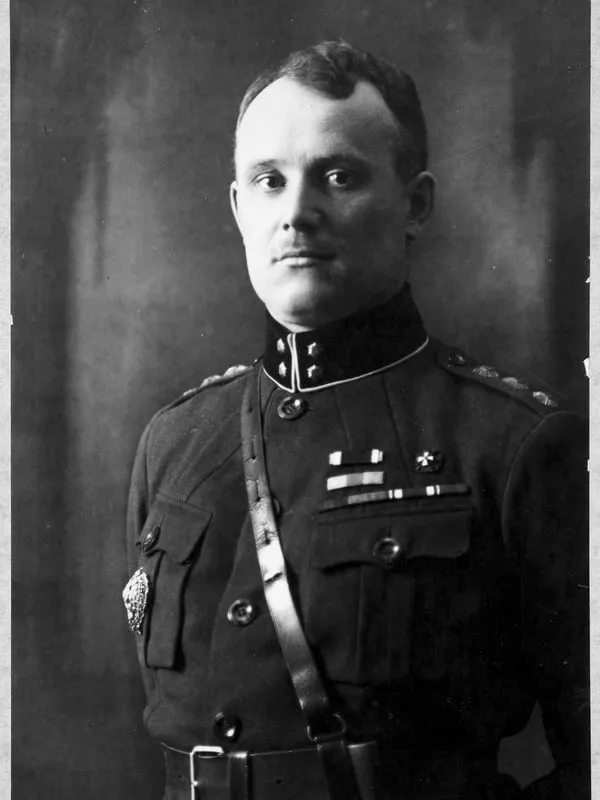
- Born:
- 12 February 1884, Vardja in Viiratsi parish near Viljandi (Governorate of Livonia, Russian Empire)
- Died:
- 13 March 1953, Vladimir (USSR)
- Author:
- Łukasz
- Photo:
- Anonymous / J. & P. Parikas, CC BY 4.0, Wikimedia Commons

Johan Laidoner was the most important soldier in the history of interwar Estonia. As commander-in-chief he led the young state to victory in the War of Independence of 1918–1920; in 1924 he directed the suppression of a communist putsch in Tallinn, and in 1934, together with Konstantin Päts, he suspended democracy and remained until 1940 the second pillar, alongside the president, of the authoritarian regime. In 1939–1940, when the Soviet Union demanded first bases and then the whole country, Laidoner and Päts chose the path of concessions, and the Estonian army did not fight in defence of the state. A few weeks after the occupation he was deported into the interior of the USSR, and he died in prison. For Poles he was a special figure: married to a Polish woman and a Polish speaker, he was one of Poland’s closest friends in the region.
From a peasant home to the General Staff Academy
He was born on 12 February 1884 (31 January by the Julian calendar) on the Raba farm in the village of Vardja in Viiratsi parish near Viljandi, the eldest of the four sons of Jaak Laidoner, a farmhand, and Mari, née Saarsen. The family could not afford further schooling, so after the town school in Viljandi the boy decided to become a soldier. In 1900 a medical board rejected him because his chest was too narrow, but a year later he was accepted as a volunteer in the 110th Kama Infantry Regiment in Kaunas. From 1902 to 1905 he studied at the Vilna Infantry Cadet School, graduating top of his course.
In Wilno (Vilnius) he met Maria Kruszewska, then fifteen, the daughter of a Polish noble family. They met again in St Petersburg, where she was studying at the conservatoire and he, from 1909 to 1912, at the Nicholas General Staff Academy, from which he graduated with a first-class diploma. They married on 30 October 1911. In 1913 their only son, Michael, was born; in April 1928 he was killed by a pistol shot in circumstances that were never fully explained. Later Maria Laidoner (PL) and her husband adopted her nephew Aleksei Kruszewski. Before the academy Laidoner served from 1905 to 1909 in the 13th Erivan Grenadier Regiment in Georgia, and after it in Caucasian regiments and on the staff of the Caucasus Military District.
An officer of the Russian army
During the First World War he served on staffs on the front against Germany and Austria-Hungary, in Poland, Galicia and Belarus: in the 3rd Caucasian Army Corps, in the 21st Infantry Division, from the autumn of 1915 in the intelligence section of the staff of the Western Front, and in 1917 as chief of staff of the Caucasian Grenadier Division and of the 62nd Infantry Division. For a reconnaissance carried out in October 1914 he received the Golden Weapon of St George, and in August 1916 he was promoted to lieutenant colonel.
After the February Revolution the Estonians began forming national units within the Russian army. In December 1917, after the Bolshevik seizure of power, a committee of Estonian servicemen appointed Laidoner commander of the 1st Estonian Infantry Division, which he took over on 5 January 1918. On 19 February, as the Germans advanced on Estonia, he was forced to step down under pressure from the local Bolsheviks and left for Petrograd. There, as military representative of the Estonian Provisional Government, which promoted him to colonel on 4 April 1918, he organised the dispatch of Estonian soldiers to the Allies in Murmansk.
Commander in the War of Independence
On 28 November 1918, a few weeks after Germany’s capitulation, the Red Army attacked Narva and the Estonian War of Independence began. Laidoner made his way through Finland to Tallinn, arriving on 8 December. Three days later he travelled to Liepāja (Libau) to see the commander of the British squadron, Admiral Edwyn Sinclair, and persuaded him, despite the loss of a cruiser to a mine, to bring his ships to the Tallinn roadstead. On 23 December the Provisional Government appointed him commander-in-chief.
The situation was desperate: the Bolsheviks stood a few dozen kilometres from the capital, and at the beginning of January 1919 the entire Estonian army numbered just over 13,000 men. Within a few weeks Laidoner built an efficient command and relied on small, mobile units supported by armoured trains and armoured cars, which seized railway junctions and roads. With the help of Finnish volunteers and the British fleet, the Estonians went over to the counter-offensive at the beginning of January, retook Tartu and Narva, and on 20 January 1919 Laidoner was made a major general. On the first anniversary of independence, 24 February 1919, he reported that the enemy had been driven out of the country. In June 1919 his forces defeated the German Landeswehr and the Iron Division at Cēsis (Võnnu), which opened the way for the Latvian national government. Laidoner deliberately carried the fighting beyond Estonia’s borders and cooperated with the White armies of General Nikolai Yudenich, without, however, committing himself to their aims, since the Whites did not recognise Estonian independence. The war ended with the Treaty of Tartu of 2 February 1920, in which Soviet Russia recognised Estonia. On 21 March 1920 Laidoner was promoted to lieutenant general, and five days later he relinquished his command.
Deputy, diplomat, defender of the republic
From 1920 to 1929 he sat in the Riigikogu, the State Assembly, for the conservative Farmers’ Assemblies, chaired its foreign affairs committee and from 1922 to 1929 represented Estonia at the assemblies of the League of Nations. On 1 December 1924 Estonian communists, supported by fighters sent from the USSR, tried to seize Tallinn. That same night the government declared martial law and again appointed Laidoner commander-in-chief. The putsch collapsed within a few hours, but the hunt for its participants went on for weeks; after martial law was lifted in January 1925, Laidoner once more left the army. In 1925 the League of Nations entrusted him with leading a commission that investigated reports of deportations of Christians on the Turkish–Iraqi frontier, in the disputed region of Mosul; its report was one of the documents on which the League based its settlement of the dispute in Iraq’s favour. In 1923 the state had granted him, in recognition of his services, an estate at Viimsi near Tallinn, which became his home.
His ties with Poland went beyond his marriage. He held the Virtuti Militari, the Grand Cross of the Order of Polonia Restituta and the Order of the White Eagle; in 1928 he paid an official visit to Warsaw, from 1930 he was honorary president of the Estonia–Poland Society in Tallinn, and in July 1934 he hosted the Polish foreign minister Józef Beck at Viimsi. He spoke Polish fluently. In 1929 the daily Vaba Maa called him “the Estonian Piłsudski” in the headline of an article.
The coup and the “Era of Silence”
In 1929 he did not stand for parliament again, but the Great Depression and the break-up of the coalition brought him back into politics. In 1933 the movement of War of Independence veterans, the so-called Vaps, pushed through in a referendum a constitution with a very strong head of state and began winning elections. Laidoner collected more than 38,000 signatures in support of his candidacy for State Elder, but the election never took place. On 12 March 1934 Päts declared a state of emergency and appointed Laidoner commander-in-chief; the Vaps leaders were arrested, parties were dissolved, press freedom was curtailed and parliament ceased to meet. Laidoner, the interior minister Kaarel Eenpalu and Päts formed the inner leadership of the state during the period known as the “Era of Silence”. Their defenders stress that they forestalled a seizure of power by a movement modelled on the fascists; their critics, that they themselves silenced the Estonians a few years before their greatest trial.
As commander-in-chief Laidoner reorganised the army in 1934, expanded conscription and the programme of rearmament, and introduced military training at universities. After the 1938 constitution came into force he sat ex officio in the upper chamber. On 24 February 1939 he was promoted to full general.
1939: a choice without a fight
After the Molotov–Ribbentrop Pact Estonia found itself in the Soviet sphere of influence. In September 1939 Laidoner had to deal with the escape of the Polish submarine ORP Orzeł from Tallinn; at his request Päts dismissed the command of the Estonian navy. In Poland he was sometimes credited with quietly helping the escapees, but the Estonian investigation found no evidence that any Estonian had knowingly assisted them. Moscow used the incident as a pretext for demanding bases. On 25 September Laidoner put the army on the highest state of readiness but did not order mobilisation, so as not to provoke the Red Army, whose forces on the border his staff estimated at more than 160,000 men against some 16,000 soldiers in the peacetime Estonian army. Together with Päts he judged that resistance would be national suicide, and on 28 September Estonia signed the Pact of Mutual Assistance and in October admitted Soviet garrisons.
That decision still divides historians. A few weeks later Finland rejected similar demands and stood up to the USSR in the Winter War. In a widely discussed book of 2008, criticised in Estonia, the Finnish historian Martti Turtola argued that the passivity of Päts and Laidoner was a deliberate choice rather than the result of coercion. According to Estonian biographers, in the winter and spring of 1940 Maria Laidoner, with Estonian help, assisted Polish officers interned in Latvia and Lithuania to escape to Finland, from where they could reach the Polish Army in France.
Occupation and deportation
On 16 June 1940 the commander of the Leningrad Military District, Kirill Meretskov, summoned Laidoner to talks in Narva. While the general was on his way there, Soviet troops were already crossing the border, and in Narva on 17 June he was obliged to sign a protocol, brought from Moscow, on their deployment. On 21 June he stood beside Päts on the balcony of Kadriorg Palace while demonstrators shouted the president down, and at a cabinet meeting he argued that since the Soviet troops had entered without incident, the Kremlin’s envoy Andrei Zhdanov had no reason to demand changes. That evening the coup was accomplished, and the next day, 22 June, Päts, under pressure from the new authorities, relieved Laidoner of his post as commander-in-chief.
On 19 July 1940, after the rigged elections but before Estonia was proclaimed a Soviet republic, the NKVD deported Laidoner and his wife from Viimsi via Moscow to Penza. For the first year they lived there under surveillance on a state pension. After the German invasion of the USSR they were arrested at the end of June 1941; their adopted son Aleksei died in November of that year in a camp near Solikamsk. Laidoner passed through Moscow’s Butyrka prison, where he was prisoner No. 11 and Päts No. 12, and through prisons in Kirov and, from the autumn of 1945, Ivanovo. His interrogators accused him above all of armed struggle against Soviet power in 1918–1920. According to the case files, on 16 April 1952 the Special Council, by then attached to the MGB, sentenced him to 25 years’ imprisonment and confiscation of property, and at the end of April he was transferred to the prison in Vladimir; some Estonian publications state that the sentence was not announced to him until March 1953. He died there on 13 March 1953, eight days after Stalin, and was buried in a mass grave in the town cemetery together with the Government Delegate for Poland, Jan Stanisław Jankowski, who died in the same prison on the same day. His remains have not been found.
Maria Laidoner, who was never charged, was released from prison in 1954, taught music for several years in Melenki in Vladimir Oblast, and was not allowed to settle in Estonia, in Haapsalu, until 1961. She died in 1978 and was buried in Tallinn beside her son; her husband has a symbolic grave there too.
Memory
Laidoner’s monument in his native Vardja, unveiled in 1937, was destroyed in 1940. It was rebuilt in 1990. In 1999 a memorial plaque was placed by the cemetery in Vladimir; in 2001 the Estonian War Museum, named after him, opened on his former estate at Viimsi; and in 2004 an equestrian statue of him was erected in Viljandi. In 2013 a plaque dedicated to his memory was unveiled, in the presence of the President of Estonia, outside the Milusin manor house in Sulejówek, home of the museum of Józef Piłsudski.
In Estonia Laidoner’s reputation remains twofold. For most he is a national hero, the victorious commander of the war that gave Estonia its statehood. At the same time it is remembered that he co-authored the 1934 coup and that in 1939–1940, unlike Carl Gustaf Mannerheim in Finland, he did not lead his army into battle. He and those closest to him paid the highest price for that decision, as did thousands of Estonian officers and their families, who in the years that followed ended up in Soviet prisons and labour camps.
Sources
Mentioned in battles
(01)Often appears with
People who appear in the same events.