1943–1944: Operation Cartwheel
New Britain campaign
- Dates:
- 15 December 1943 – 21 August 1945
- Front:
- Pacific
- Location:
- New Britain Island in the Bismarck Archipelago: the Arawe Peninsula and Cape Merkus, Cape Gloucester and Borgen Bay, the Willaumez Peninsula with Talasea, Cape Hoskins, Jacquinot, Wide and Open Bays, and the approaches to Rabaul on the Gazelle PeninsulaOn the battle map →
- Sides:
- United States and AustraliaDouglas MacArthur, Walter Krueger, William Rupertus, Julian Cunningham, Alan RamsayJapanHitoshi Imamura, Iwao Matsuda
- Result:
- Allied victory. The Americans took the western part of the island with the airfield at Cape Gloucester and gained control of the Vitiaz Strait; the Australians bottled up the Japanese garrison of Rabaul on the Gazelle Peninsula. Rabaul was never stormed – the Japanese ceased fighting after the Empire’s capitulation and surrendered on 6 September 1945.
- Author:
- Łukasz
Name and dates
The New Britain campaign is the name given to the fighting between American, Australian and New Guinean forces and the Japanese on New Britain – the largest island of the Bismarck Archipelago, at whose north-eastern tip lay Rabaul, the main Japanese base in the South West Pacific. The island is crescent-shaped and some 600 kilometres long; its interior is filled with rainforest-clad volcanic mountains over 1,800 metres high, and its coasts with jungle, mangrove swamps and coral reefs, which limited the number of places suitable for a landing. Before the war it was home to more than a hundred thousand New Guineans and fewer than five thousand Europeans and Asians; Rabaul was the capital of the Australian-administered Territory of New Guinea.
The first part of the campaign was the American Operation Dexterity, conducted by the staff of General Douglas MacArthur as part of Operation Cartwheel – the plan to encircle and neutralise Rabaul. It comprised the landing at Arawe on the south coast (code-named Director, 15 December 1943), the main landing at Cape Gloucester at the western end of the island (Backhander, 26 December 1943) and the landing at Talasea on the Willaumez Peninsula (Appease, 6 March 1944). The second part – from October 1944 to the end of the war – consisted of the operations of the Australian 5th Division, which took over the island from the Americans and confined itself to containing the Japanese garrison at Rabaul.
Most accounts take 15 December 1943, the day American cavalry landed at Arawe, as the start of the campaign. Its end is dated to 21 August 1945: after Emperor Hirohito announced the decision to surrender, the fighting on the island ceased and the Australians confined themselves to patrolling. The formal surrender of the Japanese forces at Rabaul was accepted only on 6 September 1945, several days after Japan’s instrument of surrender was signed in Tokyo Bay. The campaign was thus a long one, but – unlike Guadalcanal or Bougainville – only its first weeks saw heavy fighting. For most of the time the two sides faced each other from opposite ends of the island, and its fate was decided by air power and naval blockade.
Background
The Japanese seized Rabaul in January 1942, overwhelming the small Australian garrison, Lark Force. Some of the soldiers made their way through the jungle and were evacuated, but about 900 were taken prisoner and more than 500 European civilians were interned. On 1 July 1942 most of them died when the Montevideo Maru, which was carrying them away from Rabaul, was torpedoed off Luzon by an American submarine – according to some sources 849 prisoners of war and 208 civilians were lost. The occupiers ruled the islanders through village headmen; those who refused to cooperate were punished, and several were killed. The Chinese community was subjected to forced labour, and some women were raped or forced into prostitution in military brothels.
Rabaul became a great base. By mid-1943 the Japanese had built four airfields around the town, with protected revetments for 265 fighters and 166 bombers, a harbour with repair workshops and huge supply dumps. From here flew the aircraft that fought over Guadalcanal and New Guinea, and from here sailed the convoys – such as the one destroyed in the Battle of the Bismarck Sea. On the rest of the island the Japanese had little: a field airstrip at Gasmata on the south coast, the airfields at Cape Gloucester and landing places for the barges that slipped along the coasts by night between Rabaul and New Guinea. In the interior Australian coastwatchers and Allied Intelligence Bureau patrols were active, gathering intelligence, rescuing downed airmen and arming New Guinean guerrillas; the Japanese hunted them and took revenge on the villages that helped them.
The capture of Rabaul had been the Allies’ goal since mid-1942. The Japanese offensive against Port Moresby, halted on the Kokoda Track and at Buna and Gona, delayed these plans. In the spring of 1943 the Joint Chiefs of Staff approved Operation Cartwheel: Admiral William Halsey’s forces were to advance through the Solomon Islands towards Bougainville, while MacArthur’s forces were to take Woodlark and Kiriwina, the Huon Peninsula in New Guinea and the western part of New Britain. In June 1943, however, the chiefs of staff concluded that an assault on Rabaul was unnecessary: the base could be neutralised by bombing and blockade. MacArthur protested at first, but the decision was confirmed in August by the Quebec Conference.
In the autumn of 1943 the Allies took further steps. After the capture of Lae the Australians landed at Finschhafen, on the western side of the Vitiaz Strait, which separates New Guinea from New Britain. From 12 October Rabaul was bombed by the aircraft of General George Kenney’s Fifth Air Force, in November carriers struck it, and from 1 November the Americans were building airfields on Bougainville. The Japanese fleet stopped using Rabaul as a base. To complete the encirclement, the far shore of the Vitiaz Strait still had to be secured – and that was the task of the New Britain campaign.
Plans and forces
On 22 September 1943 MacArthur’s headquarters issued the order for Operation Dexterity. It was to be carried out by Alamo Force – in practice the headquarters of General Walter Krueger’s US Sixth Army – which was to seize the whole western part of the island, from Cape Gloucester to the Gasmata–Talasea line. General Kenney was opposed: he believed that building airfields at Cape Gloucester would take too long and that the existing bases were sufficient for bombing Rabaul. Krueger and MacArthur’s naval commanders argued, however, that without control of both shores of the Vitiaz Strait convoys sailing further west along New Guinea would be at risk. In November the landing at Gasmata was abandoned – it lay too close to the Rabaul airfields, the Japanese were reinforcing it and the ground was swampy. On 21 November it was decided instead to land at Arawe, where a PT boat base was to be established, and the landing itself was meant to divert Japanese attention from the main blow. The first operation was scheduled for 15 December and the second for 26 December.
Sent to Arawe was Brigadier General Julian Cunningham’s Director Task Force, built around the 112th Cavalry Regiment – a Texas unit that had given up its horses and fought as infantry – reinforced with artillery, engineers and a Marine amphibian tractor company. The main task was entrusted to Major General William Rupertus’s 1st Marine Division, veterans of Guadalcanal who had spent a year resting and rebuilding in Australia. Reconnaissance was provided by Marine patrols and the Alamo Scouts, put ashore on the island from PT boats between September and December. The scale of the undertaking was, however, shaped by an underestimate of the enemy: for a long time the Allies believed that there were a few tens of thousands of Japanese on the whole island, whereas in reality there were almost twice as many.
For on New Britain and neighbouring New Ireland there were – according to the Australian official history – more than a hundred thousand Japanese soldiers, sailors and civilian workers. They came under the Eighth Area Army of General Hitoshi Imamura at Rabaul; the naval forces were commanded by Vice Admiral Jin’ichi Kusaka. In September 1943 Japanese Imperial Headquarters decided that the Bismarck Archipelago lay outside the new “absolute national defence zone” and ordered the forces there merely to delay the Allies. Imamura, expecting a landing in the western part of the island, sent reinforcements there: Lieutenant General Yasushi Sakai’s 17th Division, brought from China in October (on the way it lost, depending on the source, between 1,200 and 1,400 men to submarine and air attack), and the group of Major General Iwao Matsuda, based on the understrength 65th Brigade and the 53rd Infantry Regiment. Rabaul nevertheless remained the most strongly defended point – until the end of the war the Japanese expected the Allies to attack it.
Course: the landing at Arawe (15 December 1943 – February 1944)
Director Task Force embarked on Goodenough Island on 13 December. For several weeks aircraft bombed the whole of New Britain, but the Arawe area was deliberately spared until the last day so as not to give away the landing site. At around three in the morning on 15 December the ships arrived off the Arawe Peninsula, near Cape Merkus. Two subsidiary detachments set off in the darkness in rubber boats. The troop that was to block the coastal track near the village of Umtingalu ran into machine-gun and light-gun fire – twelve of its fifteen boats sank, and a dozen or more men were killed or went missing. The other detachment captured Pilelo islet, where it destroyed a Japanese radio station; an Australian radar station was soon set up there.
The main landing, after 6.25 a.m., was chaotic – the boat waves became mixed up and reached the shore at the same time – but there were few Japanese nearby. The cavalrymen quickly occupied the peninsula and the Amalut plantation, and in the afternoon built a defensive line across the neck of the peninsula. Rabaul’s aircraft responded: over the following days dozens of Japanese aircraft, and on 21 December at least 150, attacked the beachhead and the supply convoys, sinking or damaging several vessels. General Sakai concluded that the landing was not the main blow, but he sent Major Masamitsu Komori’s battalion and a battalion of the 141st Infantry Regiment from Cape Bushing to Arawe. Komori, convinced that there were few Americans, attacked several times at the end of December; the attacks were beaten off by mortar fire.
The Japanese dug in a few hundred metres from the American line. Cunningham considered that the purpose of the landing had already been achieved and did not want to incur needless losses; only after reinforcements arrived – a company of the 158th Infantry Regiment and a Marine tank company – did the Americans attack on 16 January 1944, after a raid by B-24 bombers and an artillery bombardment, with tanks in the lead, and take the Japanese positions. This cost 22 killed and 64 wounded; the Americans put enemy losses at 139 killed. Komori withdrew towards the airfield, which the Allies had no intention of taking, and his force, ravaged by hunger and dysentery, joined the general retreat at the end of February. The planned PT boat base was ultimately never developed – it was judged unnecessary, and a modest supply point on Pilelo sufficed. In all, according to some sources, the fighting cost the Allies 118 killed, 352 wounded and four missing.
Course: Cape Gloucester (26 December 1943 – January 1944)
The main landing, which historians call the Battle of Cape Gloucester, was preceded by weeks of air raids that destroyed most of the defences around the two Japanese airfields at the western end of the island. The airfields were defended mainly by the 1st Battalion of Colonel Kōki Sumiya’s 53rd Infantry Regiment, supported by artillery and rear-echelon units; the rest of Matsuda’s group was further east, by Borgen Bay. The Japanese based their defence on the hills – Target Hill and Hill 660 – and on the tracks along which they could move reserves, and they barely fortified the swampy beaches near Cape Silimati.
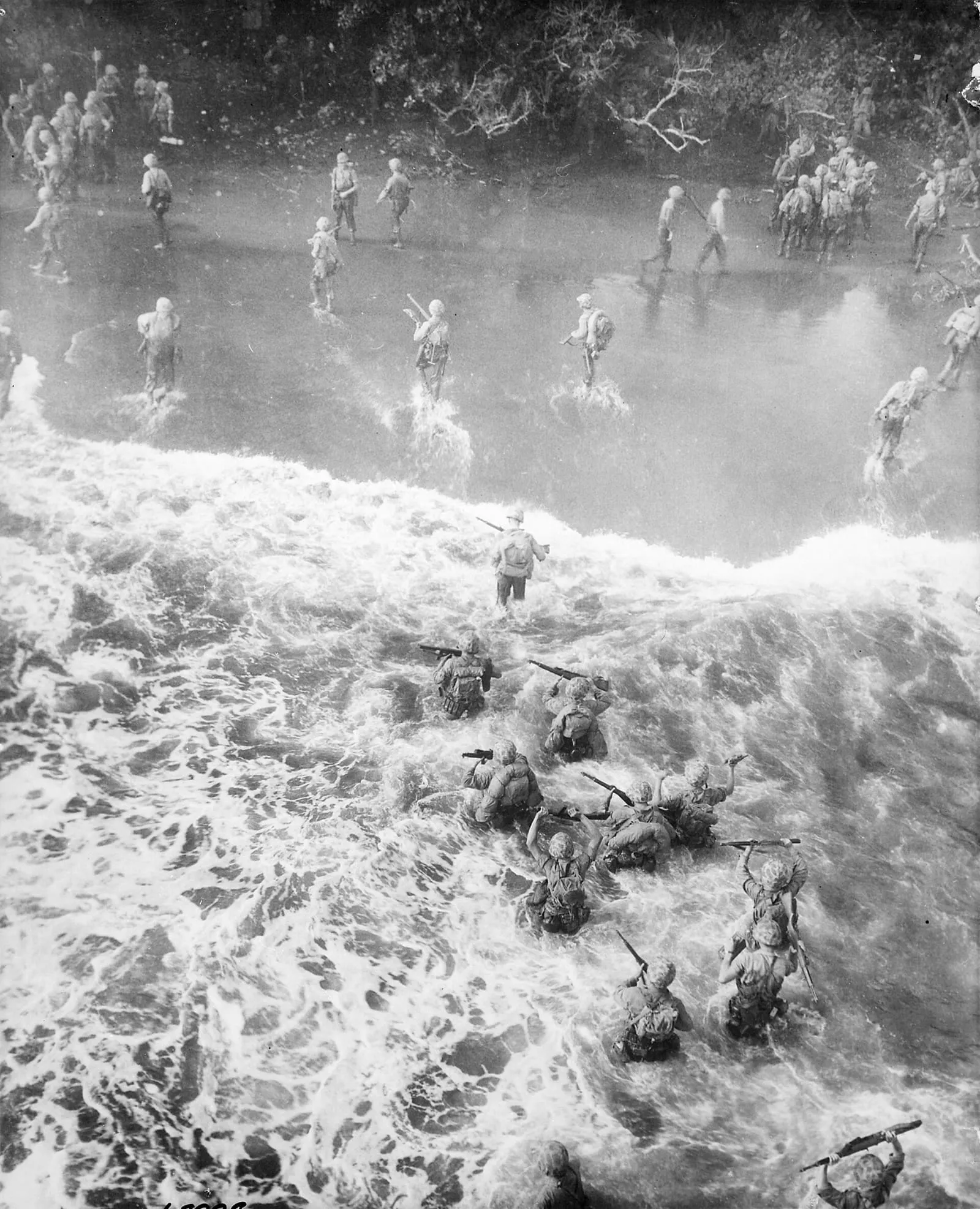
On the morning of 26 December, after a bombardment by American and Australian ships and a bomber raid on Target Hill, the 7th Marines landed on the two Yellow Beaches near Cape Silimati, about eight kilometres south-east of the airfields. Smoke from the bombardment obscured the shore and some of the boats landed in the wrong place, but there was almost no resistance. A battalion of the 1st Marines simultaneously landed on Green Beach at Tauali, on the other side of the peninsula, and cut the coastal road; there it later repulsed a night attack in which 89 Japanese were killed. Behind the 7th Marines came the rest of the 1st Marines, advancing north along the coast towards the airfields. In the afternoon aircraft from Rabaul arrived – in the morning they had been diverted by the Arawe landing – and sank the destroyer USS Brownson, on which more than a hundred men were killed. In the evening and during the night the Marines beat off the first Japanese counter-attacks.
The terrain proved a worse enemy than the Japanese. Behind the beaches stretched swamps in which men and vehicles sank, and the monsoon rain – an average of about 250 millimetres a week from 27 December to 21 January – turned the only track into mud. The soldiers called the area “the green hell”. On 28 December, with the help of tanks, the Americans broke through a Japanese roadblock on the way to the airfields, losing nine killed; the Japanese lost at least 266 men there. On 29 December the 5th Marines landed and outflanked the defences from the south-west. By evening most of the airfield was in American hands, and by 30 December the Marines held both runways and Razorback Ridge to the south of them.
In the first half of January 1944 the 5th and 7th Marines moved south towards Borgen Bay to push the Japanese artillery back from the airfield. On 2–4 January they fought heavily along a stream the soldiers named Suicide Creek, where the 53rd Regiment’s bunkers hidden in the jungle were taken only with the help of tanks, and on 3 January they repulsed a counter-attack by the 141st Regiment at Target Hill. The Marines then took Aogiri Ridge – later named Walt’s Ridge after the battalion commander, Lieutenant Colonel Lewis Walt – and beat off Japanese night attacks. On 16 January, after three days of fighting, they took Hill 660. According to some sources, about 50 Marines and more than 200 Japanese were killed there. Matsuda withdrew with some 1,100 men, abandoning his command post; organised resistance in the western part of the island ceased.
The capture of Cape Gloucester and the Huon Peninsula gave the Allies control of both shores of the Vitiaz Strait. Engineers, battling downpours, built a runway some 1,600 metres long on the site of the Japanese airfield, but the base played no great part: because the runway was short and slippery, American P-38 fighters could not be kept there, and in the spring of 1944 it was used mainly by Royal Australian Air Force Kittyhawk squadrons. The American historian John Miller wrote in the Army’s official history that Cape Gloucester “never became an important air base”.
Course: Talasea and the Japanese retreat (January – April 1944)
In mid-January General Sakai asked for permission to withdraw from the western part of the island; Imamura granted it on 21 January. The remnants of the 17th Division and Matsuda’s group, ravaged by hunger, malaria and dysentery, set off eastwards along the north coast towards Cape Hoskins and Rabaul, with Marine patrols on their heels fighting dozens of small skirmishes. In February the Americans occupied Rooke Island in the Vitiaz Strait, whose garrison had already withdrawn.
On 6 March 1944 a combat team of the 5th Marines landed on the western shore of the Willaumez Peninsula, at Volupai plantation, and advanced across the isthmus towards the airstrip at Talasea. The operation was meant to cut off the retreating Japanese, but a small rearguard held up the Americans long enough for the main force to slip past. By 9 March Talasea was in American hands, at a cost of 17 killed and 114 wounded; about 150 Japanese were killed. Further east the Americans advanced only by patrols; on 7 May 1944 Army troops, who by then had relieved the Marines, occupied the abandoned airfield at Hoskins plantation.
By this time Rabaul was only a shadow of a base. From January 1944 it was also bombed by aircraft from the airfields on Bougainville; the town was completely destroyed, and many ships and aircraft were lost in the harbour and on the airfields. From February the Japanese stopped sending ships to Rabaul; on 19 February its air units made their last attempt to intercept an Allied raid, and on 20 February they were recalled to Truk. The American seizure of the Admiralty Islands, and Halsey’s of Emirau Island north of New Ireland, closed the ring. Even so, the garrison – reckoned at some 98,000 men, with hundreds of guns and supplies hidden in volcanic caves – remained intact, and on 14 March 1944 Imperial Headquarters ordered Imamura to “hold the Rabaul area as long as possible” in order to tie down Allied forces.
In April 1944 the 1st Marine Division, which had lost 310 killed and 1,083 wounded on New Britain, was relieved by General Rapp Brush’s US 40th Infantry Division, which came from Guadalcanal. The Marines sailed to the Russell Islands, from where they set out for Peleliu in September. For the following months the two sides kept to opposite ends of the island, and in its central part only guerrillas led by Australians of the Allied Intelligence Bureau were active, pushing the Japanese outposts back to Ulamona on the north coast and Kamandran on the south coast. In the summer of 1944 Imamura’s staff concluded that, since the Allies were heading for the Philippines, an assault on Rabaul had become unlikely.
Course: the Australian phase (October 1944 – August 1945)
In the autumn of 1944 the 40th Division was taken away to the Philippines, and responsibility for New Britain passed to the Australians – the government in Canberra wanted Australian territories to be retaken by its own soldiers. The task was given to Major General Alan Ramsay’s 5th Division, which had previously fought on the Huon Peninsula. Australian intelligence estimated the enemy’s strength at some 38,000 men; in fact – according to the Australian official history – Imamura had about 69,000 troops fit for combat (53,000 from the army and 16,000 sailors), almost twice as many. It was, however, correctly foreseen that the Japanese would remain in their fortifications around Rabaul. The garrison, cut off from supplies, grew rice and vegetables; it had only two serviceable aircraft and some 150 barges. Ramsay was ordered to keep the Japanese under pressure but not to commit large forces.
At the beginning of October 1944 the Australian 36th Battalion landed at Cape Hoskins, and at the beginning of November the rest of the 6th Brigade landed at Jacquinot Bay on the south coast, where a port, an airfield and a hospital were built by May 1945. Air support was provided by two New Zealand squadrons of Corsair fighters, and coastal transport by American and later Australian landing barges. For lack of shipping, the transfer of the division dragged on until April 1945. From December 1944 the Australians advanced along both coasts – by barge, from bay to bay – towards the line between Open and Wide Bays, which cut off the Gazelle Peninsula. In the north, reinforced by the 1st New Guinea Infantry Battalion, they reached Baia on Open Bay; in the south they took Kamandran on 15 February 1945.
The only serious fighting took place in March and April 1945 in the Waitavalo–Tol area on Wide Bay, where a Japanese battalion held out on the ridges of Mount Sugi. On 5 March the 19th Battalion forced the Wulwut River, and on 18 March the 14th/32nd Battalion took Bacon Hill; rain, mortars and bunkers meant that the whole area was not secured until April. After that the Australians confined themselves to patrolling across the neck of the Gazelle Peninsula to prevent a sortie from Rabaul. Scouts of the 2/2nd Commando Squadron, who got close to the fortress, judged the terrain so difficult that large Japanese forces would be unable to move through it. In April 1945 Ramsay was replaced by General Horace Robertson, and in August by General Kenneth Eather. When Japan announced its surrender on 15 August, the fighting on the island ceased.
The surrender of Rabaul
On 6 September 1945, four days after the signing of Japan’s instrument of surrender, General Imamura and Vice Admiral Kusaka signed, aboard the British aircraft carrier HMS Glory off New Britain, the surrender of all Japanese forces in New Guinea, New Britain, New Ireland, Bougainville and the surrounding islands to the commander of the Australian First Army, Lieutenant General Vernon Sturdee. The same day the 29th/46th Battalion of the Australian 4th Brigade entered Rabaul. More than eight thousand prisoners were freed from Japanese camps on the island – many of them Indian soldiers captured in Malaya and Singapore, as well as Chinese and Indonesians brought there for forced labour. Many of their comrades had not survived hunger, disease and executions. In 1947 an Australian military court sentenced Imamura to ten years’ imprisonment for crimes committed by troops under his command.
Losses
Allied losses were small for the scale of the campaign. The 1st Marine Division lost 310 killed and 1,083 wounded on New Britain, and the task force at Arawe 118 killed, 352 wounded and four missing; to these must be added more than a hundred killed aboard the destroyer Brownson and on other ships attacked by Rabaul’s aircraft. In 1944–1945 the Australians lost only 53 killed and 140 wounded, while 21 soldiers died of disease and accidents. Some sources give these figures, drawing on the official histories of both countries.
By their own figures, the Japanese lost 3,868 killed in the fighting in the western part of the island up to April 1944, while American estimates speak of more than two thousand killed at Cape Gloucester alone in December and January. Far more men were carried off by disease and hunger: total Japanese losses on New Britain and the other islands of the Bismarck Archipelago are estimated at some 30,000 killed and dead, most of them from exhaustion and disease during the retreat and the siege. The number of victims among the islanders remains unknown – they died in air raids, in reprisals for helping the Allies, in tribal fighting that broke out in the wake of the guerrilla war, and from hunger in ruined villages.
Significance
The New Britain campaign completed the western arm of Operation Cartwheel. Together with the fighting on Bougainville and the seizure of the Admiralty Islands and Emirau, it ensured that Rabaul – a fortress whose capture had in 1942 seemed a precondition of any further progress in the Pacific – was encircled and left to itself. Some hundred thousand Japanese soldiers and sailors sat out the rest of the war in underground shelters without influencing its course, while MacArthur advanced along New Guinea to the Philippines and Admiral Chester Nimitz across the Central Pacific. It was one of the most successful applications of the “island-hopping” strategy: instead of a bloody assault on a fortified base, it was enough to seize a few footholds on its approaches and cut it off by sea and air.
Historians disagree, however, about whether the landings in the western part of the island were themselves necessary. The authors of the Marine Corps official history, Henry Shaw and Douglas Kane, held that Arawe made the Cape Gloucester landing easier. The naval historian Samuel Eliot Morison judged the Arawe landing an undertaking of “little value”, and John Miller of the Army’s official history concluded that both operations were “probably not essential” either to neutralising Rabaul or to the advance on the Philippines – although they brought some benefits at relatively small cost. These assessments largely vindicate the objections Kenney had raised from the start.
The official historian Gavin Long judged the Australian phase of the campaign to have been inadequately supported – especially by aircraft and ships, whose absence delayed the concentration of the 5th Division – but called its outcome excellent: an inexperienced division held in check forces equal to five divisions while losing few men. General John Coates called it “a classic example of a containment campaign”. Japanese and Australian historians point out that success was made easier by the caution of Imamura, who had orders to conserve his forces for joint action with the fleet, and without a fleet and aircraft any offensive was pointless. For Australia the campaign was also the recovery of its own territory: at Rabaul, where Lark Force had been destroyed in 1942, the surrender of an army of nearly a hundred thousand men was accepted in 1945, and trials were later held there for crimes committed against prisoners of war and islanders.