- Category:
- Military operations
- Front:
- Pacific
- Date:
- 15 September 1944
- Author:
- Łukasz
- Battle:
- Battle of Peleliu
- Tags:
- United States, Japan, William Halsey, Chester Nimitz
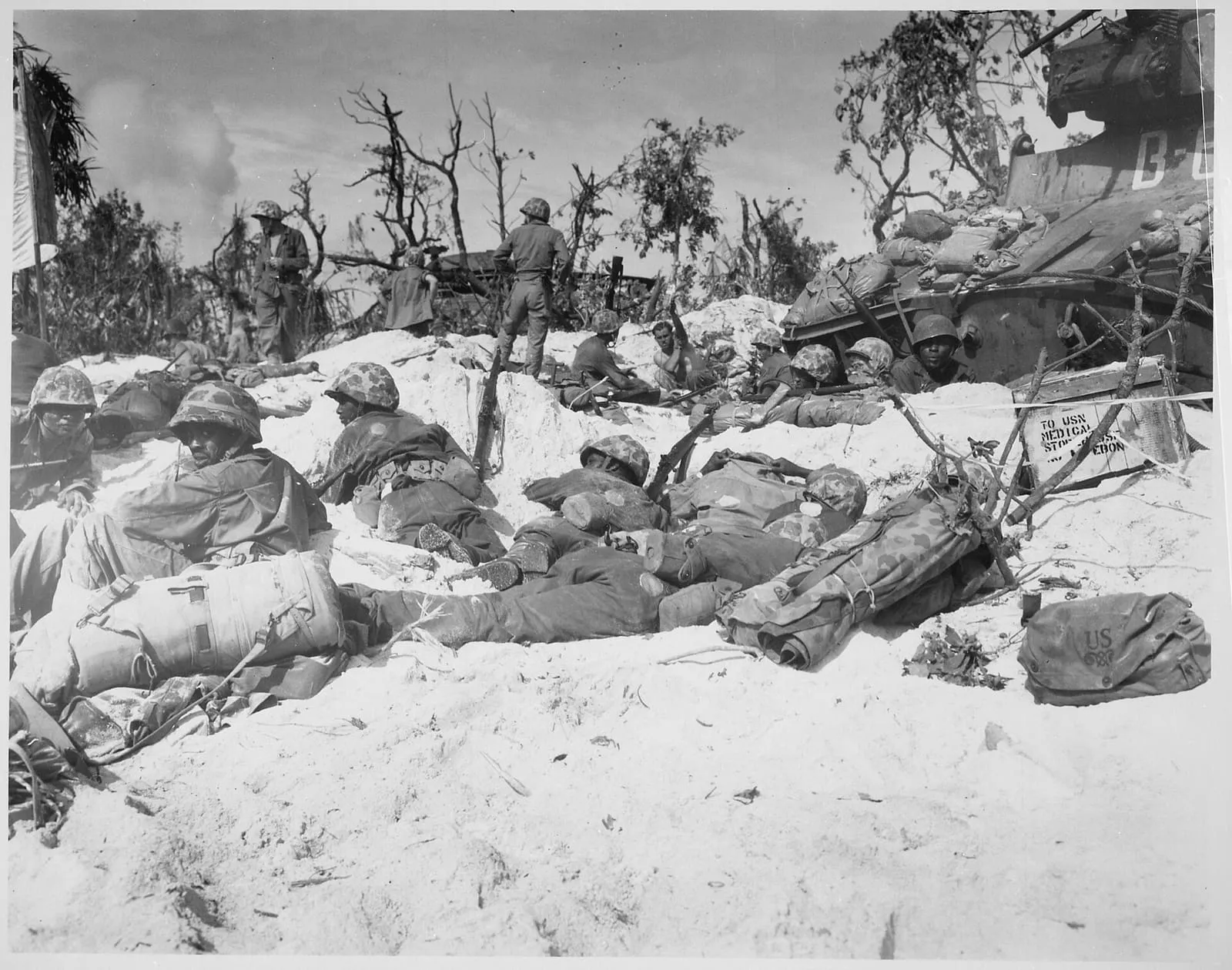
At 8.32 a.m. on 15 September 1944 the first amphibious tractors carrying men of the 1st Marine Division reached the beaches on the south-western coast of Peleliu, a small coral island at the southern end of the Palau archipelago, in the western Caroline Islands. The objective was the airfield, which was to cover from the east General Douglas MacArthur’s promised return to the Philippines. The division commander expected a short, sharp fight. Instead the Japanese garrison, hidden in hundreds of caves in the limestone ridge at the centre of the island, held out until the end of November. Peleliu became one of the bloodiest battles fought by the Marine Corps in the whole Pacific war, and also one of the most controversial: historians still ask whether it needed to be fought at all.
US Marines landed on Peleliu, and a bloody battle of attrition followed that lasted two and a half months: the island was declared secured on 27 November, after 73 days of fighting, although the last Japanese did not emerge from the caves until many months later. From the second week of the fighting onwards, an ever larger share of the burden passed from the Marines to the Army’s 81st Infantry Division.
Why Palau
In the summer of 1944, after the carrier strikes on the Marianas, the Americans had taken Saipan, Tinian and Guam, while in Washington and at Pearl Harbor the dispute over the onward route to Japan continued: through the Philippines, as MacArthur wanted, or through Formosa, as some of the admirals preferred. Whatever the outcome of that dispute, the planners concluded that before the leap to the Philippines the Palau Islands, lying less than a thousand kilometres east of Mindanao, had to be neutralised. Japanese aircraft and garrisons stationed there could threaten the flank and supply lines of MacArthur’s forces advancing from New Guinea. The airfield on Peleliu, the most important in the archipelago, was to serve further operations once in American hands.
The operation was code-named Stalemate II. In its original form it covered Peleliu, the neighbouring island of Angaur, and then Yap and Ulithi atoll. For lack of landing ships it could not begin until the fighting in the Marianas was over. The naval forces were commanded by Admiral William Halsey, whose Third Fleet had at the end of August taken over the task forces previously under Raymond Spruance, and the landing force by Marine Major General Roy Geiger, commander of III Amphibious Corps. The 1st Marine Division, veterans of Guadalcanal and of Cape Gloucester on New Britain, was to land on Peleliu, and the 81st Infantry Division on Angaur.
A few days before the landing the plan was called into question by Halsey himself. In the first half of September his carriers struck Palau, Mindanao and the central Philippines and met surprisingly weak resistance from Japanese aircraft. On 13 September the admiral proposed cancelling the capture of Palau, Yap and other intermediate objectives and throwing the troops earmarked for these islands straight at Leyte in the central Philippines. Admiral Chester Nimitz accepted part of the proposal: the American Chiefs of Staff, then meeting at the Quebec Conference, brought the invasion of Leyte forward to 20 October within twenty-four hours and dropped Yap. Nimitz judged, however – according to accounts cited in American historiography – that it was too late to call off the landings on Peleliu and Angaur, since the convoys were already on their way and Palau had to be secured in any case. This episode later became the main argument of those who regarded the battle as unnecessary.
A new Japanese defence
Peleliu is some 9 kilometres long and at most 3 kilometres wide. On the flat southern part of the island the Japanese had built a Z-shaped airfield, while through its central and northern parts runs the Umurbrogol – a labyrinth of steep limestone ridges, ravines and cliffs covered in dense jungle, which hid their true shape from aerial photographs. The rock contained hundreds of natural caves and old galleries of phosphate mines worked during the Japanese mandate over the Carolines. Before the battle the Japanese had moved the island’s indigenous inhabitants to the larger islands of the archipelago, mainly Babeldaob, so that, unlike on Saipan, the fighting on Peleliu did not claim many victims among the local population.
The defence of the archipelago was entrusted to Lieutenant General Sadae Inoue’s 14th Division, transferred in the spring of 1944 from the Kwantung Army in Manchuria; its headquarters was on the island of Koror. On Peleliu the commander was Colonel Kunio Nakagawa of the 2nd Infantry Regiment, reinforced with battalions from other units, naval personnel and construction workers – according to the US official history some 10,000–11,000 men in all, of whom roughly 6,500 were trained infantry. Major General Kenjirō Murai was also sent to the island to assist Nakagawa with advice, but actual command remained in the colonel’s hands.
Defeats in the Gilbert and Marshall Islands and the Marianas had led the Japanese high command to change its tactics. Until then garrisons had tried to stop landings on the beaches, where naval gunfire crushed them, and the remnants had hurled themselves into night-time banzai charges that ended in the slaughter of the attackers. The new guidelines ordered something different: the beaches were to be defended only enough to delay and bleed the landing force, while the main forces were to be hidden inland in bombproof positions, forcing the enemy into a long battle of attrition. Nakagawa applied them on Peleliu with consistency. The caves of the Umurbrogol were linked by tunnels, their entrances protected by steel doors and camouflaged, and the positions sited to cover one another. Suicidal charges were forbidden. The defenders did not expect to survive; the aim was for each of them to cost the enemy as much time and blood as possible.
At the same time Nakagawa did not give up the beaches without a fight. On the west coast, opposite the airfield, he deployed an infantry battalion and mined the approaches, and on the rocky headlands enclosing the beaches to the north and south he cut positions into the coral for anti-tank guns and 20 mm cannon that swept the beach with enfilade fire. The most dangerous of these was the headland on the left flank of the landing, which the Marines simply called “The Point”.
“Two, three days at most”
The American plan did not differ from earlier landings. The 1st Marine Division, commanded by Major General William Rupertus, set out at the beginning of September from its base on Pavuvu in the Solomon Islands. From 12 September the ships of Rear Admiral Jesse Oldendorf – five old battleships, cruisers and destroyers – shelled the island for three days, and carrier aircraft had been bombing it for several days before that. Frogmen of the underwater demolition teams cleared obstacles on the reef. Oldendorf eventually reported that he had run out of targets. In reality the bombardment had destroyed the aircraft and buildings around the airfield, but the positions hidden in the rocks survived almost untouched, and the defenders did not betray them with a single shot.
Rupertus was convinced that the battle would be short. According to an often-quoted account, he told his officers that it would be “a tough one, but a fast one” and would last three days, perhaps only two. This belief had consequences: only a handful of war correspondents went ashore, so for a long time the battle was almost absent from the American press. The general, who had broken his ankle during an exercise, remained aboard ship on the day of the landing, far from the beaches.
The plan called for three regiments to land side by side on a front of about three kilometres. In the north, on the White beaches, the 1st Marines under Colonel Lewis Puller were to attack; in the centre, on Orange 1 and 2, Colonel Harold Harris’s 5th Marines; and in the south, on Orange 3, Colonel Herman Hanneken’s 7th Marines. Harris’s regiment was to cut across the island and take the airfield, Puller was to turn north towards the hills, and Hanneken was to clear the southern tip.
Landing day
As the amphibious tractors crossed the reef, Japanese artillery and mortars opened fire from the hills, and the guns on the headlands began to rake successive waves from the flank. According to American accounts, by 9.30 a.m. some 60 amphibious tractors and DUKWs had been destroyed or disabled. The left flank fared worst: Puller’s 1st Marines were pinned down by fire from “The Point”, some of their communications equipment was destroyed before it even reached the shore, and one company was cut off. The 3rd Battalion, 7th Marines, struggled on Orange 3 with obstacles on the reef that forced the tractors to come in single file.
The 5th Marines, sheltered by palm groves, got furthest. In the afternoon, as the Marines approached the airfield, Nakagawa launched a counter-attack across the runway by a dozen or so light tanks with infantry riding on them. American Sherman tanks, anti-tank guns, bazookas and aircraft smashed it in short order. It was the only major counter-attack in the style of earlier battles; after that the defenders reverted to their own tactics. By evening the Americans held the strip of beaches and a beachhead reaching in places a kilometre and a half inland, but they were far from their planned objectives. According to Marine Corps figures, the first day cost the division more than a thousand killed and wounded, including about 200 killed. During the night Japanese soldiers infiltrated behind American lines and fought hand to hand in the foxholes.
The airfield, “The Point” and Bloody Nose
On 16 September the 5th Marines crossed the open airfield under artillery fire from the hills and reached the east coast, cutting the island in two. Over the following days the 7th Marines destroyed an isolated Japanese battalion at the southern end. As early as 17 September the first light observation aircraft landed on the captured strip, and at the end of the month they were followed by Marine Corsair fighters, which took off to attack targets a few dozen seconds’ flight away, dropping among other things napalm. The heat joined the defenders in the fight: daytime temperatures exceeded 40 degrees Celsius, and drinking water was brought in fuel drums that had not been properly cleaned. Many Marines collapsed from heat exhaustion.
On the left flank Captain George Hunt’s K Company, 3rd Battalion, 1st Marines, took “The Point”, destroying one machine-gun nest after another and a bunker with a 47 mm gun. For more than a day and night afterwards, almost without water or ammunition, it beat off Japanese counter-attacks. According to the Marine Corps history, when reinforcements arrived only a dozen or so men of the company were still fit to fight.
Then Puller’s regiment went into the Umurbrogol, which the Marines called “Bloody Nose Ridge”. Every ridge turned out to be covered by fire from several others, every hill taken to be just another line of defence. The defenders fired only when they could inflict the heaviest losses, aimed at corpsmen and stretcher-bearers, and at night sent small parties against the American positions. In six days, according to Marine Corps figures, the 1st Marines lost about 1,750 men, more than two-thirds of their strength; some companies ceased to exist. Rupertus long refused to ask for help from the Army, but in the end Geiger, after visiting Puller’s command post, withdrew the regiment from the line.
It was replaced by soldiers of Major General Paul Mueller’s 81st Infantry Division. On 17 September two of its regiments had landed on neighbouring Angaur, an island defended by some 1,400 Japanese. Within a few days the Americans had taken most of the island and could start building an airfield there, but the last pockets of resistance in the rocks in the north-west were eliminated only in the second half of October. On 23 September the 321st Infantry Regiment moved from Angaur to Peleliu and, together with the Marines, encircled the last Japanese positions in the Umurbrogol, known from then on simply as “the Pocket”.
What followed
The battle for the Pocket turned into a methodical siege: bulldozers cleared roads, flame-thrower tanks burned out cave after cave, and engineers blew up and sealed the entrances. In mid-October the exhausted 7th Marines were relieved by the 5th Marines, and on 20 October the 81st Division took over command on the island. The regiments of the 1st Marine Division returned to Pavuvu in October; after a month of fighting the division had lost, according to Marine Corps figures, more than 6,500 killed and wounded, over a third of its strength. On 24 November Nakagawa sent his last report, burned the regimental colours and, together with General Murai, committed suicide; both were posthumously promoted to lieutenant general. On 27 November the Americans declared the island secured. A small group of Japanese soldiers and sailors nevertheless hid in the caves until April 1947 and surrendered only when a former Japanese admiral convinced them that the war was over.
Losses were very high for so small an island. According to official American figures, the Marines lost at least 1,250 killed and died of wounds and more than 5,000 wounded on Peleliu and the neighbouring islets, and the 81st Division several hundred killed and more than two thousand wounded on Peleliu and Angaur. Japanese losses on Peleliu are estimated at about 10,000 killed; only some 200 men were taken prisoner, most of them Korean construction workers. The ratio of the attackers’ losses to the number of defenders was the highest of all the American landings in the Pacific.
The value of the prize turned out to be slight. The airfield on Peleliu played no significant part in the fighting for the Philippines, which began in October, and the Japanese garrison on the other Palau islands, including Babeldaob and Koror, left to its own devices, was in no position to threaten the Americans. Ulithi atoll, on the other hand, taken without a fight, became a great fleet anchorage. Some historians, following Halsey, therefore regard the battle as unnecessary; others point out that when the decision was taken the commanders could not have known this, and that Palau lay right beside the route to the Philippines. What is certain is that Peleliu was a portent of things to come. Nakagawa’s tactics – defence in depth, in underground fortifications, without suicidal charges – were repeated in 1945 on Iwo Jima and Okinawa, where they cost the Americans even more blood. A veteran of the 1st Division, Eugene Sledge, later described Peleliu and Okinawa in his memoir With the Old Breed, one of the most important accounts of the Pacific war by an ordinary soldier.
Sources
Meanwhile
(04)Elsewhere, within a week.
- 15 September 1944 · Western FrontThe liberation of NancyOn 15 September 1944 Patton's Third Army entered Nancy. Fighting went on along the Moselle, and from 18 September a tank battle raged at Arracourt.
- 17 September 1944 · Western FrontOperation Market Garden beginsOn 17 September 1944 the Allies dropped three airborne divisions in the Netherlands and XXX Corps set off towards the Rhine. The goal was the bridge at Arnhem.
- 13 September 1944 · Western FrontThe Allies at the Siegfried LineOn 11 September 1944 the first American patrol crossed the German border; on 12–13 September VII Corps attacked the Siegfried Line near Aachen.
- 17 September 1944 · MediterraneanThe fighting in San MarinoOn 17–20 September 1944 the 4th Indian Division drove the Germans out of neutral San Marino. On 21 September the republic reportedly declared war on Germany.
Related events
(04)The same battle, people or subject.
- 4 January 1945 · PacificThe January raids on FormosaOn 3–4 January 1945 Halsey's carriers struck Formosa and the Ryukyus to cover the Luzon invasion. They returned over the island on 9, 15 and 21 January.
- 12 October 1944 · PacificThe raids on FormosaOn 12–16 October 1944 Halsey's carriers crushed Japanese air power over Formosa. Tokyo announced 11 carriers sunk – in reality, not one.
- 20 October 1944 · PacificThe landing on LeyteOn 20 October 1944 the US Sixth Army landed on Leyte. General MacArthur waded ashore and told the Filipinos by radio: “I have returned”.
- 9 August 1944 · PacificThe dispute over the road to JapanIn summer 1944 the Americans argued over whether to strike Luzon or Formosa. Roosevelt favoured MacArthur, but the Joint Chiefs decided on 3 October.