1943–1944: The Dnieper–Carpathian offensive
Battle of the Korsun–Cherkassy Pocket
- Dates:
- 24 January – 17 February 1944
- Front:
- Eastern Front
- Location:
- The Kaniv–Korsun salient on the right bank of the Dnieper between Kaniv, Cherkasy, Zvenyhorodka and Lysianka (Kiev and Cherkasy regions, USSR)On the battle map →
- Sides:
- Soviet UnionGeorgy Zhukov, Ivan Konev, Nikolai Vatutin, Pavel RotmistrovNazi GermanyErich von Manstein, Wilhelm Stemmermann, Theobald Lieb, Hermann Breith
- Result:
- Soviet victory. On 28 January the 1st and 2nd Ukrainian Fronts encircled XI and XLII Army Corps (about 56,000–60,000 men) in the salient on the Dnieper. The German relief force failed to break through to the pocket, and Group Stemmermann broke out during the night of 16–17 February, losing almost all its heavy equipment; Stemmermann was killed. The number of survivors remains disputed: according to German documents about 35,000–40,000 men got out, while Soviet figures claim the Germans lost about 55,000 killed and 18,000 prisoners.
- Author:
- Łukasz
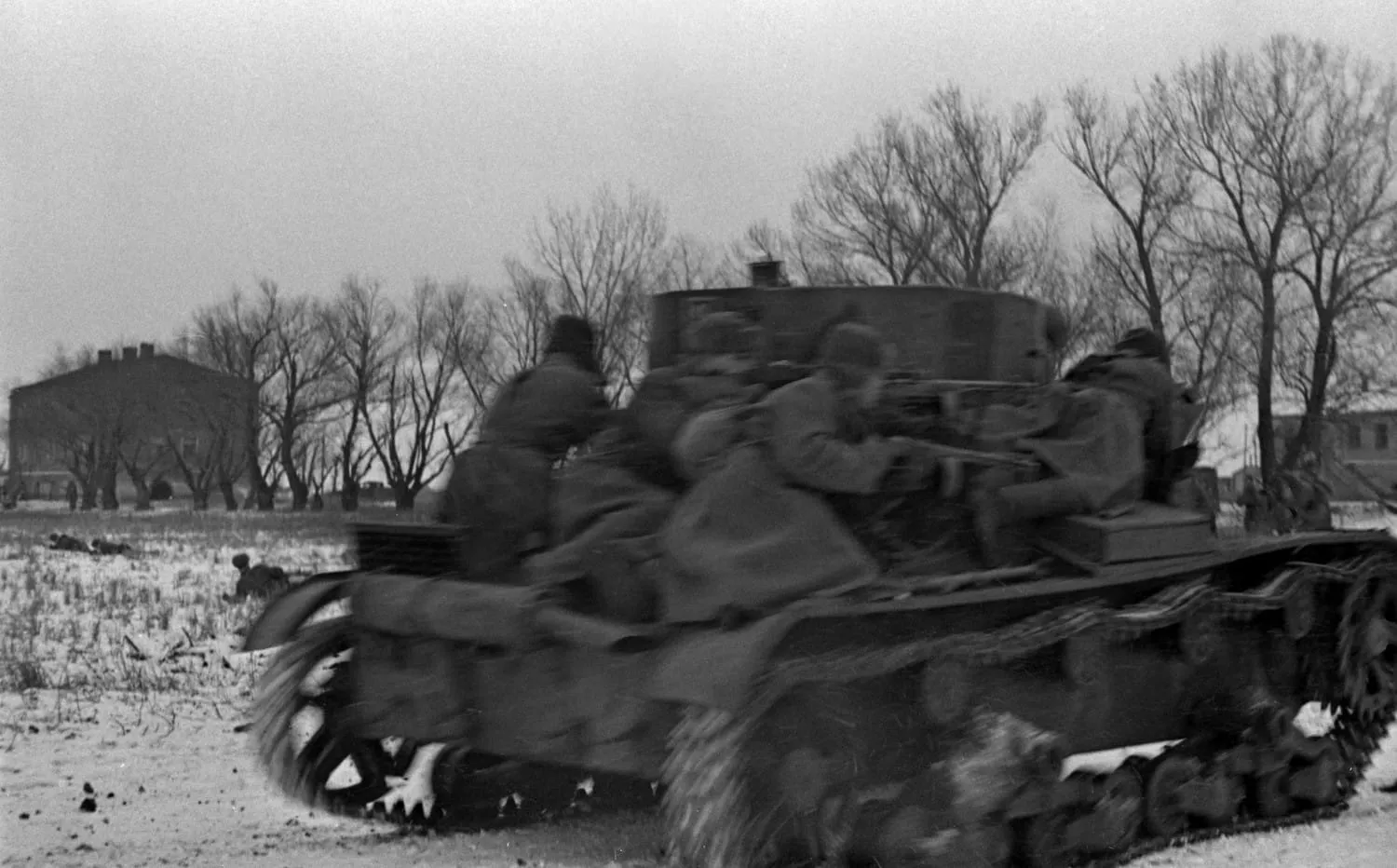
The Battle of Korsun (in the literature also the battle of the Cherkassy pocket; Russian Корсунь-Шевченковская операция) was the encirclement of two corps of the German Eighth Army in a salient of the front on the Dnieper, between Kaniv and Cherkasy, in the winter of 1944. On 24 January 1944 the 2nd Ukrainian Front of General of the Army Ivan Konev attacked the salient from the south-east, and two days later the 1st Ukrainian Front of General of the Army Nikolai Vatutin struck from the north-west. On 28 January the pincers closed near Zvenyhorodka. Some 56,000–60,000 German troops were trapped in the pocket, among them the 5th SS Panzer Division Wiking and the Walloon SS Assault Brigade Wallonien, in which Léon Degrelle served.
For three weeks the encircled troops defended an ever-shrinking pocket while German panzer corps tried to break through to them from outside. The relief force stalled a few kilometres short of its goal, so during the night of 16–17 February General Wilhelm Stemmermann’s group set out to break out on its own. Some of the men reached their own lines near Lysianka, but almost all the equipment was left on the battlefield, many men were killed by Soviet tanks and cavalry or drowned in an icy river, and Stemmermann himself fell. Both sides proclaimed the battle a victory, and historians still dispute how many Germans escaped the encirclement.
Name and dates
Polish and Soviet literature names the battle after the town of Korsun-Shevchenkivskyi (Korsun-Shevchenkovsky), which lies roughly in the middle of the salient. The Germans and most Western authors speak of the “Cherkassy pocket” (Kessel von Tscherkassy), although the Red Army had already taken Cherkasy itself in December 1943 and the town lay outside the encirclement. Soviet historiography, following Ivan Konev, called the victory the “Stalingrad on the Dnieper”. The name “Battle of Korsun” on its own also refers to an engagement fought in 1648.
The battle is best dated by the limits of the Soviet Korsun-Shevchenkovsky operation: from the 2nd Ukrainian Front’s attack on 24 January to 17 February 1944, when, after the German breakout, Soviet units wiped out the last groups of encircled troops west of Shenderivka. Soviet documents count their own losses within the same limits. Some Western studies end the battle on 16 February, the day the breakout order was issued, while others extend it to 18–20 February, when the last stragglers were crossing the Hnylyi Tikych river (Russian: Gniloy Tikich). The operation was the first major battle of the offensive that Soviet historiography calls the Dnieper–Carpathian operation – a series of blows that drove the Germans out of right-bank Ukraine between late December 1943 and April 1944.
Background
In the autumn of 1943 the Red Army won the Battle of the Dnieper: it crossed the river on a broad front, liberated Kiev on 6 November, and in December took Cherkasy and reached the approaches to Kirovograd (now Kropyvnytskyi) and Kryvyi Rih. Field Marshal Erich von Manstein’s Army Group South had failed to hold the “East Wall”, which was supposed to run along the Dnieper and in many places existed only on maps.
On 24 December 1943 the 1st Ukrainian Front launched an offensive from the Kiev area towards Zhytomyr and Berdychiv, and in early January its right wing reached Poland’s pre-war border in Volhynia. In the Kirovograd operation (5–16 January) the 2nd Ukrainian Front took Kirovograd on 8 January. Between these two wedges, on the right bank of the Dnieper, remained the last German grouping still clinging to the river: a salient extending from Kaniv towards Cherkasy, about 100 kilometres long and a few dozen wide, with Korsun at its centre. On the map it looked like a wedge driven into the Soviet front, its flanks reaching towards the rear of both Ukrainian Fronts. The front had taken this shape by mid-December, and in January the salient grew ever deeper.
The salient was held by two corps on the left wing of General Otto Wöhler’s Eighth Army: XI Army Corps under General of Artillery Wilhelm Stemmermann and XLII Army Corps under Lieutenant General Theobald Lieb. They comprised the 57th, 72nd, 88th and 389th Infantry Divisions, Corps Detachment B (the remnants of three shattered divisions), Herbert Gille’s 5th SS Panzer Division Wiking with the Walloon 5th SS Assault Brigade Wallonien under its command, as well as the Estonian SS battalion Narwa and several thousand Russian and Ukrainian volunteers (the so-called Hiwis). On average the divisions were at little more than half their establishment strength. Manstein repeatedly asked for permission to withdraw the corps and shorten the front. Adolf Hitler refused: he hoped the salient would serve as a base for a thrust towards Kiev and the recovery of the Dnieper line, and he regarded any retreat as politically damaging.
For the Soviet command the salient was an obvious target. Marshal Georgy Zhukov, the representative of the Supreme High Command (the Stavka) coordinating the operations of both fronts, proposed cutting it off at its base with two converging thrusts, forming an inner and an outer ring of encirclement and destroying the troops trapped inside – on the model of Stalingrad. The Stavka approved the plan in mid-January, and Joseph Stalin expected a swift and complete victory.
Forces and plan
The main blow from the south-east was to be delivered by Konev’s 2nd Ukrainian Front: the 4th Guards Army and 53rd Army were to break through the defences at the junction of the German corps, after which the 5th Guards Tank Army of Colonel General of Tank Troops Pavel Rotmistrov and the 5th Guards Cavalry Corps were to pour into the gap. The 52nd Army was to pin the Germans down at the eastern end of the salient. From the north-west Vatutin’s 1st Ukrainian Front attacked with the 27th and 40th Armies and the newly formed 6th Tank Army (PL) of General Andrei Kravchenko. The two arms of the pincers were to meet in the Zvenyhorodka–Shpola area, forming the outer ring, while the combined-arms armies formed the inner one.
Soviet superiority was clear, though smaller than later propaganda suggested. The two fronts committed a dozen or more rifle divisions and six tank and mechanised corps to the operation, but the divisions were badly depleted after the autumn fighting, and the tank armies had a few hundred tanks each rather than their full complements. On the other hand, the Red Army’s mobility was now quite different from that of 1942: American all-wheel-drive lorries supplied under Lend-Lease made it possible to carry fuel and ammunition where German vehicles got bogged down in the mud. The operations were covered by the 2nd and 5th Air Armies, and the Soviet command prepared extensive deception measures. The Eighth Army’s war diary nevertheless shows that the Germans expected an attack; what surprised them was the appearance of a new tank army on the western flank.
The battle
The encirclement (24–28 January)
On 24 January 1944, after a reconnaissance in force, the 4th Guards Army and 53rd Army struck the positions of the 389th Infantry Division on the south-eastern edge of the salient. The front was broken on the very first day, and on 25 January Rotmistrov’s army entered the gap. Its 20th and 29th Tank Corps advanced rapidly westwards towards Shpola and Zvenyhorodka. The 389th Division practically ceased to exist, and although the Germans managed to close the breach behind the Soviet tanks, cutting off their rear for several days, they did not stop the spearhead itself.
The 1st Ukrainian Front’s attack, launched on 26 January (25 January according to some studies), made slower progress. The inexperienced 6th Tank Army, with about 160 tanks and 50 self-propelled guns, got stuck in the German defences and had to fight its way through them with the help of the infantry. Only a mobile group of the 233rd Tank Brigade of the 5th Mechanised Corps – a few dozen tanks carrying infantry – passed through Lysianka and on 28 January reached the outskirts of Zvenyhorodka. There it met the leading elements of Rotmistrov’s 20th Tank Corps. The ring was closed.
At first it was thin and full of holes, but over the next few days the two tank armies formed an outer front facing west and south, while the 27th and 52nd Armies and the 4th Guards Army formed the inner ring. Inside were both corps, some 56,000–60,000 men. Command over them was soon assumed by the senior of the two corps commanders, General Stemmermann; the encircled troops were named Group Stemmermann (Gruppe Stemmermann). Konev is said to have assured Stalin that the encircled enemy would not escape.
Fighting in the pocket and the relief attempt (29 January – 15 February)
Manstein reacted quickly. He brought in two panzer corps from other sectors: General Nikolaus von Vormann’s XLVII Panzer Corps on the southern flank and General Hermann Breith’s III Panzer Corps in the west, with the 1st, 16th and 17th Panzer Divisions, the 1st SS Panzer Division Leibstandarte SS Adolf Hitler and the heavy panzer regiment of Lieutenant Colonel Franz Bäke, equipped with Tigers and Panthers. Hitler, however, was not content with a relief operation: he demanded that the two corps, attacking towards each other, should themselves encircle and destroy the Soviet tank armies that had closed the pocket. Breith proposed concentrating his forces on the shortest route to Group Stemmermann, but to no avail.
The attacks began on 1–4 February. Vormann’s weak 11th Panzer Division, with a few dozen tanks and assault guns, stalled after a few days. III Panzer Corps drove in deeper, but by 8 February it was clear that the “counter-encirclement” would fail. Manstein then changed direction: after regrouping, Breith’s corps was to take the shortest route east, towards Lysianka and the pocket. The regrouping cost three days. On 11 February the 16th and 17th Panzer Divisions set off again, took Lysianka and seized a bridgehead on the eastern bank of the Hnylyi Tikych, but could get no further. The thaw set in: the roads turned into swamp, the tanks used twice as much fuel, and supplies had to be carried on men’s backs or dropped from aircraft.
Inside the pocket the situation grew worse by the day. The Soviet command tried to split the encircled forces into pieces: during the night of 5–6 February and again on 7–10 February the 4th Guards Army and the 5th Guards Cavalry Corps struck at the junction of the two corps. Stemmermann patched up one breach after another with the only mobile formation he had – the Wiking division, shuttled from one end of the pocket to the other. The Luftwaffe organised an airlift: Ju 52 transports landed at the airfield at Korsun, bringing in fuel and ammunition and flying out more than 4,000 wounded, and after the airfield was lost on 12 February supplies were dropped by parachute. According to the calculations of the Eighth Army staff, however, this covered only about half of the encircled troops’ daily needs.
On 8 February Soviet envoys came to the German lines under a flag of truce with an ultimatum signed by Zhukov, Konev and Vatutin calling for surrender. Stemmermann and Lieb rejected it. The encircled troops were also appealed to by radio and leaflet by German generals in captivity, members of the League of German Officers and of the National Committee for a Free Germany, among them Walther von Seydlitz-Kurzbach, who had been captured at Stalingrad. They did not persuade the commanders to give up, although many of those later taken prisoner carried the committee’s leaflets as passes into captivity.
The encircled troops gradually shifted the pocket south-west, towards the approaching relief force, giving up ground in the north. On 10–12 February they took the villages of Nova Buda and Komarivka; on 13 February the commander of the Wallonien brigade, SS-Sturmbannführer Lucien Lippert, was killed in the fighting for Nova Buda, and Degrelle took over command. After heavy fighting against the 27th Army the encircled troops held on to Shenderivka (PL), the last sizeable village before the relief force’s lines. The pocket shrank to a few kilometres across and lay under incessant artillery fire and air attack. The soldiers called Shenderivka “the gate of hell”.
Stalin, Zhukov and Konev
The dragging out of the battle and the progress of the German relief force alarmed Stalin. Konev, Zhukov’s ambitious rival, reported that the trouble was caused above all by the 27th Army of Vatutin’s front, which held the most threatened sector of the inner ring. On 12 February the Stavka placed this army under Konev and entrusted him with the entire task of destroying the encircled forces, leaving Vatutin and Zhukov to repel the relief attempt on the outer front. Zhukov wrote in his memoirs that Stalin sharply rebuked him at the time for sluggishness and then left both him and Vatutin out of the victory celebrations: on 18 February Moscow fired artillery salutes for the troops of the 2nd Ukrainian Front alone, which Zhukov called an “unforgivable mistake” on the part of the Supreme Commander. Historians see in this Stalin’s typical habit of playing his subordinates’ ambitions against one another.
The breakout (16–17 February)
On the evening of 15 February the Eighth Army informed Stemmermann that III Panzer Corps, paralysed by the weather and supply shortages, could come no closer: Group Stemmermann would have to break through on its own to the line Zhurzhyntsi – Hill 239, where it would link up with the relief force. The signal did not say that both these positions were in Soviet hands – something the encircled troops discovered only during the breakout. On 16 February Manstein, without waiting for Hitler’s decision, issued the order: “Password Freedom, objective Lysianka, 23.00 hours.” The breakout was to be led by General Lieb; Stemmermann remained with the rearguard, made up of the remnants of the 57th and 88th Infantry Divisions. About 1,450 wounded who could not be taken along were left in Shenderivka in the care of doctors and medical orderlies.
Some 45,000 men set off at night in three columns: in the north a divisional group formed from the 112th Infantry Division, in the centre the 72nd Infantry Division, and in the south Wiking with the Walloons. The first battalions passed through the Soviet lines at night without a shot being fired and towards morning on 17 February reached the German positions at Lysianka and the village of Oktiabr. The left-hand column, however, ran into Soviet tanks on Hill 239 and had to go round it to the south. At dawn the breakout turned into chaos. Guns, wagons and almost all the vehicles that could not climb the icy slopes were abandoned. Konev threw every available tank, all his artillery and the cavalry of the 5th Guards Cavalry Corps into the fight to break the columns apart. German accounts describe T-34 tanks driving into the mass of soldiers, wounded and supply wagons, and Cossacks cutting down the fleeing men with sabres, including those trying to surrender – Soviet accounts present the same slaughter as the destruction of an enemy who refused to lay down his arms.
The main mass of the troops veered south of the bridges built by the relief force and reached the Hnylyi Tikych at a point where the stream, swollen by the thaw, was a dozen or more metres wide and about two metres deep. The men crossed the icy water by swimming, on fallen trees and on abandoned vehicles. Hundreds drowned or died of exposure, and many reached the other bank without weapons, boots or uniforms. The rearguard of the 57th and 88th Divisions crossed later dry-shod, over bridges built by the engineers, bringing several hundred wounded with them. General Stemmermann was killed on 18 February (on 17 February according to some accounts) when his car was hit by a shell from a Soviet anti-tank gun. According to Konev’s memoirs, the general’s body was identified and buried with military honours on his orders. The last groups of stragglers continued to reach Lysianka for several days, while Soviet units rounded up the rest near Shenderivka and along the river.
Losses
The balance sheet of the battle is one of the most disputed on the Eastern Front. Soviet reports and official historiography stated that about 55,000 German dead were counted on the battlefield and in mass graves, and about 18,000 taken prisoner. According to this version, hardly anyone escaped from the pocket. Konev even spoke of 130,000 killed and wounded, a figure confirmed neither by German documents nor by modern historians.
The German documents tell a different story. Of the roughly 60,000 men encircled, fewer than 50,000 remained before the breakout; about 45,000 set out on it, and according to Eighth Army returns some 27,700 soldiers and more than a thousand Russian volunteers reached the lines of III Panzer Corps. Including the wounded evacuated by air before 12 February, the German documents give about 40,000 survivors. On this basis Karl-Heinz Frieser in the German semi-official history of the war, the American Douglas Nash and the Swedes Niklas Zetterling and Anders Frankson conclude that some 35,000–40,000 men got out of the encirclement and that the irrecoverable losses of the encircled forces (killed, missing and captured) were of the order of 20,000. The American historian David Glantz, on the other hand, questions the German survivor figures as inflated. On one point neither side has any doubt: the encircled divisions lost practically all their artillery, tanks, vehicles and transport, and the survivors had to be withdrawn to the rear to be rebuilt.
Soviet losses in the operation from 24 January to 17 February amounted, according to official figures, to 80,188 men, including 24,286 killed and missing and 55,902 wounded. The German relief corps also suffered heavy losses, especially in tanks, some of which could not be recovered from the mud. The inhabitants of the Ukrainian villages on the battlefield, which changed hands many times, were also victims of the fighting.
Significance
Korsun was not a second Stalingrad, as Soviet propaganda proclaimed – a large part of the encircled troops escaped from the pocket – but it was a clear victory for the Red Army. It eliminated the last German salient on the middle Dnieper, put out of action for several months six divisions that had lost all their heavy equipment, and tied down Manstein’s panzer corps at a time when they were needed elsewhere. While the German reserves were fighting near Lysianka, the right wing of the 1st Ukrainian Front took Równe (Rivne) and Łuck (Lutsk), and in February the 3rd and 4th Ukrainian Fronts captured Nikopol and Kryvyi Rih. The battle also showed how much the balance of forces had changed: the Red Army was now capable of conducting a deep encirclement operation with tank armies, while the Wehrmacht – for all its skill in defence and relief operations – could at best save men, not equipment or ground.
The battle brought promotions and propaganda laurels. On 20 February 1944 Konev was made Marshal of the Soviet Union, and a day later Rotmistrov became the first ever Marshal of Armoured Forces (PL). On the German side Gille and Degrelle received high decorations, and Third Reich propaganda presented the breakout as the heroic liberation of comrades-in-arms; General Vormann recalled that the soldiers of the relief force were astonished by news of a “great victory at Cherkassy”. Degrelle, who had come out of the pocket with the Walloons, became a newsreel hero and was received by Hitler. At the end of February 1944 Vatutin was seriously wounded in an ambush by a unit of the Ukrainian Insurgent Army and died in Kiev in April.
Korsun was the first link in a chain of defeats that drove the Germans out of right-bank Ukraine in the spring of 1944. In March both Ukrainian Fronts pressed on west and south: Konev’s troops reached the Dniester and the Prut, while the First Panzer Army was encircled near Kamenets-Podolsky (Kamianets-Podilskyi) and broke out of the pocket only with the greatest difficulty. Hitler dismissed Manstein on 30 March 1944. In April the Red Army entered Romanian territory and stood at the foot of the Carpathians, and the front moved onto the lands of pre-war Poland – near Kowel (Kovel), Tarnopol (Ternopil) and Brody. The Red Army later applied the experience of Korsun – deep encirclement, a double ring and fighting off a relief force – in Belarus and at Iași and Chișinău.