Soviet Union
Georgy Zhukov
Commander of Soviet forces at Khalkhin Gol (1939), Chief of the General Staff (1941), Deputy Supreme Commander-in-Chief (1942–1945), Marshal of the Soviet Union (from 1943), Soviet Minister of Defence (1955–1957)
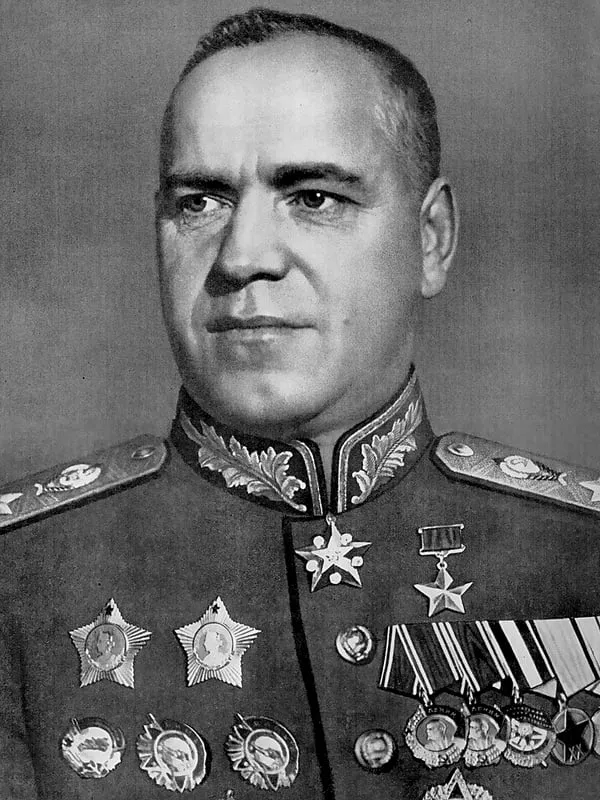
- Born:
- 1 December 1896, Strelkovka, Kaluga Governorate (Russian Empire)
- Died:
- 18 June 1974, Moscow (USSR)
- Author:
- Natalia
- Photo:
- Grigorij Wajl, domena publiczna, Wikimedia Commons

Georgy Zhukov was the most famous commander of the Red Army in the Second World War. The son of poor peasants from near Kaluga, a non-commissioned officer in the Tsarist cavalry in the First World War and a Red squadron commander in the Civil War, he rose through the interwar years in the shadow of greater names, and he survived the Great Purge even as his superiors perished one after another. The world first heard of him in the summer of 1939 in Mongolia, where in the Battle of Khalkhin Gol he encircled and destroyed a Japanese division. That victory, won in the last days of peace in Europe, influenced Japan’s decision not to attack the USSR and opened Zhukov’s way to the top. During the war with Germany he was Chief of the General Staff, commander of fronts and deputy to Joseph Stalin as Supreme Commander-in-Chief. He defended Leningrad and Moscow, helped devise the plan for the encirclement at Stalingrad, and in 1945 took Berlin and accepted Germany’s surrender. Twice removed from power in later years, he remained for Russians a symbol of victory – and for many historians also a commander who won at the cost of enormous losses.
Furrier and dragoon
He was born on 1 December 1896 (19 November in the Julian calendar) in the village of Strelkovka in the Maloyaroslavets district of Kaluga Governorate, about a hundred kilometres south-west of Moscow. His father, Konstantin, was a shoemaker who had been placed in an orphanage as a child; his mother, Ustinya, worked in the fields. Georgy completed three years at a parish school, and in 1908 he went to Moscow to be apprenticed to his uncle, a furrier. In the evenings he studied at a school for adults. By 1912 he was a journeyman with three boys under him.
In August 1915 he was called up into the army. He was posted to the cavalry and, after training as an NCO, fought in the 10th Novgorod Dragoon Regiment on the South-Western Front. He received two soldier’s Crosses of St George for bravery. In October 1916 he was badly concussed by an exploding mine and partly lost his hearing. The revolution found him in a reserve regiment; in December 1917, after the old army had disintegrated, he returned home, where he lay ill with typhus for a long time.
Red cavalryman
On 1 October 1918 he volunteered for the Red Army, and in March 1919 he joined the Bolshevik party. In the Civil War he fought in the 1st Moscow Cavalry Division against the Ural Cossacks, then near Tsaritsyn against the forces of Anton Denikin; in the autumn of 1919 he was wounded by grenade fragments. In 1920 he completed a cavalry course in Ryazan and became a platoon commander, then a squadron commander. From December 1920 to August 1921 he took part in suppressing the peasant Tambov Rebellion, for which he received the Order of the Red Banner: on 5 March 1921, near the village of Vyazovaya Pochta, his squadron held off the attack of a much stronger rebel force for several hours. The Civil War shaped him for life. He came out of it convinced that a commander must be hard on his subordinates and ruthless towards the enemy.
In the 1920s he commanded a cavalry regiment in Belarus, completed the Higher Cavalry School in Leningrad and, in 1929–1930, courses for senior commanders at the Frunze Military Academy. In 1930 he took over a brigade in the 7th Samara Cavalry Division, commanded by Konstantin Rokossovsky. Rokossovsky wrote in an evaluation at the time that Zhukov had “a strong will” and was “decisive and firm”, “demanding and stubborn”, but “not very kindly” and “morbidly ambitious”. The rivalry between the two commanders lasted to the end of their lives. In 1933 Zhukov took over the 4th Cavalry Division in Slutsk, in 1937 the 3rd and in 1938 the 6th Cavalry Corps, and in July 1938 he became deputy commander for cavalry of the Belorussian Special Military District.
These were the years of the Great Purge. The commanders under whom Zhukov had served and who had promoted him were killed: Marshal Mikhail Tukhachevsky, the commander of the Belorussian Military District Ieronim Uborevich and many others. At a party conference Zhukov was accused of having “failed to notice enemies of the people” around him. According to his memoirs, he then telegraphed Stalin and the People’s Commissar for Defence, Kliment Voroshilov, and the matter died down. In February 1938 he was given the rank of Komdiv, equivalent to major general. The purge that swept away his elders opened the way for younger men like him.
Khalkhin Gol
In May 1939, on the disputed border between Mongolia and Manchukuo, fighting broke out involving Japanese and Mongolian troops and the Soviet 57th Special Corps stationed in Mongolia. The first clashes went badly for the Red Army. On 1 June Voroshilov summoned Zhukov to Moscow and sent him to Mongolia on an inspection. Zhukov arrived on 5 June, and his reports were so critical of the corps command that on 12 June he was given the command himself. He moved his headquarters from Ulan Bator to Mount Khamar-Daba, a few kilometres from the front, and began bringing up tanks, artillery and aircraft. The coordination of all Soviet forces in the Far East was entrusted to Komandarm 2nd Rank Grigory Shtern, a veteran of Spain and of the fighting at Lake Khasan.
At the beginning of July the Japanese crossed the Khalkhin Gol and seized Mount Bain-Tsagan on the western bank. Without waiting for the infantry, Zhukov threw the 11th Tank Brigade and an armoured car brigade straight into a counter-attack from the line of march. The losses in equipment were enormous, but after three days of fighting the Japanese withdrew across the river. This decision, contrary to the regulations, brought a denunciation of Zhukov to Moscow and an inspection by the Deputy Commissar for Defence, Grigory Kulik, and then by the head of the army’s political directorate, Lev Mekhlis. Zhukov’s results spoke in his defence. On 19 July his corps was converted into the 1st Army Group, and at the end of the month he was given the rank of Komkor.
Over the following weeks he prepared his blow. Several thousand lorries brought ammunition, fuel and food from the nearest railway stations, hundreds of kilometres away, while the troops concealed the build-up by transmitting false reports about the construction of winter fortifications. At dawn on 20 August 1939, after an air raid and an artillery bombardment, the offensive began. The infantry pinned the Japanese down in the centre while armoured and motorised groups outflanked them on the wings and after a few days closed the encirclement in the Nomonhan area. By 31 August General Michitarō Komatsubara’s 23rd Infantry Division had been largely destroyed. On 29 August Zhukov received the first of his four gold stars of Hero of the Soviet Union. A ceasefire was signed in Moscow on 15 September, and two days later the Red Army marched into Poland. Zhukov’s command in Mongolia was harsh: he punished commanders for every setback, and many of his subordinates remembered him as severe to the point of cruelty. He himself later regarded Khalkhin Gol as the school in which he learned to coordinate tanks, artillery, aircraft and infantry.
Before the war with Germany
In May 1940 Stalin received Zhukov in the Kremlin; in June he promoted him to General of the Army and gave him the Kiev Special Military District, the largest in the country. In the same month Zhukov commanded the troops that, after the Soviet ultimatum to Romania, occupied Bessarabia and northern Bukovina. In January 1941, in map war games at the General Staff, he commanded the “blue”, that is German, side and by most accounts outperformed his opponents. Stalin soon appointed him Chief of the General Staff, a post Zhukov held from 1 February 1941.
His role in the last months before the war is disputed. In mid-May 1941 the General Staff drafted a plan under which the Red Army was to forestall a German attack with a strike through southern Poland. The document, which bears no signatures, was found in the archives after 1991. Some authors, led by Viktor Suvorov, saw it as proof of Soviet preparations for aggression; most historians believe that Stalin did not approve it and that in June 1941 the Red Army was ready neither to attack nor to defend. Zhukov himself admitted after the war that the plan had not been approved.
From Leningrad to Stalingrad
When the Germans launched Operation Barbarossa on 22 June 1941, Zhukov signed the directive ordering immediate counter-attacks, which were unrealistic given that the frontier armies had been shattered. After several weeks of defeats, at the end of July, he proposed to Stalin that Kiev be abandoned to prevent the encirclement of the South-Western Front. Stalin rejected this advice and removed him from the General Staff. At the head of the Reserve Front Zhukov carried out the Yelnya offensive, the Red Army’s first successful attack of the war. Meanwhile, in September, the Germans encircled and captured several hundred thousand Soviet soldiers at Kiev.
In September 1941 Stalin sent him to Leningrad, which the Germans had just cut off from the rest of the country. Zhukov strengthened the city’s defences, sent to the front everyone who could fight and resorted to draconian measures. His coded order of 28 September 1941 announced that the families of soldiers who surrendered would be shot, and so would the soldiers themselves on their return. In October, when the Germans broke through the front at Vyazma and Bryansk, Stalin summoned him to Moscow and gave him command of the Western Front. Zhukov halted the German advance on the approaches to the capital, and on 5 and 6 December he launched the counter-offensive that drove the Germans back from Moscow. For it he used fresh divisions brought from Siberia and the Far East, which was possible partly because Japan, remembering Khalkhin Gol, did not attack the USSR.
The year 1942 brought him defeats about which Soviet historiography long kept silent. The bloody attacks on the so-called Rzhev salient, including Operation Mars in November and December, cost hundreds of thousands killed and wounded without breaking the German defences. In August 1942 Stalin made him his deputy as Supreme Commander-in-Chief. Together with the Chief of the General Staff, Aleksandr Vasilevsky, Zhukov prepared Operation Uranus, which in November 1942 encircled the German 6th Army at Stalingrad. Its pattern – pinning the enemy down in the centre and striking his weak flanks with powerful groupings – recalled the manoeuvre on the Khalkhin Gol. In January 1943 Zhukov coordinated the breaking of the siege of Leningrad and became the first Marshal of the Soviet Union created since the outbreak of the war. In the summer, as a representative of the Stavka, he took part in the Battle of Kursk, although Rokossovsky later claimed that Zhukov had taken more credit for it than he deserved.
The Vistula, the Oder, Berlin
In the spring of 1944, after General Nikolai Vatutin was mortally wounded, Zhukov commanded the 1st Ukrainian Front for two months. In the summer he coordinated the Belorussian fronts in Operation Bagration, which smashed the German Army Group Centre and brought the Red Army to the Vistula. As a representative of the Stavka he also supervised operations on the Warsaw axis over the following months, with a break to prepare the entry into Bulgaria. During the Warsaw Uprising the Soviet forces halted on the right bank of the Vistula. In their memoirs Zhukov and Rokossovsky attributed this to the exhaustion of the troops after the great offensive and to the strength of the German defence. Polish historians point out that the decision on how much help to give the insurgents was above all a political one and was taken by Stalin.
On 16 November 1944 Zhukov took command of the 1st Belorussian Front, which included the Polish 1st Army. In January 1945 his forces opened the Vistula–Oder offensive; on 17 January soldiers of the Polish 1st Army entered the ruins of Warsaw, and by the end of the month the front’s spearheads stood on the Oder, less than a hundred kilometres from Berlin. In February and March Zhukov cleared Pomerania, where the Polish 1st Army broke through the Pomeranian Wall. On 16 April he launched the Berlin offensive. The assault on the Seelow Heights cost him heavy losses, because Stalin played him off against his rival, Marshal Ivan Konev, whose 1st Ukrainian Front was also heading for Berlin. On 2 May the city’s garrison capitulated. On the night of 8–9 May 1945 at Karlshorst Zhukov accepted, on behalf of the USSR, the instrument of Germany’s unconditional surrender, signed by Field Marshal Wilhelm Keitel. On 24 June, mounted on a white horse, he took the salute in Red Square at the Victory Parade, which was commanded by Rokossovsky.
His soldiers entered Germany after years of German crimes on Soviet soil. Zhukov’s orders of early 1945 called for vengeance for loved ones “tortured to death”, and the Red Army’s advance was accompanied by mass rape, looting and violence against civilians, on Polish lands as well. In occupied Germany Zhukov was the first commander-in-chief of the Group of Soviet Forces and head of the Soviet Military Administration. He sat on the Allied Control Council, took part in the Potsdam Conference and became friends with General Dwight Eisenhower.
Two falls
Zhukov’s popularity troubled Stalin. In 1946 the marshal was recalled from Germany, and at a meeting of the Main Military Council in June he was accused of claiming credit for the victory and of disloyalty. The security police arrested and tortured his associates to extract testimony incriminating him. Zhukov was given the second-rank Odessa Military District, and in 1948, after a search that turned up furniture, paintings and valuables brought back from Germany, the even less important Urals District. He was not, however, arrested.
After Stalin’s death in March 1953 Zhukov became First Deputy Minister of Defence. On 26 June 1953, at a meeting of the party leadership, he personally arrested the head of the political police, Lavrentiy Beria, which decided the struggle in favour of Nikita Khrushchev. In 1954, at the Totskoye range, he directed troop exercises in which a real atomic bomb was used. In February 1955 he became Soviet Minister of Defence. That year he accompanied Khrushchev to the Geneva conference, and in 1956, as minister, he was responsible for the military side of the suppression of the Hungarian Revolution. He pressed for the rehabilitation of the commanders murdered in the purge, among them Tukhachevsky, Uborevich, Blyukher and Shtern. In June 1957 his support saved Khrushchev from the plot of Molotov, Malenkov and Kaganovich, and in return Zhukov was made a member of the Presidium of the Central Committee. A few months later Khrushchev decided that the marshal had grown too powerful. When Zhukov returned from a visit to Yugoslavia and Albania in October 1957, he was dismissed as minister, and a plenum of the Central Committee removed him from the party leadership, accusing him of “Bonapartism” and of undermining the party’s role in the army. In 1958 he was retired.
Last years and memory
In retirement Zhukov wrote his memoirs. After Khrushchev’s fall Leonid Brezhnev restored his public honours, and in May 1965 the marshal stood on the reviewing stand during the celebrations of the twentieth anniversary of victory. His Reminiscences and Reflections (PL) appeared in 1969, after years of wrangling with the censors, who cut his criticism of Stalin and inserted passages about Brezhnev’s role; a fuller version was published only at the end of the 1980s. Zhukov died in Moscow on 18 June 1974. Against his wishes his body was cremated, and the urn with his ashes was immured in the Kremlin Wall.
Zhukov was four times Hero of the Soviet Union and twice a recipient of the Order of Victory. In Russia he is regarded as the greatest military leader of the twentieth century, compared with Suvorov and Kutuzov. Western historians, and Russian ones after 1991, take a more nuanced view: they see a commander of exceptional willpower and operational talent, who saved Moscow and won the war’s key battles, but who also suffered defeats, as at Rzhev, and paid no heed to losses in his own ranks. His first victory was of particular importance for the course of the war: on the Khalkhin Gol in August 1939 Zhukov not only tested the method of fighting he later used against the Germans, but also helped ensure that in 1941 Japan struck south rather than at the Soviet Union.
Sources
Commanded in battles
(17)- 11 May – 16 September 1939The Battle of Khalkhin GolFar East
- 22 June – 5 December 1941Operation BarbarossaEastern Front
- 10 July – 10 September 1941Battle of Smolensk (1941)Eastern Front
- 8 September 1941 – 27 January 1944Siege of LeningradEastern Front
- 30 September 1941 – 7 January 1942Battle of MoscowEastern Front
- 8 January – 20 April 1942Rzhev–Vyazma offensive (1942)Eastern Front
- 28 June – 18 November 1942Case BlueEastern Front
- 23 August 1942 – 2 February 1943Battle of StalingradEastern Front
- 5 July – 23 August 1943Battle of KurskEastern Front
- 26 August – 23 December 1943Battle of the DnieperEastern Front
- 24 January – 17 February 1944Battle of the Korsun–Cherkassy PocketEastern Front
- 22 June – 29 August 1944Operation BagrationEastern Front
- 13 July – 29 August 1944Lwów–Sandomierz offensiveEastern Front
- 12 January – 3 February 1945Vistula–Oder offensiveEastern Front
- 24 January – 23 February 1945Battle of PoznańPoland
- 10 February – 4 April 1945East Pomeranian offensiveEastern Front
- 16 April – 2 May 1945The Battle of BerlinEastern Front
Mentioned in battles
(06)Often appears with
People who appear in the same events.
On the timeline
(84)The 40 most important of 84 events. All tagged “Georgy Zhukov” (20) →