Belgium
Léon Degrelle
Leader of the Rex party (1935–1945), commander of the Walloon volunteers of the Wehrmacht and Waffen-SS (1941–1945)
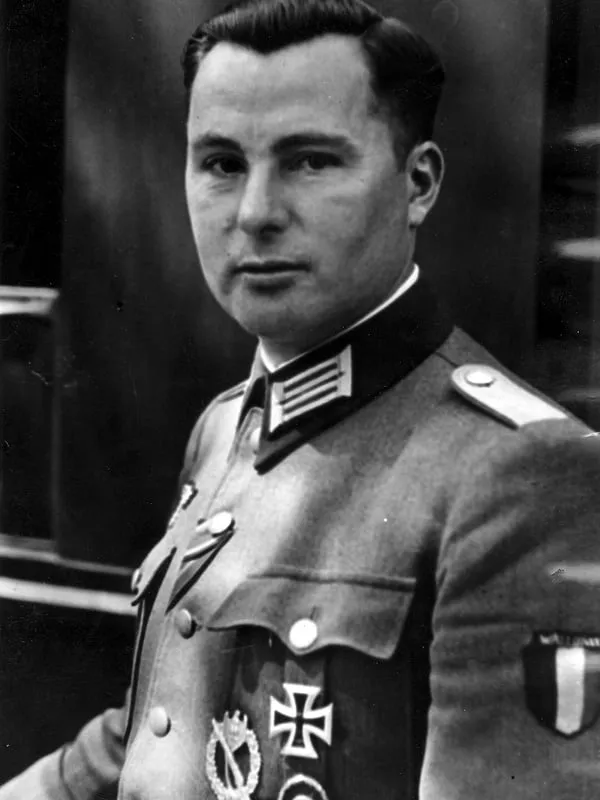
- Born:
- 15 June 1906, Bouillon (Belgium)
- Died:
- 31 March 1994, Málaga (Spain)
- Author:
- Łukasz
- Photo:
- Alber, domena publiczna, Wikimedia Commons

Léon Degrelle was Belgium’s most notorious fascist and one of the best-known figures of collaboration in occupied Europe. In the mid-1930s, as a Catholic journalist not yet thirty, he created the Rex movement, which in 1936 won more than a tenth of the vote and shook Belgian democracy. After Belgium’s defeat in 1940 he openly tied his movement to Nazi Germany, and from 1941 he fought on the Eastern Front with the Walloon volunteers, first in the Wehrmacht and then in the Waffen-SS. Hitler held him up as a model for collaborators throughout Europe. Sentenced to death in absentia in Belgium, he escaped in 1945 to Franco’s Spain and for half a century, until his death in 1994, was a patron of European neo-Nazis and Holocaust deniers.
Youth and Catholic journalism
Léon Joseph Marie Ignace Degrelle was born on 15 June 1906 in Bouillon, in the Ardennes in the Belgian province of Luxembourg, the fifth child of Édouard Degrelle, a brewer from the French Ardennes, and Marie Boever. His father, a naturalised Belgian, was a conservative Catholic Party politician and a provincial councillor. The household was deeply religious. Léon was educated at a Jesuit school in Namur, where he devoured Léon Bloy, Charles Péguy and above all Charles Maurras, the ideologue of the monarchist and nationalist Action Française.
From the mid-1920s he studied at the Catholic University of Louvain, but he was more absorbed by the Catholic Action of Belgian Youth and by journalism than by law, and he never completed his studies. He wrote poems, pamphlets and polemical books, and in 1929 Father Norbert Wallez took him on at the Catholic daily Le Vingtième Siècle, where the cartoonist Hergé was also starting out at the time. After an article in which he praised the assassination of the Mexican President-elect Álvaro Obregón by a Catholic assassin, Degrelle went to Mexico and wrote reports on the Cristero War, the Catholic rebellion against the anticlerical government.
In October 1930 the Catholic Action of Youth put him in charge of a small publishing house, Christus Rex, named after Christ the King. Degrelle turned it into a business producing mass-circulation periodicals and pamphlets, and from 1931 he and his father took control of it. He gradually made it a platform for attacks on the leadership of the Catholic Party, which he accused of weakness and of ties to high finance. In 1932 he married Marie-Paule Lemay, with whom he had five children.
Rex and the 1936 election
In 1935 Christus Rex became a political movement, and its supporters came to be called Rexists. On 2 November 1935 Degrelle and his men burst into a congress of Catholic activists in Kortrijk and demanded that the party leaders step down. A few days later he was expelled from the party, and Cardinal Joseph-Ernest van Roey forbade the clergy to cooperate with Rex. In February 1936 Degrelle announced that his movement would stand in the elections and founded the daily Le Pays Réel.
The campaign was tempestuous. Degrelle, a superb speaker, addressed countless rallies, promised to sweep away the “rotten” politicians with a broom, and accused the government of the former banker Paul van Zeeland of links with the “banksters”. The programme of Rex was authoritarian and corporatist: a strong government answerable to the king, curbs on parliamentarism, Catholic moral renewal. In the election of 24 May 1936 Rex won 11.5 per cent of the vote, 21 of the 202 seats in the Chamber of Representatives and 12 in the Senate, with more than 15–20 per cent in some districts of Wallonia and Brussels. King Leopold III received him, as he did the other party leaders, and is said to have remarked afterwards that Degrelle had proved both conceited and inadequate.
The peak came quickly and passed just as quickly. Degrelle travelled to Italy, from where he received subsidies from the government of Benito Mussolini, and on 26 September 1936 he was received in Germany by Adolf Hitler and Joseph Goebbels. On 6 October he signed a secret agreement with the Flemish nationalists of the Flemish National Union (VNV), and its disclosure alienated many Belgian patriots. A march on Brussels on the Mussolini model, announced for 25 October 1936, drew a few thousand people instead of the promised hundreds of thousands and ended with Degrelle’s detention by the police.
In March 1937 Degrelle forced a by-election in Brussels, hoping that his victory would compel the king to dissolve parliament. The Socialists, Catholics and Liberals put up a joint candidate against him, Prime Minister Van Zeeland, and Cardinal Van Roey publicly condemned Rex as a danger to the country and the Church. On 11 April 1937 Degrelle was defeated, winning 19 per cent of the vote against the Prime Minister’s 76 per cent. After that defeat the movement steadily lost members and voters. In the election of April 1939 Rex took 4.4 per cent of the vote and 4 seats in the Chamber, with Degrelle himself elected for Brussels. The movement, increasingly antisemitic, was turning into an openly fascist party.
War, prison and return
In September 1939 Degrelle, like most Belgian politicians, supported the country’s neutrality, but he blamed the war on Britain, France and the “hidden forces of freemasonry and Jewish finance”. In January 1940 he secretly asked the Germans for money for a new daily. On 10 May 1940, the day of the German invasion, the Belgian authorities arrested him in breach of his parliamentary immunity, together with several thousand people suspected of sympathising with the enemy, and handed him over to the French. He was beaten and moved from prison to prison. He escaped the fate of the 21 prisoners shot by French soldiers at Abbeville on 20 May, and in Belgium he was long believed to be dead. Traced in July to the Le Vernet internment camp, he was released thanks to the German diplomat Otto Abetz and returned to Brussels on 30 July 1940.
After the capitulation of its army Belgium was under German military administration, the king was a prisoner and the government was in exile. Degrelle hoped to become head of the government of an authoritarian Belgium within a German Europe. He sought the backing of the court, the Church and the Germans and reached an understanding with the Socialist Henri de Man, but Leopold III refused to receive him and the occupiers ignored him. He therefore relaunched Le Pays Réel and built up the Formations de Combat, strong-arm squads that attacked Jewish shops in the autumn of 1940.
Collaboration and the Eastern Front
On 1 January 1941 he ended an article in his newspaper with the salute “Heil Hitler”, and on 5 January, at a rally in Liège, he proclaimed the ideological kinship of Rexism and Nazism. The turn did not bring him power, and Rex kept losing members. In May 1941 the Germans handed its Flemish branch over to the VNV. The attack on the USSR became his lifeline. In July 1941 Degrelle obtained permission to form a unit of French-speaking volunteers, the Walloon Legion, and announced that he himself would join it as a private. On 8 August some 850 volunteers, most of them Rexists, left for training in the Reich. Degrelle handed over the leadership of Rex at home to Victor Matthys.
The Legion, attached to the Wehrmacht, fought from 1942 in Ukraine and the Donets Basin, losing most of its men. Degrelle, brave and fond of risk, was promoted, won the Iron Cross and became an officer in 1942. He understood, however, that in Nazi Europe it was the SS that counted. He courted Heinrich Himmler, and on 17 January 1943 in Brussels he declared that the Walloons were a Germanic people forced to speak French. Many former Rexists then left the movement. On 1 June 1943 the Legion was transferred to the Waffen-SS as the SS Assault Brigade Wallonien. During this period Degrelle enriched himself with property seized from Jews, and when in July 1943 the parish priest of Bouillon refused him communion because he was in German uniform, his men held the priest for several hours in the Degrelle family home. The Bishop of Namur excommunicated him for it, although the penalty was later lifted.
At the turn of January and February 1944 the brigade was caught in the encirclement at Cherkasy (Korsun). It broke out decimated, and its commander, Lucien Lippert, was killed. Degrelle formally took command of the brigade, and on 20 February 1944 Hitler presented him with the Knight’s Cross. Propaganda made him a hero, and in April the surviving legionaries marched in full kit through Charleroi and Brussels. When the resistance shot his brother Édouard in July 1944, Degrelle demanded that Himmler execute a hundred hostages. Himmler did not grant the demand, but Rexists linked to the German Security Police murdered three hostages near Bouillon. Further shootings and killings in Belgium were carried out by Rexists, and their leader never expressed disapproval of them.
In the summer of 1944 Degrelle fought with the Walloons in Estonia, and at the end of August (sources give 25 or 27 August) he received the Oak Leaves to the Knight’s Cross from Hitler. According to his later accounts, Hitler told him on that occasion that if he had a son, he would want him to be like Degrelle; historians regard these words as his invention. In September the brigade was renamed the 28th SS Grenadier Division Wallonien, although it never reached divisional strength. In 1945 the remnants of the unit fought in Pomerania and on the Oder. Rex, dissolved in March 1945, left behind in Belgium a memory of treason and terror.
Flight to Spain
In December 1944 a Belgian military court sentenced Degrelle to death in absentia, and he was later stripped of his citizenship. At the end of April 1945 he abandoned his men and made his way through Denmark to Norway, which was still occupied. There, on 7 May, he boarded a Heinkel He 111 bomber – according to many accounts an aircraft belonging to the minister Albert Speer – made available to him by Josef Terboven. The next day the aircraft crash-landed on a beach at San Sebastián. Degrelle, seriously injured, was taken to hospital.
The government of Francisco Franco was unwilling to hand him over. Belgium demanded his extradition, and the British and Americans considered taking custody of him as a member of the German armed forces, but in the summer of 1946 (some studies give 1947) Degrelle vanished from the hospital with the evident help of the Spanish authorities. He hid in Andalusia, and in 1954, having been adopted by a Spanish woman, he obtained Spanish citizenship as León José de Ramírez Reina. He made money from a construction company that among other things worked on building American air bases in Spain. In 1964 Belgium extended the limitation period of his sentence by a special law known as the lex Degrelliana, and later barred him from entering the country.
An unrepentant Nazi
From the 1960s Degrelle again appeared in public. He showed himself in SS uniform, was friends with Otto Skorzeny and kept up contacts with the far right in Spain, France, Belgium and Germany, including Jean-Marie Le Pen. His villa near Málaga became a place of pilgrimage for neo-Nazis. He wrote books in which he presented himself as a soldier of Europe fighting Bolshevism and as a close confidant of Hitler, although in reality he met him only a few times. In a frequently cited interview of 1977 he said that he had been a Nazi and would remain one until his death.
He was also one of the leading purveyors of Holocaust denial. In 1979, before the visit of John Paul II to Auschwitz, he addressed an open letter to the Pope in which he denied that the extermination had taken place. In 1985 he repeated in an interview with the Spanish weekly Tiempo that there had been no gas chambers and that Josef Mengele had been an ordinary doctor. He was then sued by Violeta Friedman, an Auschwitz survivor whose family had died in the gas chambers. The lower courts dismissed her suit, but in 1991 the Spanish Constitutional Court found in her favour, ruling that freedom of expression did not protect statements that violated the dignity of the victims of genocide. The judgment influenced later Spanish legislation against genocide denial.
His first wife, sentenced to imprisonment in Belgium after the war, did not follow him to Spain and died in 1984. That same year Degrelle married Jeanne Brevet Charbonneau, a relative of Joseph Darnand, head of the Vichy Milice. He died of heart failure on 31 March 1994 in a hospital in Málaga, aged 87. Belgium refused to allow his remains to be brought back, and his ashes were scattered, according to differing accounts, near Berchtesgaden or near Bouillon.
Assessment
Degrelle was a gifted orator and agitator whose charisma briefly carried a sizeable part of the rebellious Catholic middle class with him in 1936. His career shows how democratic Belgium was able to defend itself: the common front of the parties and the Church in 1937 pushed Rex to the margins long before the war. Degrelle rose to prominence only thanks to the German occupation, and not as a politician – the occupier never gave him power – but as a soldier whose courage was exploited by SS propaganda. Historians, from Martin Conway to Belgian scholars of collaboration, stress that his real influence was far smaller than he claimed in his memoirs, which are full of boasting and invention. For Belgians he remained a symbol of treason and impunity, and for the post-war far right one of the last surviving leaders of the collaborationist movements and the source of the myth of the Waffen-SS’s “European” crusade.
Sources
Mentioned in battles
(01)Often appears with
People who appear in the same events.