1935–1936: The Italian invasion of Ethiopia
The Second Italo-Ethiopian War
- Dates:
- 3 October 1935 – 5 May 1936
- Front:
- Africa
- Location:
- The Ethiopian Empire (Abyssinia). Northern front: from the Eritrean border through Tigray (Adwa, Aksum, Mekelle, Tembien, Amba Aradam, Maychew) to Dessie and Addis Ababa; southern front: from Italian Somaliland through the Ogaden (Gorahei, Degehabur) and the Genale Doria valley (Dolo, Negele Boran) towards HararOn the battle map →
- Sides:
- Kingdom of Italy (with colonial troops from Eritrea, Somaliland and Libya)Emilio De Bono, Pietro Badoglio, Rodolfo GrazianiEthiopian EmpireHaile Selassie I, Ras Imru, Ras Desta
- Result:
- Italian victory. The Italians took Addis Ababa on 5 May 1936, and on 9 May Mussolini proclaimed the annexation of Ethiopia. Guerrilla resistance, however, continued until the country's liberation in 1941.
- Author:
- Łukasz
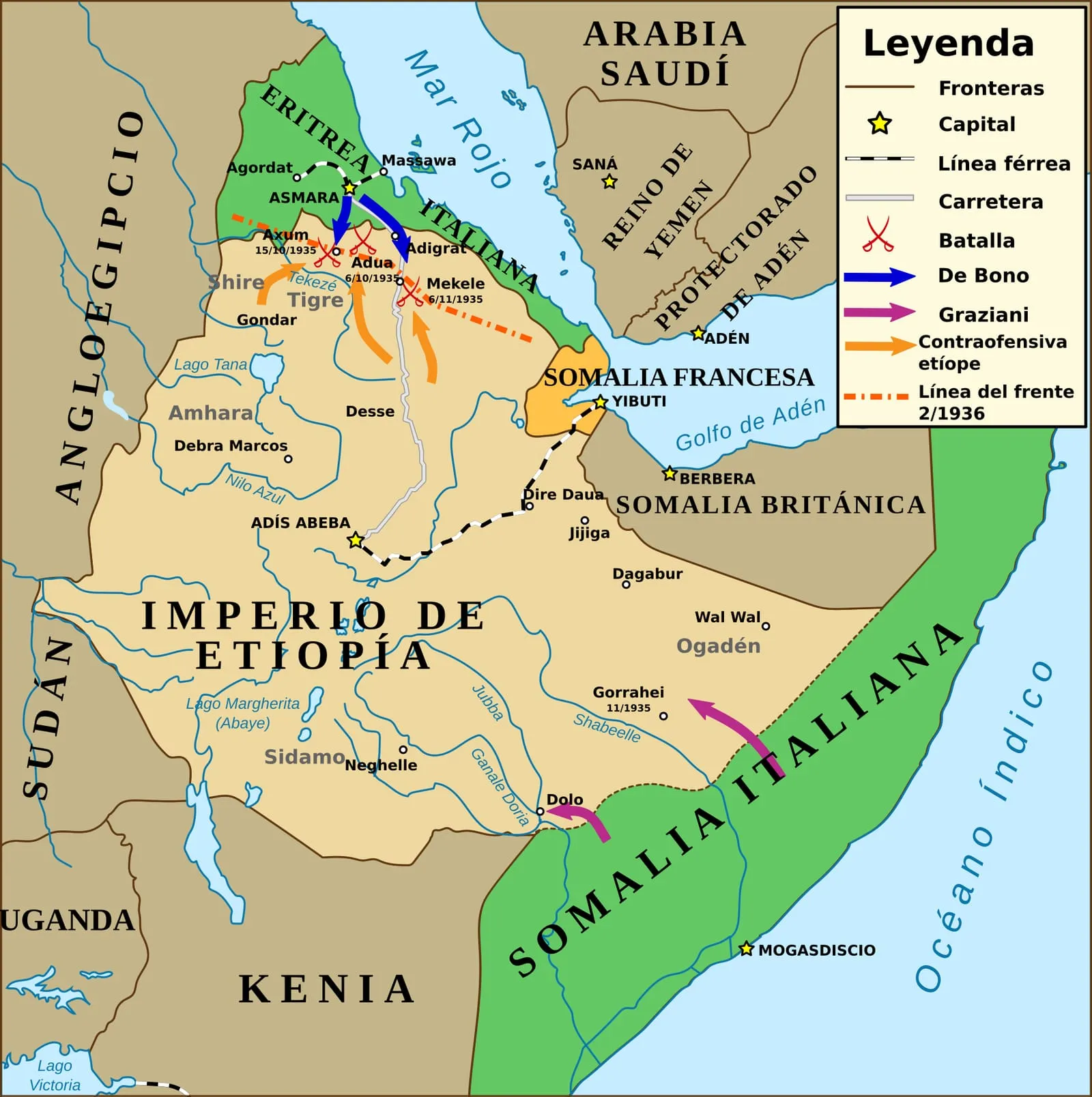
The Second Italo-Ethiopian War is regarded as the largest colonial war in history. It was also the first war in which one member of the League of Nations conquered another member state in its entirety. On the morning of 3 October 1935, without a declaration of war, the troops of Benito Mussolini crossed the border river Mareb from Eritrea into Ethiopia, while smaller forces advanced from Italian Somaliland. The empire of Haile Selassie I, alongside Liberia the only fully independent African-ruled state on the continent, fielded a large but poorly armed army that had no air force, almost no artillery and no means of defending itself against aircraft. The League of Nations declared Italy the aggressor and imposed sanctions on it, but without an oil embargo and without closing the Suez Canal, while at the same time Britain and France were secretly preparing a plan to partition Ethiopia. After an unsuccessful Ethiopian counter-offensive in the winter of 1935, the Italians – dropping mustard gas from aircraft on a massive scale – destroyed one imperial army after another in February and March 1936. On 5 May 1936 Marshal Pietro Badoglio rode into Addis Ababa, and four days later Mussolini proclaimed the birth of an empire. The war, which cost the Ethiopians tens of thousands of lives – hundreds of thousands by their own reckoning – destroyed the credibility of the League of Nations and the system of collective security, and pushed Mussolini, condemned by London and Paris, into the arms of Adolf Hitler.
Name and dates
The war is called the Second Italo-Abyssinian or Italo-Ethiopian War to distinguish it from the first, of 1895–1896, which ended in Italy’s defeat at Adwa. The names Abyssinia and Ethiopia were used interchangeably at the time: Europe preferred the former, the Ethiopians and their state the latter. In Italy it was, and still is, called the Ethiopian War (guerra d’Etiopia), and Fascist propaganda called it the conquest of the empire. In Ethiopia the war and the years of occupation that followed are referred to simply as the Italian invasion. Neither Italy nor Ethiopia formally declared war. Mussolini spoke of a response to an Ethiopian threat to Italy’s colonies, while Haile Selassie, who to the end avoided any step that the Italians could use as a pretext, publicly announced general mobilisation only when the Italian columns were already on the march.
The war is dated from 3 October 1935, the day the border was crossed, to 5 May 1936, when the Italians took the capital and Mussolini announced that the war was over. That date, like the annexation proclaimed on 9 May, is, however, largely conventional. In the south, the army of General Rodolfo Graziani took Harar on 8 May and Dire Dawa on 9 May. Much of the country, especially the west and south-west, had not yet seen an Italian soldier. Regular remnants of the Ethiopian army fought on until the turn of 1936 and 1937: Ras Imru surrendered on 19 December 1936, and Ras Desta was captured and shot in February 1937. Guerrilla warfare continued until 1941, when Ethiopia was liberated by British troops and Ethiopian patriot forces.
Background
Adwa and the Fascist empire. Italy had two colonies in the Horn of Africa – Eritrea on the Red Sea and Somaliland on the Indian Ocean – but had failed to take Ethiopia, which lay between them. On 1 March 1896 the army of Emperor Menelik II destroyed an Italian expeditionary corps at Adwa, and Italy was forced to recognise the country’s independence. For Italian nationalists, and later for the Fascists, Adwa was a humiliation that had to be avenged. Mussolini, who throughout the 1920s concluded agreements with Ethiopia, including the treaty of friendship and arbitration of 1928, at heart dreamed of an empire that would give Italy land for settlers, raw materials and the prestige of a great power. At the end of 1932 the Minister of the Colonies, Emilio De Bono, drew up the first invasion plan on his orders, and on 30 December 1934 Mussolini ordered preparations for the conquest of the whole of Ethiopia in a secret directive. Historians point out that he was in a hurry because he wanted to settle the matter before a rearmed Germany threatened Austria, and before Ethiopia had time to arm itself.
Walwal and the Abyssinia Crisis. The pretext was provided by the Walwal incident. In 1930 the Italians had built a post at the wells of the Walwal oasis in the Ogaden, far beyond the border line laid down in their agreements with Ethiopia. On 5 December 1934 fighting broke out there between the Ethiopian escort of an Anglo-Ethiopian boundary commission and Somali troops in Italian service. More than a hundred people were killed on the Ethiopian side and several dozen on the Italian side. Mussolini demanded an apology and compensation; Haile Selassie appealed for arbitration and to the League of Nations. In September 1935 the arbitration commission blamed neither side, but by then Italy was already shipping tens of thousands of soldiers to Africa.
The powers and Mussolini. Britain and France regarded Italy as an indispensable ally against Germany. In July 1934, when he sent divisions to the Brenner Pass after the assassination of Chancellor Dollfuss, Mussolini had shown that he was ready to defend Austria’s independence. On 7 January 1935 the French Foreign Minister, Pierre Laval, signed agreements with Mussolini in Rome under which France ceded to Italy strips of desert on the borders of Libya and French Somaliland, together with a block of shares in the Djibouti–Addis Ababa railway. In a private conversation Laval assured Mussolini of a “free hand” in Ethiopia. Exactly what he said is still unknown: he later claimed that he had meant only economic freedom, whereas Mussolini took it as consent to conquest. In April 1935, at the conference in Stresa, Britain, France and Italy condemned German rearmament and undertook to preserve peace “in Europe”. Ethiopia was not mentioned, and Mussolini took this as tacit acceptance. Britain, which in June 1935 had concluded a naval agreement with Germany on its own, still tried for a compromise: in June Anthony Eden proposed in Rome that Ethiopia cede part of the Ogaden to Italy in exchange for an outlet to the sea through the British port of Zeila, but Mussolini rejected the offer. Stanley Baldwin’s government reinforced the Mediterranean Fleet over the summer and declared that it would support the League, but neither Britain nor France intended to go to war over Ethiopia. The United States, which was outside the League, passed the Neutrality Act in August 1935, banning the sale of arms to belligerents – which in practice hit Ethiopia, which had no arms industry of its own.
Forces. The Italian mobilisation was without precedent in the history of colonial wars. According to a War Ministry report of October 1936, some 21,000 officers, 443,000 NCOs and men and 97,000 civilian workers, who built the roads, were sent to East Africa in connection with the war. In Eritrea alone there were nine divisions, including several divisions of the Fascist militia, the so-called Blackshirts, as well as a corps of Eritrean askari, Italy’s best colonial soldiers. On the southern front Graziani initially had two divisions, together with Somali, Libyan and irregular units. The Italians had several thousand machine guns, some 2,000 guns, several hundred tankettes, several hundred aircraft of the Regia Aeronautica and thousands of lorries. Ethiopia could field, according to various estimates, between 350,000 and more than 700,000 men, but these were mostly feudal levies raised by the great provincial lords, the rases, armed with rifles of every kind and with little ammunition. Only the Imperial Guard, a few thousand strong and drilled by Belgian instructors, had modern training. The army had a few hundred machine guns, a few dozen anti-aircraft guns, a handful of obsolete artillery pieces and around a dozen aircraft. The arms embargo that Britain and France applied to both sides for most of 1935 hurt only Ethiopia. Weapons, including at least several thousand rifles, were quietly sold to it by Germany, which saw in a protracted war a chance to break up the front ranged against it.
Course of the war
October and November 1935: Adwa and Mekelle
At dawn on 3 October 1935 the three Italian corps of General Emilio De Bono crossed the Mareb. Haile Selassie ordered his border forces not to give battle, because his armies from the south and west of the country still had to march hundreds of kilometres on foot to reach Tigray. On 6 October the Italians took Adwa, the symbol of the 1896 defeat, and on 15 October the holy city of Aksum, from which one of the great ancient obelisks was later carried off to Rome. On 11 October Dejazmach Haile Selassie Gugsa, the emperor’s son-in-law and governor of eastern Tigray, went over to the Italians with some of his men, which Italian propaganda publicised widely. On 14 October De Bono proclaimed the abolition of slavery in the occupied territories, intended to convince the world that Italy was on a civilising mission.
At that point De Bono wanted to halt. An experienced but cautious general, he believed that the army first had to build roads from Eritrea and secure its rear before pushing on into the mountainous, roadless country. Mussolini, who wanted quick victories for the sake of opinion at home and abroad, pressed for a further advance. On 3 November the Italians moved south and on 8 November entered Mekelle without a fight. De Bono halted again. In mid-November Mussolini decided to recall him, and on 16 November De Bono received, by way of consolation, the baton of a Marshal of Italy. At the end of November command in East Africa passed to the Chief of the General Staff, Marshal Pietro Badoglio.
In the south Graziani, against orders confining him to the defensive, had been attacking Ethiopian posts in the Ogaden since early October. The most stubborn resistance came from the fort of Gorahei in the Fafan valley, whose commander, Afewerk Welde Semayat, manned an anti-aircraft gun himself. Gorahei fell only at the beginning of November, after his death. On 11 November an Italian motorised column pursuing the Ethiopians was ambushed on the Gerer River, and the southern front fell quiet for several weeks, partly because of the rains.
Sanctions and the Hoare–Laval Plan
The League of Nations reacted faster than ever before. On 7 October 1935 the League Council found that Italy had resorted to war in breach of the Covenant of the League, and on 10 and 11 October the Assembly endorsed this finding. Only Italy voted against, while Austria, Hungary and Albania, which were tied to Rome, refused to join the sanctions. On 18 November the sanctions agreed by several dozen states came into force: an arms embargo, a ban on credit to Italy, a ban on imports of Italian goods and a ban on exports of certain raw materials to Italy. Excluded from the list, however, were oil, coal and steel – precisely what Italy could not wage war without – and Britain did not close the Suez Canal to Italian shipping, through which all the army’s supplies passed. A proposal for an oil embargo, put forward at the League at the beginning of November, was repeatedly postponed, chiefly at Laval’s request, and was never adopted. Mussolini warned that he would treat it as an act of war. London and Paris argued, moreover, that without the participation of the United States, which did not belong to the League and had no intention of restricting its exports, an embargo would be ineffective anyway. Germany, which had left the League in 1933, traded with Italy unhindered. In Italy the sanctions were a gift to propaganda. On 18 December, the “Day of the Wedding Ring”, millions of Italians, led by Queen Elena, handed their gold wedding rings over to the state, and the regime’s popularity reached its peak.
At the same time Britain and France were seeking a settlement behind the League’s back. On 7 and 8 December 1935 the British Foreign Secretary, Samuel Hoare, and Laval, by then Prime Minister of France, agreed a plan in Paris under which Ethiopia was to cede to Italy a large part of Tigray including Adwa and extensive tracts of the Danakil desert and the Ogaden, and to grant it an exclusive economic and settlement zone across the whole south of the country. In return the emperor was to receive a narrow corridor to the sea, which the press dubbed a “corridor for camels”. The Hoare–Laval Plan was leaked to the press as early as 9 December. In Britain, where Baldwin’s government had won an election a few weeks earlier on a promise of loyalty to the League, a storm broke out. On 18 December Hoare was forced to resign, and Eden took his place. Haile Selassie rejected the plan, Mussolini delayed his reply, and once the plan had collapsed he no longer had any reason to fear a compromise. Laval held on in Paris for another month and resigned on 22 January 1936. In the eyes of the world the plan was proof that the powers which talked of sanctions in Geneva were ready to reward the aggressor.
The Ethiopian counter-offensive and gas
In December 1935 the Ethiopian armies at last reached the northern front. The emperor’s plan was for the armies of Ras Kassa Haile Darge and Ras Seyoum Mengesha to strike in the centre through Tembien; for the army of the War Minister, Ras Mulugeta Yeggazu, to hold the Italians on the Amba Aradam massif south of Mekelle; and for Ras Imru, the emperor’s cousin and governor of Gojjam, to cross the Takaze River on the left wing, retake Shire and Aksum and threaten Eritrea. On 15 December Imru’s forces crossed the Takaze and in the Dembeguina gorge routed an Italian covering column, capturing several tankettes. The Italians withdrew from Shire towards Aksum. In Tembien Kassa’s and Seyoum’s men drove them from several positions and at the end of December took Abbi Addi. For the first time since the start of the war the Italians were on the defensive.
The answer was poison gas. Although Italy had signed the 1925 Geneva Protocol banning its use, it had stockpiled mustard gas and arsines in East Africa. On 27 October 1935 Mussolini authorised Graziani to use gas “as a last resort”; on 16 December he renewed this authorisation, and on 28 December he empowered Badoglio to use all gases and flamethrowers, “even on a large scale”. From the second half of December aircraft dropped mustard-gas bombs and sprayed the agent over troops, river crossings, roads, pastures and the rivers from which people and animals drank. Mustard gas burned the skin, blinded and destroyed the lungs. The Ethiopians, mostly barefoot and clad only in cotton shammas, had no masks or protection of any kind. Italian propaganda justified the use of gas as reprisal for the killing and mutilation of the downed airman Tito Minniti on 26 December, but Mussolini’s first authorisations had been issued earlier. Aircraft also bombed field hospitals and Red Cross ambulances. On 30 December near Dolo on the southern front bombs fell on a Swedish field hospital, killing one of the Swedish doctors, and in March 1936 a British field hospital near Korem was bombed. On the Ethiopian side there were, in turn, crimes against prisoners, including the mutilation of captured askari and Italians, and the use of banned dum-dum bullets. The Italian command carefully concealed the use of gas from journalists. Italy denied it for sixty years, until in 1996 the Defence Minister, Domenico Corcione, admitted in parliament that mustard gas and arsines had been used.
January–March 1936: the destruction of the Ethiopian armies
On the southern front Graziani forestalled the offensive of Ras Desta Damtew, the emperor’s son-in-law, who was advancing with a large army from Sidamo province down the Genale Doria valley towards Dolo, intending to invade Somaliland. His columns, bombed from the air – with mustard gas among other things – were exhausted by hunger and disease before they ever made contact with the Italians. On 12 January 1936 Graziani launched a counter-offensive with well over ten thousand men in lorries, supported by aircraft. Desta’s army disintegrated, and on 20 January the Italians took Negele Boran. Graziani was later made Marquis of Neghelli for this.
In the north Badoglio, reinforced by two new corps, halted the advance of Kassa and Seyoum in the second half of January in the First Battle of Tembien (20–24 January). At the Uarieu Pass the Ethiopians surrounded a Blackshirt division and for several days came close to destroying it, but the besieged troops were saved by aircraft and gas. Badoglio then struck at each of the emperor’s armies in turn. On 10 February two Italian corps began to encircle the Amba Aradam massif, held by nearly eighty thousand of Ras Mulugeta’s men. After five days of fighting, on 15 February, the Ethiopians began to fall back, and the retreat – bombed from the air and attacked by Azebo Oromo, who had risen against the emperor – turned into a rout. Mulugeta himself was killed by the attackers at the end of February. On 27–29 February, in the Second Battle of Tembien, the Italians destroyed the armies of Kassa and Seyoum, and from 29 February to early March, in the Battle of Shire, they drove Imru’s army back across the Takaze. During the river crossing on 3 and 4 March more than a hundred aircraft rained high-explosive and incendiary bombs and mustard gas on the fleeing soldiers. Imru lost several thousand men and most of his army. In less than a month three of the four northern armies had ceased to exist.
Maychew and Lake Ashenge
Haile Selassie decided to fight the last battle himself. By tradition the emperor was to lead his army in the decisive encounter, and the last units still fit to fight, including the Imperial Guard, had stayed with him. Instead of retreating, he gathered some thirty thousand men at Korem and planned an attack on the Italian positions at Maychew (Italian: Mai Ceu). Delaying the attack for nearly two weeks allowed the Italians to bring up reinforcements, and Italian intelligence, intercepting Ethiopian radio messages, knew the emperor’s intentions. At dawn on 31 March 1936 three Ethiopian columns attacked positions held by Alpini and Eritrean askari, some forty thousand men in all. The Imperial Guard fought with a courage that won the enemy’s respect and in places broke into the Italian lines, but artillery, machine-gun and air attack halted the assault. After further failed attacks the emperor ordered a retreat. The withdrawal through the valley by Lake Ashenge became a massacre: in the first days of April, most heavily on 4 April, aircraft attacked the retreating columns with high-explosive bombs and mustard gas, while the Azebo fell on the stragglers. The Ethiopian army in the north ceased to exist.
April and May: the road to Addis Ababa
After Maychew the Italians pressed on almost unopposed. On 1 April a motorised column under the secretary of the Fascist Party, Achille Starace, took Gondar, and on 15 April the Eritrean corps entered Dessie, where the emperor had earlier had his headquarters. In the south, on 14 April, Graziani attacked the army of Dejazmach Nasibu Zeamanuel in the Ogaden, which was holding fortifications designed by the Turkish general Wehib Pasha, a former Ottoman commander in the First World War. After heavy fighting the Italians broke through the defences and took Degehabur on 30 April.
Haile Selassie, making his way through the mountains with the remnants of his army, reached Addis Ababa on 30 April. After a stormy council it was decided that the emperor would go abroad to plead Ethiopia’s cause before the League of Nations, while the government would move to Gore in the west of the country. Ras Imru was made regent. On 2 May Haile Selassie and his family left by train for Djibouti, from where a British cruiser took him to Palestine. In the abandoned capital riots and looting broke out in which several hundred people were killed, and foreigners took refuge in the legations.
Meanwhile, on 26 April, Badoglio set out from Dessie for the capital in the “March of the Iron Will”: a motorised column of more than twelve thousand men under General Italo Gariboldi, with Eritrean battalions in the vanguard, covered almost four hundred kilometres of mountain road. The only serious obstacle was the road over the Termaber Pass, which the Ethiopians had blown up. At four in the afternoon on 5 May 1936 Badoglio entered Addis Ababa. Mussolini had insisted that Italian soldiers, rather than the askari, who could have got there a few days earlier, be the first to enter the capital. That same evening he announced from the balcony of the Palazzo Venezia that the war was over, and on 9 May that Ethiopia was being incorporated into Italy and that King Victor Emmanuel III was assuming the title of Emperor of Ethiopia. On 1 June Ethiopia, Eritrea and Somaliland were combined to form Italian East Africa, with Badoglio as its first viceroy. As early as 11 June he was replaced by Graziani, who had been made a Marshal of Italy after the capture of Harar.
The war did not end in May
The proclamation of the empire did not mean that the Italians controlled the country. During the rainy season of 1936 they held essentially only the roads and towns along the routes of their armies. On 28 July forces led by the sons of Ras Kassa and other commanders broke into Addis Ababa and were driven out only after two days. In the autumn Italian columns occupied the west of the country. On 19 December 1936 Ras Imru, cornered on the Gojeb River, surrendered and was interned in Italy, where he remained until 1943. The brothers Wondossen, Aberra and Asfawossen Kassa were shot around the same time. Ras Desta fought on in the mountains of the south. After his defeat at Gogetti in February 1937 he was captured and shot on 24 February. A few days earlier, on 19 February 1937, two young Eritreans threw grenades at Graziani during a ceremony in Addis Ababa. The viceroy was wounded, and for three days Italian Blackshirts, soldiers and civilians massacred the inhabitants of the capital. The number of victims is disputed: the Italian authorities spoke at the time of a few hundred dead, the Ethiopian side after the war of thirty thousand, and present-day researchers give figures ranging from several thousand to nearly twenty thousand. In May 1937, on Graziani’s orders, monks and pilgrims were shot at the monastery of Debre Libanos. Terror did not break resistance but strengthened it. The patriot movement (the arbegnoch) remained active in the mountains until 1941, when British troops, together with Ethiopian forces, liberated the country during the East African campaign, and on 5 May 1941 – exactly five years after Badoglio – Haile Selassie returned to his capital.
Losses
According to an official Italian communiqué of June 1936, between the beginning of 1935 and the end of May 1936 1,148 Italian soldiers and Blackshirts were killed, 125 died of wounds and 31 went missing; in addition, some 1,600 askari and 453 civilian workers were killed. Historians regard these figures as understated. According to the calculations of the Italian historian Angelo Del Boca, by the end of 1936 – that is, including the first months of fighting against the guerrillas – some 3,700 Italian soldiers and more than 600 civilians had been killed, and he estimates the askari’s losses at about 4,500 dead. Many more soldiers died of disease or were sent home because of it.
Ethiopian losses were incomparably greater and far less certain. The Italian command estimated them at 40,000–50,000 killed on the northern front and 15,000–20,000 on the southern. In a memorandum submitted to the powers after the war, the Ethiopian government put the number killed in the war at 275,000 and the total number of victims of the war and the occupation of 1935–1941 – including those killed in reprisals, in camps and in destroyed villages – at more than 760,000. Del Boca considered these figures inflated; other historians estimate the overall number of victims of the war and occupation in the hundreds of thousands. Nor is it known how many people the gas killed. According to various estimates, the Italian air force dropped between about three hundred and five hundred tonnes of chemical agents. Ethiopian commanders and some foreign observers, including the British general J.F.C. Fuller, considered gas the decisive factor in the victory, whereas Del Boca and Giorgio Rochat hold that the outcome was decided above all by Italy’s technical, organisational and air superiority, and that gas hastened the disintegration of the Ethiopian army and broke its morale.
Significance
For Italy the war was Fascism’s greatest triumph. Mussolini styled himself the founder of an empire, and his popularity, as even critical historians acknowledge, was never higher. At the same time the conquest cost Italy a fortune and tied down tens of thousands of soldiers in Africa, and the cost of maintaining the colony exceeded any revenue drawn from it. An army that for years remembered easy victories over an enemy without aircraft or artillery went to war with Britain in 1940 convinced of its own strength.
For the League of Nations the war was a defeat from which it never recovered. For the first time in its history member states applied the sanctions provided for in the Covenant, and for the first time it became clear that sanctions from which everything that really mattered had been excluded would not stop a great power. On 30 June 1936 Haile Selassie spoke in Geneva, warning that others would fall victim to the same indifference tomorrow, and on 4 July the League decided to lift the sanctions. After Japan’s invasion of Manchuria, it was the second act of aggression by a great power that nobody opposed. The dictators drew the conclusion that the democracies would not risk war in defence of principles.
The most important consequences, however, concerned Europe. The Stresa Front, the only coalition that could have stopped Hitler, fell apart before it had really come together. Hitler took advantage of the fact that the attention of London, Paris and Rome was fixed on Africa and, on 7 March 1936, at the height of the crisis, sent troops into the demilitarised Rhineland. Mussolini, who as recently as 1934 had been guarding Austria against Germany, now concluded that the only state that had not condemned him was Germany. In July 1936 he agreed to the German–Austrian agreement that heralded the end of an independent Austria; in October Germany recognised the Italian conquest of Ethiopia, and on 1 November Mussolini proclaimed the Rome–Berlin Axis. From 1936 the two dictators jointly supported General Franco in Spain; in December 1937 Italy left the League of Nations, and in May 1939 it concluded the “Pact of Steel” with Germany. In this way the war over Ethiopia, fought far from Europe, became one of the most important links in the chain that led to 1939. Ethiopia, the first country occupied by a future Axis power, was also the first to regain its independence during the Second World War.