Ethiopia
Haile Selassie
Regent of Ethiopia (1916–1930), negus (1928–1930), Emperor of Ethiopia (1930–1974, in exile 1936–1941)
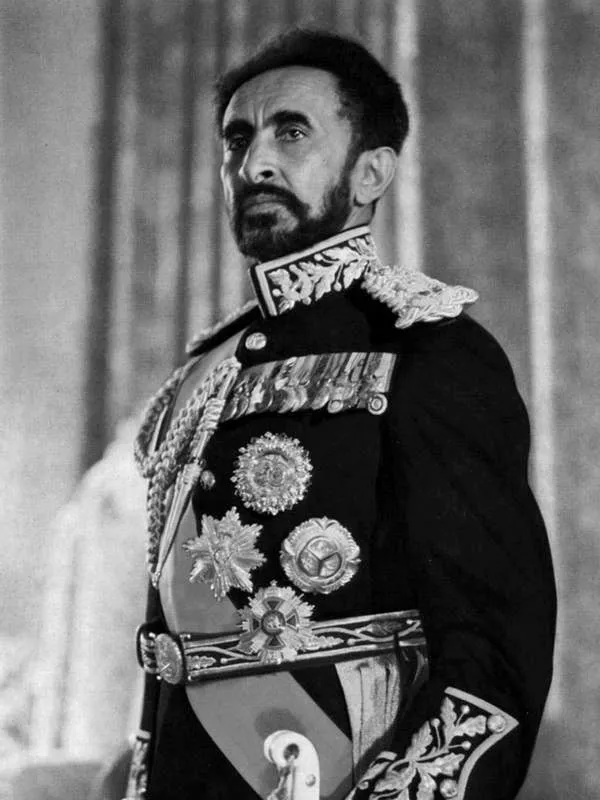
- Born:
- 23 July 1892, Ejersa Goro near Harar (Ethiopian Empire)
- Died:
- 27 August 1975, Addis Ababa
- Author:
- Natalia
- Photo:
- autor nieznany, domena publiczna, Wikimedia Commons

Haile Selassie I, known before his coronation as Ras Tafari Makonnen, ruled Ethiopia for almost sixty years, first as regent and then as emperor. He wanted to modernise one of the oldest states in the world and to defend its independence amid colonial empires, and he regarded membership of the League of Nations as the best guarantee of it. In 1935, when Benito Mussolini’s Italy attacked his country, he discovered that this guarantee meant nothing. His address in Geneva in June 1936, in which he warned the world of the consequences of inaction, became one of the symbols of the 1930s, and the defeat of Ethiopia, abandoned by the League, opened the way to the Rome–Berlin Axis and to war. In 1941, thanks to the British and Ethiopian guerrillas, he became the first ruler of a country occupied by the Axis powers to return to his throne. He reigned for more than thirty years more, until in 1974 a military junta overthrew him and a year later, in all probability, murdered him.
The son of Ras Makonnen
He was born on 23 July 1892 at Ejersa Goro in the province of Hararghe as Tafari, the son of Ras Makonnen, governor of Harar and a close relative of Emperor Menelik II. His father was one of the commanders at the victorious Battle of Adwa in 1896, in which the Ethiopians routed the Italian army and preserved their country’s independence. Tafari was taught in Harar by Capuchin missionaries and by a doctor from Guadeloupe, learning French and something of European ideas. At thirteen he was given the title of dejazmach, roughly equivalent to a count, and after his father’s death in 1906 a succession of governorships, including Harar around 1910. In 1911 he married Menen Asfaw, with whom he spent half a century.
After Menelik’s death power passed to his grandson Lij Iyasu, whom the Christian aristocracy and clergy accused of favouring Islam. He was deposed on 27 September 1916. Menelik’s daughter Zewditu was proclaimed empress, and Tafari, then one of the youngest of the great nobles, became ras, heir to the throne and regent. In practice it was he who administered the state, although in the early years his position was weak in the face of the empress, the conservative chiefs and the clergy.
The regent and the League of Nations
Tafari continued the cautious modernisation begun by Menelik. He founded schools, brought in foreign advisers, built roads and a printing press, and drew young men educated abroad into the administration. He saw his principal goal, however, in foreign policy. On 28 September 1923 Ethiopia was admitted to the League of Nations. Britain had doubts because of the slavery that still existed in the country, but France and Italy supported the application. Ethiopia undertook to combat slavery and the arms trade, and in 1924 Tafari issued a decree on the gradual emancipation of slaves. In practice slavery survived for a long time, and Italian propaganda would later use it as an argument for Italy’s “civilising mission”.
In 1924 Tafari made a grand tour of Europe and the Middle East. He visited Jerusalem, Cairo, Paris, Brussels, Stockholm, London, Rome and Geneva. The European press wrote at length about his retinue and about the lions he presented to France and to King George V. His most important aim – access to the sea of his own – he did not achieve. A year later Britain and Italy exchanged notes dividing economic influence in Ethiopia between them. Tafari protested to the League of Nations and both powers withdrew from these plans, but the lesson was clear.
In this situation the regent opted for an understanding with Rome. On 2 August 1928 he signed with the Italian envoy a twenty-year Treaty of Friendship and Arbitration, together with a convention on a free zone at Assab and a road from Assab into the Ethiopian interior. He was counting on arbitration in border disputes, but he had no intention of building the road, which he regarded as a ready-made invasion route. His opponents at court accused him of excessive deference to Italy and in September 1928 tried to overthrow him. The attempt failed, and on 7 October 1928 the empress was obliged to crown him negus, or king.
Emperor
In 1930 the empress’s husband, Ras Gugsa Welle, took up arms against the regent and was killed on 31 March at the Battle of Anchem. Two days later, on 2 April, Empress Zewditu died. Tafari became emperor and took the name Haile Selassie, “Power of the Trinity”. On 2 November 1930 he was crowned in St George’s Cathedral in Addis Ababa before guests from all over the world: the British Duke of Gloucester, the French Marshal Louis Franchet d’Espèrey, the Italian Prince of Udine, a personal representative of President Herbert Hoover and delegations from Egypt, Turkey, Sweden, Belgium and Japan. In Jamaica some black believers saw the coronation as the fulfilment of a prophecy, and from that conviction grew the Rastafari movement, named after Tafari. The emperor himself was a faithful member of the Ethiopian Orthodox Church.
On 16 July 1931 Haile Selassie gave Ethiopia the first written constitution in its history and established a bicameral parliament. The constitution, however, left all power in the emperor’s hands. The years that followed were filled with the centralisation of the state, the building of an army with the help of Belgian and Swedish instructors, and a struggle against the independence of the provincial chiefs.
War with Italy
From the mid-1920s Italian units from Somalia pushed deep into the disputed Ogaden, and at the end of 1932 Mussolini decided to prepare for war. On 5 December 1934 a bloody clash took place between Ethiopian soldiers and an Italian post at the oasis of Walwal (Ual-Ual). The emperor demanded arbitration under the 1928 treaty and appealed to the League of Nations, but the League procrastinated for ten months, while Britain and France, anxious to keep Italy in the front against Hitler, sought a compromise at Ethiopia’s expense. Meanwhile one Italian division after another sailed for Eritrea and Somalia.
On 3 October 1935 Italy invaded Ethiopia without a declaration of war. The League declared it the aggressor and imposed sanctions, but weak ones, without an oil embargo. The Ethiopian army, numerous but poorly armed and without an air force, went over to the counter-offensive at the end of 1935 and in places forced the Italians onto the defensive. At that point the Italian commanders, with Mussolini’s consent, began to use poison gas on a massive scale, above all mustard gas, dropped from aircraft on troops and civilians alike. In early 1936 the Ethiopian armies were destroyed one after another. On 31 March the emperor himself led the last army into the attack at Maychew and was defeated. After a stormy council it was decided that he would leave the country to plead its cause in Geneva. On 2 May 1936 he left with his family by train for Djibouti, from where a British cruiser took him to Palestine. On 5 May Marshal Pietro Badoglio entered Addis Ababa, and Victor Emmanuel III assumed the title of Emperor of Ethiopia.
Exile and Geneva
On 30 June 1936 Haile Selassie addressed the Assembly of the League of Nations in Geneva. Italian journalists in the gallery drowned him out with whistles until they were removed. The emperor spoke in Amharic. He described the aircraft that sprayed mustard gas over soldiers, women, children, herds, rivers and pastures, and recalled that it was he who had concluded with Italy a treaty of friendship forbidding recourse to force. He asked what value undertakings towards small states had, and what the League intended to do. He closed by saying that God and history would remember the decision of those assembled. A few days later the League lifted the sanctions. Before three years had passed, other members of the League – Austria, Czechoslovakia, Albania and then Poland – had fallen victim to the same mechanisms.
The emperor spent the years 1936–1941 in England, mainly in Bath, in the modest Fairfield House. He fought to prevent the world from recognising the annexation, wrote his memoirs and suffered personal tragedies: the Italians shot two of his sons-in-law, and one of his daughters died in captivity in Italy. In Ethiopia the occupiers pursued a brutal policy. In February 1937, after an attempt on the life of the viceroy, Rodolfo Graziani, thousands of people were massacred in Addis Ababa, and in May of that year hundreds of monks and pilgrims from the monastery of Debre Libanos were shot. Despite the terror, Ethiopian guerrillas, known as the Patriots, fought on in the mountains.
The return
Everything changed on 10 June 1940, when Mussolini entered the war on Germany’s side. Overnight Ethiopia became Britain’s ally. The emperor flew to Sudan, from where he coordinated the rising. In January 1941 he crossed the Ethiopian border together with Major Orde Wingate’s Gideon Force, while British, Indian, African and South African troops struck at the Italians from Sudan, Kenya and Somaliland in the East African campaign. On 5 May 1941, exactly five years after Badoglio’s entry, Haile Selassie rode into Addis Ababa and called on his people not to take revenge on the Italians. Ethiopia was the first country occupied by the Axis powers to regain its independence.
In the first years the emperor had to fight for full sovereignty, because the British treated the country as enemy territory they had conquered. In 1942 he finally abolished slavery, and in December of that year Ethiopia declared war on Germany, Italy and Japan. In February 1945, on his way back from Yalta, President Franklin Delano Roosevelt received him aboard the cruiser USS Quincy on the Great Bitter Lake in Egypt. Ethiopia was a founding member of the United Nations.
The last decades and the fall
After the war Haile Selassie became one of the most respected leaders in the world. In 1952 Eritrea, a former Italian colony, was federated with Ethiopia by decision of the United Nations, and in 1962 the emperor abolished its autonomy, which provoked the thirty-year Eritrean War of Independence. Faithful to the idea of collective security, he sent troops to Korea and to the Congo under the UN flag. In 1963 the Organisation of African Unity was founded in Addis Ababa, and the emperor was its first chairman. In 1971 he visited China and met Mao Zedong.
At home, however, his rule remained autocratic and reform proceeded slowly. In December 1960 the Imperial Guard attempted a coup, which was put down. In the early 1970s a famine in Wollo province, concealed by officials, claimed tens of thousands of lives, and rising prices and mutinies in the army undermined the authority of the octogenarian ruler. On 12 September 1974 a military council known as the Derg deposed him and placed him under arrest. On 27 August 1975 the authorities announced that he had died of illness. After the fall of the junta it emerged that the emperor had in all probability been murdered on the orders of its leaders. His remains were found in 1992 beneath a building in the palace grounds, and in 2000 they were buried in Holy Trinity Cathedral in Addis Ababa.
Significance
For the history of the road to the Second World War, Haile Selassie remained above all the man in Geneva who came for the help promised by the Covenant of the League of Nations and did not receive it. Time magazine named him its Man of the Year for 1935. The defeat of Ethiopia showed the dictators that the Western powers would not risk war in defence of principles, and it drew Mussolini closer to Adolf Hitler, whose Germany, already outside the League, did not join the sanctions and quickly recognised the Italian conquest. In Ethiopia and in Africa he is remembered as a defender of independence and the father of African unity, but also as an autocrat whose reign was ended by famine and revolution.
Sources
Commanded in battles
(01)Mentioned in battles
(01)Often appears with
People who appear in the same events.