Italy
Pietro Badoglio
Chief of the Supreme General Staff (1925–1940), Governor of Libya (1929–1933), Viceroy of Ethiopia (1936), Prime Minister of Italy (1943–1944)
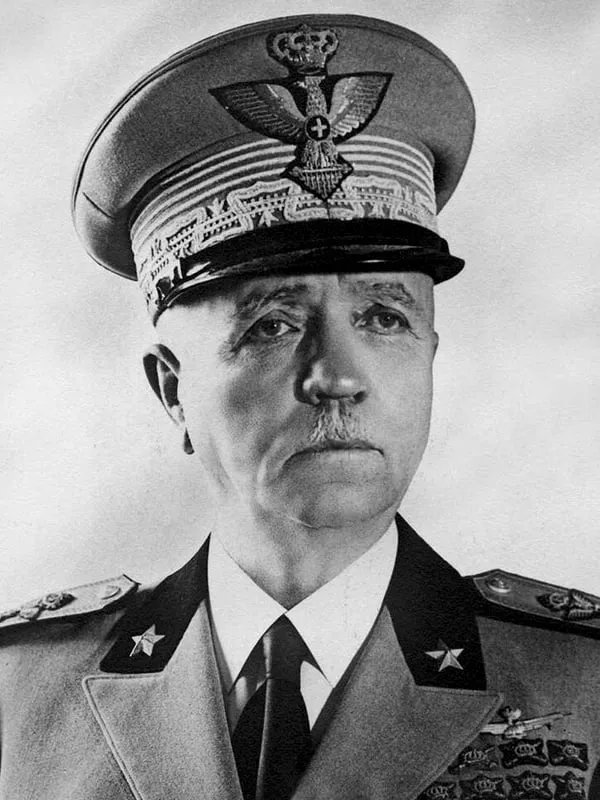
- Born:
- 28 September 1871, Grazzano Monferrato (Kingdom of Italy)
- Died:
- 1 November 1956, Grazzano Badoglio
- Author:
- Łukasz
- Photo:
- autor nieznany, domena publiczna, Wikimedia Commons

For fifteen years Pietro Badoglio was the highest-ranking soldier of Fascist Italy, although he was never a Fascist by conviction. As Chief of the Supreme General Staff from 1925 to 1940 he was responsible for preparing the Italian armed forces for the war that they would go on to lose. In Libya he directed the brutal “pacification” of Cyrenaica, in which tens of thousands of people died in concentration camps. In Ethiopia he commanded the army that, using poison gas, crushed the forces of Emperor Haile Selassie and took Addis Ababa in May 1936. That conquest sank the League of Nations and pushed Italy into the arms of Germany. In 1943, as the regime of Benito Mussolini collapsed, the king entrusted him with the government, and Badoglio signed an armistice with the Allies and declared war on Germany. He went down in history as a man who served whatever power the Crown happened to wield, and who never answered for his crimes in Africa.
An artilleryman in the colonies
He was born on 28 September 1871 in Grazzano Monferrato in Piedmont, into the family of a small landowner. In 1888 he entered the military academy in Turin and became an artillery officer. In February 1896, just after the defeat at Adwa, he was sent to Eritrea with General Antonio Baldissera’s reinforcements. He took part in the expedition that relieved the besieged Italian garrison at Adigrat and served in garrisons on the Eritrean plateau until 1898. On his return he completed the war college and moved into staff work. During the Italo-Turkish War of 1911–1912 he fought in Libya, where his planning of operations earned him promotion to major.
Sabotino, Caporetto and Villa Giusti
The First World War made him a general. In 1915, as a staff lieutenant colonel, he prepared the assault on Monte Sabotino, a heavily fortified Austrian position above Gorizia. On 6 August 1916, during the Sixth Battle of the Isonzo, the mountain fell, and Badoglio, who had directed the preparations, was promoted to general, becoming one of the fastest-rising commanders in the army. He was later given the title of Marquis of Sabotino. By 1917 he was commanding XXVII Corps on the Isonzo.
On 24 October 1917 the Austrians and Germans launched the offensive that went down in history as the Battle of Caporetto. The front broke, among other places, in the sector of Badoglio’s corps near Tolmin. Historians fault him for leaving the right bank of the Isonzo weakly held even though it was known that the blow might fall precisely there, and for the fact that his artillery, waiting for orders, failed to open fire in time. Even so, the commission of inquiry into the causes of the defeat laid the blame chiefly on Luigi Cadorna and the army commanders, and Badoglio was the only corps commander to escape a formal reprimand. In November 1917 he even became deputy to the new commander-in-chief, General Armando Diaz, and helped rebuild the army all the way to the victory at Vittorio Veneto. He was a member of the delegation that negotiated the Armistice of Villa Giusti with Austria-Hungary, signed on 3 November 1918. According to some historians, in the post-war years he carefully erased from the records the traces of his own responsibility for Caporetto.
Between the monarchy and Fascism
In February 1919 he became a senator. In the autumn of that year, as extraordinary military commissioner in Venezia Giulia, he had to deal with the seizure of Fiume by Gabriele D’Annunzio. From December 1919 to February 1921 he was chief of staff of the army. In October 1922, on the eve of the March on Rome, he is said to have assured King Victor Emmanuel III that the army would easily disperse the Fascist columns if it were given the order. The king gave no such order, and Mussolini became prime minister. Badoglio, regarded as an opponent of the Fascists, was sidelined to the post of ambassador to Brazil.
He soon came to terms with the new regime, however. On 4 May 1925 Mussolini appointed him head of the newly created Supreme General Staff, which was to coordinate all branches of the armed forces. In June 1926 Badoglio received the new rank of Marshal of Italy. He held his post until 1940, but his real power was limited: for most of that period Mussolini himself ran the service ministries through his under-secretaries, and Badoglio had no staff of his own worthy of the name. Even so, for fifteen years he had a decisive influence on the doctrine, the equipment and the choice of commanders of an army that in 1940 proved unprepared for modern war.
Libya: the camps in Cyrenaica
In December 1928 Badoglio became the first joint governor of Tripolitania and Cyrenaica, that is, of Italian Libya. His task was to crush the long-running uprising of the Senussi movement in Cyrenaica, led by Omar al-Mukhtar. Together with his deputy, General Rodolfo Graziani, he decided to cut the guerrillas off from the population. In June 1930 he ordered the resettlement of the nomads of the Jebel Akhdar plateau. Some 100,000 people were driven on foot across the desert to concentration camps on the coast, and most of their herds perished. Badoglio wrote to Graziani at the time that he was aware of the gravity of the step but that it had to be carried through to the end, “even if the entire population of Cyrenaica should perish”. Tens of thousands of people died in the camps of hunger, disease and exhaustion. A barbed-wire fence many kilometres long was built along the border with Egypt. When al-Mukhtar was captured in September 1931, Badoglio ordered a trial whose verdict would “without doubt” be death, and an execution to be carried out in one of the camps as a warning. On 24 January 1932 he declared resistance in Libya at an end. At the beginning of 1934 he returned to Rome, and was succeeded by Italo Balbo.
Ethiopia
Badoglio was sceptical of the plans for war with Ethiopia. He feared the cost, the supply problems of a distant theatre and a conflict with Great Britain, and the preparations were being run from the Ministry of the Colonies by his rival, General Emilio De Bono. But when Italy attacked Ethiopia on 3 October 1935 and the cautious De Bono halted in Tigray, Badoglio contributed to his downfall with critical reports. In mid-November Mussolini gave him supreme command in East Africa.
Badoglio first halted the advance in order to bring up reinforcements and build roads. In December the Ethiopian armies went over to the counter-offensive and in places threatened the Italian positions. Mussolini then authorised the use of poison gas, and Badoglio made use of that permission on a massive scale. From the end of December 1935 until the spring of 1936 aircraft dropped mustard-gas bombs and sprayed the agent over troops, villages, pastures and rivers, in breach of the Geneva Protocol of 1925, which Italy had ratified. The telegrams containing his authorisations and reports survive in the archives; for decades, however, the Italian authorities denied that gas had been used, until they officially admitted it in the 1990s.
Badoglio waged the war methodically, with an overwhelming superiority in aircraft and artillery. In January and February 1936 his forces fought two battles in Tembien and destroyed the army of Ras Mulugeta at Amba Aradam, and at the beginning of March the army of Ras Imru in Shire. On 31 March at Maychew he threw back the last attack, led in person by the emperor, and his aircraft massacred the retreating Ethiopian columns. On 26 April he set out from Dessie on the final “March of the Iron Will”, and on 5 May 1936 he entered Addis Ababa. He became the first Viceroy of Ethiopia, but as early as June he handed the office over to Graziani and returned to Italy. The king made him Duke of Addis Ababa, and the Fascist Party admitted him to its ranks. In 1938 his home town took the name Grazzano Badoglio.
A war he did not want
Between 1936 and 1940 Badoglio was at the height of his prestige. In 1937 he also succeeded Guglielmo Marconi as president of the National Research Council. When, in the spring of 1940, Mussolini decided to enter the war on the side of Adolf Hitler’s Germany, Badoglio warned that the army was not ready for a long war, but he did not oppose it. After the declaration of war on 10 June 1940 he supported handing supreme operational command to Mussolini, which allowed him to avoid direct responsibility. In October 1940 he agreed to the attack on Greece, even though he had earlier warned that far larger forces and more time would be needed. The Greco-Italian War ended in humiliation, and the radical Fascists, led by Roberto Farinacci, publicly accused the marshal. Badoglio resigned, and his resignation was accepted on 4 December 1940. He was succeeded by Ugo Cavallero. For the next two and a half years he remained on the sidelines, keeping in touch with the court and with dissident officers.
The fall of Mussolini and the armistice
In the summer of 1943, after the defeats in Africa and the Allied landings in Sicily, the king decided to get rid of Mussolini. To replace him he chose Badoglio, a general loyal to the Crown rather than an anti-Fascist politician. On 25 July 1943, after the Grand Council of Fascism had voted on a motion by Dino Grandi, Victor Emmanuel III dismissed Mussolini, had him arrested and appointed Badoglio prime minister. The new government’s first proclamation declared: “The war continues.” Badoglio dissolved the Fascist Party, but at the same time he secretly sought an agreement with the Allies – something the Germans foresaw and exploited to move further divisions into Italy.
On 3 September 1943, at Cassibile in Sicily, his envoy signed a secret armistice. When the Allies announced it on 8 September, Badoglio read a short statement on the radio ordering the armed forces to cease fighting the Allies and to resist attacks “from any other quarter”, but he gave the army no clear orders in the event of a German response. The next morning the king, Badoglio and the high command fled Rome for Pescara and from there by warship to Brindisi. Left without orders, the army disintegrated within days under the German blows of Operation Achse, and hundreds of thousands of soldiers were taken prisoner. The flight from Rome still weighs on Badoglio’s memory in Italy today. On 29 September, in Malta, he signed the extended armistice terms, and on 13 October 1943 the Kingdom of Italy declared war on Germany.
Badoglio’s government in Brindisi, and later in Salerno, was regarded by the anti-Fascist parties as a continuation of the old regime. In April 1944, after an agreement under which the king consented to hand power to his son Umberto, Badoglio headed a government that included the anti-Fascist parties, among them the Communist Palmiro Togliatti. After the liberation of Rome in June 1944 the parties refused to go on working with the marshal, and he resigned. On 18 June he was replaced by Ivanoe Bonomi.
No reckoning
After the war Ethiopia demanded that Badoglio and Graziani be tried for the use of poison gas and the bombing of Red Cross hospitals, and placed them on its list of war criminals. Italy extradited neither of them, and Great Britain, which saw Badoglio as a guarantor of an anti-Communist Italy, did not press the matter. An Italian commission set up to investigate the charges brought no one to trial. In 1946 Badoglio was stripped of his seat in the Senate. He spent his last years in his home town, where he founded a nursery school named after his mother and a museum of his own career. He died there on 1 November 1956.
Significance
On the road to the Second World War, Badoglio was above all an executor. He did not invent Fascist imperialism, but it was he who put it into practice in Libya and Ethiopia with methods that would be used on a far greater scale in Europe in the years that followed: the expulsion of entire communities, concentration camps and chemical weapons used against civilians. The capture of Addis Ababa was a triumph that convinced Mussolini of his own infallibility, buried the League of Nations and opened the way to the alliance with Hitler. As chief of the general staff, he was for fifteen years responsible for an army that went to war in 1940 without the tanks, artillery and supplies its tasks demanded. In 1943 he led Italy out of that war, but in such a way that its army and its people paid the price. His career shows how the traditional military elites and the monarchy served Fascism for as long as it brought victories, and abandoned it once it began to lose.
Sources
Commanded in battles
(02)Mentioned in battles
(06)Often appears with
People who appear in the same events.
On the timeline
(57)The 40 most important of 57 events. All tagged “Pietro Badoglio” (9) →