- Category:
- Military operations
- Front:
- Western Front
- Date:
- 14 May 1940
- Author:
- Łukasz
- Battle:
- Dutch Campaign
- Tags:
- Netherlands, Luftwaffe, Third Reich, Henri Winkelman
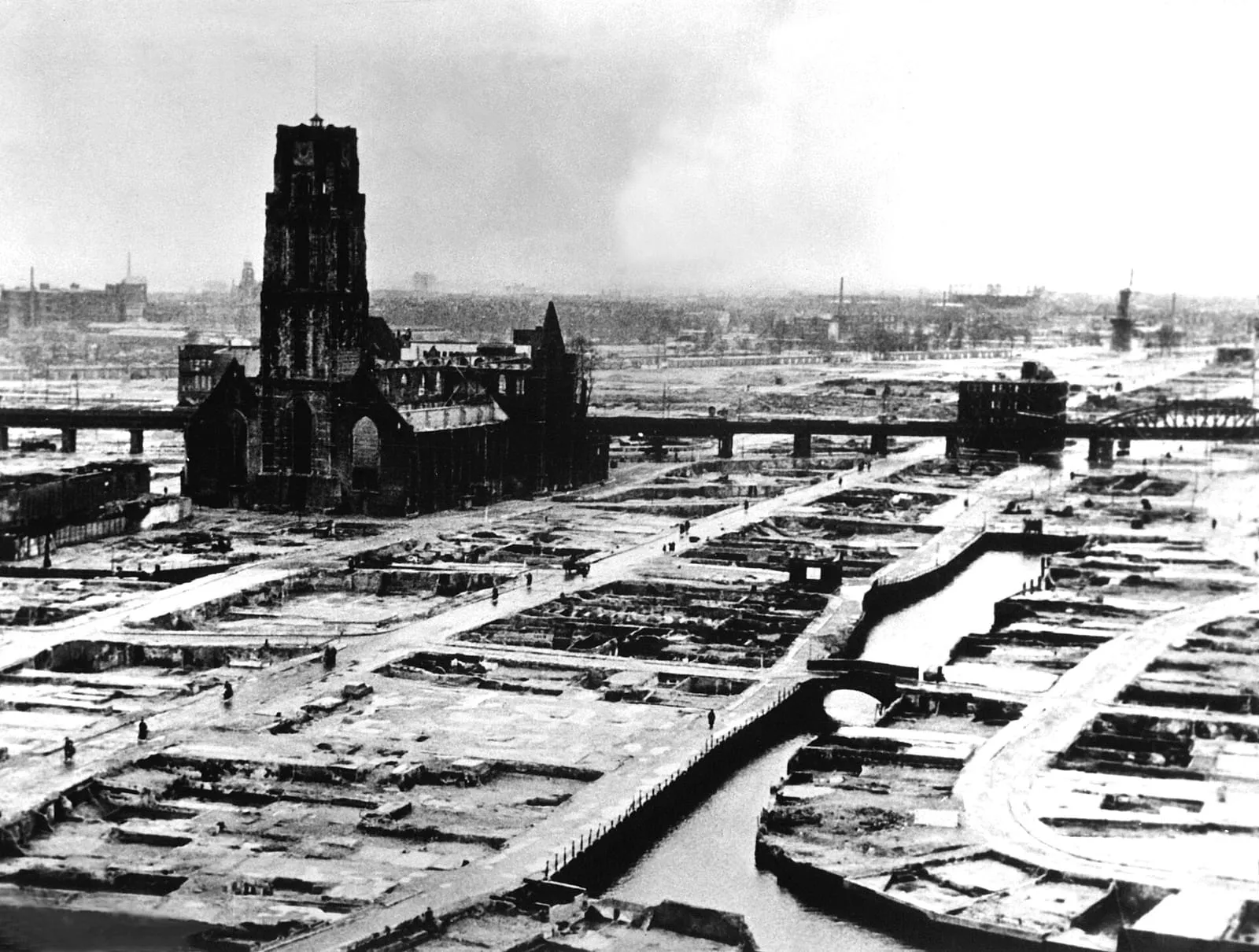
On 14 May 1940, shortly before 1.30 p.m., German Heinkel He 111 bombers appeared over Rotterdam. Within a quarter of an hour they dropped almost a hundred tonnes of bombs on the city centre and the Kralingen district, and the fires that broke out after the raid consumed nearly the whole historic centre of the second city of the Netherlands. Several hundred people were killed and some 80,000 lost their homes. The bombs fell at the very moment when the German commander on the spot was negotiating the city’s surrender with its defenders and had just halted his attack. A few hours later, under the threat of the same fate for Utrecht, the Commander-in-Chief, General Henri Winkelman, ordered the Dutch army to lay down its arms. On 15 May he signed the act of capitulation in a school at Rijsoord. Fighting continued only in Zeeland, where the Dutch and the French held out until 17 May; the last units, on the island of Noord-Beveland, surrendered on 18 May.
The bridges over the Maas
From the first hours of the war Rotterdam was one of the main objectives of the German airborne assault. On the morning of 10 May paratroopers and airlanding infantry under General Kurt Student seized Waalhaven airfield and the bridges in the southern suburbs, and twelve seaplanes landed on the Nieuwe Maas in the very heart of the city, putting ashore troops who captured the Willemsbrug road bridge and a small bridgehead on the northern bank. Under the German plan, the bridges at Moerdijk, Dordrecht and Rotterdam were to open the way for the ground forces into the heart of Fortress Holland. Unlike the defeat at The Hague, this part of the operation succeeded, though not completely: Dutch marines and garrison troops under Colonel Pieter Scharroo kept the Germans off the northern bank for four days, but they could not destroy the bridge either.
On 13 May the German 9th Panzer Division crossed the bridges at Moerdijk and Dordrecht and reached Rotterdam. The same day the Dutch lost the battle of the Grebbeberg in the east, and Queen Wilhelmina and the government sailed for Britain, handing authority in the country to the Commander-in-Chief. Even so, Winkelman had no intention of capitulating as long as there was any chance of further resistance. In Rotterdam the front had not moved for three days, and any attack across the narrow bridge into the dense, canal-crossed built-up area threatened the Germans with heavy losses.
The Germans, meanwhile, were pressed for time. The commander of the Eighteenth Army, General Georg von Küchler, feared a British landing, and on 13 May he instructed the commander of XXXIX Corps, General Rudolf Schmidt, to break the resistance in Rotterdam “by all means”, threatening the destruction of the city if necessary and carrying out the threat. The next day Hitler, in Directive No. 11, stated that the Dutch army had proved stronger than expected and that political and military considerations required its resistance to be broken quickly. Bomber wing Kampfgeschwader 54 was transferred to the Dutch front.
The ultimatum
For 14 May Schmidt and Student planned an attack across the Willemsbrug with tanks, engineers and the SS Leibstandarte Adolf Hitler regiment, preceded by a limited, precise strike by dive-bombers against the defenders’ positions. Destroying the city was not in their interest, since rubble would hamper the tanks. The Luftwaffe command, however, including Hermann Göring himself, pressed for carpet bombing of the city centre, which was to force the whole country to capitulate. The commander of the 2nd Air Fleet, General Albert Kesselring, by his own account in his memoirs, argued with Göring over the scale of the attack. In the end, before noon on 14 May, some 90 Heinkels of KG 54 under Colonel Walter Lackner took off from airfields in Germany.
In the morning German envoys carried Schmidt’s ultimatum across the Willemsbrug: if the city did not surrender within two hours, “the most extreme means of destruction” would be used. Colonel Scharroo received it at around 10.30 a.m. The mayor, Pieter Oud, judged that the city could not be evacuated in so short a time and asked for Rotterdam to be surrendered. Scharroo, who saw no military need to capitulate, turned to Winkelman. Winkelman decided to play for time: the document was unsigned and bore neither the name nor the rank of its sender, so the defenders demanded an ultimatum in proper form. At around 12.15 p.m. the Dutch envoy, Captain Backer, delivered this reply to Lieutenant Colonel Dietrich von Choltitz, commander of the airlanding battalion in the bridgehead.
Schmidt treated the reply as the opening of negotiations. He cancelled the artillery bombardment planned for 1 p.m., sent a signal to the air command that the raid was to be called off, and prepared a new ultimatum, this time signed, with a deadline of 4.20 p.m. It had been agreed beforehand that if the bombing was to be cancelled, the Germans in the bridgehead would fire red signal flares. At around 1.20 p.m., as Backer was making his way back towards the bridge with the new ultimatum, aircraft appeared over the city.
The raid
The bombers came in two formations. The smaller one, about 36 aircraft, approached from the south. When red flares went up from the bridgehead, the first three aircraft had already dropped their bombs, but the rest turned back. The larger formation, Lackner’s 54 aircraft, came in from the north-east, over ground held by the Dutch. The flares were either not seen in the smoke and haze or not recognised in time. Between about 1.27 and 1.40 p.m. the Heinkels dropped their bombs, some 1,300 in all, of 50 and 250 kilograms, on a strip of buildings from Kralingen to the old city centre and Hofplein station. Watching the explosions, Schmidt is said to have exclaimed: “My God, this will be a catastrophe!”
The city’s anti-aircraft defence was practically non-existent, as the guns had earlier been moved to The Hague. The bombs struck densely built-up streets, warehouses and oil tanks in the port. Hundreds of fires broke out, which the decimated fire brigade, without water or communications, could not bring under control. A strong wind turned them within a few hours into a firestorm; they were still being put out many days later. More than 24,000 homes burned, along with several thousand shops, workshops and warehouses and dozens of schools and churches, among them the Gothic church of St Lawrence, of which only the walls and the tower remained. Some 2.5 square kilometres of the city centre were destroyed. The town hall, the main post office and the stock exchange were among the buildings that survived.
The death toll is uncertain. For a long time the figure given was some 800–900 victims (814 according to the tally of the Dutch historian Allert Goossens). A list of victims compiled in recent years by Rotterdam researchers includes 711 people killed in the raid of 14 May alone and more than 1,100 victims of all the bombings of the city from 10 to 14 May. The number might have been higher had thousands of residents not left the city centre after four days of fighting. In the first days after the raid Allied and Dutch sources reported that 30,000 people had been killed. That figure, repeated for years, fixed the image of Rotterdam as a martyred city and influenced British decisions in the days that followed.
The surrender of the city and the country
Captain Backer made his way through the burning city to Scharroo’s headquarters in the Blijdorp district. After consulting the mayor and his officers, and with no means of reaching The Hague, the colonel decided to surrender the city to save it from another raid. At 3 p.m. he ordered a ceasefire, and at 3.50 p.m. he came to Schmidt and accepted his terms. Göring, meanwhile, had ordered a second raid, to take place if the whole city was not occupied. When Schmidt learned of this, at 5.15 p.m. he sent an uncoded signal that Rotterdam was in German hands, although this was not yet true; the bombers were turned back. In the evening, during talks at the Dutch headquarters, General Student went to the window to stop a shooting in the street and was seriously wounded in the head by a stray German bullet. German soldiers, convinced that the Dutch had fired, lined up a group of prisoners and civilians against a wall; Choltitz prevented the execution.
In The Hague, Winkelman at first intended to fight on. The possibility of terror raids had been considered before the war and had not been regarded as a reason to capitulate, and the defence of the Water Line and the area around The Hague could still be sustained for a while. Soon, however, the commandant of Utrecht reported that the Germans were demanding the city’s surrender and that aircraft were dropping leaflets declaring that only unconditional capitulation could spare it “the fate of Warsaw” – a city devastated by the Luftwaffe in September 1939. Winkelman concluded that the Germans intended to destroy every city that resisted and that the army had no means of stopping them. In keeping with the government’s instruction to avoid needless casualties, at 4.50 p.m. he sent out by teleprinter an order to destroy weapons and surrender to the nearest German units. At 5.20 p.m. he informed the German envoy in The Hague, and at around 7 p.m. he announced the decision on the radio.
The capitulation did not cover the navy, most of whose ships had already sailed for England, or the province of Zeeland, where Dutch troops had been fighting under French operational command since 13 May. The commander of the base at Den Helder, Rear Admiral Hoyte Jolles, wanted to fight on, and Winkelman had difficulty persuading him to obey the order.
Rijsoord, 15 May
At 5 a.m. on 15 May a German messenger brought to The Hague an invitation to talks with General von Küchler. The meeting took place in the primary school of the village of Rijsoord (today part of the municipality of Ridderkerk), south-east of Rotterdam, where the German headquarters was located. The talks were brief. The only dispute arose over Küchler’s demand that Dutch airmen who continued to fight alongside the Allies be treated as francs-tireurs without the protection of the laws of war. Winkelman refused and made it clear that what was capitulating was the army on European territory, not a state that was still waging war from its colonies and from London. The act was signed before noon, at about 10.15 a.m. according to most accounts. Winkelman is reported to have said: “We are not making peace; we are continuing the war.” Some 280,000 soldiers laid down their arms. About 22,000 of them were taken to Germany for a time; most were soon released to go home.
Zeeland
Zeeland, a province of islands and peninsulas at the mouth of the Scheldt, came under a separate naval command headed by Rear Admiral Hendrik van der Stad. From 10 May French troops of the 60th and 68th Infantry Divisions arrived through the port of Vlissingen (Flushing) to cover the approaches to Antwerp, and on 13 May the Dutch came under their operational command. Co-operation went badly: the French had no faith in the Dutch positions on the Zuid-Beveland isthmus and occupied other lines, with no time to dig in.
The SS Deutschland regiment advanced on Zeeland. On the evening of 14 May, after news of Winkelman’s capitulation, the garrison of the Bath position at the eastern end of the isthmus scattered after the first shelling. On 15 May the Zanddijk position fell, and on 16 May the Germans forced the canal across Zuid-Beveland. On the morning of 17 May the French repulsed the first attack across the Sloedam causeway leading to the island of Walcheren, but after heavy artillery fire and air attacks the defence collapsed. That day the centre of the provincial capital, Middelburg, burned down. Although the destruction of the town was described as a bombing, Dutch researchers attribute it chiefly to artillery fire – mainly German, though a share of French shells cannot be ruled out – and to a fire that spread in a strong wind. Nearly 600 buildings burned, including the town hall and most of the municipal archives; 11 people were killed. That evening the French Brigadier General Marcel Deslaurens fell at Vlissingen while covering the evacuation of his men across the Scheldt. Late in the evening of 17 May the Dutch units on Walcheren and Zuid-Beveland surrendered to the commander of the SS regiment, Felix Steiner, and on the morning of 18 May the cut-off garrison of Noord-Beveland capitulated.
The date of 18 May, under which chroniclers often record “the German victory in the battle of Zeeland”, therefore refers to the last surrender on the islands; the main fighting had ended the day before. On the mainland south of the Scheldt, in Zeelandic Flanders, the French held out longer. On 19 May, at French request, the Dutch units there were withdrawn into Belgium, and the Germans had occupied the whole of this strip of the country by 27 May.
Significance
The Dutch campaign lasted five days and, counting Zeeland, not quite eight. According to Allert Goossens’s tally, some 2,300 Dutch soldiers and more than 2,000 civilians were killed in it; the Germans lost about 2,000 dead and between 225 and 275 aircraft, most of them transports, and some 1,350 German prisoners, mainly paratroopers from around The Hague, were shipped to Britain before the capitulation. The Netherlands, which had clung to neutrality for more than a hundred years and had stayed out of the First World War, came under occupation for almost five years. At the end of May civil authority was taken over by Reich Commissioner Arthur Seyss-Inquart. The state, however, did not capitulate: the government and the queen in London, the navy, the merchant fleet and the rich Dutch East Indies remained on the Allied side.
The bombing of Rotterdam became, alongside Guernica and Warsaw, one of the symbols of German terror from the air. The dispute over whether it was a crime has continued since the war. The German side, including Göring and Kesselring before the tribunal at Nuremberg, maintained that Rotterdam was a defended city in a combat zone and that the bombers, which had already reeled in their trailing aerials, did not receive the recall. Some historians point out that, according to surviving documents, Schmidt’s signal reached the staff of the 2nd Air Fleet at around 12.40 p.m., more than half an hour before the raid; that the target was the buildings of the city centre, not the defenders’ positions by the bridge; and that the whole attack had above all a political purpose – to force the country to capitulate by threatening to destroy one city after another. That is exactly how it was used a few hours later against Utrecht. No one was ever convicted for Rotterdam.
The raid also had consequences beyond the Netherlands. News of tens of thousands of victims reached London just as Winston Churchill’s new government was considering lifting the restrictions that had so far prevented the bombing of targets deep inside Germany. On 15 May the War Cabinet approved raids on the industry of the Ruhr, and that very night RAF bombers flew over Germany. Thus began the British bombing offensive that in 1942–1945 reduced most German cities to rubble.
Rotterdam began rebuilding almost immediately. The rubble was cleared away, and instead of recreating the old centre, planners designed a new city with broad streets and modern architecture. In 1953 Ossip Zadkine’s monument The Destroyed City was erected there – a figure with its heart torn out, commemorating 14 May 1940. Winkelman, who refused to co-operate with the occupier, was arrested in July 1940 and spent the rest of the war in captivity.
Sources
Meanwhile
(04)Elsewhere, within a week.
- 13 May 1940 · Politics“Blood, toil, tears and sweat”On 13 May 1940, in his first speech as prime minister, Churchill offered the Commons “blood, toil, tears and sweat”. The House backed him by 381 votes.
- 13 May 1940 · PoliticsQueen Wilhelmina in LondonOn 13 May 1940 Queen Wilhelmina left the Netherlands aboard HMS Hereward and reached England. The de Geer government followed her the same day.
- 16 May 1940 · DiplomacyChurchill in ParisOn 16 May 1940 Churchill flew to Paris. Gamelin admitted he had no reserve, archives burned at the Foreign Ministry and London agreed to send more fighters.
- 10 May 1940 · PoliticsChurchill becomes Prime MinisterOn 10 May 1940, the day of the German offensive in the West, Chamberlain resigned and the King asked Churchill to form a coalition government.
Related events
(04)The same battle, people or subject.
- 10 May 1940 · Western FrontThe Battle for The HagueOn 10 May 1940 German airborne troops landed near The Hague to seize the Dutch Queen and government. By nightfall the Dutch had retaken three airfields.
- 10 May 1940 · Western FrontGermany attacks in the WestOn 10 May 1940 the Wehrmacht struck the Netherlands, Belgium and Luxembourg. The Allies advanced into Belgium as Kleist's tanks entered the Ardennes.
- 24 May 1940 · Western FrontThe halt order before DunkirkOn 24 May 1940 Hitler approved halting the tanks before Dunkirk. By 26 May the Allies had strengthened their defence, and the Germans took Boulogne and Calais.
- 13 May 1940 · Western FrontThe battles of the Grebbeberg and the AfsluitdijkOn 13 May 1940 the Germans broke the Dutch Grebbe Line on the Grebbeberg. In the north the Kornwerderzand works on the Afsluitdijk held out to the end.