1940–1943: The North African campaign
Operation Battleaxe
- Dates:
- 15–17 June 1941
- Front:
- Mediterranean
- Location:
- The Libyan–Egyptian frontier in Marmarica: the Halfaya Pass and Sollum on the coast, Fort Capuzzo, Point 206 and the Hafid Ridge (Point 208) on the plateau above the escarpment, Sidi Omar and Sidi Suleiman on the edge of the desert; the British start lines near Sofafi and Buq BuqOn the battle map →
- Sides:
- United KingdomArchibald Wavell, Noel Beresford-PeirseNazi Germany and ItalyErwin Rommel
- Result:
- Axis victory. The British attack broke down against the defences of the Halfaya Pass and the Hafid Ridge, and a German counterstroke through Sidi Omar and Sidi Suleiman forced the Western Desert Force to fall back to its start lines on 17 June. The British lost about a thousand men and more than 90 tanks, Tobruk remained under siege, and Churchill replaced Wavell with General Claude Auchinleck.
- Author:
- Łukasz
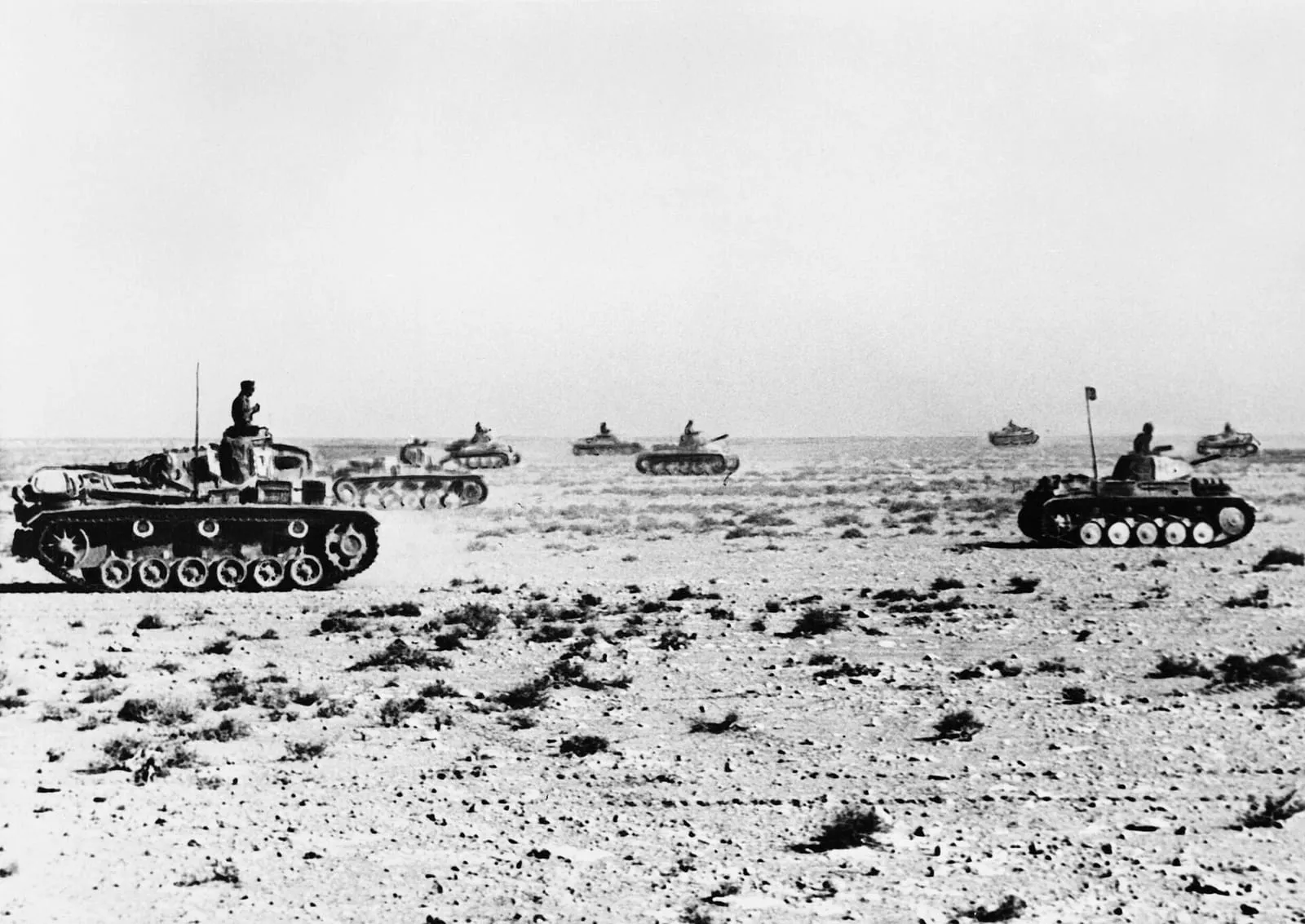
Operation Battleaxe was the first major British offensive against the German Afrika Korps and the first battle of the war in which a sizeable German armoured force defended rather than attacked. In mid-June 1941 the Western Desert Force of Lieutenant General Noel Beresford-Peirse – the re-formed 7th Armoured Division, part of the 4th Indian Division and the 22nd Guards Brigade, with some 190 cruiser and infantry tanks in all – struck at the Axis defences on the border between Egypt and Libya. It was to destroy the forces of Lieutenant General Erwin Rommel around Sollum and Fort Capuzzo, then push west and relieve besieged Tobruk. The Prime Minister, Winston Churchill, who a few weeks earlier had insisted on running a convoy of tanks through the Mediterranean, expected a decisive victory.
It was over in three days. On the first day the attacks on the Halfaya Pass and the Hafid Ridge collapsed under the fire of dug-in German guns, among them the notorious 88 mm anti-aircraft guns. The British took only Fort Capuzzo and the ground around it. On 16 and 17 June Rommel sent two armoured divisions in a wide sweep through the desert into the rear of the attackers and very nearly cut them off from Egypt. The British escaped at the last moment, having lost almost a thousand men and more than half the tanks with which they had begun the battle. The defeat cost the British Commander-in-Chief in the Middle East, General Archibald Wavell, his post.
Name and dates
The code name Battleaxe was given to the larger offensive, for which Wavell had issued preliminary instructions as early as 1 May 1941, before the smaller attack known as Brevity. In some German accounts the battle appears as the Battle of Sollum (Schlacht bei Sollum), after the small town and bay on the frontier. It should not be confused with Operation Brevity of 15–16 May 1941, fought over the same ground, or with Operation Crusader five months later.
The operation lasted from dawn on 15 June until the evening of 17 June 1941; the sources agree on these dates. The offensive was originally planned for 7 June and then for 10 June, but the commander of the 7th Armoured Division, Major General Michael O’Moore Creagh, won another five days to train crews who had only just received their new tanks. By the evening of 17 June the British units were back on the Sidi Barrani–Sofafi line from which they had set out, and the Axis troops had reoccupied their positions on the frontier.
Background
Rommel on the Egyptian frontier
In the spring of 1941 the British lost almost everything in North Africa that they had won in the winter in Operation Compass. In Rommel’s first offensive the German and Italian forces retook Cyrenaica in less than three weeks, laid siege to Tobruk from 10 April, and their weaker detachments reached the Egyptian frontier and at the end of April seized the Halfaya Pass. Two great assaults on Tobruk failed. General Friedrich Paulus, sent out by the Army High Command, forbade Rommel at the beginning of May to make any further attacks on the fortress, and in a report to Berlin described the Afrika Korps’ position as weak, with serious shortages of fuel and ammunition. The British read this report thanks to the breaking of German ciphers (Ultra). Churchill became convinced that one strong blow would be enough to drive the Germans away from Tobruk and pressed Wavell ever more insistently for an offensive.
The Tiger convoy and Brevity
Wavell had too few tanks. The 7th Armoured Division, which had routed the Italians in the winter, had not existed as a fighting formation since February: its vehicles had been worn out on the march across Cyrenaica and its men dispersed to other tasks. On 21 April the Defence Committee in London, under pressure from Churchill, decided to send tanks and fighters not round Africa but straight through the Mediterranean, risking attack by Axis aircraft and warships but saving several weeks. The Tiger convoy reached Alexandria on 12 May and, according to the British official history, delivered 82 cruiser tanks, including fifty new Crusaders, 135 Matilda infantry tanks, 21 light tanks and 43 Hurricane fighters. One of the ships, the Empire Song, struck a mine on the way and sank with several dozen tanks and a few aircraft.
Without waiting for the new tanks, Wavell struck a quick blow in mid-May with the forces he had to hand. In Operation Brevity on 15–16 May, troops under Brigadier William Gott recaptured the Halfaya Pass and, for a few hours, Fort Capuzzo, but withdrew after a German counter-attack, and on 26–27 May the Germans regained the pass as well. On 28 May – the same day on which the Chiefs of Staff in London concluded that, after the fall of Crete, the airfields of eastern Cyrenaica had to be recovered at all costs – Wavell issued the orders for Battleaxe.
Wavell between fronts
Wavell was preparing the offensive at the worst possible moment. His command was conducting several campaigns at once: in May there was the war with Iraq, from 20 May to 1 June the Battle of Crete was fought, ending in a costly evacuation, and on 8 June British, Australian, Indian and Free French troops entered Syria and Lebanon, which were controlled by Vichy. Little infantry was left in the desert: the 4th Indian Division had only one of its brigades to hand, the 11th Indian Brigade, just back from Eritrea, and it was made up with the 22nd Guards Brigade. In a telegram of 28 May to the Chief of the Imperial General Staff, General John Dill, Wavell did not conceal his doubts. He wrote that British armoured cars were inferior to the German ones, that the infantry tanks were too slow for mobile warfare and the cruisers too unreliable. The first stage of the operation, he believed, would succeed, but there might then not be enough strength for the second.
Forces and plans
The British
The operation was allotted the largest force that could be supplied in the desert. According to the British official history, compiled by a team under Major General Ian Playfair, Creagh’s 7th Armoured Division had the 7th Armoured Brigade with two regiments of cruiser tanks (the 2nd and 6th Royal Tank Regiments, the latter with the new Crusaders), the 4th Armoured Brigade with two regiments of Matildas (the 4th and 7th Royal Tank Regiments) and a support group of motorised infantry and horse artillery. The 4th Indian Division of Major General Frank Messervy had Brigadier Reginald Savory’s 11th Indian Brigade (the 2nd Battalion Cameron Highlanders, the 2nd/5th Mahratta Light Infantry and the 1st/6th Rajputana Rifles) and the 22nd Guards Brigade, and for the duration of the operation the 4th Armoured Brigade was placed under its command. In all there were about 90 cruiser tanks, nearly 100 Matildas and several dozen light tanks; the number of men given in the literature varies from about 20,000 to 25,000.
The desert air force, commanded by Air Commodore Raymond Collishaw of No. 204 Group RAF, had according to the official history 98 serviceable fighters (Hurricanes and American Tomahawks) and 105 bombers (Blenheims, Marylands and Wellingtons). The Chiefs of Staff instructed the Air Officer Commanding-in-Chief in the Middle East, Air Marshal Arthur Tedder, to accept great risks on other fronts in order to give Battleaxe the strongest possible support. Many squadrons, however, had only just arrived from East Africa or had pilots freshly sent out from England with no experience of fighting the Germans. At Beresford-Peirse’s request the fighters were to patrol over his own troops throughout the battle.
The first stage was to destroy the Axis forces on the frontier, in the Bardia–Sollum–Capuzzo–Sidi Azeiz area, with three thrusts. On the right, the 11th Indian Brigade with two squadrons of Matildas was to take the Halfaya Pass, attacking simultaneously from above, along the plateau over the escarpment, and from below, along the coastal plain. In the centre, the 22nd Guards Brigade and the 4th Armoured Brigade were to attack Point 206 and Fort Capuzzo from the south-west. On the left, desert flank, the 7th Armoured Brigade with a column of the support group was to advance on the Hafid Ridge, where German tanks were expected, and destroy them. Should a great tank battle develop, the Matildas of the 4th Brigade were to join the 7th Armoured Division; the two divisional commanders were to decide between them when to switch the brigade from one task to the other. In the second stage the troops were to defeat the enemy around Tobruk and El Adem, and in the third to advance on Derna and Mechili. The Tobruk garrison was given no task in the first stage, as it was judged too early for a sortie from the fortress.
Beresford-Peirse set up his headquarters at Sidi Barrani, more than 90 kilometres in a straight line and over five hours’ drive across the desert from the battlefield, because only from there did he have reliable communications with air headquarters at Maaten Baggush. In the course of the battle this proved to be one of its most serious weaknesses.
The Axis forces
After Brevity Rommel realised how easily his thin line of outposts on the frontier could be broken and had it rebuilt. The Halfaya Pass, the area around Sollum, Qalala, Point 206 south of Capuzzo and Point 208 on the Hafid Ridge were turned into strongpoints prepared for all-round defence, well camouflaged, with minefields and anti-tank guns. Supplies were short, however, and not all of them had built up enough ammunition, fuel and water. The defence of the frontier was entrusted to the 15th Panzer Division, whose command Generalmajor Walter Neumann-Silkow had taken over on 8 June. It had the 8th Panzer Regiment with about a hundred tanks, roughly half of them Panzer III and Panzer IV medium tanks, a motorised rifle battalion, an anti-tank battalion with 37 mm and 50 mm guns and a battery of heavy anti-aircraft guns. In the Sollum–Musaid–Capuzzo area stood three battalions and an artillery regiment of the Italian Trento motorised division, the rest of which was defending Bardia.
The Halfaya Pass was held by a German-Italian detachment of about 900 men under Captain of the Reserve Wilhelm Bach, a Protestant pastor from Mannheim by profession, made up of a battalion of the 104th Rifle Regiment and Italian infantry and artillery. The key to the defence, however, was the 88 mm guns. These anti-aircraft guns, firing heavy shells at high velocity, could pierce the armour of a Matilda at ranges at which the British 2-pounders were helpless. The Germans had tested them against captured Matildas in France as early as the summer of 1940. According to the official history there were probably five of them at the Halfaya Pass and four on the Hafid Ridge, while another four accompanied the 8th Panzer Regiment. Dug in so that their barrels barely showed above the ground, they were invisible from the tanks. In reserve, south of Tobruk, stood Generalmajor Johann von Ravenstein’s 5th Light Division, renamed the 21st Panzer Division in August; its 5th Panzer Regiment had 96 tanks, 57 of them medium. According to figures cited in the literature, the Axis had about 13,000 men in the battle area (including 7,500 Italians) and about 190 tanks, and in the air roughly 60 serviceable German and 70 Italian fighters and 84 bombers.
Rommel expected an attack. The Afrika Korps’ radio intercept service followed the regrouping of British units, and this, together with other signs such as increased air and rail traffic, convinced him that the blow would fall around 15 June. Some accounts say that careless radio talk in the 7th Armoured Division gave him certainty a few hours in advance. Rommel also prepared for a sortie from Tobruk: on the night before the offensive his artillery shelled the fortress. His greatest worry was fuel. In his memoirs he wrote that he awaited the British attack with anxiety, knowing that the movements of his troops would be dictated by the fuel gauge rather than by tactical requirements.
Course of the battle
15 June: Halfaya, Capuzzo and the Hafid Ridge
The British columns moved out of the Sofafi and Buq Buq area during the night and reached their start lines before dawn, unmolested by the Axis air forces. RAF fighters dominated the battlefield that day: according to the official history the enemy made only six weak air raids in the whole day.
On the right the attack went badly from the outset. The battery that was to open fire on the upper end of the Halfaya Pass at 5.40 a.m. got stuck in soft sand. The commander of C Squadron of the 4th Royal Tank Regiment, Major Miles, waited until 6 a.m. and then led twelve Matildas into the attack without artillery support. When the tanks came within close range, the dug-in 88 mm and anti-tank guns opened fire on them. According to accounts, Miles’s last radio message was: “They are tearing my tanks to pieces.” Of the twelve Matildas the Germans destroyed eleven, and Miles was killed. Below, on the coastal plain, four of the six Matildas ran onto mines that should have been cleared beforehand, and the remaining two, blocked, could do nothing but fire from where they stood like pillboxes. The Cameron Highlanders on the plateau were driven back, and the 1st/6th Rajputana Rifles and the 2nd/5th Mahrattas assaulted the positions below the pass several times without success; the commander of the Rajputs was killed in the last attack. From then on British soldiers called Halfaya “Hellfire Pass”.
In the centre Messervy began his attack at about 10.30 a.m. The 4th Royal Tank Regiment struck at Point 206 and drew a battalion of the 8th Panzer Regiment into the fight. At about 1.30 p.m. Messervy sent the 7th Royal Tank Regiment against Fort Capuzzo; it broke through the defences and took the fort, capturing guns and several hundred German and Italian prisoners. After several failed attempts Point 206 also fell. Because communications kept failing, however, the Guards infantry arrived late, and the tanks, instead of replenishing, had to wait on the captured ground. The Germans, alarmed at the prospect of a breakthrough towards Bardia, counter-attacked several times, the last time at about 6.30 p.m., but all their counter-attacks were beaten off. During the night the 2nd Battalion Scots Guards occupied an outpost at Musaid.
On the desert flank the 7th Armoured Brigade reached the Hafid Ridge at about 9 a.m. The ridge turned out in fact to be three parallel crests, and in the morning haze it was hard to make out where the enemy was. As the cruiser tanks of the 2nd Royal Tank Regiment crossed the first crest, hidden anti-tank guns opened fire on them at close range. The British cruisers were armed with 2-pounder guns, which had no high-explosive ammunition and could not deal effectively with gun crews or infantry, and the brigade’s artillery was far away. In the course of the day the British attacked Hafid three times, largely blind. One outflanking move from the west took the defenders by surprise, but as they approached Point 208 several tanks which, lacking wireless sets, had not received the order to withdraw were destroyed by the 88 mm guns. In the afternoon, when observers reported that the Germans were pulling back from the ridge, the 6th Royal Tank Regiment set off in pursuit. Beyond the second crest it ran into an ambush of anti-tank guns: according to both German and British accounts it lost eleven Crusaders destroyed and six badly damaged within a few minutes. In the evening a battalion of the 5th Panzer Regiment of the 5th Light Division arrived from the west, and there was no longer any question of taking the ridge.
The day’s balance was unfavourable. Success had come only in the centre, at Fort Capuzzo; on both flanks the attack had stalled. According to the official history the 7th Armoured Brigade had 48 battleworthy cruisers left in the evening out of about 90, and the 4th Armoured Brigade – according to other accounts – 37 Matildas out of nearly a hundred, though another eleven were repaired by morning. Many damaged vehicles were abandoned on the battlefield; the Germans, who had well-organised tank recovery and repair units, retrieved both their own and, often, British ones. Beresford-Peirse decided that the next day the 11th Indian Brigade would renew the attack on Halfaya, the Guards would hold Capuzzo, and the Matildas of the 4th Brigade would join the 7th Armoured Division to destroy the German tanks at Hafid together.
16 June: the counter-attack at Capuzzo and the fighting at Sidi Omar
Rommel, meanwhile, had a fairly accurate picture of his opponent’s situation: from radio intercepts and captured documents he knew the British losses and intentions. He was most worried about the Halfaya garrison, which was cut off and running out of supplies. He decided not to wait. The 15th Panzer Division was to attack Capuzzo at dawn and pin down the Matildas, while the 5th Light Division, which had reached Sidi Azeiz by midnight, was to swing in a wide arc south through the desert towards Sidi Omar and then turn east and north-east into the rear of the British at Halfaya.
The 8th Panzer Regiment’s attack on Capuzzo, made at about 6 a.m. in two columns on either side of the fort, broke down. According to the official history it was smashed by the Matildas of the 4th Armoured Brigade, the 31st Field Regiment and a battalion of the Buffs, firing from positions prepared during the night; German and British accounts speak of several dozen German tanks damaged, many of which were quickly repaired. The Scots Guards then occupied the barracks at Sollum. Messervy, however, judged the situation in the centre too tense to hand the Matildas over to the 7th Armoured Division. Below the Halfaya Pass the 11th Indian Brigade twice attacked Bach’s positions without success.
The issue was being decided on the desert flank. From dawn the 5th Light Division advanced south along the frontier, and the 7th Armoured Brigade and the support group’s columns tried all day to stop it. The fighting zigzagged towards Sidi Omar. The Germans used tactics the British did not yet understand. Panzer IVs shelled the British field guns with high explosive from long range, and when these withdrew, medium tanks with 50 mm guns closed in and, together with the anti-tank guns, destroyed the poorly armed cruisers. When the British charged, the Germans fell back behind a screen of anti-tank guns while lighter units worked round the flanks. Meanwhile the British vehicles broke down one after another. According to the official history the 7th Armoured Brigade’s two regiments had only about 21 serviceable tanks between them by evening, and the German attack at dusk was ended only by nightfall.
In the evening Wavell flew in to Sidi Barrani. Creagh and Messervy agreed between themselves that, since the Guards had a firm hold on Capuzzo, the Matildas would join the 7th Armoured Division the next morning. Rommel, who had watched the fighting at Sidi Omar in person, anticipated this move and decided to forestall it. At about 4 p.m. he ordered the 15th Panzer Division to leave only a weak screen at Capuzzo and move to the northern flank of the 5th Light Division. In the morning both divisions were to strike towards the Halfaya Pass: the 5th Light Division through Sidi Suleiman, the 15th Panzer Division in an arc through Alam Abu Dihak.
17 June: the race for Halfaya and the retreat
At 4.30 a.m. the German tanks moved off. The 4th Armoured Brigade, which had already begun to shift to its new task, was drawn into a fight with the 15th Panzer Division and held it, but further south the 5th Panzer Regiment pushed the 7th Armoured Brigade back to the south-east and at about 8 a.m. reached Sidi Suleiman, a dozen or so kilometres from the Halfaya Pass. The Germans were now in a position to cut off the 22nd Guards Brigade at Capuzzo and get into the rear of Savory’s brigade below the pass. Radio communications were failing, and only at 9.30 a.m. did Creagh manage to report to Western Desert Force headquarters that he had just 22 cruisers and 17 Matildas left, and ask for the commander to come. The Germans intercepted this message too. Rommel later wrote that it sounded as if the British commander no longer felt equal to the situation, and he decided to draw the net tight by advancing on Halfaya.
Wavell concluded that he had to take the decision himself. He flew with Beresford-Peirse to the 7th Armoured Division’s headquarters near Halfway House, arriving at 11.45 a.m. Messervy had already acted. Judging that only an immediate withdrawal could save the Guards, at 10.45 a.m. he informed Creagh by radio – speaking in Hindustani for security – that his infantry would be pulling back from Capuzzo and Halfaya from 11 a.m. Wavell decided that it was too late to countermand this order and, having weighed up the enemy’s strength, cancelled his own order for a counter-attack at Sidi Suleiman. He ordered the operation broken off, a withdrawal, and the recovery of as many damaged tanks as possible, and then flew back to Cairo, where the business of the Syrian campaign awaited him.
The retreat was covered by the remnants of the two armoured brigades, which held up the German tanks on the road to Halfaya until the afternoon, roughly until 4 p.m. British fighters covered the withdrawing columns all day while bombers attacked German vehicle columns; according to the official history the enemy made only one successful dive-bomber attack, but it killed or wounded nearly a hundred men. The 22nd Guards Brigade slipped out of the pocket, and the 11th Indian Brigade, which had suffered heavy losses, was extricated from its dangerous position below the pass. When the German tanks reached the pass and joined up with Bach’s garrison, the trap was already empty. By evening the British were back on the Sidi Barrani–Sofafi line, and the Axis forces had reoccupied their positions on the frontier.
Losses
According to the British official history the Western Desert Force lost 122 killed, 588 wounded and 259 missing, a total of 969 men, as well as four guns. Of the roughly 90 cruisers and nearly 100 Matildas that began the battle, 27 cruisers and 64 Matildas were lost in action or through breakdown; other tallies, which also count light tanks, give 98 vehicles lost. The RAF lost 33 fighters and three bombers. The official history gives German losses from German records: 93 killed, 350 wounded and 235 missing. Only twelve German tanks were totally destroyed, eight of the 8th Panzer Regiment and four of the 5th; probably about fifty were damaged or broken down, not counting those repaired during the battle itself. The Germans lost ten aircraft. Italian losses are uncertain: the British claimed to have taken about 350 prisoners, most of whom they released before withdrawing, and more recent studies give a figure of 592 killed, wounded and missing.
Significance
Battleaxe was a hard lesson for the British. The British official history lists the reasons for the failure: haste, which meant that crews had no time to get to know their new tanks and that the brigades and the armoured division had had no training together; the combination in one division of fast but unreliable cruisers and slow Matildas, likened to “ill-matched partners in a three-legged race”; too little artillery and transport; a commander several hours’ drive from the battlefield; and unreliable communications. For the first time the British came up against the full German method of armoured warfare, in which tanks fought chiefly against infantry, artillery and vehicles, leaving the destruction of enemy tanks to the anti-tank guns. The weakness of British weapons also became apparent: the 2-pounder was already too weak, and the new 6-pounders began to reach the Middle East in any numbers only at the end of 1941. From then on the 88 mm gun became one of the symbols of the desert war, and the Germans learned to use it together with their tanks.
For Rommel it was his first great defensive battle and his first victory over an enemy superior in tanks. On 1 July 1941 he was promoted to General der Panzertruppe, and in August he took command of the newly formed Panzer Group Africa. Tobruk remained under siege, and during the summer neither side had the strength for another offensive; the Germans strengthened their frontier defences, and their garrison held the Halfaya Pass until January 1942.
The most serious consequences of the defeat, however, were felt in London. Churchill, who by his own account received the news of the failure at his country house at Chartwell and wandered about the valley in low spirits for a long time, lost confidence in Wavell. On 21 June he telegraphed to tell him that he was exchanging posts with the Commander-in-Chief in India, General Claude Auchinleck. Wavell accepted the decision without protest and took full responsibility for Battleaxe on himself. Auchinleck arrived in Cairo on 1 July and assumed command on 5 July. Creagh soon lost his command too, and in October Beresford-Peirse was sent off to the Sudan. Auchinleck resisted the Prime Minister’s pressure and did not go over to the offensive until he had assembled much larger forces. Only in November 1941 did the newly formed Eighth Army launch Operation Crusader, which relieved Tobruk and forced Rommel to retreat from Cyrenaica.