United Kingdom
Arthur Coningham
Commander of No. 4 (Bomber) Group (1939–1941), the Western Desert Air Force (1941–1943), the Northwest African Tactical Air Force (1943) and the 2nd Tactical Air Force (1944–1945)
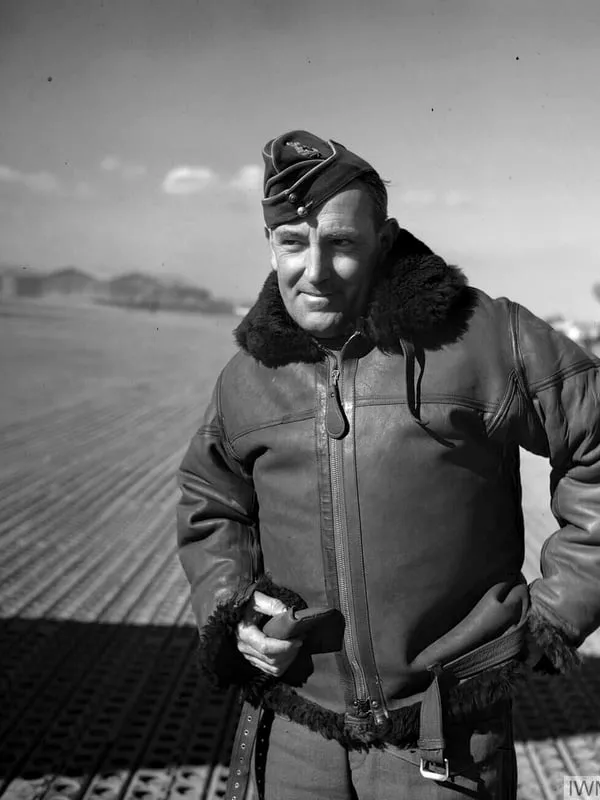
- Born:
- 19 January 1895, Brisbane (Australia)
- Died:
- 30 January 1948, Atlantic Ocean, on the route from the Azores to Bermuda
- Author:
- Natalia
- Photo:
- Royal Air Force official photographer, domena publiczna, Wikimedia Commons

Arthur Coningham, known to his colleagues all his life as “Mary”, was the commander who did most to teach the Allied air forces to fight side by side with the land forces. Over the Egyptian and Libyan desert he created an air force that moved from airfield to airfield with the front, answered calls from soldiers in the front line and cut the enemy off from his supplies. The principles he set down in 1943 – first command of the air, then isolation of the battlefield, finally direct support of the attack, and over it all a single air command, equal in standing to the army command – became the basis of modern joint operations doctrine. He ended the war in Germany as commander of the 2nd Tactical Air Force, and died in the mysterious loss of an airliner over the Atlantic.
The son of a fraudster
Arthur Coningham was born on 19 January 1895 in Brisbane, Queensland, Australia (some sources, including the RAF officers’ record, give the date as 11 March 1895). His father, also Arthur, had played Test cricket for Australia, but was by temperament a swindler. When a court in Sydney revealed that he had fabricated evidence in a lawsuit with which he had tried to extort money from a Catholic priest, the family moved to New Zealand; there the father served six months in prison for fraud. The son won a scholarship to Wellington College, was a better horseman and shot than scholar, and the family scandals made him ambitious, reserved and almost teetotal. Although born in Australia, he always considered himself a New Zealander. His nickname “Mary” came from “Maori”.
In August 1914 he volunteered for the New Zealand force that occupied German Samoa. In the spring of 1915, as a trooper of the Canterbury Mounted Rifles, he sailed for the Middle East and in June reached Anzac Cove at Gallipoli, but sunstroke, dysentery and typhoid sent him from one hospital to the next. In 1916 he was discharged as unfit for service. That April Coningham sailed to England at his own expense and volunteered for the Royal Flying Corps.
Fighter ace
From December 1916 he flew with No. 32 Squadron over the Western Front in DH.2 single-seat fighters, which during the Battle of Arras often attacked German infantry and roads from low level. On 30 July 1917 he was wounded in air combat. For attacks pressed home at close range and for continuing a patrol despite a wound he was awarded the Military Cross and the Distinguished Service Order. In 1918, as a 23-year-old major, he commanded No. 92 Squadron, flying S.E.5a fighters, which in the last months of the war bombed and strafed German airfields, columns and gun positions. He was credited with 19 victories in all, nine of them destroyed by him alone. From the very beginning, then, his war in the air was largely a war fought over the heads of the men on the ground.
Between the wars
After the war Coningham received a permanent commission in the Royal Air Force. He commanded a bomber squadron at Mosul in Iraq, and in 1925 led three aircraft from Cairo to Kano (PL) in Nigeria and back – the first flight across Africa from west to east. For this expedition, some 10,000 kilometres long, he received the Air Force Cross. The route across Central Africa was to become, in the Second World War, the way by which aircraft reached Egypt. Later Coningham was an instructor at Cranwell and at the Central Flying School, the senior RAF officer in the Sudan, and in 1937–1939 commanded the flying-boat base at Calshot. In 1932 he married Nancy, widow of the businessman Sir Howard Frank; they had a daughter.
Bombers and the desert
At the start of the war Coningham, as an air commodore, commanded No. 4 Group of Bomber Command, which flew Whitley heavy bombers by night. Until the spring of 1940 it dropped mainly leaflets over Germany; later it bombed targets in Italy and in the Ruhr. After the raid on Mannheim in December 1940 Coningham, like his superiors, admitted that he did not know what his bombers were actually achieving.
In July 1941 Arthur Tedder, commander of the RAF in the Middle East, brought him out to Egypt and gave him No. 204 Group, transformed in the autumn into the Western Desert Air Force, later known as the Desert Air Force. Coningham found a force that hardly knew how to support the land forces. He built a system in which fighter, bomber and reconnaissance squadrons moved up behind the front with their own workshops and stores, while liaison officers with the land forces passed on calls for air attacks by radio. He introduced fighter-bombers on a large scale, able both to fight in the air and to attack columns. He demanded results but did not interfere in the details of his subordinates’ work; an error that cost the lives of friendly troops, however, could mean the end of the career of the man responsible.
In November 1941 his air force supported Operation Crusader. During the Battle of Gazala in June 1942 his aircraft covered and supplied the besieged Free French at Bir Hakeim. When on 4 June the fighters broke up a dive-bomber raid, General Marie-Pierre Koenig signalled: “Bravo! Merci pour la RAF!”, and Coningham replied: “Bravo à vous. Merci pour le sport.” After the defeat at Gazala the desert air force covered the retreat to El Alamein with ceaseless attacks on the armoured columns, and in July it helped to stop Rommel there. In August the Eighth Army was taken over by Bernard Montgomery, who moved his headquarters next to Coningham’s; from then on the army and the air force planned their battles together, and at first the two commanders understood each other perfectly. In the Battle of Alam Halfa Coningham’s bombers attacked the German columns crowded in front of the ridge for several days and nights, and in the Second Battle of El Alamein the Allied air forces already had decisive superiority. After the victory Coningham was knighted. His air force accompanied the Eighth Army as far as the capture of Tripoli in January 1943.
Tunisia, Sicily, Italy
In February 1943, after the Casablanca Conference, the Allies united their air forces in North Africa. Coningham, promoted to air marshal, took over the Northwest African Tactical Air Force, which combined the British and American squadrons supporting the First and Eighth Armies. He set out his principles in a pamphlet sent to every senior officer: tactical air power must work with the army, but the army could not command it or scatter it as an umbrella over every unit. Not everyone accepted this. On 1 April, during the fighting at El Guettar, General George Patton, whose observation post had been bombed by the Germans, killing his aide, sent out a report complaining of a total lack of air cover. Coningham replied with a signal just as widely distributed: he gave the number of aircraft sent that day over the front of the US II Corps and stated that if the report was meant seriously, then the corps’ troops were not battleworthy. This provoked a crisis in Anglo-American relations. Tedder and the American General Carl Spaatz went to Patton to smooth things over, and Coningham had to apologise.
In the summer and autumn of 1943 his air forces supported the invasion of Sicily and the fighting in Italy. On 2 December, at a press conference in Bari, he declared that the Germans had lost the war in the air and that he would regard any significant Luftwaffe action over the area as a personal affront. That same evening about a hundred German Ju 88 bombers attacked the crowded and poorly defended port. The raid on Bari sank more than a dozen ships and proved the heaviest loss of Allied shipping since Pearl Harbor. That very night Coningham was visiting the wounded in hospitals.
Normandy and Germany
In January 1944 he took command of the 2nd Tactical Air Force, the British part of Air Chief Marshal Trafford Leigh-Mallory’s Allied Expeditionary Air Force, and prepared air support for the invasion of Normandy. His Typhoons, Spitfires and Mosquitoes destroyed German columns deep inside France and accompanied the British and Canadian forces all the way into Germany. His relations with Montgomery, however, soon deteriorated. Montgomery bypassed Coningham and went straight to Leigh-Mallory, while Coningham openly criticised the army for its slowness at Caen, without which there was no room for airfields. At the end of June Montgomery demanded his removal, but Tedder warned Eisenhower that this would be a disaster, and in August Montgomery wrote to Alan Brooke that Coningham was hostile to the army and that his commanders never wanted to see him. Coningham stayed in his post. In September 1944 his stepson Howard Frank was killed serving with the Guards Armoured Division.
On 1 January 1945, in Operation Bodenplatte, the Luftwaffe took the airfields of the 2nd Tactical Air Force in Belgium and the Netherlands by surprise, destroying many aircraft on the ground, but losing more than two hundred of its own pilots. On 3 March 1945 bombers of No. 2 Group, part of his command, missed a park near The Hague where the Germans kept V-2 rockets and hit a residential district, killing more than five hundred civilians (the bombing of Bezuidenhout). Coningham’s biographer Vincent Orange faults him for responding to the tragedy slowly and too briefly, which weakened his standing with Portal and Churchill.
Disappearance
In 1945 Coningham handed over the 2nd Tactical Air Force to Air Marshal Sholto Douglas, who was to command the occupation air force in Germany, and took over Flying Training Command. He regarded this as a humiliation and in 1947 left the RAF. At the end of January 1948 he flew as a passenger in the Avro Tudor IV “Star Tiger” of British South American Airways, from London via Lisbon and the Azores to Bermuda. On the night of 29–30 January the aircraft, with about thirty people on board, disappeared over the Atlantic on the last leg of the flight before Bermuda. No wreckage was ever found, and the inquiry into the loss could not establish its cause. The disappearance later became one of the favourite stories about the so-called Bermuda Triangle.
Assessment
Coningham was a difficult, proud and touchy man who could not hide his contempt for those he considered ignorant of air matters, and who alienated Patton, Montgomery and many army officers. At the same time it was he who built the model of cooperation between air and land forces that proved one of the keys to the Allied victories from El Alamein to the Rhine. His principles were taken up by the Americans, who had learned under his command in Tunisia, and air power historians call him the architect of modern tactical air doctrine. His achievements remained in the shadows, not least because he died before he could write his memoirs.
Sources
Mentioned in battles
(04)Often appears with
People who appear in the same events.