Equipment
The Douglas C-47 Skytrain (Dakota)
The military version of the DC-3 airliner: it carried paratroopers to Normandy and the Netherlands, towed gliders and supplied armies in Burma and New Guinea.
- Role:
- transport aircraft
- State:
- United States
- Maker:
- Douglas
- First flight:
- 23 December 1941
- Built:
- more than 10,000
- Author:
- Łukasz
- Updated:
- 1 November 2026
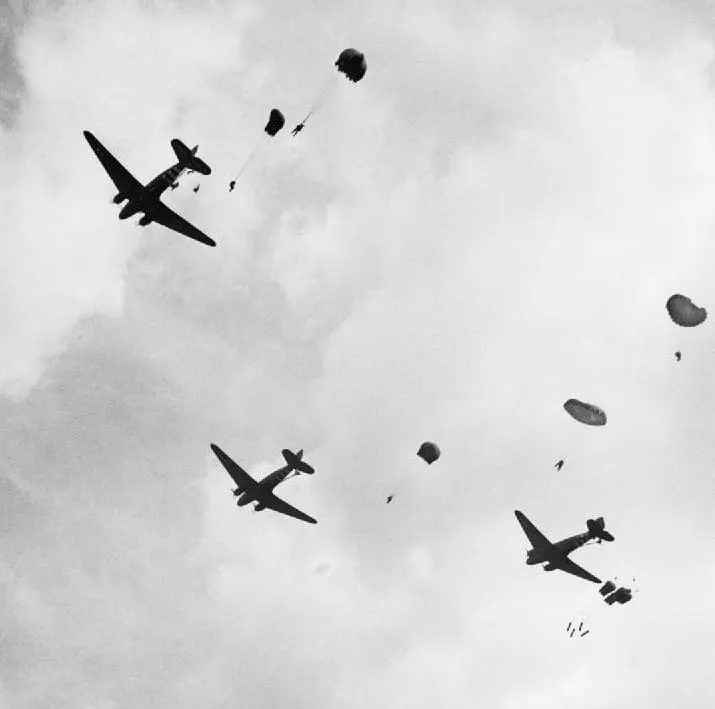
The Douglas C-47 Skytrain, the Dakota in British service, never dropped a bomb, and yet it is hard to name an aircraft more important to the Allied victory. It was the military version of the Douglas DC-3 airliner, adapted to carry cargo, paratroopers and wounded men to and from makeshift airfields. In the jungles of New Guinea and Burma it took the place of roads that did not exist, and in Europe it dropped airborne divisions and towed gliders. Slow, unarmed and unarmoured, it was an easy target, but in everyday work it seemed almost indestructible.
An airliner in uniform
The Douglas DC-3, first flown in December 1935, carried passengers for American airlines from 1936 and quickly became their mainstay. The Army Air Forces ordered a military version: with more powerful engines, a strengthened floor and rear fuselage, and large cargo doors on the left side. The first C-47 took off on 23 December 1941, two weeks after Pearl Harbor. It could take up to 28 paratroopers or several tons of cargo, and even a jeep could be rolled into its cabin. It was built at Douglas’s plants at Long Beach and Oklahoma City, the latter turning out more than five thousand aircraft in two and a half years. The Americans called it the Skytrain or, affectionately, the Gooney Bird; the British called it the Dakota.
Air roads in the Pacific and Asia
New Guinea was the first great school of air transport. In September 1942 George Kenney flew soldiers of the American 32nd Division to Port Moresby and convinced MacArthur that in the mountains and jungle the transport aircraft could replace roads. A year later, on 5 September 1943, the American 503rd Parachute Infantry Regiment jumped from 79 C-47s over the Markham valley; each aircraft emptied in ten seconds, and the whole regiment was in the air in less than five minutes. The transports then flew the Australian 7th Division in to the captured landing ground.
In Burma transport aircraft made it possible to fight where the army had no supply lines. Dakotas of No. 31 Squadron RAF supplied the columns of the first Chindit expedition in 1943, and in March 1944 American C-47s, towing gliders, landed the second expedition deep behind Japanese lines; in a week some 9,000 men and more than a thousand mules were flown in. In the Battle of Imphal and Kohima General William Slim moved a whole division from the Arakan by air and supplied the besieged troops from the air. At the airfield at Myitkyina some 14,000 transport aircraft landed between May and October 1944. All this time C-47s and larger Curtiss C-46s also flew across the Himalayas to China, on the route the airmen called the Hump, which cost hundreds of aircraft. In 1945 the Anglo-American Combat Cargo Task Force brought the Fourteenth Army fuel and ammunition during the Battle of Meiktila and Mandalay, and its weakness was that the Americans could take their aircraft away to China at any moment.
Airborne landings in Europe
In Europe the C-47 became the aircraft of airborne assault. The first great test, the landing in Sicily in July 1943, went badly: a strong wind scattered the paratroopers and gliders, and on 11 July the ships’ anti-aircraft guns, which had just been fighting off a German air raid, fired on 144 transports over the Gulf of Gela. The lessons were applied in Normandy. On the night of 5–6 June 1944 more than a thousand C-47s carried the paratroopers of the American 82nd and 101st Airborne Divisions to the Cotentin peninsula and towed their gliders.
On 17 September 1944, the first day of Operation Market Garden, hundreds of C-47s and the gliders they towed appeared in the sunshine over the Netherlands; within a few days soldiers of the Polish brigade of Stanisław Sosabowski were also jumping from them. In December besieged Bastogne waited for the weather: on 23 December 253 of the 264 C-47s sent dropped about 334 tons of ammunition, food and medical supplies over the town. The last great airborne operation of the war, Operation Varsity across the Rhine on 24 March 1945, needed some 1,600 transport aircraft, most of them C-47s, and more than 1,300 gliders. In the Pacific, in February 1945, C-47s dropped paratroopers on Corregidor, and nine of them took part in freeing the internees of the camp at Los Baños.
Most III
One flight wrote the C-47 into Polish history. Heavy Halifaxes and Liberators dropped men and arms to the Home Army by parachute, but only a Dakota with extra tanks could land on a meadow in occupied Poland and fly back to Italy. On the evening of 25 July 1944 a C-47 of No. 267 Squadron RAF took off from Brindisi, flown by the New Zealander Stanley Culliford with a Polish second pilot, Kazimierz Szrajer (PL). It landed near Tarnów, on the landing ground code-named “Motyl”, and took on parts of a German V-2 rocket recovered by Home Army intelligence, as well as Polish politicians. The aircraft stuck in the sodden ground and got off it only after several attempts; in the morning Operation Most III ended with a landing at Brindisi.
The balance
More than 10,000 C-47s and their military variants were built, and the USSR, which received more than seven hundred under Lend-Lease, had earlier bought a licence for the DC-3 and built its copy as the Li-2. After the war thousands of cheap surplus Dakotas rebuilt civil airlines all over the world, among them the Polish LOT, which bought several in 1946. In 1948 C-47s began the Berlin airlift, and in Vietnam they were still flying as gunships. The American air force retired the last of them in 1975, but some are flying to this day.
Sources
Battles
(04)- 10 July – 17 August 1943Allied invasion of SicilyBetween 10 July and 17 August 1943 the Allies took Sicily. Mussolini fell, but the Germans and Italians got some 100,000 men out across the Strait of Messina.
- 4–16 September 1943Capture of LaeOn 4–16 September 1943 Australian sea and air landings took Lae, and Salamaua on the 11th; the Japanese 51st Division escaped over the Saruwaged Range.
- 7 March – 3 July 1944Battles of Imphal and KohimaIn March–July 1944 the Japanese 15th Army tried to take Imphal and Kohima in India. Operation U-Go ended in defeat, starvation and retreat over the Chindwin.
- 14 January – 28 March 1945Battle of Meiktila and MandalayJanuary–March 1945. Slim's Fourteenth Army crossed the Irrawaddy, took Meiktila and Mandalay and shattered the Japanese armies in central Burma.
In the chronicle
(21)1943
1944
- 9 January 1944The British take Maungdaw
- 6 March 1944Operation Thursday – the second Chindit expedition
- 6 April 1944The siege of Kohima
- 18 May 1944The Myitkyina airfield
- 25 July 1944Operation Most III
- 17 September 1944Operation Market Garden begins
- 22 December 1944McAuliffe’s “Nuts!”
- 23 December 1944Clear skies over the Ardennes
- 26 December 1944The relief of Bastogne