1940–1943: The war in the Mediterranean
Allied invasion of Sicily
- Dates:
- 10 July – 17 August 1943
- Front:
- Mediterranean
- Location:
- Sicily (Kingdom of Italy): the beaches of the south and south-east coast between Licata and Cassibile, the Catania plain, the Etna massif, the western part of the island with Palermo, the Caronie mountains with Troina, and the north coast and the Strait of MessinaOn the battle map →
- Sides:
- United Kingdom, United States and CanadaDwight Eisenhower, Harold Alexander, Bernard Law Montgomery, George PattonItaly and Nazi GermanyAlfredo Guzzoni, Albert Kesselring, Hans-Valentin Hube
- Result:
- Allied victory. After 38 days of fighting the whole of Sicily was in Allied hands and the Mediterranean shipping lanes were open. The campaign contributed to the overthrow of Mussolini on 25 July 1943. The Axis forces, however, escaped encirclement: according to various calculations, more than 100,000 German and Italian troops in all crossed the Strait of Messina, together with much of their equipment.
- Author:
- Natalia
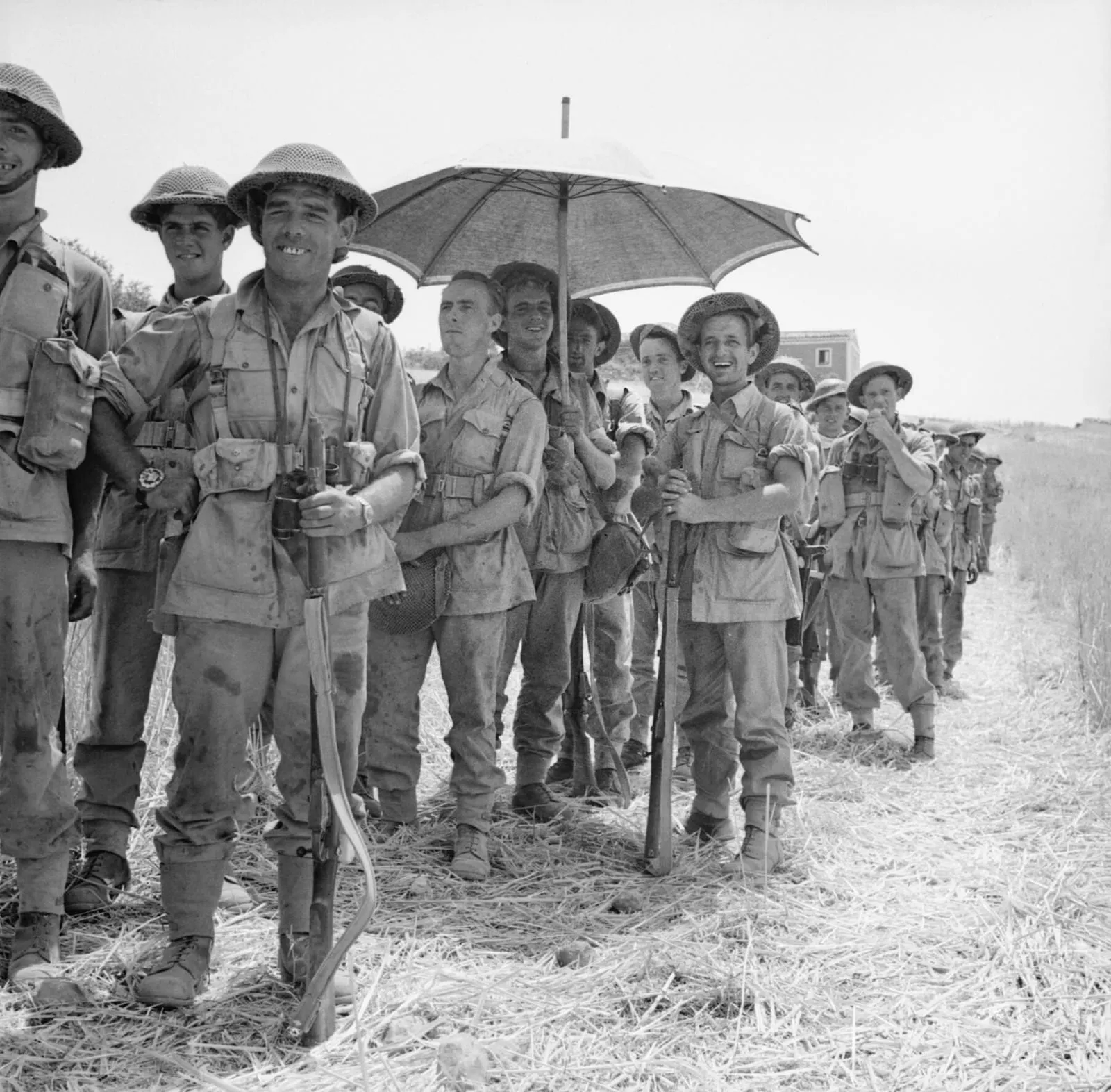
The invasion of Sicily, known by the code name Operation Husky, was the Western Allies’ first great landing on the territory of a European Axis state and at the same time the first step towards taking Italy out of the war. On the night of 9–10 July 1943 American and British airborne troops descended on the island, and at dawn seven divisions of the US Seventh Army and the British Eighth Army landed on several dozen beaches along the south and south-east coast. In terms of the width of the assault front and the number of divisions put ashore on the first day, it was the largest amphibious operation of the entire war. For five and a half weeks the Allies fought the Italian 6th Army and several German divisions: the British were held up on the Catania plain and below Etna, while the Americans swept across the western part of the island to Palermo and then fought their way along the north coast towards Messina. In the course of the campaign, on 25 July, Benito Mussolini was overthrown in Rome. On 17 August the first Americans entered Messina – a few hours after the last Germans had sailed for the mainland. Sicily was a victory, but an incomplete one: the Axis forces managed to avoid being trapped in a pocket and crossed to Calabria.
Name and dates
The code name Husky (after the breed of sled dog) was given to the whole operation, from the planning in early 1943 to the capture of the island. The British airborne operations had names of their own: the glider landing near Syracuse was called Ladbroke, and the parachute drop on the Primosole bridge Fustian. The German evacuation of the island in August went under the code name Lehrgang (“training course”).
The campaign is taken to have begun on 10 July 1943, the day of the seaborne landing, although the first aircraft carrying airborne troops took off from Tunisia on the evening of 9 July, and the paratroopers and gliders came down shortly before and just after midnight. It is taken to have ended on 17 August, when the Americans, followed immediately by the British, entered Messina and the German and Italian evacuation across the Strait of Messina came to an end. The campaign thus lasted 38 days.
Background
The decision to strike at Sicily was taken in January 1943 at the Casablanca Conference. The Americans wanted to shift the main effort as quickly as possible to a landing in France; the British wanted to use the armies assembled in North Africa for further operations in the Mediterranean. Sicily was the compromise: its capture would open the sea route through the Mediterranean (convoys to Egypt and India would no longer have to sail round Africa), draw German forces away from the Eastern Front and increase the pressure on Italy, whose morale was rapidly crumbling after the defeats in Africa. In May, at the Trident Conference in Washington, the date of the operation was confirmed, and Dwight Eisenhower was instructed to prepare further operations to eliminate Italy from the war – without deciding whether, or where, the Allies would land on the mainland.
Eisenhower was the supreme commander of the operation. The ground forces – grouped in the 15th Army Group – were commanded by General Harold Alexander, the naval forces by Admiral Andrew Cunningham, and the air forces by Air Chief Marshal Arthur Tedder. The original plan envisaged dispersed landings in the west and the south-east of the island, so as to seize the ports of Palermo and Catania at once. General Bernard Law Montgomery considered it dangerous and at the beginning of May pushed through a concentrated version: the two armies were to land side by side in the south-eastern corner of Sicily. Montgomery’s Eighth Army was to take Syracuse, Augusta and Catania and advance along the east coast to Messina, while General George Patton’s US Seventh Army was to cover its left flank. This division of tasks, which relegated the Americans to a supporting role, later became a source of tension between the two commanders.
Preparations for the operation had been under way since the spring. After the surrender of the Axis forces in Africa, Allied aircraft spent two months bombing the airfields and ports of Sicily and Sardinia, and in June forced the surrender of the garrison of Pantelleria and of Lampedusa. According to Allied tallies, from mid-May to the day of the invasion Allied airmen flew more than 42,000 combat sorties and destroyed more than 400 Axis aircraft; by 10 July only two airfields on the island were still fully operational. At the same time British intelligence carried out Operation Mincemeat: fabricated documents planted on the Spanish off the coast at Huelva were meant to convince the Germans that the Allies’ main objectives were Greece and Sardinia and that Sicily was only a feint. Adolf Hitler took this version seriously and in May and June reinforced Greece and Sardinia, although the Italian command and some German officers still expected an attack on Sicily.
The opposing forces
Sicily was defended by General Alfredo Guzzoni, commander of the Italian 6th Army, which consisted of two corps. According to the most frequently cited figures, at the beginning of July there were some 200,000 Italian troops on the island, about 32,000 German army troops and about 30,000 Luftwaffe ground personnel. Roughly half of the Italians served in four field divisions (among them the Livorno and Napoli Divisions), the rest in poorly armed coastal divisions and brigades, made up largely of reservists of local origin. Guzzoni’s plan assumed that the coastal units would absorb the first blow and give the field divisions time to counter-attack. The striking force consisted of two German divisions: the Hermann Göring Panzer Division (close to a hundred tanks but little infantry) and the 15th Panzergrenadier Division. Formally they were subordinate to the Italians, but in practice they took their orders from the German liaison officer with the 6th Army, General Fridolin von Senger und Etterlin, who answered to Field Marshal Albert Kesselring, the German commander in the south. In July the Germans sent paratroopers of the 1st Parachute Division to the island, along with part of the 29th Panzergrenadier Division and the headquarters of General Hans-Valentin Hube’s XIV Panzer Corps, who gradually took over the actual direction of the defence. By the end of July the number of German troops on the island had risen to about 70,000.
On the Allied side seven divisions were allotted to the first wave. In the western sector, between Licata and Scoglitti, the US 3rd Infantry Division under General Lucian Truscott, the 1st Infantry Division and the 45th Infantry Division landed – the last two under General Omar Bradley’s II Corps. In the eastern sector, from Pachino to Cassibile, the British 5th, 50th and 51st (Highland) Infantry Divisions and the 1st Canadian Infantry Division came ashore – for the Canadians, after the defence of Hong Kong and the Dieppe Raid, this was their first sustained land campaign of the war. They were to be supported from the air by the 82nd Airborne Division and the British 1st Airborne Division. Estimates of strength vary with the method of counting: some 150,000–160,000 troops were put ashore in the first few days, and over the whole campaign, according to some tallies, close to half a million passed through the island. The invasion fleet, including landing barges and craft, numbered some 2,500–3,000 vessels. For the first time on such a scale, new LST, LCT and LCI landing ships and craft were used, as were DUKW amphibious trucks, which made it possible to unload supplies straight onto the beaches.
Course of the campaign: the airborne assault and the landings (9–10 July)
On the evening of 9 July a strong wind blew up over the Mediterranean, gusting up to 70 km/h. The weather very nearly forced the command to call off the operation, and it hit hardest the airborne troops, used for the first time in the war on such a scale. The British 1st Airlanding Brigade was to land near Syracuse in Operation Ladbroke and seize the Ponte Grande bridge. Of the nearly 150 gliders, mostly American Waco CG-4s towed by inexperienced crews, more than 60 were released too early and came down in the sea; according to various calculations, from over 200 to about 250 men drowned. Only a dozen or so gliders reached the landing zones. The bridge was taken by fewer than a hundred men, who held it until the afternoon of 10 July; when their ammunition ran out the survivors surrendered to the Italians, but the advancing British 5th Division retook the crossing before the defenders could blow it up. The US 505th Parachute Infantry Regiment of the 82nd Division under Colonel James Gavin, making its first combat jump, was scattered over several dozen kilometres between Gela and Syracuse. The dispersed paratroopers nonetheless fought on in small groups, cutting communications and tying down the defenders, and on 11 July a group gathered by Gavin halted the advancing units of the Hermann Göring Division on Biazza Ridge.
The seaborne landing began at about 2.45 a.m. on 10 July on several dozen beaches stretching along roughly 170 kilometres of coast, from Licata in the west to Cassibile in the east. The same wind that had scattered the paratroopers helped to achieve surprise – many defenders assumed that no one would risk a landing in such weather. Some units landed in the wrong places and several hours late, and landing craft grounded on unseen sandbars, but most of the Italian coastal divisions put up no serious resistance, and some of their units disintegrated without a fight. There were exceptions, however: at Gela an Italian coastal battalion lost almost half its strength defending the beach against American Rangers. On 10 July itself the British took Syracuse with its port undamaged, the Americans Licata, and the Canadians the airfield near Pachino. By evening several tens of thousands of Allied troops were ashore, and the beachheads were expanding rapidly.
Course of the campaign: Gela and the fight for the beachheads (11–17 July)
The most dangerous Axis counter-attack fell on 11 July on the American beachhead at Gela. Tanks of the Hermann Göring Division and infantry of the Italian Livorno Division got to within a few hundred metres of the beach in places. The attack broke down under the fire of naval guns – the cruisers and destroyers lying offshore – and of the field guns and tanks the Americans had managed to land. Patton, who came ashore that day, appeared in the front line at Gela and personally urged the troops to hold on. The Italian infantry suffered heavy losses in these attacks.
On the night of 11–12 July came the most tragic episode of the campaign. Patton called for reinforcements from the 504th Parachute Infantry Regiment of the 82nd Division, and 144 C-47 transport aircraft arrived over Gela just after a German air raid on the fleet. Although the ships and the troops ashore had been warned of the flight, one ship opened fire, and then everyone was shooting. According to American figures, 23 aircraft were shot down and several dozen damaged; the paratroopers lost 229 men, 81 of them killed, and the aircrews several dozen more. Among the aircraft shot down was that of the assistant commander of the 82nd Division, Brigadier General Charles Keerans; he survived the ditching off the coast but went missing inland the next day and was later declared dead. Two nights later, during Operation Fustian, British aircraft carrying the 1st Parachute Brigade were likewise fired on by their own ships and then by Axis anti-aircraft defences; some turned back, some were shot down, and the rest dropped their men far from the objective.
Meanwhile the British were advancing along the east coast. On 13 July they took Augusta. The objective of Fustian was the Primosole bridge over the Simeto river, the gateway to the Catania plain. On the night of 13–14 July only a small part of the brigade – the equivalent of about two companies – landed in the right places. The paratroopers captured the bridge but on the evening of 14 July had to fall back before German paratroopers who had been dropped near Catania the day before. The bridge was retaken only on 16 July by the British 50th Division, after heavy fighting by battalions of the Durham Light Infantry. Beyond it, on the plain and before Catania, the Eighth Army’s advance stalled for several weeks.
On 14 July, during the fighting for the airfield near Biscari, soldiers of the US 180th Infantry Regiment of the 45th Division committed a war crime: in two separate incidents they murdered 73 prisoners – 71 Italians and two Germans. In the first, Sergeant Horace West shot with a sub-machine gun 37 prisoners whom he was supposed to escort to the rear; in the second, Captain John Compton had 36 Italians who had surrendered to his company shot. The matter was reported by the regimental chaplain. West was sentenced by court martial to life imprisonment, but was released as early as 1944 and returned to duty; Compton was acquitted after invoking a speech by Patton, who before the invasion had allegedly urged ruthlessness towards an enemy who kept up resistance. Patton denied that his words could be understood in that way. According to research by Italian and American historians, in the first days of the invasion American soldiers also killed civilians, including at Vittoria and near Canicattì.
Course of the campaign: Palermo and the Etna Line (18 July – early August)
Held up before Catania, Montgomery decided to outflank the Etna massif from the west and persuaded Alexander to allot to the Eighth Army Highway 124 through Vizzini and Caltagirone, previously assigned to the Americans. Patton, who had been given only the task of covering the British flank, took this as a humiliation. He obtained permission for a “reconnaissance in force” towards Agrigento, and when that port was taken on 17 July he formed General Geoffrey Keyes’s Provisional Corps (the 3rd Infantry Division, the 2nd Armored Division and part of the 82nd Airborne Division) and sent it across the western part of the island towards Palermo. The Germans had already withdrawn their units from there to the east, and the demoralised Italian divisions were surrendering en masse. The American columns covered some 160 kilometres in three days, and on the evening of 22 July entered Palermo, which its Italian commandant surrendered. Over the next few days the Americans took Trapani and Marsala; according to American figures, they captured several tens of thousands of Italians in western Sicily. The military significance of the drive was limited – the main Axis forces stood in the east – but Palermo gave the Seventh Army a large port, and Patton the prestige he craved.
In the east the fighting took on a different character. Hube, whose XIV Panzer Corps was gradually assuming command of all German units, pulled them back to a shortened defensive line running from Catania through the foothills of Etna towards the north coast, which the Allies called the Etna Line. The mountainous terrain, winding roads and demolished bridges favoured the defenders. In heavy fighting the Canadians took Leonforte on 22 July and Agira on 28 July, while Bradley’s US II Corps, sent north, reached the north coast on 23 July. The island had been cut in two, and the further advance was to proceed along two roads, by the sea and through the mountains, towards Messina.
The invasion also had immediate consequences far from Sicily. As early as 13 July Hitler, pointing to the threat to Italy, called off the offensive at Kursk, part of the Battle of Kursk, and began transferring units to the west. In Italy itself the defeat in Sicily and the first air raid on Rome, on 19 July, sealed the fate of the regime. On the night of 24–25 July the Grand Council of Fascism passed a vote of no confidence in Mussolini, and the next day King Victor Emmanuel III dismissed him and had him arrested. Marshal Pietro Badoglio became the new prime minister. The government announced that Italy would continue the war at Germany’s side, but secretly sought contact with the Allies. The Germans were not deceived: they began moving fresh divisions into Italy and preparing to take control of the country. In Sicily the Italian units fought with less and less conviction from then on, and the burden of the defence fell almost entirely on the Germans.
Course of the campaign: Troina, Catania and the race for Messina (31 July – 17 August)
Around the turn of July and August the Allies attacked the Axis defensive line along its whole length. The heaviest fighting was waged by the US 1st Infantry Division for Troina, a mountain town in the Caronie range, defended by the 15th Panzergrenadier Division and Italian units. From 31 July to 6 August the defenders launched, according to American figures, some twenty-odd counter-attacks; only when the Americans had taken the heights overlooking the town and the neighbouring sectors had begun to give way did the Germans withdraw by night to the next line. The British took Centuripe on 3 August, entered Catania, abandoned by the Germans, on 5 August, and on the night of 6–7 August captured Adrano. On 13 August units of both armies entered Randazzo on the northern slopes of Etna. Patton, determined to beat Montgomery to Messina, three times put small landing forces ashore behind the enemy along the north coast – on 8 August at Sant’Agata, on 11 August at Brolo and on 16 August at Spadafora. They delayed the German retreat but failed to cut it off, and at Brolo the battalion put ashore fought surrounded for a whole day and suffered heavy losses.
During this period Patton committed acts that very nearly ended his career. On 3 August, in a field hospital near Nicosia, he slapped Private Charles Kuhl, who was being treated for “battle exhaustion”, and called him a coward; on 10 August, in another hospital, he struck Private Paul Bennett, who was suffering from severe shell shock, and threatened him with a pistol. Eisenhower reprimanded Patton severely and ordered him to apologise to the men concerned, to the hospital staff and to the soldiers of the Seventh Army, but kept him in his post. When the affair became public in the American press it caused an uproar; Patton was left without a combat command for many months, and command of the American ground forces in the coming invasion of France went to his former subordinate, Bradley.
Meanwhile the Germans and Italians were preparing the evacuation. At the end of July Kesselring and Hube concluded that the island could not be held. The Strait of Messina, about three kilometres wide at its narrowest point, was covered on both shores by more than two hundred anti-aircraft guns and heavy coastal artillery; Allied airmen compared the fire to the defences of the Ruhr. The Italians began shipping their units out at the beginning of August, and Operation Lehrgang, the main evacuation of the German forces, lasted from 11 to 17 August. Each night the German units fell back a dozen or so kilometres, covering themselves with mines and demolitions, while ferries, barges and motor boats plied the strait without a break. Allied air and naval forces failed to stop them: daylight raids were too costly, and warships did not dare enter the range of the batteries in the narrow strait. According to German and Italian tallies, more than 100,000 men crossed in all – according to various calculations, some 40,000–52,000 Germans (including the wounded) and about 62,000 Italians – and the Germans also took out, depending on the source, from about 10,000 to more than 14,000 vehicles, several dozen tanks and nearly a hundred guns.
On the night of 16–17 August patrols of the US 3rd Infantry Division entered Messina. The last German boats left for Calabria at dawn on 17 August. In the morning Patton drove into the city, and shortly afterwards the British vanguard arrived. Patton had won the “race for Messina”, but there was no longer anyone there to encircle.
Losses
Figures for losses vary according to the source and the method of counting. According to Allied tallies, the US Seventh Army lost 8,781 men (about 2,200 killed and missing, about 5,900 wounded and nearly 600 taken prisoner), and the British Eighth Army 11,843 (about 2,100 killed and missing, about 7,100 wounded and about 2,600 prisoners). The Canadians, fighting as part of the Eighth Army, lost 2,310 men, including 562 killed. The navies of the two countries lost several hundred killed and missing in all, among other things as a result of air attacks on the invasion fleet. Total Allied losses are usually estimated at 20,000–25,000 men.
Axis losses were considerably higher, mainly because of the mass surrender of Italians. According to the German official history, the German forces lost about 28,000 men (4,325 killed, 4,583 missing, 5,532 taken prisoner and about 13,500 wounded); other authors give about 20,000. According to the Historical Office of the Italian Army General Staff, the Italians lost 4,678 killed, more than 36,000 missing, about 32,500 wounded and nearly 117,000 taken prisoner – although many of the “missing” were probably men killed and buried on the battlefield, and some were local soldiers who had simply gone home. Earlier Allied studies stated that some 100,000 Axis troops in all were taken prisoner. The civilian population suffered too: inhabitants of the bombed cities, especially Messina, Palermo and Catania, were killed, as were victims of the fighting and of crimes committed by soldiers of both sides.
Significance
The capture of Sicily opened the route through the Mediterranean to the Allies – for the first time since 1941 merchant ships could sail safely from Gibraltar to the Suez Canal, shortening the voyage to India and Australia by thousands of miles. The island became an air base and a springboard for further operations. Most important, however, were the political consequences: the invasion hastened the fall of Mussolini, and Badoglio’s new government opened secret negotiations with the Allies as early as August. On 3 September 1943 the Eighth Army crossed the Strait of Messina to Calabria; on the same day an armistice with Italy was signed at Cassibile in Sicily, announced on 8 September, and on 9 September the Allies landed at Salerno. In response the Germans disarmed the Italian army and occupied most of the country, and the campaign in the Italian peninsula dragged on until the spring of 1945.
For the Allies Sicily was a school before the Normandy landings. It demonstrated the strength of a combined command and the usefulness of the new landing craft and amphibious vehicles, but it also exposed weaknesses: the tragic consequences of firing on friendly aircraft, poor coordination between the air forces and the ground and naval forces, and the lack of any plan to cut off the enemy’s retreat across the Strait of Messina. This last omission had serious consequences – the divisions saved from Sicily, including the Hermann Göring Division, the 15th and 29th Panzergrenadier Divisions and the 1st Parachute Division, fought a few weeks later at Salerno, and later on the Gustav Line and at Monte Cassino. The Sicilian campaign also drew Hitler’s attention away from the Eastern Front at a crucial moment in the summer of 1943 – together with the defeat at Kursk, it meant that Germany had lost the strategic initiative for good.