- Category:
- Military operations
- Front:
- Western Front
- Date:
- 26 December 1944
- Author:
- Natalia
- Battle:
- Battle of the Bulge
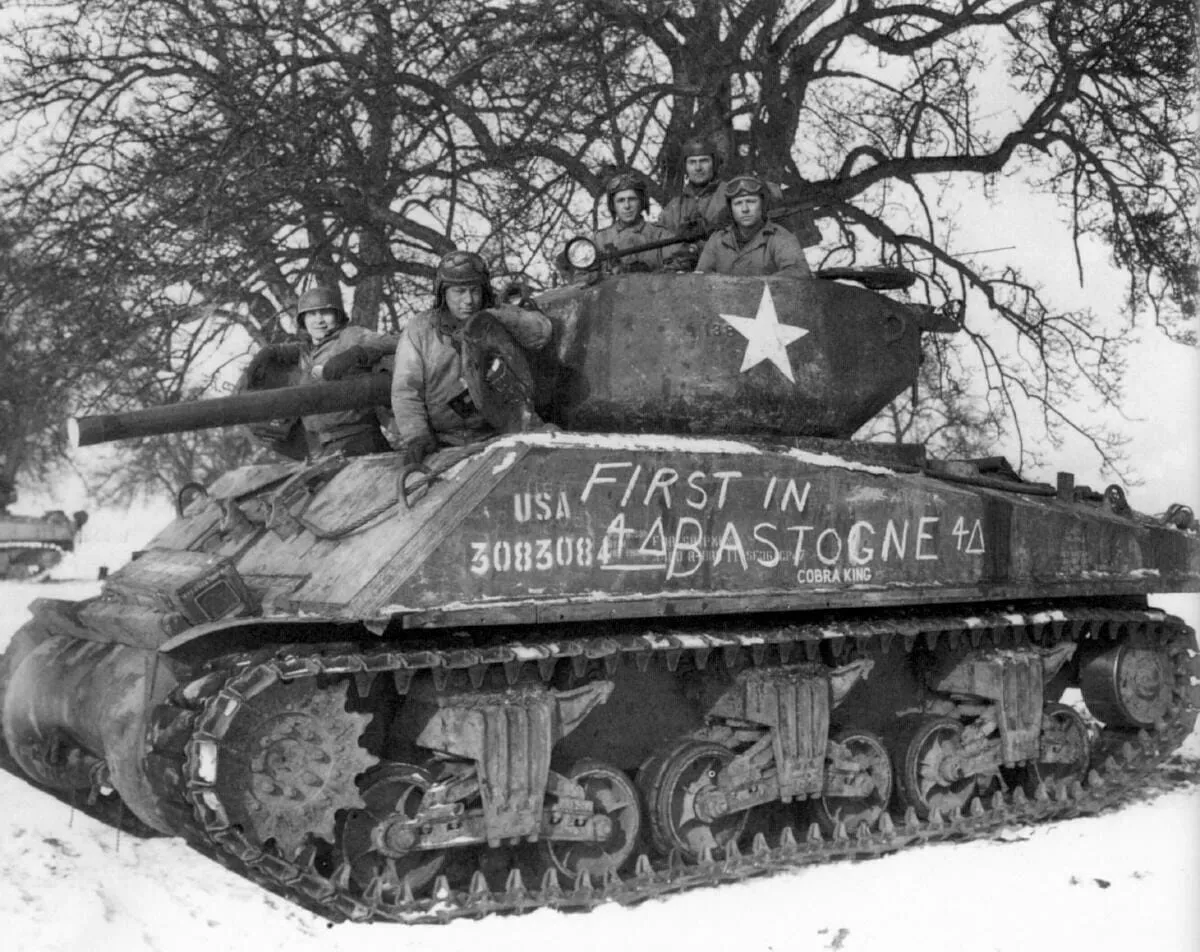
On 26 December 1944, at around 4.50 p.m., an M4 tank named “Cobra King” from C Company of the 37th Tank Battalion reached, near the village of Assenois, the positions of the 326th Airborne Engineer Battalion, which was defending the southern edge of encircled Bastogne. It was commanded by Lieutenant Charles Boggess, and the battalion by Lieutenant Colonel Creighton Abrams. A few minutes later more tanks and armoured half-tracks of the 4th Armored Division, part of General George Patton’s Third Army, began to arrive among the engineers. After five days of complete encirclement, the defenders of the Belgian town – the 101st Airborne Division, elements of the 10th Armored Division and the remnants of units shattered in the first days of the German offensive – had regained an overland link with the rest of the US Army.
Under this date some chronologies record that the siege of Bastogne was broken by the tanks of Patton’s Third Army “and with it the Ardennes offensive collapses and ends in defeat”. The first part of that statement is true; the second needs qualifying. The corridor opened on 26 December was at first very narrow, and the Germans went on attacking Bastogne and its approaches until the first days of January 1945. On 31 December they launched another offensive in Alsace – Operation Nordwind. The bulge in the Ardennes front was not eliminated until the end of January 1945. By then the German offensive no longer had any chance of reaching its objectives – the Meuse and Antwerp remained beyond its reach – but it did not “collapse” in a single day on 26 December. It ended in defeat over the following month of fighting.
The town of seven roads
The German offensive in the Ardennes began on 16 December. Its aim was to cross the Meuse and take Antwerp, thereby splitting the British and American armies. On the southern wing of the assault was General Hasso von Manteuffel’s Fifth Panzer Army, and further south still, covering its flank, General Erich Brandenberger’s Seventh Army. Bastogne, a small town in the Belgian province of Luxembourg, mattered greatly to both sides: seven main roads of the Ardennes converged on it. Whoever held them controlled communications throughout the region.
The capture of Bastogne was entrusted to General Heinrich von Lüttwitz’s XLVII Panzer Corps (2nd Panzer Division, Panzer Lehr Division and 26th Volksgrenadier Division). The resistance of the 28th Infantry Division on the river Our, however, delayed the Germans long enough for General Troy Middleton, commander of the American VIII Corps, to send Combat Command B of the 10th Armored Division into the town, and on the night of 18/19 December the 101st Airborne Division arrived by lorry, having earlier been withdrawn to France to rest after the fighting in the Netherlands; soon Bastogne was encircled. The division’s commander, General Maxwell Taylor, happened to be in the United States, so the defence was directed by his artillery commander, Brigadier General Anthony McAuliffe.
On 20 December the Germans cut further roads out of the town, and at noon on 21 December they closed the ring. Lüttwitz’s main armoured forces – the 2nd Panzer Division and most of Panzer Lehr – bypassed Bastogne and pushed on westwards towards the Meuse. Left before the town was the 26th Volksgrenadier Division, supported by part of Panzer Lehr. On 22 December Lüttwitz called on the defenders to surrender and received McAuliffe’s famous reply, “Nuts!”. The defenders were short of artillery ammunition, dressings and doctors – the division’s medical company, together with its surgeons, had been captured on the night of 19/20 December. Only the clearing weather of 23 December allowed C-47 transport aircraft to drop supplies over Bastogne and fighter-bombers to attack the besieging troops.
On Christmas Day the Germans, reinforced by a panzergrenadier regiment of the 15th Panzergrenadier Division, made their strongest assault on the western sector of the perimeter, around Champs and Hemroulle. A dozen or more tanks broke through the lines of the 327th Glider Infantry Regiment but were destroyed by paratroopers of the 502nd Regiment and tank destroyers of the 705th Battalion. On the evening of 24 December German bombers had raided the town; one bomb destroyed an aid station in the centre, killing more than twenty wounded men and a Belgian volunteer nurse, Renée Lemaire (sources give different casualty figures). When another day of fighting dawned on the morning of 26 December, the defenders still held the whole perimeter, but their supplies remained meagre and the wounded had nowhere to be evacuated to.
The Third Army turns north
The decision to relieve the town was taken on 19 December at a conference in Verdun called by General Dwight Eisenhower. Patton, whose Third Army was then preparing to attack in the Saar after the fighting for Metz had just ended, declared that he could attack northwards with three divisions on 22 December. Many of those present took this for a boast: wheeling an army through 90 degrees and moving it more than a hundred kilometres over snowbound roads within three days seemed impossible. Patton’s staff, however, had already prepared plans for just such a turn, and the speed of the march became one of the US Army’s best-known logistical achievements of the war. According to the history of the 4th Armored Division, its leading combat command covered about 240 kilometres in under twenty-four hours on 18 and 19 December, driving through the night as well.
The attack was carried out by General John Millikin’s III Corps: General Hugh Gaffey’s 4th Armored Division in the centre, with the 26th and 80th Infantry Divisions on the right. As promised, it set off at dawn on 22 December from the area of Arlon, about 30 kilometres south of Bastogne. The following days belong to the wider American counter-offensive in the Ardennes. Patton had counted on a quick breakthrough, which turned into a slow and bloody struggle. The way was barred by Ludwig Heilmann’s 5th Parachute Division of the Seventh Army, reinforced with assault guns. The paratroopers defended every village, and their engineers blew bridges and felled trees across the roads.
Combat Command A advanced along the main Arlon–Bastogne road. At Martelange it had to wait while engineers built a new bridge over the Sûre to replace the one that had been blown, and then took Warnach and Tintange in turn. Combat Command B, advancing along side roads, took Chaumont on 23 December but was driven out the same day by a German counter-attack, losing 11 tanks according to the US official history. On Christmas Day the American spearheads were still several kilometres from the Bastogne perimeter. Patton urged his commanders to move faster; in his diary at that time he wrote: “A clear cold Christmas, lovely weather for killing Germans, which seems a bit queer, seeing Whose birthday it is.”
One of the best-known anecdotes about Patton also belongs to this period: at his request the Third Army chaplain, Father James O’Neill, had already composed in December a prayer for good fighting weather, printed on Christmas greeting cards for the troops. When the skies cleared after 23 December, Patton – according to the chaplain’s recollections – decided that the prayer had “worked” and decorated O’Neill with the Bronze Star.
Through Assenois
The decisive move was the shift to the left wing of the 4th Armored Division’s third combat command – the reserve combat command (CCR) under Colonel Wendell Blanchard. On Christmas Eve and Christmas Day it moved west onto the road from Neufchâteau to Bastogne and on 25 December took Remoiville. On the morning of 26 December its spearhead captured Remichampagne and Clochimont. The main strength of the combat command consisted of Lieutenant Colonel Abrams’s 37th Tank Battalion and Lieutenant Colonel George Jaques’s 53rd Armored Infantry Battalion – both already short of tanks and men after several days of fighting.
According to plan, the combat command was to push on towards Sibret (PL), but reconnaissance showed that the village was strongly held. In the afternoon Abrams and Jaques decided on their own responsibility to turn towards Assenois – a smaller village lying closer to the perimeter – and to break through it on the move before the Germans could reinforce that sector. Abrams called for artillery support. A short, violent barrage from several artillery battalions came down on Assenois, and the tanks of C Company followed close behind it, driving into the village before the defenders had emerged from cover.
The column drove through Assenois under fire. Beyond the village the Germans had managed to scatter anti-tank mines on the road, on which some of the infantry half-tracks were halted, and the column was split. Even so, several tanks, led by Lieutenant Boggess, pressed on northwards through the woods. At 4.50 p.m. “Cobra King” reached the first positions of the 326th Engineer Battalion. McAuliffe soon appeared on the spot and, according to those present, greeted the tank crews with the words “I am mighty glad to see you.” Abrams arrived shortly afterwards. The infantry of the 53rd Battalion spent the rest of the day and the night clearing Assenois, taking many prisoners.
That same day gliders carrying surgeons and medical equipment landed near the town, and transport aircraft continued their supply drops. At first the corridor was only a few hundred metres wide and ran along a narrow forest road under fire from both sides. Only on 27 December, once infantry and tanks had widened and secured it, did the first lorry convoys with supplies pass through, together with ambulances that began taking out of the town the wounded who had been waiting several days for evacuation. That day General Maxwell Taylor, who had cut short his stay in the United States, also reached Bastogne and took over command of the division from McAuliffe.
For this feat Abrams – after the war a general, Chief of Staff of the US Army and the man after whom the M1 Abrams tank is named – gained a reputation as one of the army’s finest armoured commanders. Patton is said to have remarked that he himself was supposed to be the best tank man in the army but had one equal – Abrams. At the end of December Patton himself called the relief of Bastogne the most brilliant operation his army had carried out so far.
Did the offensive collapse?
The relief of Bastogne coincided with several other decisive developments. On the northern wing American troops held the Elsenborn Ridge, and the columns of the 6th SS Panzer Army had stalled. The westernmost spearhead of the German 2nd Panzer Division was surrounded and destroyed on 24–26 December near Celles, a few kilometres from the Meuse, by the American 2nd Armored Division of VII Corps. Once the skies cleared, Allied air power ruled overhead. The German divisions were short of fuel. It was now clear that the Meuse would not be crossed and that the plan of reaching Antwerp had become unrealistic.
This did not, however, mean the end of the fighting. According to Manteuffel’s post-war accounts, he himself, as well as Field Marshal Gerd von Rundstedt and Field Marshal Walter Model, argued in the last days of December for limiting the objectives or withdrawing from the exposed salient. Hitler refused. The capture of Bastogne now became the Fifth Panzer Army’s main task, and new forces were brought up to the town, among them the 1st SS Panzer Division “Leibstandarte”, the 12th SS Panzer Division “Hitlerjugend” and the Führer Escort Brigade. On 30 December the Germans struck at the corridor from the east, near Lutrebois, on the same day that the Americans resumed their attack west of the town. The heavy fighting around Bastogne – in the forests and on snow-covered fields, in temperatures well below freezing – went on until the first days of January and was among the bloodiest of the whole battle.
At the same time, on the night of 31 December/1 January, the Germans launched Operation Nordwind in Alsace, and on 1 January the Luftwaffe made a massed attack on Allied airfields in Belgium and the Netherlands (Operation Bodenplatte). On 3 January 1945 the Allied counter-attack from the north and south against the Ardennes salient began. On 8 January Hitler agreed to the withdrawal of the forward divisions; on 16 January troops of the First and Third Armies met at Houffalize, and by 25 January the front was back roughly on the line of 16 December. Only then can the offensive be said to have ended in defeat.
Losses and civilians
According to American figures, between 19 December 1944 and 6 January 1945 the 101st Airborne Division lost 341 killed, 1,691 wounded and 516 missing. Combat Command B of the 10th Armored Division had about 500 killed, wounded and missing. The losses of the 4th Armored Division and the III Corps infantry divisions in the fighting to open the corridor were also high, and some tank battalions were reduced to a dozen or so serviceable vehicles. German losses at Bastogne are hard to separate from those of the offensive as a whole; the 26th Volksgrenadier Division and the 5th Parachute Division were badly bled.
Before the war Bastogne had a few thousand inhabitants. Some fled before the Germans arrived, but many stayed in the town and lived through the siege in cellars and in the buildings of the seminary and convents, alongside the soldiers and the wounded. The town and the surrounding villages were largely destroyed by German shelling and air raids, and in January also by the fighting to retake the ground. Civilian deaths in the Belgian Ardennes and Luxembourg are estimated at several thousand in total over the whole offensive. Among the civilians who helped the wounded in Bastogne were the nurses Renée Lemaire, killed in the air raid, and Augusta Chiwy, whose work the United States honoured only in 2011.
Distinction and legend
The defence of Bastogne became one of the most famous American battles of the war. On 15 March 1945, at the camp at Mourmelon-le-Grand in France, Eisenhower personally presented the 101st Airborne Division with the Presidential Unit Citation – according to American sources, the first time in the army’s history that it had been awarded to an entire division. The citation was also awarded to Combat Command B of the 10th Armored Division and to some of the other units that took part in the fighting. Belgium decorated the 101st with the Croix de Guerre with Palm. The division’s soldiers began proudly calling themselves the “Battered Bastards of Bastogne”, although many of them stressed that they had not felt “rescued” by Patton – they believed they had held the town themselves. Years later McAuliffe also pointed out that the role of the 10th Armored Division’s combat command, which had fought at Bastogne from the first day, had never been properly recognised.
For the defence of the town McAuliffe received the Distinguished Service Cross, and shortly afterwards he took command of the 103rd Infantry Division. The 101st Division, which had earlier jumped into Normandy and the Netherlands, won a place in popular memory thanks to Bastogne; years later its story became the basis of many books and films. Bastogne commemorates the siege to this day – there are many monuments in the town and its surroundings, and on Mardasson Hill a great American memorial, the Mardasson Memorial, was unveiled in 1950.
Place in the war
The relief of Bastogne did not end the Ardennes offensive, but it was one of its turning points. Holding the road junction throughout the most dangerous phase of the German assault forced the Fifth Panzer Army to bypass the town by side roads and to disperse its forces, and the opening of the corridor on 26 December dashed German hopes of taking Bastogne without another major battle. Instead of throwing its last reserves into a drive towards the Meuse, the German command became entangled in a ruinous struggle around the town.
The rapid turn of the Third Army also demonstrated the US Army’s ability to regroup large forces quickly in winter conditions. At the same time the battle caused tensions in the Allied command. When Field Marshal Bernard Montgomery, who had commanded the northern flank since 20 December, described the course of the fighting at a press conference on 7 January 1945 in a way the Americans took as belittling their achievements, General Omar Bradley and Patton reacted with great irritation. The dispute over who had “saved” the situation in the Ardennes dragged on in memoirs long after the war.
The final balance of the offensive was disastrous for Germany. According to various estimates, American losses amounted to some 75,000–89,000 killed, wounded and missing, and German losses to some 67,000–100,000. The Germans also lost hundreds of tanks and aircraft that they could no longer replace. The reserves used up in the Ardennes were missing in mid-January 1945, when the Red Army launched its great offensive from the Vistula. Bastogne remained in memory as a symbol: a small Belgian town in which an encircled division held out until Patton’s tanks reached its lines.
Sources
Meanwhile
(04)Elsewhere, within a week.
- 24 December 1944 · AtlanticThe sinking of the LeopoldvilleOn 24 December 1944 U-486 torpedoed the Belgian troopship Leopoldville off Cherbourg. 763 soldiers of the US 66th Infantry Division were killed.
- 28 December 1944 · BalkansChurchill in AthensFrom 25 to 28 December 1944 Churchill and Eden were in strife-torn Athens. A conference of Greek parties brought no truce but did agree on a regency.
- 29 December 1944 · Eastern FrontThe siege of Budapest beginsOn 29 December 1944 the Red Army sent envoys with an ultimatum into encircled Budapest. Both were killed, and the Soviets began their assault on Pest.
- 31 December 1944 · PoliticsHungary declares war on GermanyGeneral Béla Miklós’s provisional government, formed in Debrecen under Soviet supervision, declared war on the Third Reich on 28 December 1944.
Related events
(04)The same battle, people or subject.
- 16 December 1944 · Western FrontThe Ardennes offensive beginsOn 16 December 1944 three German armies struck a thin American line in the Ardennes. Hitler aimed to retake Antwerp and split the Allies.
- 16 January 1945 · Western FrontThe link-up at HouffalizeOn 16 January 1945 patrols of the US First and Third Armies met near Houffalize. The Bulge was cut, but pushing the Germans back went on until 28 January.
- 24 December 1944 · Western FrontThe counter-offensive in the ArdennesOn 24 December 1944 Collins’s VII Corps resolved to strike the German 2nd Panzer Division at Celles. Patton had been driving on Bastogne since 22 December.
- 3 January 1945 · Western FrontThe attack on HouffalizeOn 3 January 1945 the US First Army attacked from the north towards Houffalize. The Allies chose a shallow pincer at mid-salient, not a cut at its base.