Equipment
The Grumman F4F Wildcat
The American carrier fighter that faced the Zero alone in 1942: slower and less agile, but rugged, it defended Wake, Midway and Guadalcanal.
- Role:
- carrier-based fighter
- State:
- United States
- Maker:
- Grumman
- First flight:
- 2 September 1937
- Built:
- between about 7,800 and 7,900
- Author:
- Łukasz
- Updated:
- 1 November 2026
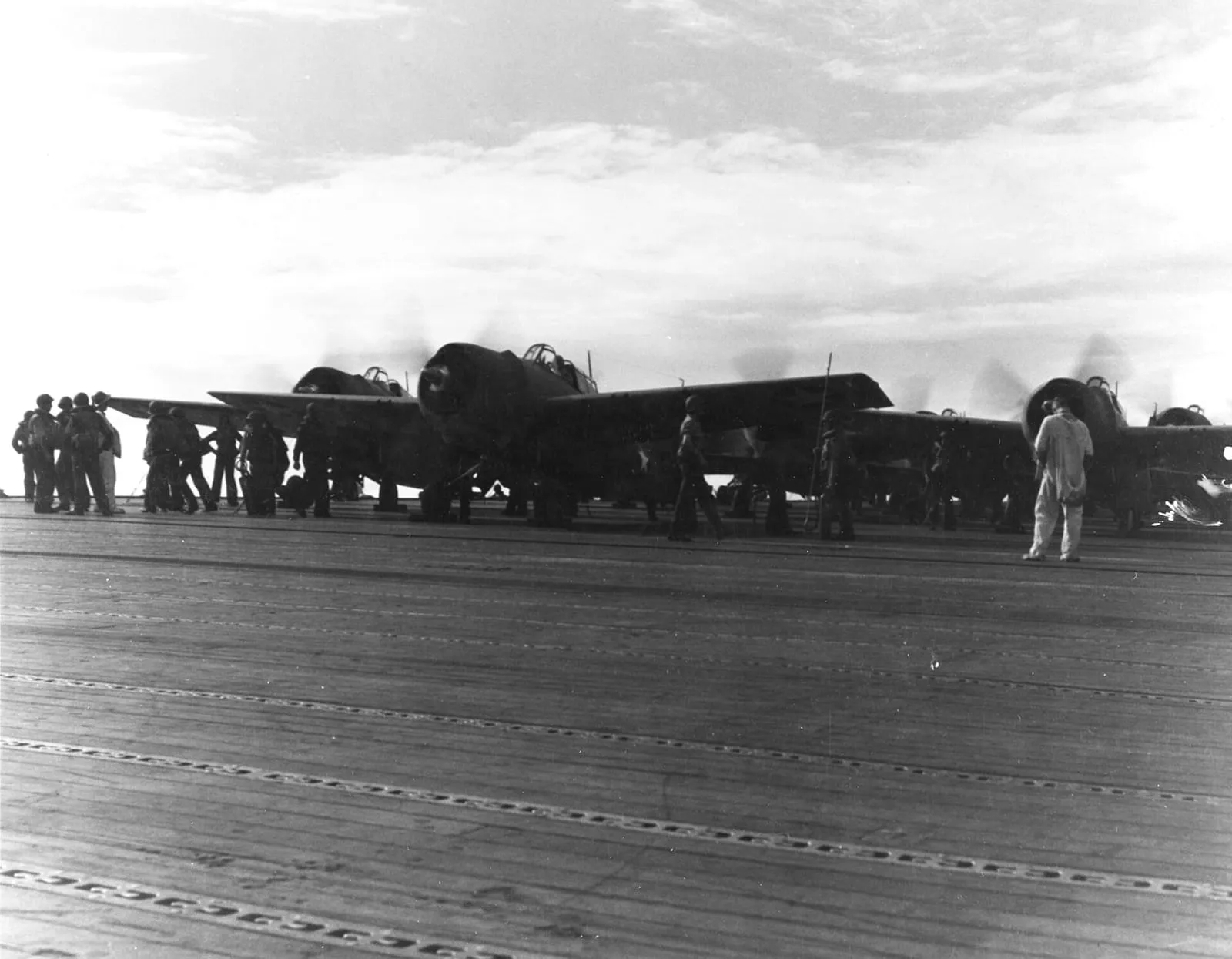
The Grumman F4F Wildcat was the fighter with which the US Navy and Marine Corps came through the hardest year of the Pacific war. From Wake to Guadalcanal it fought the Japanese Zero, which outclassed it in almost every respect, and yet Wildcats shot down more aircraft than they lost. They owed this to a sturdy structure, armour, and tactics their pilots devised before they had even met the enemy. When newer machines replaced them on the fleet carriers, Wildcats flew on from small escort carriers, over the Atlantic and over the Philippines.
From biplane to monoplane
In 1936 the navy ordered a biplane fighter from Grumman as insurance in case Brewster’s new monoplane failed. Grumman soon decided that biplanes had no future and turned the design into a metal monoplane. The prototype first flew on 2 September 1937, but in comparative trials the navy chose the Buffalo. Grumman did not give up: it installed a more powerful engine with a two-stage supercharger and in February 1939 flew the rebuilt aircraft, clearly better at high altitude. The navy ordered it into production, and the first F4F-3s reached squadrons on 26 November 1940. The name Wildcat was officially given only in the autumn of 1941.
Britain, however, was first into combat. Machines ordered by France were taken over after its fall by the Royal Navy, which called them Martlets. On Christmas Day 1940 a Martlet flying from an airfield in Orkney shot down, over Scapa Flow, a German Ju 88; it was the first victory by an American fighter in British service. Lumley Lyster, responsible for naval aviation at the Admiralty, pressed for the purchase of further batches of these aircraft for the Royal Navy’s carriers.
Wake and the first months in the Pacific
On 4 December 1941 the carrier Enterprise flew off twelve F4F-3s of the Marine squadron VMF-211 near Wake Atoll. Four days later a Japanese raid destroyed seven of them on the ground, but the surviving machines fought in the defence of Wake for two weeks: on 11 December their bombs helped sink the destroyer Kisaragi, which blew up. On 22 December the last two serviceable Wildcats threw themselves at a raid covered by Zeros; one did not return and the other landed wrecked, and the next day the atoll surrendered.
On 20 February 1942 Lieutenant Edward O’Hare of the Lexington almost single-handedly attacked a formation of G4M bombers heading for his carrier; he was credited with five kills and the Medal of Honor, and Chicago’s airport bears his name today. Wildcats escorted the first raids by American carriers, shot down several floatplanes over Tulagi, and during the Battle of the Coral Sea defended the carriers against Japanese strikes. It became clear then that in a turning fight with the Zero an American pilot stood no chance.
Tactics against agility
Lieutenant Commander John Thach of squadron VF-3, working in 1941 from the news reaching him from China about a new Japanese fighter, devised a manoeuvre for two pairs of aircraft. When the enemy got on the tail of one of them, both pairs turned towards each other and the other brought him into its sights. At Midway in June 1942 Thach, with a handful of fighters, escorted the Yorktown’s torpedo aircraft and tested his idea in combat against superior numbers of Zeros. In his report after the battle, however, he wrote that the F4F was “pitifully inferior” to the Japanese fighter in climb, manoeuvrability and speed.
The Wildcat had its strengths too. It survived hits that set a Zero on fire, protected its pilot with armour and had self-sealing tanks, and in a dive it was faster than its opponent. The F4F-4 version received folding wings, which let a carrier take more aircraft, and six 12.7 mm machine guns, though with less ammunition for each. Pilots learned to attack with a height advantage, fire in a single pass and break away in a dive, instead of fighting on the Japanese pilots’ terms.
Guadalcanal
On 20 August 1942 nineteen Marine Wildcats landed at the captured Henderson Field, the first aircraft of the Guadalcanal campaign. In the months that followed, the fighters of the so-called Cactus Air Force intercepted Japanese raids from Rabaul. Warned by observers hidden on the islands and by radar, the pilots had time to climb above the incoming bombers and attack them from above before the escort could react. Major Joe Foss of squadron VMF-121 shot down 23 aircraft in a few weeks and, with 26 victories, was the most successful Wildcat pilot. Over the carriers, Wildcats defended the fleet in the Battle of the Eastern Solomons, where the Enterprise and the Saratoga put more than fifty of them in the air. According to American tallies, from August to mid-November both sides lost more than a hundred fighters each over the island, but the Japanese could not replace their experienced pilots.
On the escort carriers
At the beginning of 1943 Grumman switched to building the Hellcat, and the Wildcat was carried on by General Motors’ aircraft division as the FM-1 and the lighter, more powerful FM-2. These machines were ideal for the short decks of escort carriers. In the Atlantic, together with Avenger aircraft, they hunted U-boats, and in June 1944 the group of the carrier Guadalcanal covered the capture of U-505. On 25 October 1944 FM-2s from the small carriers of “Taffy 3” attacked Japanese battleships and cruisers off Samar, often without bombs or ammunition, simply to distract them.
The Wildcat served until the end of the war. According to navy tallies its pilots claimed 6.9 kills for every machine lost in air combat. Depending on the source, between about 7,800 and 7,900 were built, more than 5,000 of them by General Motors.
Sources
Battles
(05)- 8–23 December 1941Battle of Wake IslandOn 8–23 December 1941 the Wake Atoll garrison repulsed a first Japanese landing and sank two destroyers, but, with no relief, fell to a second landing.
- 4–8 May 1942Battle of the Coral SeaOn 4–8 May 1942 carriers fought carriers for the first time in the Coral Sea. The Americans lost Lexington, but Japan called off the landing at Port Moresby.
- 5 May – 6 November 1942Battle of MadagascarFrom 5 May to 6 November 1942 British, African and South African troops took Vichy Madagascar, from the Diego Suarez base to the armistice at Ambalavao.
- 3–7 June 1942Battle of MidwayOn 3–7 June 1942 off Midway Atoll American aircraft sank Nagumo's four carriers. Japan abandoned the operation; the United States lost Yorktown.
- 7 August 1942 – 9 February 1943Guadalcanal campaignFrom 7 August 1942 to 9 February 1943 the Americans held the airfield seized on Guadalcanal until, after six months of fighting, Japan evacuated the island.
In the chronicle
(15)1942
- 1 February 1942The Marshalls–Gilberts raids
- 8 March 1942The Japanese at Lae and Salamaua
- 20 April 1942Operation Calendar
- 3 May 1942The Japanese on Tulagi
- 5 May 1942The landing on Madagascar
- 7 May 1942The sinking of Shōhō
- 9 May 1942Operation Bowery
- 4 June 1942The sinking of Nagumo's carriers
- 11 August 1942The sinking of HMS Eagle
- 21 August 1942The Battle of the Tenaru
- 24 August 1942The Battle of the Eastern Solomons
- 15 September 1942The sinking of USS Wasp
- 13 October 1942The bombardment of Henderson Field