United Kingdom
Lumley Lyster
Rear Admiral Aircraft Carriers, Mediterranean Fleet (1940–1941), Fifth Sea Lord and Chief of Naval Air Services (1941–1942), commander of the Home Fleet's aircraft carriers (1942–1943)
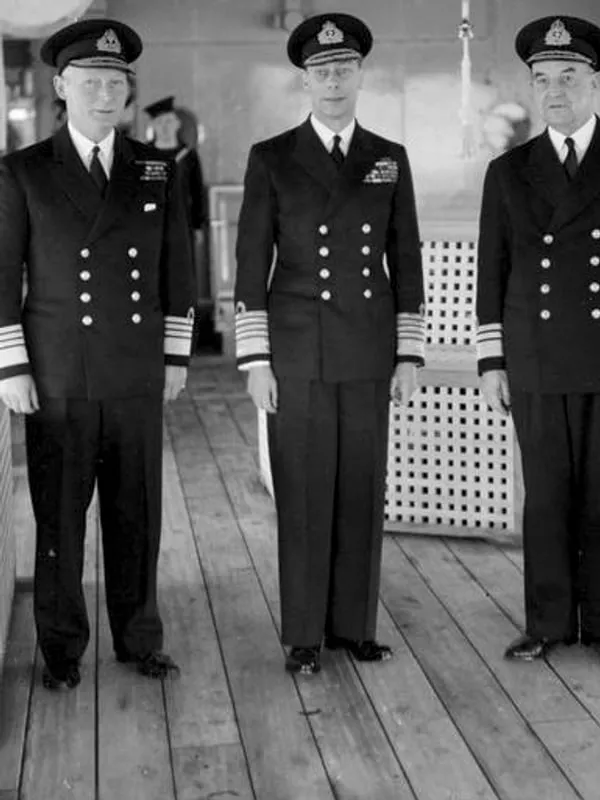
- Born:
- 27 April 1888, Coleshill (Warwickshire, England)
- Died:
- 4 August 1957, Charminster (Dorset, England)
- Author:
- Łukasz
- Photo:
- John Alfred Hampton, domena publiczna, Wikimedia Commons

Sir Arthur Lumley St George Lyster, known as Lumley Lyster, was a Royal Navy officer who spent most of his career in naval gunnery but won fame as a commander of aircraft carriers. It was he who in 1938 drew up, and in November 1940 carried out, the plan for a night attack by torpedo aircraft on the Italian fleet at Taranto – the first carrier air strike in history to put half of an enemy’s battleships out of action in a single night. Later, as Fifth Sea Lord, he directed the expansion of naval aviation, and in August 1942 he led the carriers in the greatest convoy battle for Malta. He belonged to the group of officers who understood, earlier than most of the Admiralty, that command of the sea was coming to depend on the aircraft rather than the battleship’s gun.
Youth and the First World War
He was born on 27 April 1888 in Coleshill in Warwickshire, the eldest son of the doctor Arthur Edward Lyster. He was educated at Berkhamsted School, and in September 1902, at fourteen, he entered the naval cadet school in the training ship HMS Britannia. He became a sub-lieutenant in 1908 and a lieutenant in 1909. From 1912 he specialised in naval gunnery at the gunnery school HMS Excellent in Portsmouth, and this speciality shaped his career for the next quarter of a century. He was also a sportsman: he played rugby, and cricket for Hampshire and the Navy.
He began the First World War as gunnery officer of the old battleship HMS Glory, which served in North American waters and helped defend the Suez Canal. According to his biographical notes he also took part in the fighting off Gallipoli during the Dardanelles campaign in 1915. He was then posted to Italy, at that time Britain’s ally. At Taranto, then a base for British ships operating in the Adriatic, he married Daisy Agnes Chamberlayne aboard the battleship HMS Queen on 18 November 1916; they had three daughters. For his service in Italy he was awarded the Order of the Crown of Italy in 1917. He therefore knew from his own experience the harbour he was to attack more than twenty years later. From 1917 he was gunnery officer and executive officer of the light cruiser HMS Cassandra in the 6th Light Cruiser Squadron of the Grand Fleet, for which he received the Distinguished Service Order (DSO) in 1919.
The interwar years
In 1919–1920 he served in the battlecruiser HMS Renown, in which the heir to the throne, the Prince of Wales – later King Edward VIII – made his tour of Canada, Australia and New Zealand. He was then gunnery officer of the 1st Battle Squadron in the battleship Barham, worked in the Admiralty’s naval ordnance department and in 1926–1928 was executive officer of the new battleship HMS Nelson. In 1928 he was promoted to captain. He sat on the ordnance committee, completed the senior officers’ courses, commanded the cruiser Danae in American waters in 1932 and in 1933–1935 commanded the Home Fleet’s 5th Destroyer Flotilla. In 1935–1936 he was commandant of the naval gunnery school at Chatham. In January 1936 he commanded the sailors who drew the gun carriage bearing the coffin of King George V, for which he was appointed to the Royal Victorian Order. He then spent more than a year as Director of Training and Staff Duties at the Admiralty.
In December 1937 Lyster, a gunnery officer with no aviation experience, took command of the aircraft carrier HMS Glorious in the Mediterranean Fleet. He quickly became a champion of carrier aviation. When in the autumn of 1938, during the crisis that ended with the Munich Agreement, war with Germany and Italy seemed close, the fleet’s commander, Admiral Dudley Pound, ordered a return to the idea, considered since the Italian invasion of Ethiopia, of striking the Italian fleet in its base. Lyster convinced Pound that the Swordfish from Glorious could attack Taranto at night and drew up a plan for such an operation. The carrier’s aircrews began practising night flying and torpedo attacks by the light of flares. The plan was so secret that it left almost no trace in the records. In 1939 Lyster was Naval Aide-de-Camp to the King, and on 1 August 1939 he was promoted to rear admiral.
From Scapa Flow to Taranto
After the outbreak of war, from December 1939, Lyster commanded the Home Fleet base at Scapa Flow and its dockyard. In May and June 1940, during the Norwegian campaign, he was rear admiral at Harstad, the base for operations against Narvik, and was mentioned in dispatches for this service. After the evacuation from Norway he returned briefly to Scapa Flow. Glorious, his former ship, was sunk in June 1940 in the Norwegian Sea by the guns of German battleships.
On 19 August 1940 Lyster became Rear Admiral Aircraft Carriers in the Mediterranean Fleet and hoisted his flag in the new armoured carrier HMS Illustrious, which at the beginning of September passed from Gibraltar to Alexandria. Admiral Andrew Cunningham thus gained both a modern carrier and an officer with a plan ready to hand. Aircraft from Illustrious attacked airfields on Rhodes and Leros and the port of Benghazi, covered convoys to besieged Malta and took part in the operations during which the Battle of Cape Passero was fought. Meanwhile Lyster and Cunningham’s staff refined the plan for Operation Judgement. The attack, planned for 21 October, was delayed by a fire in the carrier’s hangar and then by a breakdown of the old Eagle. Lyster decided to strike with a smaller force, Illustrious alone.
During the night of 11–12 November 1940 twenty-one Swordfish from Illustrious, with Lyster on board, attacked Taranto in two waves. Torpedoes hit the battleships Littorio, Conte di Cavour and Caio Duilio, while the British lost only two aircraft. Lyster and Cunningham wanted to repeat the attack the following night, but the weather prevented it. In the New Year Honours of 1941 Lyster was appointed to the Order of the Bath. On 10 January 1941 German dive-bombers of X Fliegerkorps, newly transferred to Sicily, badly damaged Illustrious. The carrier reached Malta and then sailed for repairs in the United States, and in February 1941 Lyster’s service in the Mediterranean came to an end.
Fifth Sea Lord
In April 1941 Lyster became Fifth Sea Lord and Chief of Naval Air Services on the Board of Admiralty. Since 1939 the Fleet Air Arm had once again been wholly under the Navy’s control, but it was weak, and its aircraft – Swordfish biplanes and heavy Fulmars – were obsolete. Lyster was responsible for its expansion: training thousands of new aircrew and mechanics, building naval air stations, buying American carrier aircraft such as the Grumman Wildcat fighter, known in Britain as the Martlet, and preparing the first escort carriers, built on merchant ship hulls for the Battle of the Atlantic. The task could not be accomplished quickly, however, and for most of the war British naval aviation lagged behind the American and Japanese.
Operation Pedestal and his last years of service
In July 1942 Lyster took command of the Home Fleet’s aircraft carriers. In August 1942 he commanded the carrier force in Operation Pedestal, the largest convoy to starving Malta. From Indomitable, Victorious and Eagle – some seventy fighters in all – he directed the defence of the convoy against hundreds of German and Italian aircraft. Eagle was sunk by a German U-boat and Indomitable was badly damaged by bombs. Of the fourteen merchant ships only five reached Valletta, among them the tanker Ohio, but their cargoes enabled Malta to hold out. Lyster was appointed to the Order of the British Empire for the operation, and in October 1942 he was promoted to vice admiral. In June 1943 he was made a Knight Commander of the Order of the Bath.
From April 1943 to 1945 he was Flag Officer Carrier Training and Administration, responsible for preparing the crews of carriers built in Britain and received from the United States, many of which sailed for the Pacific in 1945. On 27 July 1945 he retired at his own request, and in September he was given the rank of admiral on the retired list. He died on 4 August 1957 at Charminster in Dorset.
Significance
Lyster was neither an airman nor a theorist of naval aviation, but a gunnery officer who at the age of fifty was given command of a carrier and grasped what a weapon he had in his hands. His plan to attack Taranto, prepared in 1938 and carried out in 1940, demanded both daring and the solution of technical problems – the range of the Swordfish, torpedoes for shallow water, illuminating the target at night. The result exceeded expectations and changed thinking about war at sea; its lesson was studied by the Japanese, among others, before their attack on Pearl Harbor. For British naval aviation, long neglected, Lyster became one of its founding figures, and the night of 11–12 November is still its day of celebration. In public memory, however, his name has remained in the shadow of Cunningham, who received most of the glory for the victory at Taranto.
Sources
Mentioned in battles
(01)Often appears with
People who appear in the same events.