Equipment
The battlecruiser HMS Renown
A fast battlecruiser from the First World War: she hunted the Graf Spee, fought Gneisenau off Lofoten, led Force H and carried Churchill.
- Role:
- battlecruiser
- State:
- United Kingdom
- Maker:
- Fairfield (Govan)
- Launched:
- 4 March 1916
- Author:
- Łukasz
- Updated:
- 1 November 2026
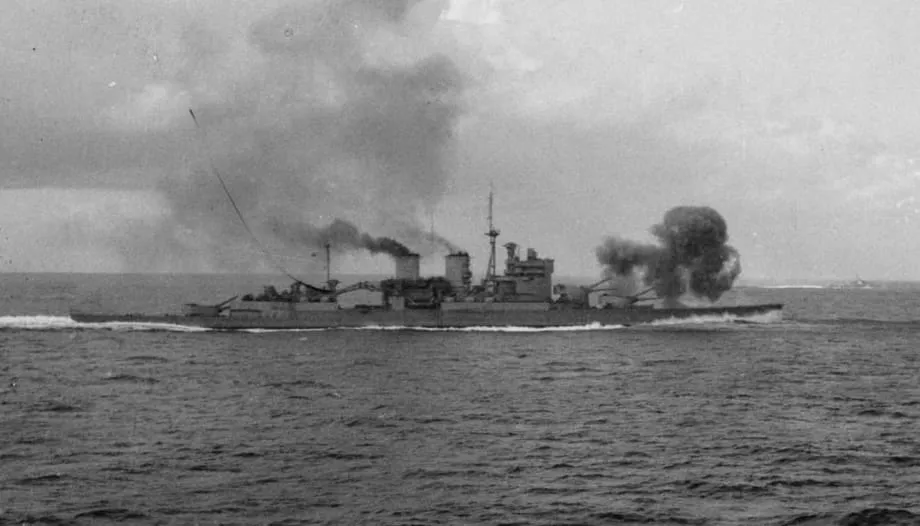
HMS Renown belonged to the generation of ships that Admiral John Fisher wanted as quickly as possible and as fast as possible: a battlecruiser with six 381 mm (15-inch) guns, capable of more than 30 knots, but with a belt little thicker than a cruiser’s. In 1939 the British had only three ships that were both faster and stronger than the German “pocket battleships”, and Renown was one of them. So throughout the war she was sent wherever speed counted: to the South Atlantic, off Lofoten, to Gibraltar, as escort for carriers bound for Malta. Unlike her sister Repulse and the larger Hood, she survived the war.
Fisher’s battlecruiser
The ship was ordered at the end of 1914, when Fisher, back as First Sea Lord, persuaded the government that the fleet needed fast capital ships to chase German cruisers. Her keel was laid on 25 January 1915 at the Fairfield yard in Govan on the Clyde, she was launched on 4 March 1916, and Renown entered service in September, after the Battle of Jutland. The fate of the three British battlecruisers that blew up there led to extra armour being added while the war was still on.
Between the wars Renown sometimes served as a royal yacht. In 1919–1922 the heir to the throne, the Prince of Wales, later Edward VIII, sailed in her to Canada, Australia, New Zealand, India and Japan, and in 1927 the Duke and Duchess of York, the future King George VI and Queen Elizabeth, went in her to Australia. In 1936–1939 the ship was rebuilt at Portsmouth for over three million pounds: she received new boilers and turbines, twenty 114 mm (4.5-inch) dual-purpose guns, a new superstructure and a hangar for aircraft, and her main guns could fire further. She rejoined the fleet a few months before the war broke out.
The Atlantic and Lofoten
In the autumn of 1939 Renown and the carrier Ark Royal formed Force K, one of the hunting groups searching the South Atlantic for the Admiral Graf Spee; on 2 December Renown sank by gunfire the German ship Watussi, abandoned by her crew. When the Graf Spee took refuge in Montevideo after the Battle of the River Plate, both ships were still far to the north. The British spread rumours that they were waiting at the mouth of the estuary, however, and Captain Langsdorff, whose officers reported seeing Renown’s silhouette on the horizon, believed them and scuttled his ship.
In April 1940 Renown covered the destroyers laying mines off the Norwegian coast. It was from her escort that the destroyer Glowworm parted company on 8 April, to be lost in action with the Admiral Hipper. Early on 9 April, the day Germany invaded Norway, Vice-Admiral William Whitworth’s battlecruiser ran into the Scharnhorst and Gneisenau in a snowstorm off Lofoten; they were covering the landing at Narvik under Admiral Günther Lütjens. In the exchange of fire Renown took two harmless hits and herself hit the Gneisenau, destroying her main fire-control position. The German ships used their advantage in speed on the rough sea and made off to the north. The action, however, could no longer hinder the landing.
Force H
On 10 August 1940 Vice-Admiral James Somerville, commander of Force H at Gibraltar, hoisted his flag in Renown. For a year the battlecruiser, Ark Royal and the cruiser Sheffield sailed together so often that they became the core of the force. In November Renown fired at Italian cruisers in the inconclusive battle off Cape Spartivento, and on 9 February 1941, with the battleship Malaya and the Sheffield, she bombarded Genoa, firing more than a hundred 381 mm shells at the port and shipyards. In May 1941 she sailed with Force H into the Atlantic against the Bismarck, but neither Somerville nor John Tovey intended to put the old, thinly armoured ship against a battleship that had sunk the Hood a few days before; the Bismarck’s fate was decided by the aircraft from Ark Royal. In the summer Renown covered the runs with fighters for Malta, such as Operation Rocket, and the convoy of Operation Substance, and in August she went home for a refit.
Convoys, Churchill and the Indian Ocean
In 1942 Renown served with the Home Fleet, covering among others the convoys to Murmansk. In the spring she escorted the American carrier Wasp, which in Operation Calendar and Operation Bowery brought more than a hundred Spitfires to Malta. In November, again with Force H, she covered the landings in North Africa against the Italian and French fleets during Operation Torch.
In 1943 the battlecruiser became the Prime Minister’s ship. In September she brought Winston Churchill from Halifax to Britain after the Quebec Conference, and in November she carried him from Plymouth to Alexandria, from where he went on to the Cairo Conference and then to Tehran. At the start of 1944 Renown sailed for the Indian Ocean and with the Eastern Fleet covered carrier strikes on Sabang and Surabaya, and in July and October she bombarded Japanese positions on Sabang and the Nicobar Islands. On 19 October 1944 her main guns fired at the enemy for the last time.
In the spring of 1945 the ship returned home. In early August, in Plymouth Sound, King George VI entertained President Harry Truman to lunch on board, as Truman was returning from the Potsdam Conference. At the end of 1946 Renown went into reserve, and in August 1948 she was towed to Faslane and broken up.
Sources
Battles
(03)- 13–17 December 1939Battle of the River PlateOn 13 December 1939 Commodore Harwood’s three British cruisers drove the Admiral Graf Spee into Montevideo. On 17 December the Germans scuttled the ship.
- 9 April – 10 June 1940Norwegian CampaignFrom 9 April to 10 June 1940 Germany conquered Norway. Norwegians, British, French and Poles fought at Trondheim and Narvik, but were defeated.
- 18–27 May 1941Operation RheinübungFrom 18 to 27 May 1941 Bismarck and Prinz Eugen tried to break out into the Atlantic. Bismarck sank Hood but went down herself after a three-day chase.