Equipment
The Fairey Swordfish "Stringbag"
The Royal Navy's biplane torpedo bomber: obsolete by 1939, yet the victor of Taranto, the aircraft that doomed the Bismarck and a hunter of U-boats.
- Role:
- torpedo bomber
- State:
- United Kingdom
- Maker:
- Fairey Aviation
- First flight:
- 17 April 1934
- Built:
- about 2,400
- Author:
- Łukasz
- Updated:
- 1 November 2026
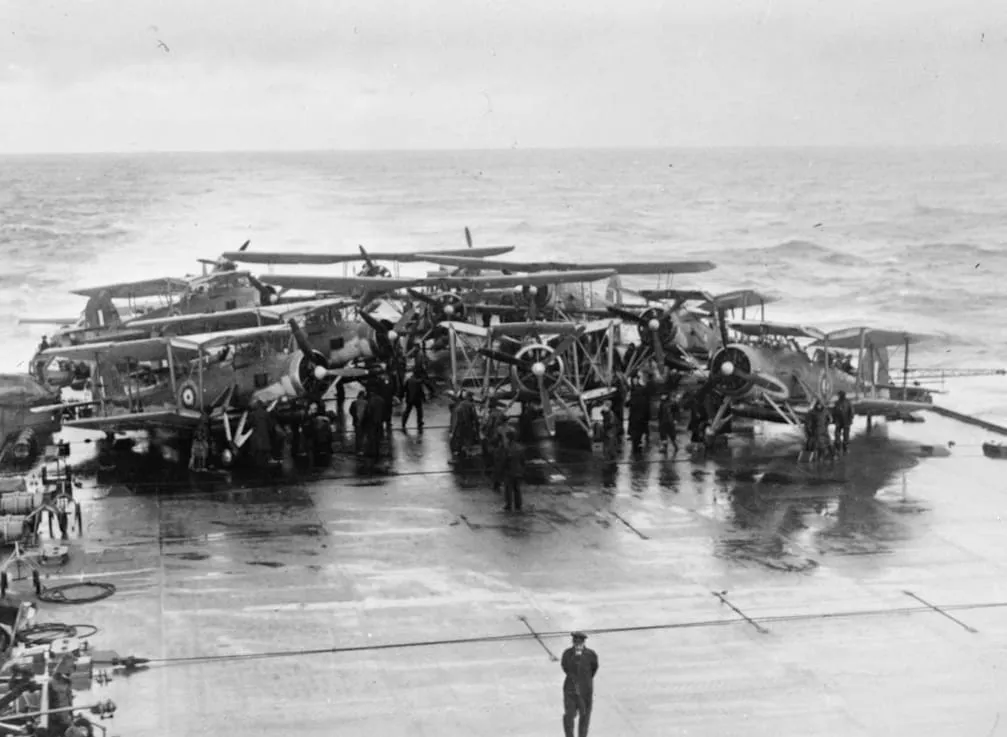
The Fairey Swordfish looked like a machine from the previous war: a fabric-covered biplane with open cockpits for three airmen and a fixed undercarriage, one torpedo under the fuselage and a top speed of little more than 200 km/h. British airmen called it the Stringbag, after the string shopping bag, because almost anything could be hung on it: a torpedo, bombs, mines, depth charges, flares, and later radar and rockets. And yet, by the reckoning of British historians, this anachronism sent more Axis tonnage to the bottom than any other Allied aircraft. At Taranto it showed that aircraft could defeat a fleet in its own harbour, and late in the war it defended convoys against U-boats from the decks of small escort carriers.
A biplane for everything
The aircraft began at Fairey as a private venture for a machine that would combine three tasks for the fleet: torpedo attack, spotting for the ships’ guns and reconnaissance. The first prototype, flown in March 1933, crashed after entering a spin. The second, slightly longer, took to the air on 17 April 1934 and, after trials on wheels and floats, was given the name Swordfish. In July 1936 the first production aircraft went to No. 825 Naval Air Squadron. When war broke out the Fleet Air Arm, only just transferred from the RAF to the Admiralty, had thirteen Swordfish squadrons, and more of the type flew on floats from the catapults of battleships and cruisers. Everyone knew the type was obsolete; a successor was due to replace it soon.
The first months brought mostly losses. Twenty-four Swordfish went down with the carrier Courageous, torpedoed on 17 September 1939. The first real success came in Norway. On 13 April 1940, in the battle of Narvik, a floatplane catapulted from the battleship Warspite led the ships up the fjord, spotted the submarine U-64 in the Herjangsfjord and sank her with bombs. It was the first U-boat of the war destroyed by a Fleet Air Arm aircraft.
Tobruk and Taranto
The Mediterranean gave the Swordfish its real chance. A few days after Italy entered the war, aircraft from the airfield at Hyères in Provence attacked Genoa, and the squadron later moved to Malta became the core of the island’s striking force. On 3 July 1940 machines from Ark Royal took part in the attack on the French fleet at Mers-el-Kébir, and three days later they torpedoed the beached battleship Dunkerque. In July Swordfish from the carrier Eagle, working from landing grounds in Egypt, sank three Italian destroyers in Tobruk harbour.
These experiences led to the aircraft’s most famous night. The plan for a night strike on the Italian fleet’s main base had been drawn up before the war by Lumley Lyster, and in November 1940, now a rear-admiral, he took it to sea under Andrew Cunningham. On the night of 11–12 November twenty-one Swordfish from Illustrious attacked the ships at Taranto in two waves. Flying low between the barrage balloons, the crews put torpedoes into Littorio, Caio Duilio and Conte di Cavour; the last never returned to service. The British lost two aircraft. The attack by twenty-one biplanes deprived the Italians, for many months, of half the battleships that lay in the harbour that night.
The Swordfish also fought at sea. In the battle of Cape Matapan in March 1941, the last wave over the Italian fleet included, besides Albacores, Swordfish from the carrier Formidable and from Maleme airfield on Crete. One torpedo disabled the cruiser Pola, and British and Italian historians still argue over who dropped it. During the siege of Malta the aircraft of No. 830 Squadron, later fitted with radar, attacked by night the convoys bound for Libya, and in the summer of 1941, together with submarines and Blenheims, they cut into the supplies of the Axis armies in Africa.
The Bismarck and the Channel
In May 1941 the Swordfish decided the chase of the German battleship. The first attack, on the night of 24–25 May, was made by nine aircraft from the carrier Victorious and scored one hit, which did no serious damage. On 26 May, with the Bismarck already close to France, the carrier Ark Royal sent two waves of fifteen aircraft against her. The first attacked the British cruiser Sheffield by mistake, fortunately without effect. The second took off at dusk from a pitching deck. The Bismarck fired at the aircraft with every gun but shot none down: according to the airmen, many flew so low that the lighter guns could not be depressed far enough. Two torpedoes hit, and one of them jammed the battleship’s rudders. The ship could no longer hold her course, and the next morning the battleships of the Home Fleet caught her.
Nine months later the Swordfish’s slowness cost thirteen airmen their lives. On 12 February 1942, during Operation Cerberus, as Scharnhorst, Gneisenau and Prinz Eugen forced their way through the English Channel in daylight, Lieutenant-Commander Eugene Esmonde led six Swordfish of No. 825 Squadron from Manston. Without proper fighter cover all were shot down before they could score a hit, and of the eighteen airmen five survived. Admiral Bertram Ramsay called the attack one of the finest examples of self-sacrifice in the war. In April, in the Indian Ocean, Japanese fighters shot down six Swordfish over Colombo that happened to be arriving at the island. From then on the aircraft no longer attacked well-defended ships by day; in May it sank French ships once more in the battle of Madagascar, but on the fleet carriers it was being replaced by Albacores and Barracudas.
Submarine hunter
The Swordfish’s second career was played out in the Battle of the Atlantic and on the Arctic routes. Small, sturdy and landing very slowly, it could fly from the short decks of escort carriers, and even from tankers and grain ships fitted with a flight deck. The Mark II received strengthened lower wings to carry eight rockets, and the Mark III a centimetric radar in a radome under the fuselage. In September 1942 three Swordfish sailed with the carrier Avenger in convoy PQ 18 and guided the escort onto a U-boat, which the destroyers sank. In Black May 1943 aircraft from Archer forced submarines to dive before they could reach attacking positions, and on 23 May one of them sank U-752 with rockets, the first U-boat destroyed with that weapon.
According to British figures, Swordfish sank fourteen submarines during the war and drove many more away from convoys. Production ended on 18 August 1944. Fairey built 692, and Blackburn’s works at Sherburn-in-Elmet, which from 1941 turned out most of the aircraft, almost 1,700; sources give a total of between 2,391 and 2,396. The Swordfish outlived both the Albacore that was meant to replace it and the war in Europe: the last front-line squadron was disbanded on 21 May 1945.
Sources
Battles
(06)- 9 April – 8 June 1940Battles of NarvikFrom 9 April to 8 June 1940 Dietl’s Germans fought British, Norwegians, French and Poles for the iron-ore port. The Allies retook Narvik on 28 May.
- 11 June 1940 – 20 November 1942Siege of MaltaFrom June 1940 to November 1942 Italy and Germany bombed and blockaded Malta. The island held out and became a base for attacks on Axis convoys to Africa.
- 23–25 September 1940Battle of DakarOn 23–25 September 1940 a British fleet and de Gaulle's Free French tried to take Dakar. Vichy forces repelled them and the attempt was abandoned.
- 27–29 March 1941Battle of Cape Matapan27–29 March 1941. Forewarned by Bletchley Park, Cunningham’s fleet damaged the Vittorio Veneto and at night sank three Italian cruisers and two destroyers.
- 18–27 May 1941Operation RheinübungFrom 18 to 27 May 1941 Bismarck and Prinz Eugen tried to break out into the Atlantic. Bismarck sank Hood but went down herself after a three-day chase.
- 5 May – 6 November 1942Battle of MadagascarFrom 5 May to 6 November 1942 British, African and South African troops took Vichy Madagascar, from the Diego Suarez base to the armistice at Ambalavao.
In the chronicle
(28)1940
- 13 April 1940The second Battle of Narvik
- 8 June 1940The sinking of HMS Glorious
- 11 June 1940The siege of Malta begins
- 14 June 1940The French Navy against Italy
- 28 June 1940A convoy clash off Crete
- 3 July 1940The attack on the French fleet at Mers-el-Kébir
- 9 July 1940The Battle of Calabria
- 1 August 1940Operation Hurry
- 23 September 1940The expedition to Dakar
- 12 October 1940The Battle of Cape Passero
- 11 November 1940The attack on Taranto
1941
- 9 February 1941The bombardment of Genoa
- 10 February 1941Malta under the bombs
- 28 March 1941The Battle of Cape Matapan
- 16 April 1941The Battle of the Tarigo convoy
- 27 May 1941The sinking of the Bismarck
- 5 July 1941Swordfishes over Tobruk
- 17 July 1941Operation Substance
- 11 August 1941Malta in August 1941
- 13 November 1941The sinking of the Ark Royal
- 1 December 1941The thousandth air raid on Malta