- Category:
- Military operations
- Front:
- Mediterranean
- Date:
- 3 July 1940
- Author:
- Łukasz
- Tags:
- United Kingdom, France, Royal Navy, French Navy
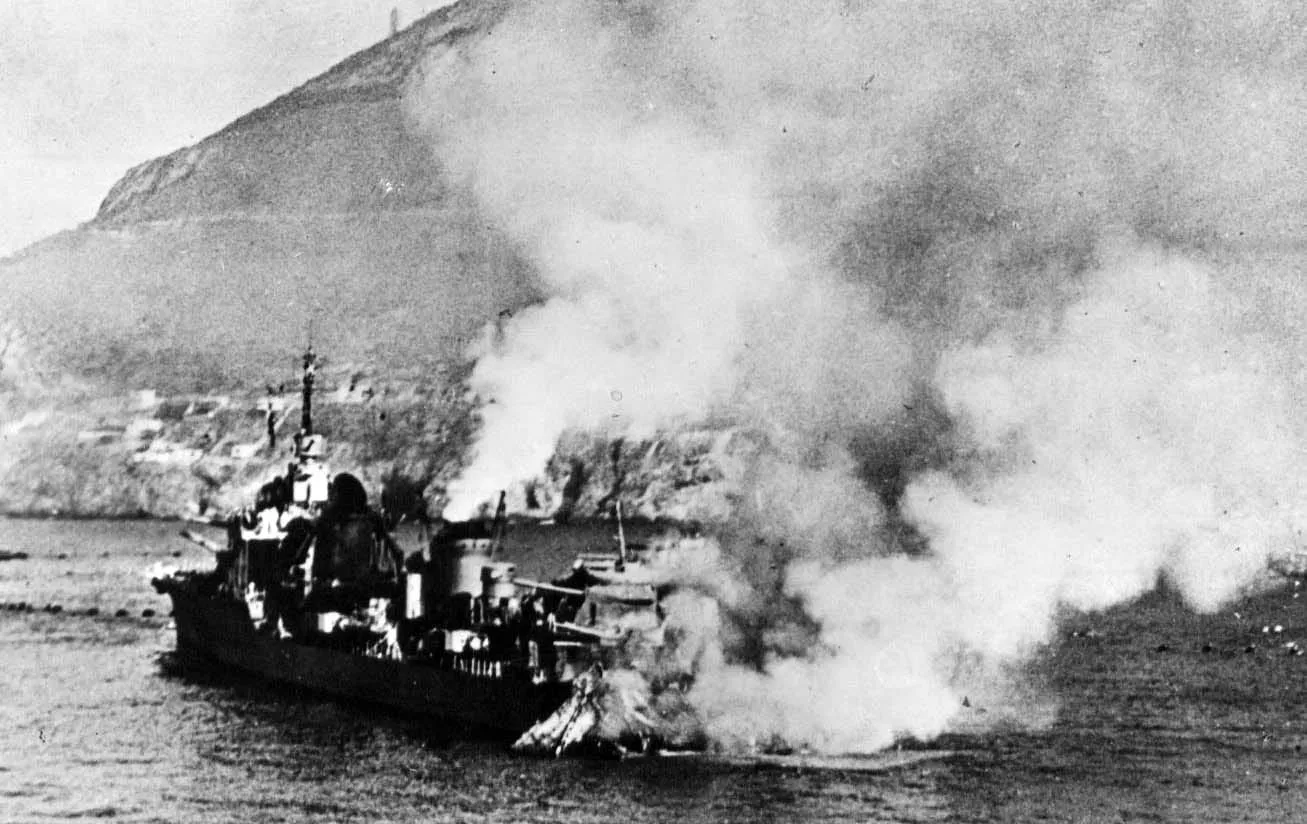
On the afternoon of 3 July 1940 a British force under Vice-Admiral James Somerville opened fire on the French squadron lying at anchor in the base of Mers-el-Kébir, a few kilometres from Oran in Algeria. Only two weeks earlier the two fleets had been allies. Within a quarter of an hour the French battleship Bretagne had blown up and two other heavy ships had been run aground. The same day the British seized by force the French warships lying in English ports, and at Alexandria they opened talks on disarming the French squadron there. The whole action bore the code name Operation Catapult. Nearly 1,300 French sailors were killed in it, and on 4 and 5 July Marshal Pétain’s government decided to break off diplomatic relations with Britain.
The fleet London feared
France had lost the war on land in June 1940, but its navy, the Marine nationale, had come through the campaign almost untouched. It was the second fleet in Europe: it had five older battleships, two modern fast battleships of the Dunkerque class, two more – Richelieu and Jean Bart – almost completed, more than a dozen cruisers, and dozens of large destroyers and submarines. As late as mid-June its ships had been shelling the Italian coast. For Britain, now left alone against Germany and Italy, the fate of this fleet was a matter of life and death: if the French ships joined the Kriegsmarine and the Regia Marina, the Royal Navy’s superiority in the Atlantic and the Mediterranean might vanish.
In March 1940 the two governments had pledged that neither would conclude a separate armistice or peace. When in June the new prime minister, Marshal Philippe Pétain, asked the Germans for terms, London agreed to release France from this pledge on one condition: before the armistice the fleet was to sail for British ports. The condition was not met. The Commander-in-Chief of the navy, Admiral François Darlan, who had joined Pétain’s government as Minister of the Navy, repeatedly gave his word – including to the First Sea Lord, Dudley Pound – that the ships would never fall into German hands. He sent them, however, not to England but to the ports of North and West Africa.
The armistice signed at Compiègne on 22 June provided in Article 8 that the fleet would assemble in its home ports and be disarmed under German or Italian supervision. The Reich government “solemnly” declared that it had no intention of using it for its own purposes. What the British noticed above all was that the home ports of most of the ships were Brest, Lorient and Cherbourg – ports occupied by the Germans – and that Hitler had already broken many similar assurances. They did not know, or did not believe, that on 24 June Darlan had issued a secret order to his commanders: if a foreign power attempted to seize the ships, they were to take them to the United States or scuttle them, and any order to the contrary, even one signed with his name, was to be regarded as given under duress.
Winston Churchill judged the risk too great. At the end of June the War Cabinet decided that the French ships were to come under British control or be put out of action, by force as a last resort. A new force, Force H, was formed at Gibraltar with the battlecruiser Hood, the battleships Valiant and Resolution, the aircraft carrier Ark Royal, two light cruisers and eleven destroyers. It was placed under Somerville, who hoisted his flag in Hood on 30 June. He himself, Admiral Dudley North at Gibraltar and the officers of the force, who knew the French from several months of fighting side by side, were opposed to the use of force and proposed further negotiation. The Admiralty replied that the decision had been taken. On 2 July Churchill told Somerville that he had been charged with “one of the most disagreeable and difficult tasks that a British Admiral has ever been faced with”.
The ultimatum
At Mers-el-Kébir lay Vice-Admiral Marcel Gensoul’s Force de Raid: the fast battleships Dunkerque and Strasbourg, the old Bretagne-class battleships Bretagne and Provence, the seaplane carrier Commandant Teste and six large destroyers. In the commercial harbour of Oran there were also a dozen or so smaller vessels and four submarines. The ships were moored stern-on to the breakwater, bows towards the shore, in the course of the demobilisation provided for by the armistice.
On the morning of 3 July the destroyer Foxhound approached Mers-el-Kébir carrying Captain Cedric Holland, commanding officer of Ark Royal, a former naval attaché in Paris who spoke good French. Gensoul considered the dispatch of an officer of lower rank a slight and refused to meet him; the talks were conducted through his flag lieutenant, Lieutenant Bernard Dufay. Holland handed over the British government’s written proposals. The French could: sail with the British and continue the fight against Germany and Italy; sail with reduced crews to a British port, from which the sailors would be repatriated and the ships returned to France after the war; or sail under British escort to a French port in the West Indies, such as Martinique, and there be demilitarised or placed in the care of the United States. If they refused, the ships were to be scuttled by their own crews within six hours, and if they did not do even that, the Royal Navy had orders to use “whatever force may be necessary”.
Gensoul replied that his ships would never be handed over to the Germans or the Italians, but that he would meet force with force. To the French Admiralty, which was just then moving from Bordeaux to Vichy, he sent a report presenting the ultimatum as a choice between joining the British and scuttling the ships. He did not mention the option of sailing to the West Indies. Darlan was not in Vichy that day – he was at his home town of Nérac – and the reply was sent by his deputy. The French ships began raising steam and preparing for action.
Somerville postponed the deadline several times. At about 1.30 p.m. aircraft from Ark Royal dropped magnetic mines in the harbour entrance. In the afternoon Gensoul at last agreed to receive Holland, who went aboard Dunkerque shortly before 4.30 p.m. The French admiral showed him Darlan’s order of 24 June and assured him that, if threatened, the ships would be taken away or scuttled. Holland took this as the beginning of an agreement. Meanwhile, however, the British had intercepted a signal from the French Admiralty announcing that squadrons from Toulon and Algiers were on their way to help Gensoul. London instructed Somerville to settle the matter before the reinforcements arrived. Holland left Dunkerque at about 5.25 p.m., and Somerville signalled that if the proposals were not accepted by 5.30 p.m. he would open fire.
The bombardment
At about 5.55 p.m. British time (French accounts, which use a clock one hour behind, give 4.55 p.m.) Hood, Valiant and Resolution opened fire at a range of some 16 kilometres. They fired their 381 mm guns, directed by aircraft from Ark Royal, from behind a high headland that screened them from the coastal artillery. The French, moored in a cramped harbour, were in a hopeless position. Dunkerque and Strasbourg had all their main armament forward, facing the shore. Provence was the first to reply.
The third salvo hit Bretagne. The shells pierced her deck and set off a magazine explosion. The old battleship capsized and sank within minutes. Nearly a thousand men died aboard her; the figure most often given is 977. Dunkerque took four hits, lost power and was run aground on the other side of the roadstead. The badly damaged Provence also settled on the bottom. The destroyer Mogador, which tried to leave harbour, had her stern, with its depth charges, blown off by a shell. After a quarter of an hour and several dozen salvoes Gensoul asked for a ceasefire. The British had stopped firing anyway, because the harbour was shrouded in smoke and dust.
Meanwhile Strasbourg, which had slipped her moorings before the first salvo fell, passed the mines and put to sea with five destroyers. At first Somerville did not believe his airmen’s reports that the ship had escaped. Once he was sure, he set off in pursuit with Hood, but two attacks by Swordfish torpedo bombers scored no hits and the old battleships fell behind. At about 8.20 p.m., fearing a night action with French cruisers coming from Algiers, Somerville broke off the chase. Strasbourg reached Toulon on 4 July. The undamaged Commandant Teste also slipped away there during the night. The British lost several aircraft and two airmen in the action.
The engagement had two epilogues. On 4 July the British submarine Pandora sank the sloop Rigault de Genouilly off the Algerian coast, mistaking her for a cruiser; twelve men were killed, and London apologised. When the commander of French naval forces in North Africa, Admiral Jean-Pierre Esteva, announced in the press that Dunkerque was only lightly damaged and would soon sail for Toulon, Churchill ordered the job to be finished. On the morning of 6 July torpedo aircraft from Ark Royal attacked the grounded ship. A torpedo struck the patrol boat Terre-Neuve, lying alongside and loaded with depth charges, and their explosion tore open the battleship’s hull. At least several dozen more sailors were killed. In all, 1,297 Frenchmen were killed at Mers-el-Kébir on 3 and 6 July, and about 350 were wounded.
Plymouth, Portsmouth and Alexandria
The second part of the operation took place in England. After the French campaign and the evacuation from Dunkirk, more than a hundred French vessels, from battleships to trawlers, with thousands of sailors, lay in British ports. Before dawn on 3 July armed naval parties and soldiers boarded the ships without warning at Plymouth, Portsmouth and other ports. They seized the obsolete battleships Paris and Courbet, the large destroyers Le Triomphant and Léopard, torpedo boats, submarines and dozens of smaller vessels. Almost everywhere this passed off without a fight. The exception was the huge submarine Surcouf at Plymouth, then the largest in the world. When her crew resisted, two British officers, Commander Denis Sprague and Lieutenant Patrick Griffiths, the British seaman Albert Webb and the French engineer petty officer Yves Daniel were killed in the shooting.
The French sailors were interned in camps. Most demanded repatriation to France; only a small proportion went over to the Free French of General Charles de Gaulle, whom London had recognised on 28 June as leader of Free France. The seized ships were gradually handed over to the Free French and, when they lacked crews, to allied navies as well. The Polish Navy declined to man the old Paris, but on 18 July it took over the destroyer Ouragan, seized at Portsmouth on 3 July. Her crew was drawn mainly from the sailors of ORP Grom, sunk off Narvik in May.
At Alexandria lay Vice-Admiral René-Émile Godfroy’s squadron: the battleship Lorraine, three heavy cruisers, a light cruiser, three destroyers and a submarine. Until June it had fought alongside Admiral Andrew Cunningham’s Mediterranean Fleet, and French and British ships were moored in the same harbour, side by side. A gunnery duel at such range would have been a massacre for both sides. Cunningham, who had received the same orders as Somerville, considered them harmful and decided to play for time. On 3 July he put the British demands to Godfroy. The French admiral at first agreed to discharge his fuel, but on 4 July, when he learned of Mers-el-Kébir, he stopped the discharge and began preparing his ships to put to sea. Cunningham did not use force. He appealed directly to the French captains and crews, and British officers visited their opposite numbers aboard the French ships. Later on 4 July Godfroy gave way: the fuel was discharged, the breech-blocks of the guns and the torpedo warheads were landed, the crews were reduced, and the ships remained under the French flag and French command. The agreement was confirmed in writing on 7 July. The squadron, known as Force X, ceased to exist as a fighting force, but no one was killed.
Dakar
The final target of the operation was the most modern French battleship, Richelieu, which had escaped from Brest ahead of the Germans to Dakar in French West Africa. On 7 July the British delivered to the commander there, Admiral Plançon, an ultimatum similar to the one at Oran. After it was rejected, a motor boat from a British sloop crept under the battleship’s stern during the night and dropped depth charges, which failed to explode. At dawn on 8 July Swordfish aircraft from the carrier Hermes attacked. One torpedo hit the stern, damaging the propeller shafts and flooding part of the hull. Richelieu was unable to put to sea for many months, although her guns could still fire from harbour. The French ships at Martinique – the aircraft carrier Béarn and the cruiser Émile Bertin, which had brought the Bank of France’s gold there – were merely watched by the British; in time they came under American supervision.
The break in relations
The news of Mers-el-Kébir caused a shock in France. Darlan, who believed he had kept his word, regarded the attack as a betrayal. He ordered British ships to be attacked wherever they were encountered and even spoke of a naval war with Britain. Pétain and the Foreign Minister, Paul Baudouin, restrained him; the marshal is said to have remarked that “one defeat is enough”, and Baudouin that an attack on the fleet was one thing and war quite another. At the cabinet meeting of 4 July it was decided to break off diplomatic relations with Britain, and this was announced on 5 July. Some chronologies place the event on 4 July; some studies, especially in English, date the break itself to 8 July, when the two sides’ diplomatic missions formally ceased to function. The French air force retaliated with raids on Gibraltar, small and ineffective for the time being. The Germans and Italians, taking advantage of the situation, agreed to suspend the armistice provision on the disarmament of the French fleet, and German propaganda – and soon Vichy’s as well – presented Mers-el-Kébir as proof of British perfidy.
In London the reaction was the opposite. On 4 July Churchill laid the matter before the House of Commons, leaving judgement, as he put it, to Parliament, the nation, the United States and the world. After his speech the members, including the Conservatives who had until then received him coolly, gave him a standing ovation. President Franklin Delano Roosevelt told the French ambassador that he would have done the same. General de Gaulle, in a radio broadcast on 8 July, called the attack an “odious tragedy” but acknowledged that it was better for the ships to be destroyed than to fall into enemy hands. Those who took part were less sure. Somerville wrote to his wife that it was “the biggest political blunder of modern times” and that they all felt “thoroughly ashamed”. In his memoirs Churchill called it “the most unnatural and painful” decision in which he had ever been concerned.
Significance
Operation Catapult did not destroy the French fleet. One old battleship was sunk and two more were damaged, as was Richelieu, but Strasbourg and most of the cruisers gathered at Toulon, and the French navy, until then largely well disposed towards the British, became hostile to them. The operation still divides historians. Some, like many British scholars, stress that after the fall of France it showed the world, and Washington in particular, that Britain would fight on and would stop at nothing. Others, like the American historian George Melton, regard it as a tactical failure and a political mistake: the French would have scuttled the ships anyway had the Germans tried to seize them, and the attack strengthened the advocates of rapprochement with Germany in Vichy.
Later events proved both sides partly right. In September 1940 Vichy forces repulsed an Anglo-Gaullist expedition at Dakar, and French aircraft bombed Gibraltar, this time much more heavily. In the years that followed, French forces loyal to Vichy fought the Allies in Syria, Madagascar and North Africa. The ships immobilised at Alexandria went over to the Allies in 1943, and Richelieu, after a refit in the United States, fought the Japanese under the command of Somerville himself. When on 27 November 1942 the Germans tried to seize the fleet at Toulon, the crews, in accordance with Darlan’s order of June 1940, scuttled their ships. For many Frenchmen this was proof that Mers-el-Kébir had been a needless crime; for the British, proof that in July 1940 they could not rely on the word of a government that had just concluded an armistice with Hitler.
Sources
Meanwhile
(04)Elsewhere, within a week.
- 4 July 1940 · DiplomacyGermany reveals Operation PikeOn 4 July 1940 the German news agency published extracts from captured French files on an Allied plan to bomb the Soviet oilfields in the Caucasus.
- 4 July 1940 · AfricaThe Italians take KassalaOn 4 July 1940 Italian troops from Eritrea took Kassala and Fort Gallabat in the Sudan. A handful of Sudan Defence Force men withdrew after hours of fighting.
- 1 July 1940 · PoliticsThe French government moves to VichyOn 1 July 1940 Pétain's government settled in Vichy. On 10 July parliament gave the marshal full powers by 569 votes to 80, ending the Third Republic.
- 5 July 1940 · PoliticsHuysmans and Jaspar in LondonOn 5 July 1940 Camille Huysmans and Marcel-Henri Jaspar set up a Belgian National Committee in London to fight on. The British did not recognise it.
Related events
(04)The same battle, people or subject.
- 14 June 1940 · MediterraneanThe French Navy against ItalyOn 14 June 1940 French cruisers from Toulon shelled Vado, Savona and the outskirts of Genoa. Until 21 June the French fleet fought the Italians at sea.
- 24 September 1940 · MediterraneanVichy reprisal raids on GibraltarOn 24 and 25 September 1940 Vichy aircraft bombed Gibraltar twice in reprisal for Dakar. The trawler Stella Sirius was sunk and 14 sailors were killed.
- 23 September 1940 · AfricaThe expedition to DakarOn 23–25 September 1940 a British fleet and de Gaulle’s Free French tried to seize Dakar. Vichy’s defenders drove them off, a blow to de Gaulle’s prestige.
- 16 June 1940 · PoliticsPétain becomes Prime Minister of FranceOn 16 June 1940 at Bordeaux Reynaud resigned and President Lebrun entrusted the government to Marshal Pétain. That night France asked for an armistice.