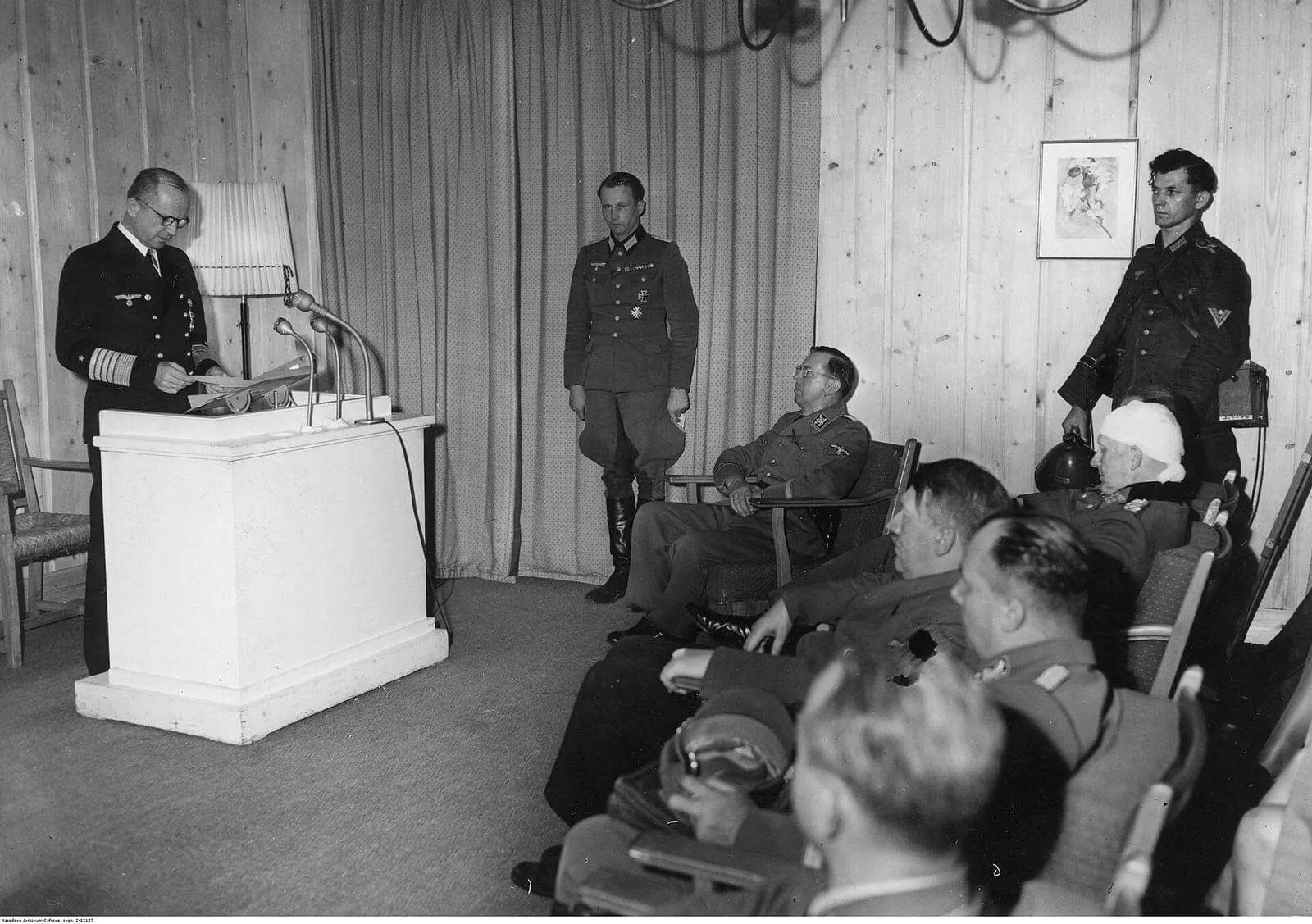
At 12.42 p.m. on Thursday 20 July 1944 a bomb hidden in a briefcase exploded in a wooden staff hut at the Wolf’s Lair – Hitler’s headquarters in the forest near Gierłoż, a few kilometres from Rastenburg (today Kętrzyn) in East Prussia. It had been placed under the map table by Colonel Claus Schenk Graf von Stauffenberg, chief of staff to the commander of the Replacement Army, who a few minutes earlier had left the conference on the pretext of an urgent telephone call from Berlin. Of the 24 people in the hut, four died of their injuries, but Adolf Hitler survived with burst eardrums, grazes and bruises. The bomb was the signal for a military coup prepared under cover of the official Valkyrie plan. By evening the coup had collapsed, and just after midnight Stauffenberg and three of his companions were shot in the courtyard of the army headquarters building on the Bendlerstraße in Berlin.
It was the most serious of more than a dozen known attempts on Hitler’s life, and the only one after which the conspirators actually set their prepared coup in motion. Its failure unleashed a wave of repression: an investigation by the Gestapo, show trials before the People’s Court, the execution of more than two hundred people and the collective punishment of the conspirators’ families. The statement that the repression reached “even Rommel” is accurate, but needs qualifying: on 20 July Field Marshal Erwin Rommel was lying seriously wounded in hospital, and he was forced to commit suicide only on 14 October 1944. The extent of his involvement in the conspiracy remains a matter of dispute among historians to this day.
The opposition to Hitler
The circle of people who tried to overthrow the regime in July 1944 was diverse and had taken shape over years. Its oldest core consisted of conservative officers and officials who as early as the Sudeten crisis of 1938 had planned to arrest Hitler should he drag Germany into war with the Western powers. Among them were Colonel General Ludwig Beck, Chief of the Army General Staff until August 1938, who resigned in protest against the plans for war with Czechoslovakia, and the former Lord Mayor of Leipzig, Carl Friedrich Goerdeler. The Munich Agreement and the lightning victories of 1939–1940 cut the ground from under these plans. The lone bomb attack by the carpenter Georg Elser in a Munich beer hall in November 1939 – the Elser assassination attempt – had no connection with them.
From 1942 the most determined group was formed by staff officers of Army Group Centre on the Eastern Front, gathered around Colonel (later Major General) Henning von Tresckow. On 13 March 1943 Tresckow and Fabian von Schlabrendorff smuggled a bomb disguised as a parcel of liqueur bottles aboard Hitler’s aircraft as it returned from Smolensk; the detonator failed. Eight days later an intelligence officer of the same army group, Rudolf-Christoph von Gersdorff, intended to blow himself up together with the dictator at an exhibition of captured weapons in the Berlin Zeughaus, but Hitler left the hall after a few minutes. Further plans for suicide attacks during demonstrations of new uniforms, involving the young officers Axel von dem Bussche and Ewald-Heinrich von Kleist, foundered on changes of date and on chance.
Alongside the military, civilian circles were active. The Kreisau Circle, which met at the estate of Krzyżowa (Kreisau) in Lower Silesia around Helmuth James von Moltke and Peter Yorck von Wartenburg – people whose views ranged from conservative to social democratic, including clergy of both denominations – was concerned more with a programme for rebuilding Germany after the fall of Nazism than with the assassination itself; Moltke had been in custody since January 1944. Goerdeler was to become chancellor, Beck head of state, and Field Marshal Erwin von Witzleben commander-in-chief of the Wehrmacht.
The conspirators’ motives varied, and historians do not reduce them to a common denominator. For some the conviction that Hitler was leading Germany to military catastrophe predominated; for others, moral outrage at the crimes in the East, of which many of them had first-hand knowledge; not infrequently the two motives were intertwined. Among the participants in the plot were also men who had themselves helped to shape occupation policy, such as the Quartermaster General, General Eduard Wagner, or the head of the Reich Criminal Police, Arthur Nebe, formerly commander of Einsatzgruppe B. Many of the conservatives among the conspirators envisaged Germany within its 1914 borders, enlarged by Austria and the Sudetenland, which could not be reconciled with the position of the Allies, who since the Casablanca Conference had been demanding unconditional surrender.
Stauffenberg and Valkyrie
From the autumn of 1943 the central figure of the conspiracy was Claus von Stauffenberg, a cavalry officer from a Bavarian aristocratic family, who in his youth had belonged to the circle of the poet Stefan George. At first he was no opponent of the new state – he welcomed the break with the Treaty of Versailles and the victory over France – but from 1942, under the impression of the conduct of the war and the crimes in the East, he spoke ever more openly of the need to remove Hitler. On 7 April 1943 in Tunisia an Allied aircraft strafed his car; Stauffenberg lost his left eye, his right hand and two fingers of his left hand. After his recovery he became chief of staff of the General Army Office (Allgemeines Heeresamt) in Berlin, under General of Infantry Friedrich Olbricht, one of the pillars of the conspiracy.
This office held the key to the coup – the Valkyrie plan (Walküre). It was an official plan, approved by Hitler, for the rapid mobilisation of units of the Replacement Army (Ersatzheer) in the event of internal unrest, such as a revolt by the millions of forced labourers. Olbricht, Tresckow and Stauffenberg supplemented it with secret orders: after Hitler’s death the Replacement Army was to announce that a “treacherous clique” of party functionaries was trying to seize power, take over executive authority, arrest the Gauleiters and the commanders of the SS and Gestapo, and occupy the ministries, radio stations and telecommunications exchanges. The weakness of the plan was that the orders had to be issued by the commander of the Replacement Army, Colonel General Friedrich Fromm, who knew of the conspiracy but had not joined it and was waiting to see how events would turn out.
On 1 July 1944 Stauffenberg, promoted to colonel, became Fromm’s chief of staff. He thus gained what the conspirators had lacked for years: personal access to Hitler’s situation conferences. From then on, however, he had to play two roles at once – the assassin in East Prussia and the organiser of the coup in Berlin. The situation at the fronts – the Allied landing in Normandy and Operation Bagration, launched on 22 June, which shattered Army Group Centre – led some of the conspirators to doubt whether the assassination still made sense. It was then that Tresckow, through Heinrich von Lehndorff, is said to have sent Stauffenberg the message that passed into history: the assassination must be attempted at any cost, because what mattered was no longer the practical purpose, but that the German resistance should dare to take the decisive step before the world and before history.
Stauffenberg twice brought the bomb to a conference with Hitler – on 11 July to the Berghof at Obersalzberg and on 15 July to the Wolf’s Lair – and each time he called it off, because Heinrich Himmler and Hermann Göring, whom the conspirators wanted to kill together with Hitler, were not present. Meanwhile the Gestapo was tightening the noose: at the beginning of July it arrested the Social Democrats Julius Leber and Adolf Reichwein, and on 17 July a warrant was issued for Goerdeler’s arrest. Stauffenberg decided that at the next opportunity he would set off the charge regardless of who was present.
The bomb at the Wolf’s Lair
On the morning of 20 July Stauffenberg and his aide-de-camp, Lieutenant Werner von Haeften, flew from Rangsdorf airfield near Berlin to East Prussia. Haeften’s briefcase contained two charges, each of about a kilogram of British plastic explosive, with chemical time fuses. The situation conference had been brought forward by half an hour, because Hitler was expecting a visit from Benito Mussolini in the afternoon. On the pretext of changing his shirt on a hot day, Stauffenberg and Haeften began to arm the charges in a side room; one-handed and using three fingers, he had to crush the acid capsule with pliers. He was interrupted by an NCO urging him to hurry, and managed to arm only one charge. The second, instead of putting it in the briefcase – even unarmed – where it would have increased the force of the explosion, he handed back to Haeften.
Contrary to an often-repeated story, the conference was not moved that day from a concrete bunker to the hut: since the beginning of July, while the shelters were being reinforced, briefings had been held in the wooden hut, and Stauffenberg knew this. Nevertheless, the light construction and the windows thrown wide open because of the heat meant that much of the blast escaped outside. Stauffenberg placed the briefcase under the heavy oak map table, on the side facing Hitler, and after a few minutes left to take a telephone call, arranged for him by the OKW’s chief of signals, General Erich Fellgiebel. One of those at the conference – according to the most frequently cited version, Colonel Heinz Brandt – moved the briefcase, which was in his way, to the other side of the table’s massive support. At that moment Hitler was leaning over the map, listening to General Adolf Heusinger’s report on the situation on the Eastern Front.
At 12.42 p.m. the charge exploded. The stenographer Heinrich Berger lost both legs and died that afternoon; Colonel Brandt and the Luftwaffe chief of staff, General Günther Korten, died within the next two days, and Hitler’s adjutant General Rudolf Schmundt on 1 October. The others, among them the chief of the OKW, Field Marshal Wilhelm Keitel, and Alfred Jodl, suffered injuries of varying severity. Hitler emerged from the smoking hut in tattered trousers, with perforated eardrums, bruises and grazes. He later claimed that his survival was a sign of Providence. In the afternoon, as planned, he received Mussolini and showed him the wrecked hut.
Stauffenberg saw the explosion from a few hundred metres away and was convinced that no one in the hut could have survived. With Haeften he managed to get out through the checkpoints, where the alarm had already been raised – at the second of them only a telephone call to an officer he knew got them through – and on the way to the airfield Haeften threw the unused charge out of the car. At about 1.15 p.m. their He 111 took off for Berlin. Meanwhile Fellgiebel, who was supposed to cut the headquarters off from communications, managed to do so only briefly and only in part; the SS lines kept working. At about 1 p.m. his ambiguous message reached Berlin: “Something terrible has happened – the Führer is alive.”
Lost hours in the Bendlerblock
In the building on the Bendlerstraße, headquarters of the Replacement Army, the conspirators received news of the explosion but not of Hitler’s death. Olbricht and his associates decided to wait. Olbricht’s chief of staff, Colonel Albrecht Mertz von Quirnheim, sent out the first alert orders on his own initiative at around 2 p.m., but the full Valkyrie operation began only after 4 p.m., when Stauffenberg telephoned from Rangsdorf airfield, where he had landed at about 3.45 p.m., and assured them that Hitler was dead.
When Stauffenberg reached the Bendlerblock at about 4.30 p.m., Fromm, who had already spoken to Keitel by telephone and knew that Hitler was alive, refused to take part in the coup and announced that the conspirators would be arrested. Stauffenberg insisted that he had set off the bomb himself and that Keitel was “lying as usual”. Fromm was detained in his office. At about 5 p.m. Beck, the designated head of state, arrived and declared that for him Hitler was dead and that he would act accordingly. Witzleben appeared only in the evening, sharply criticised the ineptitude of the whole operation, and at about 8.45 p.m. drove off to his estate, where he was arrested the following day. Others who were in the know, such as Admiral Wilhelm Canaris, remained passive.
The Valkyrie orders were encrypted as secret and transmitted one at a time over a few teleprinters; it took nearly three hours for them to reach all the military districts. That same day Hitler appointed Himmler commander of the Replacement Army. From late afternoon the Reich’s radio stations broadcast special announcements that the Führer had survived an assassination attempt with minor injuries, and in the evening Keitel sent a teleprinter message to the commands: “The Führer is alive! In perfect health!”
The issue was decided in Berlin itself. The city commandant, Lieutenant General Paul von Hase, ordered Major Otto-Ernst Remer, commander of the Großdeutschland guard battalion, to cordon off the government quarter. Remer carried out the order, but an officer he had sent out, in civilian life an employee of the Propaganda Ministry, persuaded him to go to Joseph Goebbels. At about 6 p.m. Goebbels put Remer through by telephone to the Wolf’s Lair. “Major Remer, do you recognise my voice?” Hitler is said to have asked, before entrusting him with control of the capital. The battalion that was supposed to seal off the ministries turned against the conspirators. Neither the radio station nor the Gestapo headquarters on the Prinz-Albrecht-Straße was seized; none of the Nazi leaders in Berlin was arrested.
Paris and the night on the Bendlerstraße
Only in Paris and Vienna were the Valkyrie orders carried out in earnest. In the French capital the military commander, General Carl-Heinrich von Stülpnagel, had some 1,200 SS and SD personnel arrested, including the Higher SS and Police Leader Carl Oberg; they offered no resistance. Everything depended, however, on Commander-in-Chief West, Field Marshal Günther von Kluge, who knew of the conspirators’ intentions. When it was confirmed at his headquarters at La Roche-Guyon that Hitler was alive, Kluge refused his support and relieved Stülpnagel of command. Before dawn the SS men were released. Meanwhile, at the front in Normandy, heavy fighting for Caen was going on, and three days earlier Rommel had been seriously wounded.
In Berlin, at about 9 p.m., a group of officers loyal to the regime led by Lieutenant Colonel Franz Herber demanded explanations from Olbricht, handed out weapons and, after a brief exchange of fire in which Stauffenberg was wounded in the arm, detained the conspirators. Fromm, released, who had reasons to cover up his own knowledge of the plot, announced that a summary court martial had sentenced Olbricht, Mertz von Quirnheim, Stauffenberg and Haeften to death. Beck, his former superior, he left with a pistol; two suicide attempts failed, and the badly wounded Beck was finished off with a shot by an NCO. A few minutes after midnight, now 21 July, the four condemned men were shot one by one by a firing squad from the guard battalion in the courtyard of the Bendlerblock, in the headlights of a lorry, in front of a sand heap. According to witnesses, Haeften shielded Stauffenberg with his own body. Witnesses remembered Stauffenberg’s last words differently – as “Long live sacred Germany” or “Long live secret Germany”, which might allude to the ideas of the George circle.
The bodies were first buried with their decorations in the cemetery of St Matthew’s Church in Schöneberg; the next day Himmler had them exhumed and cremated and the ashes scattered. At about 1 a.m. Hitler spoke on the radio from the Wolf’s Lair: a “very small clique of ambitious, unscrupulous and at the same time criminal and stupid officers” had hatched a plot to kill him and the Wehrmacht’s operations staff; now it would be “exterminated without mercy”. Fromm did not save himself – arrested on 21 July, he was executed on 12 March 1945. On the same day, 21 July, Tresckow took his own life on the Eastern Front by detonating a grenade, so that his death would divert suspicion from his friends.
The regime’s revenge
The investigation was conducted by a “20 July special commission”, set up on 21 July within the Reich Security Main Office under Ernst Kaltenbrunner, which by some estimates numbered up to 400 officials. At the beginning of August Hitler set up a “Wehrmacht Court of Honour”, including Field Marshal Gerd von Rundstedt, Keitel and General Heinz Guderian – appointed Chief of the Army General Staff on 21 July – which expelled suspect officers from the army so that they could be tried not by a military court but by the People’s Court under Roland Freisler. At the first trial, on 7–8 August, Witzleben, General Erich Hoepner, Peter Yorck von Wartenburg and five other defendants were sentenced to death; they were hanged the same day in Plötzensee prison, and the executions were filmed. Goerdeler, captured in August in West Prussia, was executed on 2 February 1945.
The number of victims varies depending on who is counted as connected with the plot. According to the German Resistance Memorial Centre and the literature on the subject, more than 200 people were executed in connection with the attempt, among them a field marshal, more than a dozen generals, diplomats and officials; more than 200 were tried before the People’s Court in several dozen trials. Some of the conspirators, like Kluge in August, committed suicide. Those arrested in August in “Operation Grid” (Aktion Gitter) – some 5,000 former politicians of the Weimar Republic – for the most part had no connection with the plot. The conspirators’ families were subjected to collective punishment (Sippenhaft): Stauffenberg’s wife Nina, pregnant with their fifth child, was sent to a camp, and his children – together with several dozen other children of conspirators – were placed under changed names in a children’s home at Bad Sachsa.
Rommel, whose name had come up in the statements of those arrested, was on 14 October 1944 presented by generals sent by Hitler with a choice: trial before the People’s Court and reprisals against his family, or poison and a state funeral. He chose poison; officially it was announced that he had died of his wounds. The regime also tightened its control over the army: from the end of July the Hitler salute was compulsory in the Wehrmacht, and on 25 July Goebbels became Plenipotentiary for Total War Mobilisation.
Place in the war
The assassination attempt did not change the course of military operations. The Allies reacted coolly – British politicians and the press presented it as a settling of scores within the German officer corps, and the demand for unconditional surrender remained in force. For the regime, on the other hand, it was an opportunity to subordinate the army completely: Himmler took over the Replacement Army, and the war went on for more than nine months. According to estimates by the historian Rüdiger Overmans, roughly as many German soldiers were killed in this final period as in the whole war before July 1944 – not counting the victims on the Allied side, among civilians and among concentration camp prisoners.
In post-war memory the plot travelled a long road – from accusations of treason, still very much alive in the first years of the Federal Republic, to recognition as a symbol of “the other Germany”. In 1952 Remer, who had publicly called the conspirators traitors, was convicted by a court in Brunswick, which ruled that the conspirators had not committed treason; the former Bendlerstraße now bears Stauffenberg’s name, and the courtyard where he died is home to a memorial. Historians continue to debate the conspirators’ motives and visions of the future, but their attempt remains the best-known act of German resistance from within the apparatus of Hitler’s state.
Sources
Meanwhile
(04)Elsewhere, within a week.
- 18 July 1944 · Western FrontThe capture of Saint-LôOn 18 July 1944 the US 29th Infantry Division entered ruined Saint-Lô, cleared on 19 July – the start line for the Operation Cobra breakthrough of 25 July.
- 22 July 1944 · Eastern FrontThe withdrawal to the Tannenberg LineAfter the defeat of Army Group Centre, Hitler agreed around 22 July 1944 to pull Army Detachment Narwa back from the Narva to the Sinimäed hills.
- 17 July 1944 · Western FrontRommel woundedOn 17 July 1944 Allied fighters strafed Field Marshal Rommel's car in Normandy. With a fractured skull he was taken to hospital and never returned to the front.
- 23 July 1944 · PolandThe Lwów uprisingOn 23 July 1944 the Home Army and the Red Army fought the Germans in Lwów. The city fell on 27 July; days later the NKVD arrested the Home Army commanders.
Related events
(04)The same battle, people or subject.
- 7 August 1944 · Crimes and repressionThe trial of the 20 July plottersOn 7 August 1944 the first 20 July conspirators stood before Roland Freisler's People's Court. All eight were hanged at Plötzensee on 8 August.
- 14 October 1944 · PoliticsRommel's suicideOn 14 October 1944 Field Marshal Rommel, accused of complicity in the 20 July plot, was forced to take poison. The regime said he had died of his wounds.
- 20 November 1944 · PoliticsHitler leaves the Wolf's LairOn 20 November 1944 Hitler left his headquarters near Rastenburg for good. In Berlin he had throat surgery; he moved into the Führerbunker only in January 1945.
- 1 August 1944 · PolandThe Warsaw Uprising beginsAt 5 p.m. on 1 August 1944 Home Army units attacked the Germans in Warsaw to liberate the capital before the Red Army entered it.