- Category:
- Military operations
- Front:
- Western Front
- Date:
- 24 July 1944
- Author:
- Łukasz
- Battle:
- Battle of Normandy
- Tags:
- United States, Wehrmacht, France, George S. Patton
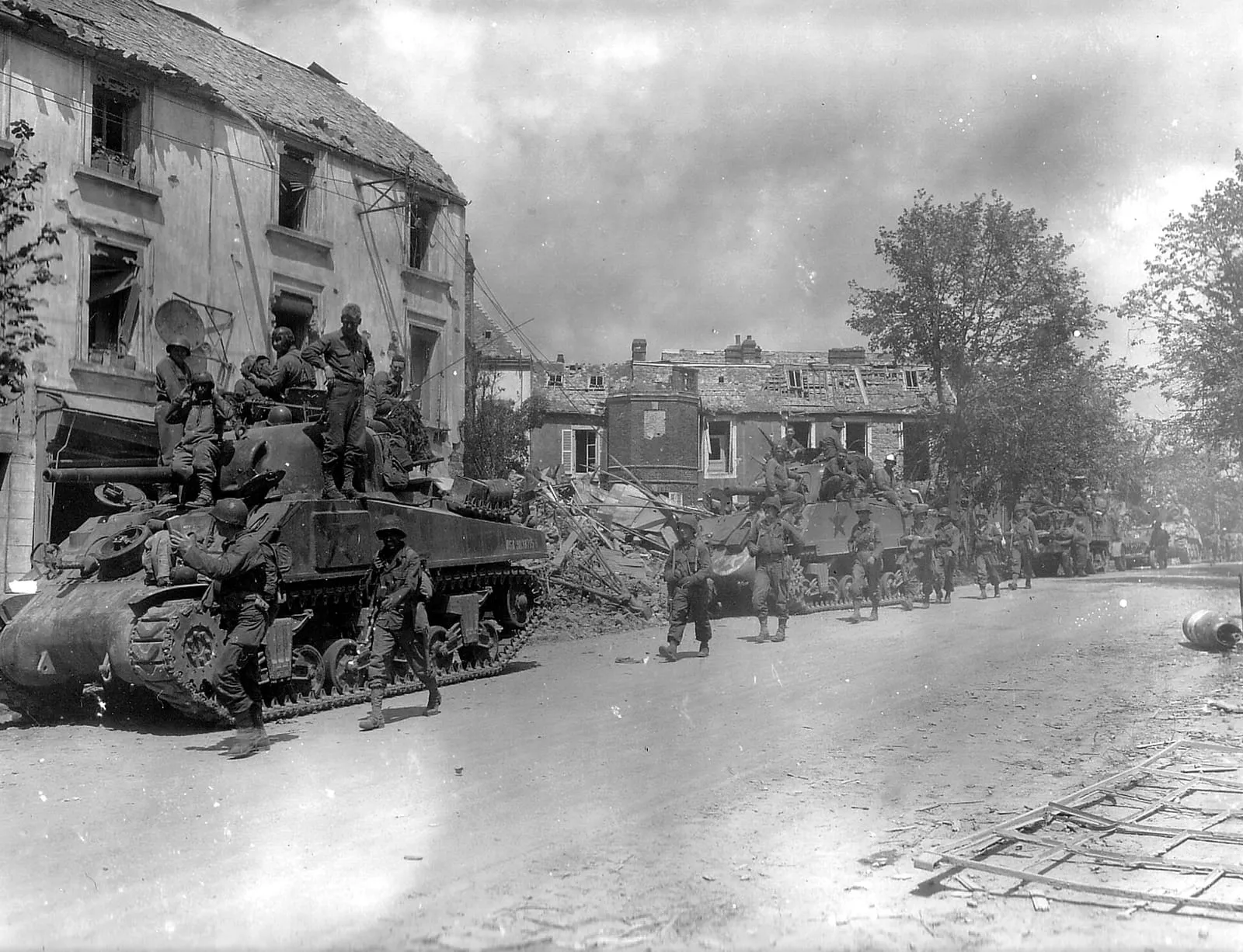
Around noon on 24 July 1944 hundreds of bombers appeared over the positions of the US First Army near Saint-Lô. They were to drop their bombs on the German lines on the far side of the straight road from Saint-Lô to Périers and open the way for Operation Cobra – an attack that, after seven weeks of fighting in Normandy, was at last to break through the German front. But cloud hung over the target, and the commander of the Allied Expeditionary Air Force, Trafford Leigh-Mallory, called off the raid at the last minute. The order did not reach every crew. Some aircraft released their loads – and some of the bombs fell on Americans. About 25 soldiers were killed and more than 130 wounded. The next day, when the raid was repeated in full strength, the tragedy recurred on a larger scale: the bombs killed more than a hundred Americans, among them Lieutenant General Lesley McNair. Even so, on 25 July the infantry went into the attack, and within three days the German defence on the western wing of the Normandy front had fallen apart.
War chronologies combine two pieces of information under 24 July: that Operation Cobra – the breakthrough at Saint-Lô – is already in full swing and the Americans are taking Coutances; and that American bombers mistakenly bombed their own troops near Saint-Lô. The second is accurate, though it needs adding to: such bombing happened on both 24 and 25 July, and the second was far more tragic. The first needs correcting. On 24 July Cobra had not yet begun – the aborted raid was a false start, and the attack proper began on 25 July. The Americans took Coutances only on 28 July.
Seven weeks in the bocage
By the end of July the Allies had some one and a half million men in Normandy, but their beachhead was still cramped. Under the original plans it should by then have taken in the whole of Normandy and part of Brittany. In the east the British and Canadians, after a month of bloody fighting, had taken the northern part of Caen, and Operation Goodwood (18–20 July) had gained them only a few kilometres of ground at the cost of hundreds of tanks. In the west the Americans had since the beginning of July been fighting their way through the bocage – a maze of fields enclosed by earth banks overgrown with hedges, in which every meadow became a small fortress. On 18 July, after more than ten days of fighting, they entered the ruins of Saint-Lô. Between 3 and 20 July First Army lost some 40,000 men, most of them infantrymen.
General Omar Bradley, commander of First Army, concluded that a slow advance on a broad front was getting nowhere. What was needed was a single powerful blow on a narrow sector, preceded by a massive bombardment that would destroy or paralyse the defenders. He put forward the idea as early as the beginning of July, and on 10 July it was accepted by the commander of 21st Army Group, General Bernard Montgomery, who was then in charge of all the ground forces in Normandy. Montgomery himself later explained that his strategy had from the outset been for the British and Canadians to pin down most of the German panzer divisions at Caen while the Americans broke through in the west. That, to a large extent, is what happened. According to figures cited by historians, on the eve of Cobra six German panzer divisions faced the British and Canadians, while only two – Panzer Lehr and the 2nd SS Panzer Division Das Reich – faced the Americans, together with the 17th SS Panzergrenadier Division, all of them badly weakened in the fighting.
The Cobra plan
The attack was to be led by the VII Corps of Major General Joseph Lawton Collins, an energetic commander who had taken Cherbourg in June. The attack sector was only about 6.5 km wide and lay west of Saint-Lô, along the Saint-Lô–Périers road. First the 9th and 30th Infantry Divisions were to punch a hole in the German defences and hold its shoulders. Then the 1st Infantry Division and the 2nd and 3rd Armored Divisions were to pass through the gap and drive south and west towards Coutances to cut off the German forces facing VIII Corps near the coast. In this way the Americans were to break out of the bocage into open country where their motorised divisions could operate.
Breaking out of the bocage was also to be helped by “Rhinos” – steel teeth welded to the front of tanks, cut from German beach obstacles. The idea is credited to Sergeant Curtis Culin of the 102nd Cavalry Reconnaissance Squadron. A tank fitted with such a blade cut through a hedgerow bank instead of climbing over it and exposing its unarmoured belly. Before Cobra, First Army workshops fitted them to several hundred tanks, and Bradley forbade their use before the attack so that the Germans would not learn of the innovation in advance.
Air power was the key. Fighter-bombers were to strike a narrow strip just beyond the road, the heavy bombers of General Jimmy Doolittle’s Eighth Air Force a rectangle measuring about 5.5 by 2 km, and medium bombers the far part of it. Before the raid the infantry was to pull back about 1,100 m from the road, which was to serve the crews as a clear landmark. Bradley wanted the bombers to come in parallel to the road, from the east, so that an aiming error would not carry the bombs onto his own troops. The airmen replied that with so narrow a strip and so many aircraft a parallel approach would take too long, and they intended to come in from the north, perpendicular to the front – over the heads of the Americans. It is still disputed whether Bradley understood and accepted this answer. He himself later claimed that the airmen had let him down; air historians point out that the risk had been explained to him.
The attack was first set for 18 July, then for 20 July, but rain and low cloud forced it to be postponed each time. Montgomery was uneasy, since Goodwood was meant to support a breakthrough that still had not begun. In Britain the command was criticised for its slowness, and Eisenhower showed his impatience. Meanwhile, on the German side, the command changed: Rommel was wounded on 17 July, and Field Marshal Günther von Kluge took personal command of Army Group B. Three days later Claus von Stauffenberg’s bomb exploded at the Wolf’s Lair – the 20 July plot did not change the situation at the front, but for a time it paralysed the German command and deepened Hitler’s distrust of his generals.
The false start of 24 July
The forecast for 24 July was uncertain, but Leigh-Mallory decided to go ahead. The raid was set for 1 p.m. When the aircraft were already airborne, Leigh-Mallory, who had flown to Normandy to watch the bombardment, saw thick cloud over the target and decided to postpone the operation by a day. The cancellation came too late. Most of the heavy bombers turned back, but several hundred aircraft – according to the American official history more than 300 heavy bombers and some fighter-bombers – had already released their bombs. Some fell on the positions of the 30th Infantry Division: one formation, whose lead aircraft accidentally dropped its load too early, released its bombs after it. About 25 Americans were killed and about 130 wounded. According to accounts, some enraged soldiers opened fire on their own aircraft.
The false start had other consequences too. The infantry, which had pulled back before the raid, had to reoccupy the positions it had abandoned, which cost further casualties. The Americans feared they had lost surprise. The Germans, however, took the events of 24 July for a repulsed attack, and the commander of Panzer Lehr, General Fritz Bayerlein, reported that an attack had been beaten off and did not redeploy his division, whose front line stood just beyond the road. Bradley was furious – he felt deceived by the airmen, who had come in perpendicular to the front – but the air force replied that there was no other way. In the evening the decision was taken: the raid would be repeated the next day according to the same plan.
The raid of 25 July and the death of McNair
At 9.38 a.m. on 25 July the first fighter-bombers struck the strip beyond the Saint-Lô–Périers road. Behind them, for almost an hour, came wave after wave of heavy bombers – according to the American official history (Martin Blumenson, Breakout and Pursuit) more than 1,500 B-17s and B-24s, according to other tallies as many as 1,800 – and finally the medium bombers. In all, some 3,000 aircraft flew over a small patch of Normandy and dropped more than 4,000 tons of bombs. It was one of the heaviest raids in support of ground troops in the whole war.
This time too some of the bombs fell on the wrong side of the road. The bombers came in from the north, and the wind carried smoke and dust from the first explosions over the American positions, so that later crews aimed at a cloud that obscured the front line. Once again units of the 30th Infantry Division suffered worst, along with the 9th Division. 111 Americans were killed and 490 wounded. The correspondent Ernie Pyle, who lived through the raid in the front line, later described how the ground shook beneath the soldiers pressed into their ditches and how they went on trembling long after the aircraft had gone.
Among the dead was Lieutenant General Lesley McNair, commander of Army Ground Forces, who since 1942 had directed the training and organisation of the American divisions – the man to whom the US Army’s ground forces largely owed their wartime shape. He was in France as an observer and at the same time as Patton’s nominal successor at the head of the fictitious First United States Army Group – part of the deception operation Fortitude, meant to persuade the Germans that the main invasion was still to come in the Calais area. He watched the raid from the positions of the 2nd Battalion of the 120th Infantry Regiment. A bomb hit his foxhole. McNair was the highest-ranking American soldier killed in Europe. He was buried quietly, and his death was announced only several weeks later so as not to give away the deception to the Germans.
According to Bradley’s memoirs, Eisenhower, who had flown to Normandy to watch the attack, said afterwards that he would never again use heavy bombers in direct support of infantry – although this was done more than once later on. The airmen, for their part, argued that the ground forces had demanded a precision from them that no one could have delivered with the bombsights of the day. The dispute over the Saint-Lô raid went on long after the war. In total, the raids of 24 and 25 July killed some 136 Americans and wounded more than 600.
The breakthrough
On the Germans the bombs fell with devastating force. Panzer Lehr, which before the raid had about 2,200 men and several dozen tanks, lost by various estimates about a thousand men and most of its heavy equipment. Bayerlein recalled after the war that at least 70 per cent of his soldiers were dead, wounded, dazed or unfit to fight. The bombed strip turned into a lunar landscape of craters, overturned tanks and buried trenches.
Even so, the American infantry, which moved off at about 11 a.m., met not emptiness but resistance. Surviving groups with 88 mm guns, individual tanks and remnants of paratroopers on the western flank put up a fierce defence. On the first day VII Corps advanced only about 2 km. At First Army headquarters there was talk of disappointment. Collins, however, noticed that the Germans had no continuous line of defence, only scattered strongpoints, and that very evening, 25 July, he decided to commit the armoured divisions without waiting for the breach to be fully opened. It was a gamble that paid off.
On 26 July the 2nd Armored Division and the 1st Infantry Division, reinforced with units of the 3rd Armored Division, joined the attack. The 2nd Armored Division took Saint-Gilles that same day. Also on 26 July, Major General Troy Middleton’s VIII Corps attacked in the west. On 27 July the German front collapsed. The Americans took Marigny and, in the west, Lessay (PL) and Périers, which the Germans had abandoned. The Germans fell back in haste, leaving huge minefields behind them.
Coutances and the road to Avranches
On 28 July the 4th Armored Division, only just entering the battle, took Coutances – the first of the operation’s main objectives. The same day Bradley gave unofficial supervision of VIII Corps to General George Patton, who had been waiting in Normandy since the beginning of July for his Third Army to be activated. Patton put both of the corps’ armoured divisions – the 4th and 6th – at the head of the advance and ordered them to race south along the coast without worrying about their flanks.
The German troops retreating from Lessay and Périers found themselves trapped between VIII and VII Corps. Near Roncey on 29 July American fighter-bombers spent several hours attacking packed columns of vehicles standing bumper to bumper on the narrow roads. According to American reports more than a hundred tanks and several hundred other vehicles were destroyed there. On the night of 29–30 July remnants of the 2nd SS Panzer Division Das Reich and the 17th SS Panzergrenadier Division tried to break out south through the American positions. Some got through; many were killed or captured. On 28 July the commander of Das Reich, Christian Tychsen, was killed.
Kluge threw everything he had at the threatened sector: the 2nd and 116th Panzer Divisions brought from the British front, and then further units. On the eastern shoulder of the breach, between Tessy-sur-Vire and Percy, Major General Charles Corlett’s XIX Corps fought them in the heaviest fighting of the whole operation. But in the west, by the coast, there was nothing left to plug the gap. On the evening of 30 July the spearhead of the 4th Armored Division drove into Avranches, at the base of the Cotentin Peninsula, and on 31 July it captured the undamaged bridge over the Sélune at Pontaubault. The road to Brittany and into the heart of France lay open. Kluge reported to Hitler’s headquarters that the front had become “one big mess”. According to the American official history, First Army took some 20,000 prisoners between 25 and 31 July.
In the east, to prevent the Germans from shifting more panzer divisions to the west, the British launched Operation Bluecoat from Caumont on 30 July towards Vire and Mont Pinçon.
Place in the war
Cobra ended the positional warfare that had gone on in Normandy since June and opened the war of manoeuvre. At noon on 1 August Patton’s Third Army entered the battle, and Bradley took command of 12th Army Group; First Army passed to General Courtney Hodges. Within a few days seven American divisions passed through the bottleneck at Avranches, spreading out across Brittany and turning east towards the Loire and the Seine. Against Kluge’s advice, Hitler ordered a counter-attack at Mortain towards Avranches on 7 August to cut the Americans off from their rear. The attack collapsed, and the German forces that had taken part in it soon found themselves encircled near Falaise, where in the second half of August Polish, Canadian, British and American units destroyed most of the German forces in Normandy. Paris was liberated on 25 August.
The operation also showed the dark side of carpet bombing. Heavy bombers could crush the defences on a narrow sector, but they could not provide the precision needed right next to the front line. Bombs fell on friendly troops more than once again – in August Canadian units and the Polish 1st Armoured Division, among others, suffered from them. The dispute over responsibility for the dead at Saint-Lô – whether the fault lay with the airmen, who chose a perpendicular approach, or with Bradley, who agreed to a bomb line so close to his troops – has never been settled.
Historians also argue about who deserves the credit for the victory. Montgomery maintained to the end of his life that the American breakthrough had been part of his plan from the start and that the bloody fighting at Caen had been meant to draw in the German panzer divisions. American writers have tended to stress Bradley’s idea, Collins’s boldness and Patton’s drive. What is certain is that at the end of July 1944 the German front in Normandy – worn out by seven weeks of fighting, stripped of reserves and air cover, and at the same time threatened in the east by the Soviet Operation Bagration – cracked just as Rommel had predicted in his last report. Soon the Wehrmacht in the west suffered one of the heaviest defeats of the whole war.
Sources
Meanwhile
(04)Elsewhere, within a week.
- 24 July 1944 · PolandThe liberation of MajdanekDuring the fighting for Lublin, Soviet soldiers entered the abandoned camp at Majdanek. Its gas chambers and crematorium were left almost intact.
- 23 July 1944 · PolandThe Lwów uprisingOn 23 July 1944 the Home Army and the Red Army fought the Germans in Lwów. The city fell on 27 July; days later the NKVD arrested the Home Army commanders.
- 25 July 1944 · PolandOperation Most IIIOn 25-26 July 1944 a British Dakota landed near Tarnów and flew out V-2 rocket parts captured by the Home Army, along with Polish politicians.
- 22 July 1944 · Eastern FrontThe withdrawal to the Tannenberg LineAfter the defeat of Army Group Centre, Hitler agreed around 22 July 1944 to pull Army Detachment Narwa back from the Narva to the Sinimäed hills.
Related events
(04)The same battle, people or subject.
- 3 July 1944 · Western FrontThe Battle of the HedgerowsOn 3 July 1944 the US First Army attacked through the Normandy hedgerows towards La Haye-du-Puits and Saint-Lô. Every kilometre cost hundreds of casualties.
- 14 August 1944 · Western FrontThe Falaise pocketOn 14 August 1944 Canadians and Poles advanced on Falaise in Operation Tractable. The pocket was closed on 19–21 August at Chambois and on the Mace.
- 4 August 1944 · Western FrontThe liberation of RennesOn 4 August 1944 the US 8th Infantry Division entered Rennes, abandoned by the Germans overnight, as Patton's Third Army spread across Brittany.
- 30 August 1944 · Western FrontThe Allies on the Marne and in RouenOn 28 August 1944 Patton's tanks crossed the Marne and on 30 August the Canadians entered Rouen. The Germans fled over the Seine as the Normandy battle ended.