- Category:
- Military operations
- Front:
- Pacific
- Date:
- 23 October 1944
- Author:
- Natalia
- Battle:
- Battle of Leyte Gulf
- Tags:
- United States, Japan, US Navy, William Halsey
At dawn on 23 October 1944, in the narrow passage between the island of Palawan and the shoals of the South China Sea, two American submarines lay submerged, waiting for a force they had been shadowing for several hours. A quarter of an hour later the heavy cruiser Atago, flagship of Vice Admiral Takeo Kurita, was already going down, and the commander of the strongest force in the Japanese fleet had to swim for his life. So began the Battle of Leyte Gulf – a series of naval and air engagements fought in Philippine waters between 23 and 26 October 1944.
The way popular chronologies describe this episode – that the US Third and Seventh Fleets won a decisive victory over the Imperial Japanese Navy in the Philippines – is accurate. It merely needs filling out: this was not one battle but at least four separate engagements, hundreds of kilometres apart, and Australian ships also fought as part of the Seventh Fleet. In terms of the number of ships and men involved – more than 200,000 sailors and airmen – it was the largest naval battle of the Second World War and, in the view of many historians, the largest in history.
Plan Shō-Gō 1
After the defeat in the Philippine Sea in June 1944, the Japanese fleet still had its battleships and heavy cruisers, but its carrier air arm had been all but destroyed. During the summer the commander of the Combined Fleet, Admiral Soemu Toyoda, prepared four variants of a “decisive battle” plan called Shō-Gō (“Victory”), depending on where the Americans struck. The first variant concerned the Philippines. Losing the archipelago would cut Japan off from the oil and raw materials of the Dutch East Indies, and the fleet, which for lack of fuel was based near Singapore, would no longer be able to return to home waters in full strength.
In mid-October the aircraft of Admiral William Halsey’s Third Fleet struck Formosa; the Japanese lost several hundred aircraft there, and their own airmen’s exaggerated reports of many American carriers sunk misled the high command in Tokyo. When American troops seized the islets at the entrance to Leyte Gulf on 17 October and the Sixth Army landed on Leyte on 20 October, Toyoda ordered Shō-1 to be carried out. The targets were the landing ships and transports in the gulf: the fleet was to destroy them before Douglas MacArthur could unload supplies for the troops ashore.
The plan was bold and extremely risky. The Japanese lacked the aircraft to cover their ships from the air, so they decided to exploit the enemy’s weakness rather than their own strength: to lure the American carriers away with a decoy and to send the battleships into the resulting gap. Already during the planning some Japanese officers assumed that the fleet might not come back from the operation; it was felt, however, that it was better to lose it fighting for the Philippines than to let it lie idle without fuel.
Four forces
The Japanese forces were divided into four groups, which were to converge on Leyte Gulf from different directions.
The strongest was Kurita’s Centre Force. It moved from the Lingga anchorage near Sumatra to Brunei on Borneo and sailed from there on 22 October with five battleships – among them the twin giants Yamato and Musashi, the largest warships in the world – as well as ten heavy cruisers, two light cruisers and fifteen destroyers. It was to cross the Philippine archipelago eastwards through the Sibuyan Sea and the San Bernardino Strait, then turn south along the coast of Samar towards Leyte Gulf.
Two smaller forces were to come from the south, through the Surigao Strait between Leyte and Mindanao. Vice Admiral Shōji Nishimura left Brunei a few hours after Kurita with two old battleships, Yamashiro and Fusō, the heavy cruiser Mogami and four destroyers. Behind him, from Formosan waters, came Vice Admiral Kiyohide Shima with two heavy cruisers, one light cruiser and several destroyers. The two forces had no common command and did not coordinate their movements – Shima followed in Nishimura’s wake some tens of miles behind.
The fourth group, Vice Admiral Jisaburō Ozawa’s Northern Force, left the Inland Sea on 20 October. It consisted of four carriers – the fleet carrier Zuikaku, the last of the six that had attacked Pearl Harbor, and the light carriers Zuihō, Chitose and Chiyoda – together with two converted battleship-carriers, Ise and Hyūga, three light cruisers and destroyers. Yet there were barely more than a hundred aircraft on board, most of them with half-trained crews. Ozawa was not meant to win the battle, only to be noticed: his carriers, formidable in name, were to draw Halsey’s fast carriers north and open the way for Kurita.
On the other side stood two great fleets, but with no common commander on the spot. Vice Admiral Thomas Kinkaid’s Seventh Fleet, with the landing force, old fire-support battleships and more than a dozen escort carriers, answered to MacArthur. Halsey’s Third Fleet, with Vice Admiral Marc Mitscher’s fast carriers of Task Force 38 and modern battleships, answered to Admiral Chester Nimitz at Pearl Harbor. Halsey was to cover the landing, but his instructions also said that if an opportunity arose to destroy the main body of the Japanese fleet, that would become his primary task. This divided mission was to weigh heavily on the course of the battle.
The Palawan Passage, 23 October
The first blow was struck by submarines. During the night of 22–23 October USS Darter and USS Dace, patrolling the so-called Palawan Passage together, picked up on radar Kurita’s force steaming in formation without any anti-submarine air cover. Darter sent a contact report – the first firm news that the main Japanese forces were heading for the Philippines – after which both boats, running on the surface all night, overtook the force and took up attack positions.
At dawn Darter fired a spread of torpedoes at Atago, Kurita’s flagship, and immediately afterwards at her sister ship Takao. A few minutes later Dace hit a third ship of the class, Maya, with four torpedoes. Atago and Maya sank within a quarter of an hour, taking several hundred sailors with them. The badly damaged Takao turned back to Brunei escorted by two destroyers. Kurita, who ended up in the water, was picked up by the destroyer Kishinami and later shifted his flag to Yamato. Part of his staff and communications equipment was lost with Atago, which in the view of many researchers hampered his command over the following days.
The next day Darter, while shadowing the damaged Takao, ran onto Bombay Shoal and stuck fast; Dace took off her entire crew and the wreck was destroyed. Yet the balance of 23 October was painful for the Japanese: before Kurita’s force had met a single American aircraft, it had lost three heavy cruisers, and the Americans now knew where the threat was coming from.
The Sibuyan Sea, 24 October
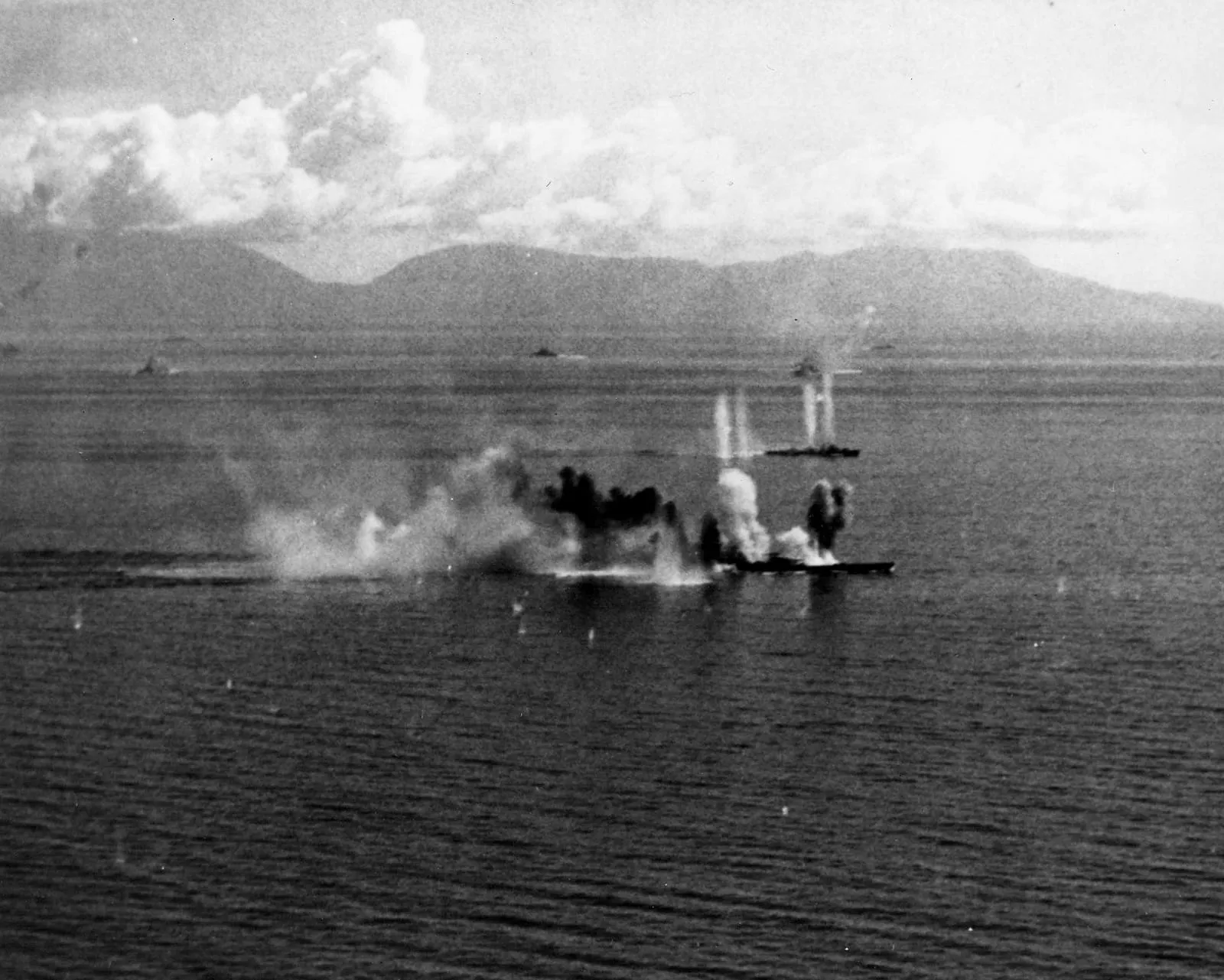
On the morning of 24 October reconnaissance aircraft from Halsey’s carriers found Kurita’s force in the Sibuyan Sea, and somewhat later Nishimura’s force in the Sulu Sea as well. Halsey concentrated his strikes on Kurita. All day long successive waves of dive bombers and torpedo aircraft from the Third Fleet’s carrier groups – some 260 sorties in all – attacked the Japanese ships, which had no fighter cover whatsoever.
Musashi took the most hits. According to American and Japanese findings she was struck by at least 17 bombs and 19 torpedoes within a few hours; the ship that was supposed to be unsinkable gradually lost speed and listed, and in the evening, at about 7.35 p.m., she capsized and sank. More than a thousand of her crew died. Other ships were also damaged, and the heavy cruiser Myōkō had to turn back to base. Yet a surprisingly large part of the Japanese strength survived: Yamato, Nagato, Kongō and Haruna sailed on. The American airmen, who measured success above all by the number of hits claimed, reported far greater damage than they had actually inflicted.
In the afternoon Kurita, receiving neither air cover nor news of Ozawa’s decoy, turned west to get out of aircraft range. American airmen reported that the Japanese were withdrawing. At about 5.15 p.m. Kurita turned east again, towards the San Bernardino Strait, and in the evening Toyoda’s order arrived for all forces to press on with the attack, “trusting in divine guidance”. Kurita’s renewed turn, however, was not given due attention on Halsey’s staff.
The loss of Princeton
The same day Japanese land-based aircraft from Luzon launched several large raids on Halsey’s westernmost carrier group. American fighters shot down most of the attackers, but at about 9.40 a.m. a single Yokosuka D4Y dive bomber hit the light carrier USS Princeton with a 250-kilogram bomb. The bomb went through the deck and started a fire in the hangar among fuelled torpedo aircraft.
The escorting ships spent many hours helping to fight the fire. In the afternoon, while the light cruiser USS Birmingham lay alongside the carrier, the bomb stores in Princeton’s stern exploded. The blast swept the cruiser’s deck: according to American figures 241 men were killed on Birmingham and more than 400 wounded – more than on the carrier itself, which lost 108 men. In the evening the wreck of Princeton was finished off with torpedoes. She was the largest American ship lost at Leyte Gulf and the only Independence-class fast light carrier sunk in action.
Ozawa’s aircraft also attacked the American carriers that day, without much result; most of the surviving machines then flew on to airfields on Luzon instead of returning to their decks. The decoy was by now almost without aircraft.
Halsey’s decision
On the afternoon of 24 October Halsey issued a preparatory order: four battleships, five cruisers and fourteen destroyers of the Third Fleet “will be formed” into Task Force 34 under Vice Admiral Willis Lee, which would fight Kurita if necessary. Halsey meant it as a plan for the future. Kinkaid, who had intercepted the signal, and Nimitz’s staff at Pearl Harbor, however, assumed that the force had already been formed and was guarding the San Bernardino Strait. A later clarification, sent by short-range radio, was not received by the Seventh Fleet.
At about 4.40 p.m. Mitscher’s airmen at last found Ozawa’s carriers, several hundred kilometres north-east of Luzon. Halsey was convinced by his pilots’ reports that Kurita’s force had been badly weakened and posed no threat to the Seventh Fleet, and that carriers – as the experience of the whole Pacific War taught – were the main target. In the evening he led all three available carrier groups north, together with the battleships. The fourth and strongest group, under Vice Admiral John McCain, which had earlier been sent to Ulithi to replenish, was only now recalled. Night reconnaissance reports that Kurita was again heading for the strait, and a signal from Lee that Ozawa’s force might be a decoy, did not change his decision. The San Bernardino Strait was left without any guard at all, of which neither Kinkaid nor Nimitz was aware. Toyoda’s plan, though no one in Tokyo yet knew it, had worked.
The decision on 25 October
The next day brought three separate engagements. During the night of 24–25 October Nishimura’s force entered the Surigao Strait, where torpedo boats, destroyers, cruisers and Rear Admiral Jesse Oldendorf’s six old battleships lay in wait; the force was almost entirely destroyed, and Nishimura went down with Yamashiro. In the morning Kurita, having passed through the San Bernardino Strait unnoticed, ran into the Seventh Fleet’s escort carriers off Samar and, after more than two hours of fighting, turned back without entering Leyte Gulf. Far to the north, off Cape Engaño, Halsey’s aircraft sank all four of Ozawa’s carriers. On the same day Japanese airmen carried out organised suicide attacks for the first time, and on 26 October American aircraft pursued the retreating Japanese forces.
The final balance was crushing. According to the most commonly cited figures, Japan lost four carriers, three battleships, about ten cruisers and more than a dozen destroyers, and some 10,000 Japanese sailors and airmen were killed (some estimates put it at 12,000). The Americans lost the light carrier Princeton, two escort carriers, two destroyers and one destroyer escort, and according to American figures about 3,000 men were killed or missing.
Place in the war
The Battle of Leyte Gulf ended the Imperial Japanese Navy’s existence as a force capable of major operations. The surviving battleships, Yamato among them, returned to bases from which – for lack of fuel and aircraft – they put to sea only occasionally. From then on Japan could neither hinder American landings nor defend the sea lanes linking it with the south; oil deliveries from the East Indies soon all but ceased. On land, however, the fighting on Leyte went on for many more weeks, as the Japanese kept sending reinforcements to the island from other parts of the archipelago.
At the same time, the first days of the battle showed how close the Americans had come to defeat. Toyoda’s plan, built on a decoy and on dispersing the enemy, succeeded in its most difficult part: Halsey went north and the road to Leyte Gulf lay open to Kurita. Why the Japanese failed to exploit this chance – and why Halsey allowed himself to be drawn away – remains one of the most debated questions in naval history. The arguments have concerned both the divided command of the American fleets and the decisions of the two admirals, Halsey and Kurita, who to the end of their lives either defended their choices or kept silent about them.
The suicide attacks that began on 25 October, and were soon being carried out on a large scale, became in the following months – in the Philippines, off Iwo Jima and Okinawa – the Japanese air arm’s most dangerous weapon against the American fleet. The loss of the fleet, for its part, sealed the fate of the Philippines: in January 1945 the Americans landed in Lingayen Gulf on Luzon, and in February and March they fought for Manila.
Sources
Meanwhile
(04)Elsewhere, within a week.
- 23 October 1944 · BalkansThe liberation of Novi SadOn 23 October 1944 Yugoslav Partisans, followed by Red Army soldiers, entered Novi Sad, the capital of Bačka, which Hungary had seized in 1941.
- 25 October 1944 · Eastern FrontThe liberation of RomaniaOn 25 October 1944 Romanian and Red Army troops took Carei and Satu Mare. Northern Transylvania, ceded to Hungary in 1940, returned to Romanian hands.
- 20 October 1944 · BalkansThe liberation of BelgradeOn 20 October 1944, after a week of street fighting, the Red Army and Tito's Partisans drove the Germans from Belgrade, free after 3.5 years of occupation.
- 27 October 1944 · Western FrontThe fighting in the Hürtgen ForestThe Hürtgen Forest fighting, begun on 19 September 1944, went on in late October; in November and December it became one of the US Army’s bloodiest battles.
Related events
(04)The same battle, people or subject.
- 25 October 1944 · PacificThe Battle off SamarOn 25 October 1944 three actions were fought in the Battle of Leyte Gulf – in the Surigao Strait, off Samar and off Cape Engaño. Kamikaze attacks began.
- 12 October 1944 · PacificThe raids on FormosaOn 12–16 October 1944 Halsey's carriers crushed Japanese air power over Formosa. Tokyo announced 11 carriers sunk – in reality, not one.
- 20 October 1944 · PacificThe landing on LeyteOn 20 October 1944 the US Sixth Army landed on Leyte. General MacArthur waded ashore and told the Filipinos by radio: “I have returned”.
- 15 December 1944 · PacificThe landing on MindoroOn 15 December 1944 the Americans landed unopposed near San Jose on Mindoro. Airfields on the island were to cover the coming invasion of Luzon.