Germany
Clemens August von Galen
Bishop of Münster (1933–1946), cardinal (1946)
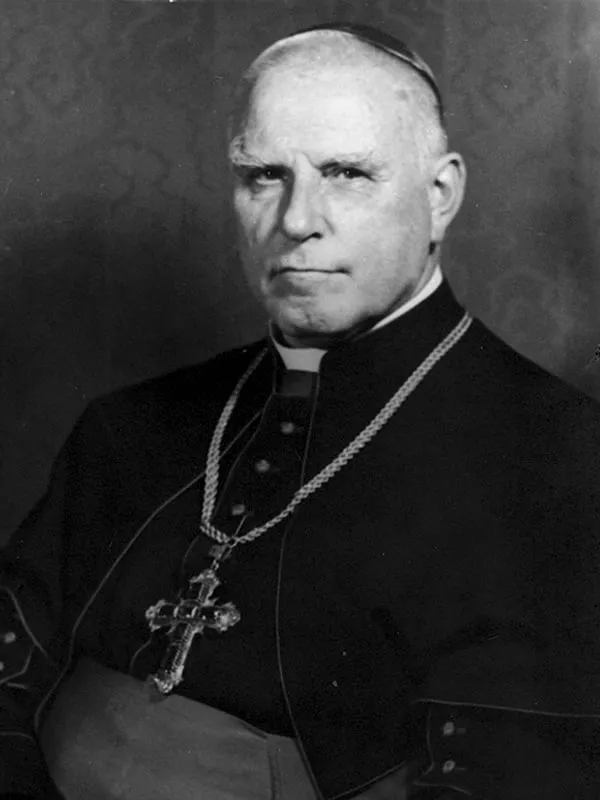
- Born:
- 16 March 1878, Dinklage (Grand Duchy of Oldenburg, German Empire)
- Died:
- 22 March 1946, Münster (Germany)
- Author:
- Natalia
- Photo:
- Domkapitular Gustav Albers († 1957), CC BY 2.5, Wikimedia Commons

Clemens August Graf von Galen was Bishop of Münster in Westphalia throughout the whole life of the Third Reich and one of the few German prelates who openly, from the pulpit, stood up against the regime’s crimes. In the summer of 1941, in three sermons, he accused the Gestapo of lawlessness and called the killing of the mentally ill under Aktion T4 by its proper name: murder. Copied out by hand and circulated across Germany, the sermons earned him the nickname “the Lion of Münster” and helped persuade Adolf Hitler to halt the gassing of patients in August 1941. Yet he was also an aristocrat of conservative and nationalist views who believed the “stab in the back” legend, supported the German war effort and remained publicly silent about the fate of the Jews. This ambiguity means that he remains a subject of dispute among historians to this day, even though the Catholic Church has beatified him.
A Westphalian aristocrat
He was born on 16 March 1878 at the family castle in Dinklage, in the Catholic Oldenburger Münsterland, the eleventh of thirteen children of Count Ferdinand Heribert von Galen, a Reichstag deputy for the Catholic Centre Party, and Elisabeth, née von Spee. The von Galens were among the oldest families of the Westphalian nobility. In the 17th century one of his ancestors, Christoph Bernhard von Galen, had been Prince-Bishop of Münster, and his paternal grandmother’s brother, Bishop Wilhelm Emmanuel von Ketteler of Mainz, was one of the founders of Catholic social teaching. His upbringing at home was strict, governed by faith and duty.
He was educated at the Jesuit college of Stella Matutina in Feldkirch, in the Austrian Vorarlberg, and since Prussia did not recognise its school-leaving examination, he sat the Abitur in 1896 at the grammar school in Vechta. He studied philosophy, history and literature at the Catholic university of Fribourg in Switzerland. In 1898, on a journey to Rome, he was received in private audience by Pope Leo XIII and resolved to become a priest. He studied theology in Innsbruck and Münster, where he was ordained on 28 May 1904.
A parish priest in Berlin
After a short spell in Münster as cathedral vicar and chaplain to his uncle, the auxiliary bishop, he went to Berlin in 1906. For more than twenty years he worked in the Catholic diaspora of the Prussian capital, among workers and craftsmen, first as curate in the parish of St Matthias, then as pastor of a new parish near the Anhalter Bahnhof, and from 1919 as parish priest of St Matthias. Out of his own fortune he funded a hostel for journeymen and the upkeep of a second curate.
In 1914 he urged his parishioners to volunteer for the army and himself tried, without success, to become a military chaplain. In keeping with the stab-in-the-back legend, he regarded Germany’s defeat and the revolution of 1918 as a betrayal of an undefeated army. The Weimar Republic, its secular liberalism and the Centre Party’s presence in coalitions with the Social Democrats aroused his dislike. He was a monarchist, considered the Treaty of Versailles unjust and saw Bolshevism as a mortal threat to Germany and the Church. In the presidential election of 1925 he backed not the Centre Party’s candidate, Wilhelm Marx, but Paul von Hindenburg. In Berlin he met the nuncio Eugenio Pacelli, the future Pope Pius XII, and the two became friends. In 1929 he returned to Münster as parish priest of St Lambert’s church on the main market square. In 1932 he published a pamphlet, The Plague of Laicism, attacking the secular character of the modern state.
A bishop in Hitler’s state
When the see of Münster fell vacant in 1933, Galen was not the favourite. The nuncio, Cesare Orsenigo, considered him stubborn and overbearing. Only after two other candidates had declined did the Holy See add him to the list, and on 18 July 1933 the cathedral chapter elected him unanimously. On 28 October 1933 Cardinal Karl Joseph Schulte of Cologne consecrated him bishop. He chose as his motto the words “Nec laudibus, nec timore” (Neither for praise nor out of fear). He was the first bishop appointed after the conclusion of the Reich Concordat and the first to swear the oath of loyalty to the state that it required, before the Prussian Minister-President, Hermann Göring.
The new bishop soon came into conflict with the regime, which had taken power half a year earlier. Even before his installation he objected to an instruction from the municipal schools officer that religious education lessons should cover “the demoralising power of the people of Israel”. In his Easter pastoral letter of 1934 he denounced as neo-paganism the claim that morality is binding only in so far as it serves the race, and the rejection of the Old Testament. At the end of 1934 he issued, as a supplement to the diocesan gazette, anonymous studies taking issue with Alfred Rosenberg’s The Myth of the Twentieth Century, and signed a foreword to them himself. When Rosenberg spoke at a party rally in Münster in July 1935, the great annual procession, attended by nearly 20,000 faithful, turned into a demonstration of support for the bishop. Galen was among the bishops who demanded public protest against violations of the Concordat instead of the quiet diplomacy favoured by the chairman of the bishops’ conference, Cardinal Adolf Bertram. In January 1937, according to most accounts, he was one of the five-member delegation of German bishops whom Pope Pius XI consulted in Rome about the encyclical Mit brennender Sorge, and after its publication in March he had it distributed throughout his diocese. In retaliation the authorities closed the diocesan printing works and confiscated it without compensation.
In national matters, however, he was loyal to the state. In 1936 he sent a telegram welcoming the Wehrmacht’s entry into the demilitarised Rhineland. Historians still argue about his attitude to the Jews. The American scholar Beth Griech-Polelle has pointed out that Galen repeated traditional anti-Judaic motifs in his sermons and never publicly spoke up in defence of the persecuted Jews, even after Kristallnacht. The German historian Joachim Kuropka, on the other hand, notes that in 1938 the Münster diocesan curia recommended to the faithful a pamphlet against antisemitism, that Galen was on good terms with the rabbi of Münster, Fritz Steinthal, to whom he offered help after the pogrom, and that according to Gestapo sources prayers for the Jews were said in the diocese at that time. Galen himself is said to have admitted later that he had let the moment pass to speak out publicly on the matter.
The Lion of Münster
Galen accepted the war as a patriotic duty, and in a pastoral letter of September 1941 he presented the German attack on the Soviet Union as a struggle against the “plague of Bolshevism”. At the same time, from 1940 onwards he knew about the killing of patients in psychiatric institutions. What finally moved him to speak out openly, however, was a wave of confiscations of monasteries and convents in his diocese. On 13 July 1941, in St Lambert’s church, he accused the Gestapo of arrests without trial and of locking people up in concentration camps, crying: “We demand justice!” On 20 July, in the Church of Our Lady, he called on the faithful to withstand the hammer blows like an anvil. On 28 July he lodged a complaint with the public prosecutor about the intended killing of patients being removed from the Marienthal asylum, and on 3 August 1941, in his third sermon, he described the removal of patients from Westphalian institutions and the false notifications of their deaths. “These are people, our neighbours, our brothers and sisters,” he said. “Poor sick people, unproductive, if you like. But does that mean they have forfeited the right to life?” He warned that if it was permitted to kill the “unproductive”, neither the old nor maimed soldiers would be safe.
Copies of the sermons circulated throughout Germany, the BBC quoted them and the RAF dropped them in leaflets. They were read by members of future resistance groups, among them the students of the White Rose in Munich. Gauleiter Alfred Meyer demanded the bishop’s arrest, and in Martin Bormann’s circle there was even talk of hanging him. Joseph Goebbels, however, persuaded Hitler that in wartime it would not do to create a Catholic martyr and risk unrest in Westphalia, and that the reckoning should be postponed until victory. On 24 August 1941 Hitler ordered the centrally run T4 programme to be halted. Historians differ in assessing how much of this decision was owed to Galen, but almost all regard his sermon as the strongest public protest against the regime’s policy since 1933. Many people were arrested for distributing the sermons, including priests from his diocese. In his table talk Hitler promised that after the war he would settle accounts with the bishop “down to the last penny”.
The last years of the war
Galen remained in office until the end of the war, under constant Gestapo surveillance. In 1943 he helped draft the bishops’ pastoral letter on the Ten Commandments, read out in churches in September, which condemned the killing of the sick, hostages, prisoners of war and people “of a foreign race or descent”. According to members of the resistance, he was kept informed of the plans of the Kreisau Circle, and documents from his beatification process suggest that in November 1943 he met Carl Goerdeler. He himself was not arrested after the attempt on Hitler’s life in July 1944, but his brother Franz, a former Centre Party deputy, was sent to Sachsenhausen concentration camp. Bombing destroyed the cathedral and the bishop’s palace in Münster, and the bishop took up residence in a convent in Sendenhorst.
After the Allies occupied Westphalia, Galen proved just as awkward for the new authorities. He protested against rape and looting by occupation troops, the internment of officials and the expulsion of Germans from the east, and in July 1945 he publicly rejected the idea of the collective guilt of the Germans. The British, in whose zone Münster lay, tolerated his criticism because of his wartime stance.
Cardinal and blessed
On 18 February 1946 Pius XII made him a cardinal, together with the Archbishop of Cologne, Joseph Frings, and the Bishop of Berlin, Konrad von Preysing, two other German bishops who had opposed the Nazis. Galen’s titular church was San Bernardo alle Terme. On 16 March 1946, his 68th birthday, he returned to the ruins of Münster, where he was given a triumphant welcome and the city made him an honorary citizen. A few days later he was taken to hospital with appendicitis, diagnosed too late, and died on 22 March 1946. He was buried in the von Galen family chapel in Münster Cathedral.
His beatification process opened in 1956. Pope John Paul II prayed at his tomb in 1987, and on 9 October 2005 Benedict XVI declared him blessed.
Significance
Galen was no opponent of the German state, nor of the war that state was waging. He was a conservative bishop who defended the rights of the Church and who, once he understood that the regime was killing defenceless fellow Germans, placed God’s law above obedience to authority. His sermon of 3 August 1941 proved that public protest in the Third Reich was possible and need not end in the protester’s death when it was backed by authority and the support of the faithful. All the starker, then, is the silence that fell when, a few months later, men from the T4 centres began building gas chambers for Jews in occupied Poland. In the history of the Second World War Galen has remained a symbol both of courage and of the limits of the German churches’ opposition.
Sources
Often appears with
People who appear in the same events.