Holy See
Pius XI
Apostolic Visitor and Nuncio to Poland (1918–1921), Archbishop of Milan (1921–1922), Pope (1922–1939), first sovereign of Vatican City State (from 1929)
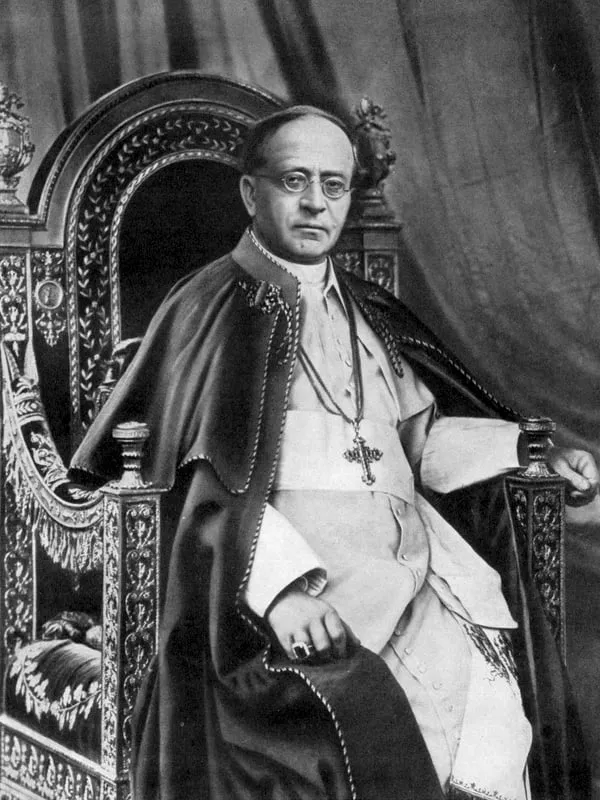
- Born:
- 31 May 1857, Desio (Kingdom of Lombardy–Venetia, Austrian Empire)
- Died:
- 10 February 1939, Vatican City
- Author:
- Łukasz
- Photo:
- After Giuseppe Felici, domena publiczna, Wikimedia Commons

Pius XI, born Achille Ratti, was pope in the years when dictatorships were rising and taking root across Europe. A scholarly librarian, mountaineer and diplomat who had witnessed the Polish–Soviet War as nuncio in Warsaw, he regarded communism as the greatest threat to the Church. He therefore sought agreements with any government that would guarantee the Church freedom to act. In 1929 he concluded the Lateran Treaty with Benito Mussolini, which ended the papacy’s quarrel with Italy and created Vatican City State, and in 1933 a concordat with the Reich of Adolf Hitler. Both dictators used these agreements to strengthen their own power, and both broke them at the first opportunity. In the last years of his life Pius XI became one of the sharpest critics of Nazism and racism, but he died a few months before the outbreak of the war he had warned against.
Librarian and mountaineer
He was born on 31 May 1857 in Desio near Milan, the son of the manager of a silk mill. Lombardy still belonged to the Austrian Empire at the time. After the seminary in Milan he studied in Rome and earned three doctorates, in philosophy, theology and canon law. He was ordained priest in December 1879. For several years he taught at the seminary, and from 1888 he worked at Milan’s Ambrosian Library, becoming its prefect in 1907. He was a respected palaeographer and editor of medieval manuscripts. In 1911 he moved to the Vatican Library, and in 1914 he became its head.
He also had a passion unusual for a clergyman. He was an outstanding mountaineer: in 1889 he was among the first to climb the Dufourspitze in the Monte Rosa massif by its east face, and he reached the summits of the Matterhorn and Mont Blanc, where one of the descent routes bears his name.
Warsaw, 1918–1921
In the spring of 1918 Pope Benedict XV unexpectedly sent the sixty-year-old librarian as apostolic visitor to Poland and Lithuania, lands still occupied by the Germans and Austrians. Once Poland regained its independence, the Holy See established diplomatic relations with it, and in June 1919 Ratti became the first nuncio to the reborn Polish state and a titular archbishop. He was consecrated on 28 October 1919 in Warsaw Cathedral. He maintained correct relations with the Chief of State, Józef Piłsudski, and organised the life of the Church in the lands of the three former partitions.
In August 1920, as the Red Army approached Warsaw and most of the diplomatic corps left for Poznań, Ratti stayed in the capital. According to some sources he was one of only two foreign diplomats to do so, the other being the representative of Turkey. Seeing the Polish–Soviet War at close quarters confirmed his conviction that Bolshevism was the mortal enemy of Christian Europe. His reports from the time also show that he shared the prejudices against Jews then widespread in the Church, portraying them as a harmful force in Polish life.
His mission ended in difficulty. In 1920 Ratti was given the task of ecclesiastical commissioner for the plebiscite areas, including Upper Silesia. When the German Cardinal Adolf Bertram, Bishop of Breslau, forbade clergy from outside the area to take part in the campaigning – a ban that fell mainly on Polish priests – it was felt in Poland that the nuncio had failed to stand up for them. The press attacked him and the government made no secret of its displeasure. In June 1921 Benedict XV appointed Ratti Archbishop of Milan and a cardinal, which brought his mission in Warsaw to an end.
Pope
Benedict XV died in January 1922. On 6 February, on the fourteenth ballot, the conclave elected Ratti, who took the name Pius XI. With his very first gesture he signalled that he wished to end the quarrel with Italy: for the first time since 1870 a new pope gave the “Urbi et Orbi” blessing from the outer loggia of St Peter’s Basilica, facing the city. He took “the Peace of Christ in the Kingdom of Christ” as the motto of his pontificate. He supported Catholic Action – organisations of lay Catholics working under the direction of the bishops rather than political parties. He concluded a record number of concordats, among them with Latvia, Bavaria, Poland (in 1925), Lithuania, Romania, Prussia and Austria.
He approached Fascism pragmatically. He distrusted parliamentary democracy, and Mussolini, though a former anticlerical, showed goodwill towards the Church. When Mussolini became prime minister in October 1922, the Vatican began to distance itself from the Catholic People’s Party. In July 1923 its leader, the priest Luigi Sturzo, stepped down under pressure from the Holy See. After the murder of Matteotti in 1924 the pope did not back the opposition. Fascist violence also struck Catholic organisations, but Pius XI protested without breaking off talks.
The Lateran Treaty
Secret negotiations with the Italian government had been going on since 1926. On 11 February 1929, in the Lateran Palace, the Cardinal Secretary of State Pietro Gasparri and Mussolini signed a political treaty, a financial convention and a concordat. The pope gained sovereignty over the Vatican, compensation for the lost Papal States and a privileged position for the Church in Italy, and in return recognised the Kingdom of Italy with Rome as its capital. Two days later he said that the agreement had needed a man such as the one “whom Providence has placed in Our path”. After a fierce dispute with Mussolini over the education of young people, the treaties came into force on 7 June 1929 and Pius XI became the first sovereign of Vatican City State. He set up Vatican Radio, founded the Pontifical Academy of Sciences and expanded the museums. In 1930 Eugenio Pacelli, the former nuncio to Germany, became Secretary of State.
Reconciliation did not remove the conflicts. In 1931 the regime dissolved the youth organisations of Catholic Action, and the pope replied with the encyclical “Non abbiamo bisogno”, in which he condemned Fascism’s “pagan worship of the State”. Towards Italy’s invasion of Ethiopia in 1935, however, he showed restraint. In August 1935 he said that a war of conquest would be unjust, but under pressure from the Italian government he did not condemn it publicly, and many Italian bishops blessed the troops setting off for Africa. Emperor Haile Selassie, with whom Italy had concluded a treaty of friendship as recently as 1928, found no support in the Vatican.
Facing Hitler and Stalin
After Hitler came to power the Holy See quickly agreed to negotiate. On 20 July 1933 Pacelli and Vice-Chancellor Franz von Papen signed the Reich Concordat. The Church received guarantees for its schools, organisations and pastoral work; in return the clergy withdrew from politics, and the Catholic Centre Party had dissolved itself even before the signing. For Hitler it was his first great international success. The Nazis broke the concordat almost from the start: they wound up Catholic organisations, closed denominational schools and staged propaganda trials of monks and friars. In 1934 the pope placed “The Myth of the Twentieth Century” by the party ideologue Alfred Rosenberg on the Index of Forbidden Books.
In March 1937 Pius XI issued two encyclicals. The first, “Mit brennender Sorge” (“With Burning Concern”), was written in German, smuggled into Germany and read from every Catholic pulpit on Palm Sunday, 21 March; it accused the Reich government of breaking the concordat and condemned the deification of race, nation and state. The second, “Divini Redemptoris”, dated five days later, was a condemnation of atheistic communism, which the pope called “intrinsically wrong”. He described the persecution of the Church in the USSR, Mexico and Republican Spain as a “terrible triangle”.
In May 1938, when Hitler came to Rome on an official visit, the pope left for Castel Gandolfo, closed the Vatican Museums and remarked bitterly that a cross had been hung out in Rome that was not the cross of Christ. When Mussolini began that summer to imitate German racial policy, Pius XI protested publicly on several occasions, saying that Italy was “unfortunately” following Germany. On 6 September 1938 he told representatives of Belgian Catholic radio that antisemitism was unacceptable, because “spiritually we are Semites”. The racial laws of the autumn of 1938 violated the concordat by forbidding marriages between Catholics of Jewish descent and “Aryans”, and the Vatican protested against them. The pope also commissioned an encyclical against racism and antisemitism, “Humani generis unitas”, but the draft reached him only in January 1939 and was never published.
Death and assessment
Seriously ill with heart disease from the autumn of 1938, Pius XI died in the Vatican on 10 February 1939, on the eve of the tenth anniversary of the Lateran Treaty, for which he had prepared an address to the Italian bishops that was critical of the regime. On 2 March he was succeeded by Eugenio Pacelli as Pius XII, who a few months later, in wartime, had to face the dilemmas his predecessor had left him.
Opinion on Pius XI remains divided. His critics point out that the concordats and agreements with Mussolini and Hitler gave both dictators prestige and the support of Catholics in the decisive years, and that the pope, focused on the rights of the Church, long kept silent about violence that did not affect Catholics. His defenders stress that no institution in the 1930s condemned Nazism as forcefully as “Mit brennender Sorge”, and that in the last years of his life Pius XI spoke out openly against racism and antisemitism before the democratic governments had found similar courage. On the road to the Second World War, his pontificate shows how the hope that one could deal with the dictators gradually gave way to the conviction that their ideologies were irreconcilable with Christianity.
Sources
Often appears with
People who appear in the same events.