Romania
Constantin Prezan
Commander of the Northern Army (1916), Chief of the General Staff of the Romanian Army (1916–1918, 1918–1920), Marshal of Romania (from 1930)
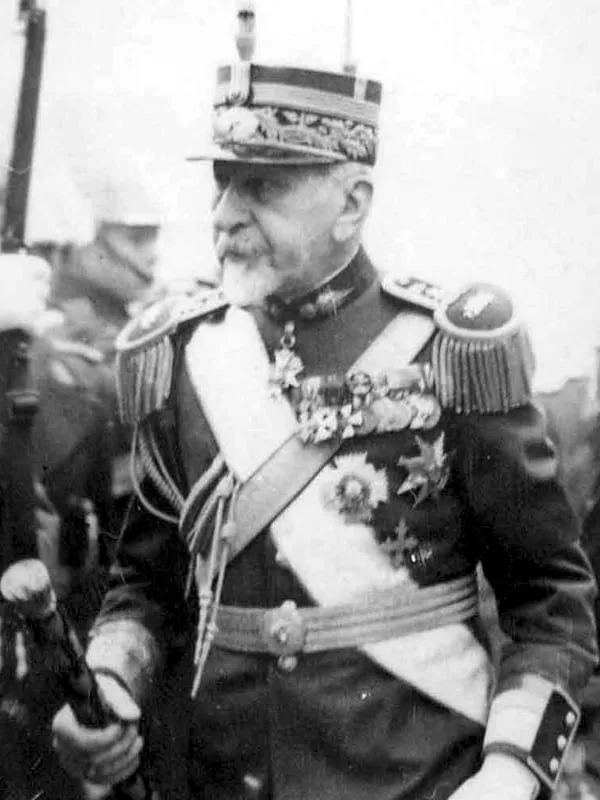
- Born:
- 27 January 1861, Sterianul de Mijloc, Butimanu commune (Romania)
- Died:
- 27 August 1943
- Author:
- Łukasz
- Photo:
- autor nieznany, domena publiczna, Wikimedia Commons

Constantin Prezan was the most important organiser of the Romanian army during and immediately after the First World War. In 1916 he commanded the Northern Army in Transylvania and then the defence of Bucharest, and from December of that year, as chief of staff at General Headquarters, he rebuilt the shattered army, which in the summer of 1917 successfully defended Moldavia. After a brief retirement he returned to the post on 10 November 1918, when Romania re-entered the war, and it was under his direction that the Romanian army occupied Bukovina and Transylvania, defended Bessarabia against the Bolsheviks and, in the war with Hungary, crushed the forces of the Hungarian Soviet Republic and in August 1919 entered Budapest. The victories won by the army under his command in 1918–1919 determined the shape of interwar “Greater Romania”, and the dispute over Transylvania, settled at that time in Bucharest’s favour, flared up again in 1940. A calm, taciturn military engineer, close to the king and to Prime Minister Brătianu, he never enjoyed the popularity of his rival, General Alexandru Averescu, but in 1930 both men were made Marshals of Romania.
Youth and pre-war career
He was born on 27 January 1861 in the village of Sterianul de Mijloc in the commune of Butimanu, north of Bucharest. According to Romanian biographers, the family had French roots, and the surname was also spelt Presan. He was educated at the school for soldiers’ sons in Iași and at the officer school in Bucharest, from which he graduated as a second lieutenant in 1880. He chose the engineers. He completed the artillery and engineering school in Bucharest and then continued his training in France. In Paris he met Ion I. C. Brătianu, then an engineering student and later prime minister, an acquaintance that was to matter greatly for his career. He lectured in fortification, supervised the manufacture in Germany of equipment for the Focșani–Nămoloasa–Galați line of fortifications, and commanded a sapper battalion.
From 1896 to 1901 he was aide-de-camp to the heir to the throne, Prince Ferdinand, the future king. The trust he won with Ferdinand at that time stayed with him throughout his career. He then commanded a regiment at Vaslui and a brigade at Bârlad, and in 1907, after the suppression of the great peasant revolt, he was promoted to general. The decree was countersigned by the then Minister of War, General Averescu, who reminded Prezan of this ten years later, when Prezan had become his superior. In 1913, in the Second Balkan War, he commanded the 7th Division in the expedition into Bulgaria, and his troops stood out for their discipline and their low losses during a cholera epidemic. In 1914 he took command of IV Corps at Iași. He was married twice; his second wife, whom he married in 1892, was Olga Eliad.
The Northern Army and the defence of Bucharest (1916)
Romania entered the war on the side of the Entente in August 1916, hoping to win Transylvania, Bukovina and the Banat, which the Allied powers had promised it in a secret treaty. Under the war plan, IV Corps was then converted into the Northern Army. Prezan was the only army commander who went to war with troops and a staff he had known for years. On the night of 27/28 August his roughly 100,000 men crossed the passes of the Eastern Carpathians and entered the Székely Land. The army advanced slowly but methodically, and it was the only one to reach roughly the line set out in the plan.
At a council of war on 15 September Prezan opposed shifting the main effort to the Danube, as Averescu demanded after the defeat at Tutrakan (Turtucaia). He lost the argument, and his fears were soon borne out. When the German Ninth Army under General Erich von Falkenhayn routed the neighbouring Romanian armies at Sibiu and Brașov, the Northern Army fell back towards the frontier. Critics accused it of making no attempt to relieve its neighbours. In the passes, however, its resistance stiffened and the Austro-Hungarians were halted.
In November, when Falkenhayn’s troops came down from the Carpathians and Field Marshal August von Mackensen crossed the Danube, Prezan took command of the army group defending Bucharest. His closest associate on the staff was Captain Ion Antonescu, later dictator of Romania. Together with the head of the French military mission, General Henri Berthelot, he devised a bold plan: to strike at the exposed flank of Mackensen’s forces before they could link up with Falkenhayn’s army. On 1 December the strike group went into action and for two days came close to success, but divisions cobbled together from the remnants of shattered units, the lack of communications and reconnaissance, and Russian help kept to a bare minimum took their toll. Romanian orders fell into German hands by chance, and Falkenhayn turned his divisions against the Romanian rear. The battle on the Argeș was lost, and on 6 December the Germans entered Bucharest.
Chief of staff (1916–1918)
In mid-December 1916 the king appointed Prezan chief of staff at General Headquarters. This might have seemed surprising after a lost battle, but Prezan had the confidence of the king and of Brătianu and the backing of Queen Marie and of Berthelot, who considered him the ablest soldier in Romania. Averescu took the appointment as an insult. General Headquarters moved to Moldavia, where in the winter of 1916–1917 Prezan, together with the French mission, reorganised, re-equipped and retrained the bled-white divisions. He also knew how to work with the Russians, who held most of the front, and was on downright friendly terms with General Dmitry Shcherbachev.
In the summer of 1917 the army rebuilt under his direction broke through the front at Mărăști, and in August it halted Mackensen’s offensive at Mărășești. These were Romania’s most important victories of the war. After the October Revolution the Russian front disintegrated, and Romania, left on its own, had to conclude an armistice at Focșani in December 1917 and, in May 1918, a separate peace with the Central Powers, which required the demobilisation of the army. In the spring of 1918 Prezan retired.
Unification and the war with Hungary (1918–1920)
When at the beginning of November 1918 the Central Powers were collapsing and the French army of General Louis Franchet d’Espèrey was approaching the Danube, Romania re-entered the war. On 10 November 1918 – 28 October according to the Julian calendar, which was still in use in Romania – Prezan once again became Chief of the General Staff. He found the army largely demobilised, with only a few divisions at full strength. Even so, over the following weeks his troops entered Bukovina and, from 13 November, crossed the Carpathians and occupied Transylvania, where on 1 December the assembly at Alba Iulia proclaimed union with Romania. At the same time the army had to defend Bessarabia, united with Romania in the spring of 1918, against Bolshevik detachments from across the Dniester.
In the spring of 1919, after Béla Kun’s communists seized power in Hungary, Romania found itself between two Soviet states. Prezan, who as chief of staff directed the operations as a whole, backed the offensive of General Gheorghe Mărdărescu’s Transylvanian troops, which in April broke the Hungarian front and brought the Romanian army to the Tisza. On 24 May he visited the front with King Ferdinand and met the commanders at Békéscsaba. In July the Romanian army repulsed the Hungarian offensive across the Tisza, crossed the river and on 3–4 August 1919 entered Budapest. The Soviet Republic fell, and Romania gained a strong card at the Peace Conference, although its high-handedness and requisitions in Hungary set it at odds with the great powers. In February 1920 the king awarded Prezan the Order of Michael the Brave, 1st Class.
On 20 March 1920, when his old rival Averescu became prime minister, Prezan left the army. Antonescu wrote bitterly that his resignation had been accepted with the haste with which one dismisses a bad farmhand. On 4 June that year the Treaty of Trianon confirmed that Transylvania, Crișana, Maramureș and the eastern Banat belonged to Romania.
After the war
Prezan kept out of politics. He was a senator by right and an honorary member of the Romanian Academy. In June 1930, together with Averescu, he received the honorary title of Marshal of Romania. According to Romanian biographers, in the same year King Carol II entrusted him with forming a government of national unity, a mission he gave up after a few days, unable to reconcile the parties. From 1938 to 1940 he was a member of the Crown Council, the king’s advisory body, which in 1940, at the height of the state’s crisis, decided to accept the Soviet ultimatum over Bessarabia and the German–Italian arbitration that took northern Transylvania from Romania. Prezan thus lived to see much of the territory he had fought for in 1918–1919 lost. According to Romanian biographers, in 1940 he turned down an offer from Antonescu, by then leader of the state, to become prime minister.
He died on 27 August 1943, while the Romanian army was fighting alongside the Germans on the Eastern Front. Sources differ on the place of his death: some give Bucharest, others his estate at Schinetea in Vaslui County. It was there that he was buried. King Michael I and Marshal Antonescu attended his funeral.
Significance
Romanian military historiography rates Prezan very highly. It stresses that it was under his direction that the army shattered in 1916 was turned into a force that halted Mackensen in 1917, and that in 1918–1919, with only small forces at his disposal, he secured for Romania control of all the lands it had claimed since 1916. Critics point to the defeat on the Argeș, the passivity of the Northern Army in October 1916, and the fact that he owed his career largely to his friendship with the court and with Brătianu. The feud between the two marshals, Prezan and Averescu, fanned by politicians, long weighed on Romania’s memory of the war. Today they are usually seen as complementary figures: Averescu was a commander who inspired his soldiers, Prezan an organiser who knew how to hold the army together.
For the road to the Second World War, what matters most is what his army did in 1918–1919. The occupation of Transylvania and the war with Hungary created “Greater Romania”, but also a lasting conflict with Hungary, which never accepted its loss and sought a revision of the borders at the side of Italy and Germany. Prezan’s pupil and associate Antonescu led Romania into the war against the USSR in 1941 to regain Bessarabia, and competed with Horthy’s Hungary for Hitler’s favour and for Transylvania.