Romania
Ion I. C. Brătianu
Prime Minister of Romania (1909–1911, 1914–1918, 1918–1919, 1922–1926, 1927), leader of the National Liberal Party (1909–1927)
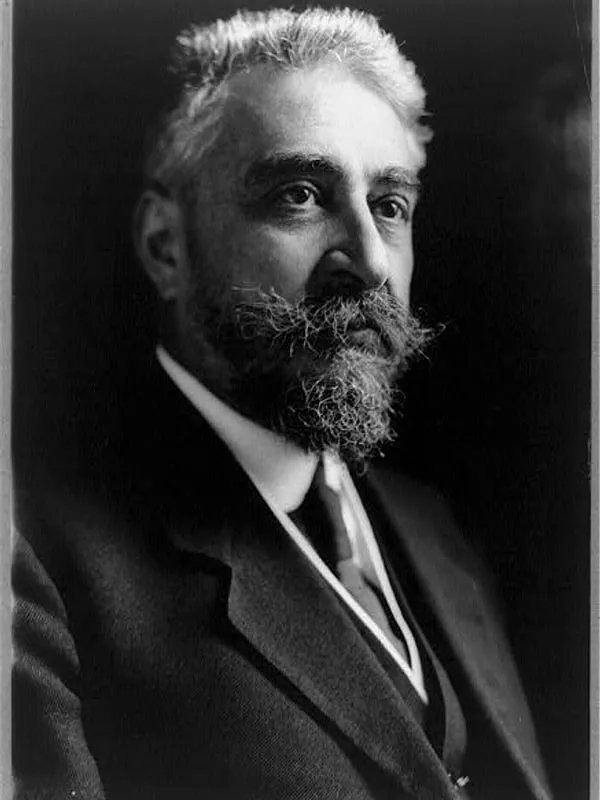
- Born:
- 1 September 1864, Ștefănești (Romania)
- Died:
- 24 November 1927, Bucharest
- Author:
- Łukasz
- Photo:
- Not stated, Harris & Ewing Collection, domena publiczna, Wikimedia Commons

Ion I. C. Brătianu, whom Romanians called Ionel to distinguish him from his famous father, was the most powerful politician in Romania in the first quarter of the twentieth century. He headed the government five times and for eighteen years led the National Liberal Party, which in that period was in practice the party of the state. As prime minister from 1914 to 1918 he kept the country neutral for two years, negotiating simultaneously with the Entente and with the Central Powers, until in August 1916 he judged that the moment had come to reach for Transylvania. The war brought Romania first defeat and occupation, and only then unification, which Brătianu defended at the peace conference in Paris while the Romanian army was fighting Hungary and occupying Budapest. To some he was the architect of Greater Romania; to others a cold gambler who sent an unprepared army to war and then ran the country like his own estate. The press called him “the sphinx”, because until the last moment nobody knew what he intended. The borders he fought for outlived him by a mere thirteen years.
The founder’s son
He was born on 1 September 1864 (20 August by the Julian calendar) on the family estate of Florica in Ștefănești, in Argeș county. He was the eldest son of Ion Brătianu, one of the founders of modern Romania, a participant in the revolution of 1848, a long-serving prime minister and leader of the Liberals. His younger brothers, Vintilă and Constantin, known as Dinu, also became politicians and in turn took over the leadership of the party after him. Ionel was educated in Bucharest, did his military service in the artillery, and from 1884 to 1889 studied in Paris at the École nationale des ponts et chaussées. On his return he worked as a railway engineer under the celebrated bridge builder Anghel Saligny. His Paris years left him with a lasting attachment to France and with friendships that proved useful later, among them his acquaintance with the future general Constantin Prezan.
In 1895 he entered parliament; he was minister of public works in 1897–1899 and 1901–1902, and in March 1907, during the great peasant revolt, he took over the Ministry of the Interior. The Liberal government crushed the rising with the army. The number of peasants killed is disputed to this day: official figures spoke of several hundred, later estimates of several thousand or even more than ten thousand. The lesson Brătianu drew from this tragedy was the conviction that Romania, a country of great latifundia and poor peasants, could not survive without land reform. In 1909 he became leader of the National Liberal Party and prime minister for the first time. In 1913 he won the party over to a programme of partial expropriation of the great landed estates and the extension of the franchise, and in January 1914 he became prime minister again.
The sphinx: neutrality, 1914–1916
On 3 August 1914, at a crown council in Sinaia, King Carol I wanted to go to war alongside Germany and Austria-Hungary, to which Romania had been bound by a secret alliance since 1883. Brătianu argued that the alliance was defensive and that Vienna had not warned Bucharest of its ultimatum to Serbia. The war, he said, would be long, so it was best to wait. The council voted for neutrality, which the prime minister called “armed expectation”. Two months later Carol I died, and the new king, Ferdinand I, left foreign policy to his prime minister.
Brătianu played a double game. In the autumn of 1914 he concluded a secret agreement with Russia, which recognised Romania’s right to Transylvania in exchange for benevolent neutrality, and he reached an understanding with Italy. At the same time he assured Vienna and Berlin that he personally favoured the Central Powers and was held back only by public opinion. In 1915, when Russia was retreating from Galicia and Poland and Bulgaria sided with Germany, he refused to help collapsing Serbia, and after its defeat he allowed huge quantities of Romanian grain to be sold to Germany and Austria-Hungary. The supporters of war, led by Take Ionescu, accused him of inaction, and the Germanophiles of betraying the country’s allies.
The war for Transylvania
In the summer of 1916 the Brusilov offensive shattered the Austro-Hungarian armies in Volhynia and Bukovina. The Russians and the French made it plain that this was the last opportunity. The prime minister went on bargaining for a few more weeks, until on 17 August he signed a treaty with the Entente which promised Romania Transylvania, the Banat as far as the Tisza and most of Bukovina. At a crown council on 27 August he admitted that he was not sure of victory, but said that inaction would be a moral desertion that would weigh on the nation’s fate for centuries. That evening Romania declared war on Austria-Hungary.
The campaign went disastrously. The offensive in Transylvania stalled, the Germans and Bulgarians struck from the south, and in December the forces of the Central Powers took Bucharest. Brătianu, who was also minister of war, bore responsibility for placing his protégé, General Dumitru Iliescu, at general headquarters, and for decisions that threw the army back and forth between Transylvania and the Danube. In Iași, however, he rebuilt the government. In December 1916 he formed a coalition government that included Take Ionescu and sent the gold of the National Bank to Moscow for safekeeping, which proved one of the costliest decisions of the war, since the Bolsheviks never returned it. After the February Revolution he travelled to Petrograd to coordinate action with the Provisional Government. Most importantly, though, he carried out the programme of 1913 during the war itself: in the summer of 1917 the parliament in Iași wrote into the constitution the principle of expropriating the great estates and universal suffrage.
The October Revolution wrecked all his plans. The Russian armies in Moldavia disintegrated and Romania was left alone. Brătianu agreed to an armistice but would not put his name to a peace that would negate his policy. In February 1918 his cabinet resigned. The peace with the Central Powers was signed by the governments that followed, and the Liberals went into opposition, which saved their reputation. The government majority in the new parliament even talked of putting Brătianu’s ministers on trial for dragging the country into the war.
Return and the peace conference
Germany’s defeat reversed the situation. On 10 November 1918 Romania re-entered the war, and in mid-November, when Hungary concluded a military convention with the Allies in Belgrade, Romanian troops began to move into Transylvania. On 12 December 1918 Brătianu became prime minister for the third time. His government oversaw the integration of Transylvania, Bukovina and Bessarabia, which in 1918 had proclaimed their union with Romania.
In January 1919 he led the Romanian delegation to the Paris Peace Conference. He demanded that the treaty of 1916 be carried out to the letter, with the whole of the Banat and the border on the Tisza. The great powers, however, considered that Romania, by concluding a separate peace, had itself broken the agreement of 1916. The Banat was divided between Romania and the Kingdom of Serbs, Croats and Slovenes, and Brătianu, accustomed to dominance in his own country, took badly the treatment of Romania as a second-class state. He particularly opposed the treaty on the protection of national and religious minorities, which he regarded as interference in Romania’s internal affairs.
In the spring of 1919, when Béla Kun’s communists took power in Budapest, Brătianu urged the powers to see Romania as a bulwark against Bolshevism. His army reached the Tisza in April and in August entered Budapest, although the conference’s Supreme Council repeatedly demanded that the advance be halted. The occupation of Hungary and the removal of machinery, rolling stock and supplies from the country drew sharp notes from the powers to Bucharest. In September 1919 Brătianu resigned rather than sign the treaties on imposed terms. The treaty with Austria and the minorities treaty were signed in December by the next government, and the Treaty of Trianon with Hungary, which awarded Transylvania to Romania, was concluded in June 1920.
Master of Greater Romania
Brătianu remained the country’s most important politician even when out of office. Twice he helped the popular general Alexandru Averescu to power, only to push him aside afterwards. From 1922 to 1926 he was prime minister again. Under his government, in 1922, King Ferdinand was crowned at Alba Iulia as ruler of Greater Romania, and in 1923 parliament adopted a constitution that fixed the country’s political system for years to come: a centralised state with universal male suffrage and a strong executive. The Liberals pursued a policy of economic nationalism under the slogan “by ourselves” (prin noi înșine), limiting the influence of foreign capital in industry and mining. Their rule, based on control of the administration and of elections, was called an oligarchy by the opposition. Brătianu was also an open opponent of equal rights for Jews, which Romania had to introduce under pressure from the powers.
Brătianu’s last great undertaking was the question of the succession. Crown Prince Carol, at odds with the Liberals and involved with Elena Lupescu, renounced his rights to the throne for the second time in December 1925, and the prime minister was the chief advocate of recognising Carol’s little son Michael as heir. In June 1927 Brătianu became prime minister for the last time. A month later King Ferdinand died, and on 24 November 1927 Brătianu himself died in Bucharest of complications of laryngitis. He was buried at the family estate of Florica. The government and the party leadership passed to his brother Vintilă.
Assessment
Romanian historiography sees Brătianu above all as the creator of Greater Romania. His admirers stress that neutrality gave the country time to prepare and that hard bargaining produced a treaty on which Romania could rely in Paris. Without the decision of August 1916, they argue, there would have been no Alba Iulia. His critics, among them many Western historians, point to the cost. Romania went to war with a poorly equipped army, with a plan that depended on Russian help, and at a moment when the Brusilov offensive was already petering out. The prime minister was also accused of filling the high command with trusted men, and the Liberals of corruption and oligarchic rule.
His death opened a period of instability. In 1930 Carol returned to the country and took the throne from his son, and in the following decade Romania, shaken by economic crisis and the growing strength of the fascist Iron Guard, slid into royal dictatorship. The order Brătianu had built rested on France and on alliances with neighbours threatened by the same revisionism: Poland, Czechoslovakia and Yugoslavia. When all these supports collapsed in 1938–1940, Greater Romania lost, within a few months, Bessarabia, northern Bukovina, southern Dobruja and northern Transylvania, which the Second Vienna Award handed to Hungary. Brătianu’s son, the historian Gheorghe I. Brătianu, and his brother Dinu, the last leader of the Liberals, died after the war in the communist prison at Sighet.
Sources
Mentioned in battles
(01)Often appears with
People who appear in the same events.