Romania
Carol II of Romania
Crown Prince of Romania (1914–1926), King of Romania (1930–1940), ruling as a dictator from 1938
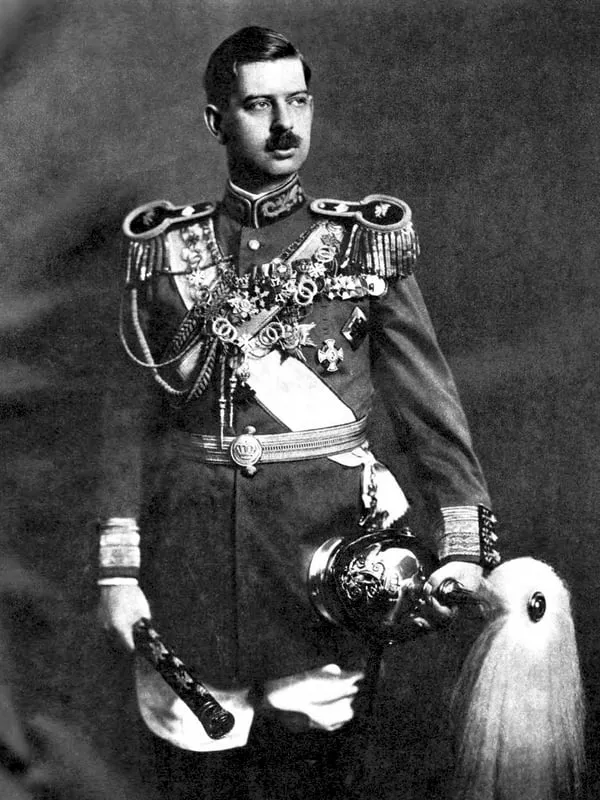
- Born:
- 15 October 1893, Sinaia (Romania)
- Died:
- 4 April 1953, Estoril (Portugal)
- Author:
- Łukasz
- Photo:
- Unidentified photographer, domena publiczna, Wikimedia Commons

Carol II was the third King of Romania and the last ruler of Greater Romania within its 1918–1940 borders. As a young man he became notorious for scandals, for deserting his regiment in wartime and for renouncing his right to the throne, and in 1930 he took the crown from his own son. During his ten-year reign he undermined the political parties and parliament, and in 1938 he imposed a royal dictatorship, which he justified as a struggle against the fascist Iron Guard. In foreign policy he manoeuvred between France, Britain and Germany, hoping in this way to preserve the borders won by his father. In the summer of 1940, after the defeat of France, this policy collapsed: in less than three months Romania ceded Bessarabia and northern Bukovina to the Soviet Union, northern Transylvania to Hungary and southern Dobruja to Bulgaria. Carol II was forced to abdicate, and power passed to General Ion Antonescu, who led the country into war at Hitler’s side.
Childhood and youth
He was born on 15 October 1893 in Sinaia, at the royal residence of Peleș in the Carpathians, the first son of the heir to the throne, Prince Ferdinand, and the British princess Marie, a granddaughter of Queen Victoria. He was the first member of the Hohenzollern-Sigmaringen dynasty to be born in Romania. The boy’s upbringing was taken over by his childless great-uncle, King Carol I, who kept his parents at a distance and surrounded him with tutors. The prince grew up spoilt and at the same time starved of affection. In 1913 his great-uncle sent him to Potsdam, to the 1st Foot Guards Regiment, to learn Prussian discipline.
In October 1914 Carol I died, Ferdinand became king and Carol crown prince. In 1916 Romania entered the war on the side of the Entente, was defeated and lost Bucharest, and the king, government and army took refuge in Moldavia. The crown prince was honorary colonel of a regiment of mountain troops and often visited the front, but in the summer of 1918, a few months after Romania had concluded a separate peace with the Central Powers, he left his unit without permission, crossed the lines into Austrian-occupied Ukraine and at the end of August secretly married, in Odessa, Ioana Maria Valentina Lambrino, known as Zizi, the daughter of a Romanian general. Under the constitution the heir to the throne could not marry a Romanian, and for an officer, leaving his regiment without leave in wartime was desertion. Carol served a period of arrest in a monastery, and at the beginning of 1919 a court annulled the marriage. In 1920 his son Mircea was born. His parents sent the crown prince on a journey round the world, and on 10 March 1921 in Athens Carol married the Greek princess Helen, daughter of King Constantine I. Their only son, Michael, was born in October 1921.
In 1922, at a time of rapprochement between Poland and Romania, which had been bound since 1921 by a defensive alliance against Soviet Russia, Józef Piłsudski decorated the crown prince with the Order of the White Eagle and the Silver Cross of the Virtuti Militari.
Renunciation and return
The marriage to Helen soon broke down, because Carol had begun an affair with Magda Lupescu, the divorced wife of an officer and the daughter of baptised Jews from Iași. In November 1925 he went to London for the funeral of Queen Alexandra but did not return home: he left with his mistress for Paris, and then from Venice and Milan wrote letters renouncing his right to the throne. The Liberals of Ion Brătianu, then in power and long at odds with the crown prince, were glad to seize the opportunity. On 4 January 1926 parliament accepted the renunciation and recognised the four-year-old Michael as heir. Carol settled in France with Lupescu as “Mr Carol Caraiman”. When Ferdinand died in July 1927, followed a few months later by Brătianu, the five-year-old Michael became king under a regency council that included Carol’s younger brother, Prince Nicholas. In 1928 Helen obtained a divorce.
The weak regency and party quarrels during the Great Depression played into the hands of those who wanted the prince back. Some leaders of the National Peasants’ Party of Prime Minister Iuliu Maniu hoped Carol would help them push the Liberals out of positions of influence. On 6 June 1930 Carol flew unexpectedly from Munich to Bucharest, and on 8 June parliament annulled the act of 1926 and proclaimed him king as Carol II. Maniu, who had demanded that the king break with Lupescu and be reconciled with his wife, soon realised that Carol had no intention of keeping his promises, and resigned in the autumn.
The king, the camarilla and the Iron Guard
Carol II did not want to be a constitutional monarch who merely reigned. He ruled through the camarilla around him – courtiers, industrialists, bankers and politicians who depended on his favour – in which Lupescu wielded particular influence. He broke up the parties by luring ambitious politicians out of them into successive governments, backed the younger Liberals of Gheorghe Tătărescu against the Brătianu family, and cultivated a personality cult: propaganda called him the “king of culture” and the “peasants’ king”, and from 1935 membership of the youth organisation “Straja Țării” (Sentinel of the Country) was compulsory. He was indeed a generous patron of science and culture, but also one of the richest men in the country, and the scandals involving the camarilla were an open secret.
The king’s greatest adversary turned out to be the fascist and antisemitic Legion of the Archangel Michael – the Iron Guard of Corneliu Zelea Codreanu. At first Carol treated it as a tool against the parties and, according to some historians, secretly funded it. In December 1933 Guardists murdered Prime Minister Ion Duca, and in the December 1937 election the Guard’s party won almost 16 per cent of the vote. The king then entrusted the government to the poet and nationalist Octavian Goga, whose cabinet introduced openly antisemitic laws and stripped hundreds of thousands of Jews of their citizenship. Six weeks later, when Goga began to come to terms with Codreanu, Carol II dismissed the government during the night of 10–11 February 1938 and appointed a cabinet headed by Patriarch Miron.
Royal dictatorship
At the end of February 1938 Romanians “approved” in an open vote a new constitution that concentrated power in the king’s hands. On 30 March all parties were dissolved, and in December 1938 the National Renaissance Front was created, the only legal political organisation, whose members wore uniforms and greeted one another with the Roman salute. The real executor of royal policy was the interior minister, and from March 1939 prime minister, Armand Călinescu. Codreanu was sentenced to ten years in prison, and during the night of 29–30 November 1938, after the king’s return from a journey to London, Paris and Germany, gendarmes killed him together with thirteen other prisoners “while trying to escape”. During that same journey, on 24 November 1938, Carol met Adolf Hitler in Bavaria, who demanded Codreanu’s release.
The king’s foreign policy was an attempt to maintain a balance. Romania was an ally of France and Poland, formed the Little Entente with Czechoslovakia and Yugoslavia, and from 1934 also belonged to the Balkan Entente; but after the remilitarisation of the Rhineland, the Munich Agreement and the occupation of the Czech lands, Carol had less and less faith in French help. Romania had oil, which Germany needed, and the king tried to obtain as much as possible for it. In March 1939, during talks with Germany, the Romanian envoy in London alarmed the British by claiming that the Reich was presenting Romania with an ultimatum, and Carol sent troops to the Hungarian border. On 23 March Bucharest signed an economic agreement with Germany, and on 13 April it accepted an Anglo-French guarantee of its independence. The king refused to join an alliance with the USSR and would never have agreed to the Red Army passing through Romania. In 1937 he visited Poland and accepted the honorary colonelcy of the 57th Greater Poland Infantry Regiment (PL), which thenceforth bore his name.
September 1939
The Molotov–Ribbentrop Pact took Bucharest by surprise; it did not know the secret protocol but guessed at it. When Germany attacked Poland, Romania did not honour the alliance of 1921, which in any case was directed only against the USSR, and on 6 September declared its neutrality. Supplies for Poland nonetheless passed through its ports and railways, and after 17 September tens of thousands of Polish soldiers and civilians crossed the border, together with the President, the government and the Commander-in-Chief. Under German pressure the authorities interned them, but turned a blind eye to the escape of thousands of soldiers to France and let a shipment of Polish gold through to Constanța. The king personally asked Berlin to agree to the departure of Ignacy Mościcki, who eventually left Romania in December 1939.
On 21 September 1939 Guardists murdered Călinescu. Carol II responded with the execution of more than two hundred Legionaries without trial, but he had lost the staunchest opponent of Germany in his entourage. In the months that followed Romania remained neutral, resisting both German pressure and British attempts to cut the Reich off from Romanian oil. In the spring of 1940 the king began to come to terms with the surviving leaders of the Guard, and after the Allied defeats in France he concluded that Germany would win the war. In June 1940 he turned the National Renaissance Front into the “totalitarian” Party of the Nation and admitted the Legionaries to it.
Summer 1940 and abdication
On 26 June 1940 the Soviet Union presented Romania with an ultimatum demanding Bessarabia and northern Bukovina. Carol II wanted to resist, but Germany and Italy advised him to give way, and on 27 June the second Crown Council voted to accept the demands. The army withdrew without a fight, and the king wrote in his diary that it was a day of national shame. On 1 July he renounced the Anglo-French guarantee; on 4 July he appointed the pro-German government of Ion Gigurtu, which included the Guard leader Horia Sima, and Romania left the League of Nations and asked for a German military mission. He had General Antonescu, who blamed the king and his camarilla for the disaster, arrested and interned in a monastery.
The concessions did not help. Hungary and Bulgaria demanded their share, and on 30 August 1940, in the Second Vienna Award, Germany and Italy gave northern Transylvania to Hungary. In the course of the summer Romania lost about a third of its territory and population, and demonstrations against the king broke out across the country, fanned by the Guard. On the advice of his courtiers and after a telephone call from the German envoy, Carol II on 5 September made Antonescu prime minister with full powers. The general at once demanded his abdication. On the morning of 6 September 1940 Carol handed the crown to the eighteen-year-old Michael and left on a special train with Lupescu and part of his fortune. At Timișoara the Legionaries fired on the train, and the king crossed the Yugoslav border lying on the floor of his carriage.
Exile and death
Travelling through Italy and France, Carol reached Spain, where under German pressure the authorities of General Francisco Franco kept him under surveillance. In the spring of 1941 he escaped to Portugal and from there made his way via Cuba to Mexico, because the United States would not admit him. In Mexico he tried to set up a “Free Romania” movement that would be recognised as a government-in-exile, but neither the British nor the Americans wanted anything to do with him, and the émigrés preferred the rival committee of the former envoy in London, Viorel Tilea. In 1944 he moved to Brazil, where in 1947 he married Magda Lupescu in Rio de Janeiro. After the war the Allies did not allow him to return home, and after the communists took power and abolished the monarchy at the end of 1947, the monarchists in exile recognised Michael, not him, as the rightful king. He spent his last years in Estoril in Portugal, where he died of a heart attack on 4 April 1953. His son, whom he had not seen since 1940, did not come to the funeral. In 2003 Carol’s remains were moved to Curtea de Argeș, the necropolis of the Romanian kings, and in 2019 they were laid to rest in the new cathedral there.
Assessment
Historians judge Carol II harshly. Many see him as a cynical and greedy ruler who destroyed Romania’s already weak democracy for the sake of personal power and who, while fighting the Iron Guard, adopted its methods himself: violence, the cult of the leader, single-party rule and antisemitic laws, which he did not repeal after Goga’s fall. Others stress that until the spring of 1940 he skilfully kept Romania out of the war and resisted German demands, and that in June 1940, without allies and facing the threat of war on three frontiers, he had no good choice. Yet his dictatorship built neither a strong army nor popular support, and when the summer of 1940 brought the partition of Greater Romania without a shot being fired, it collapsed within days. The humiliation of that summer and the desire to recover Bessarabia drove General Antonescu’s Romania in 1941 into war against the Soviet Union at Hitler’s side, and with it into participation in the Holocaust.
Sources
Often appears with
People who appear in the same events.