France
Louis Franchet d’Espèrey
Commander of the Fifth Army (1914–1916) and of army groups (1916–1918), Commander-in-Chief of the Allied Armies in the East (1918–1920), Marshal of France (1921)
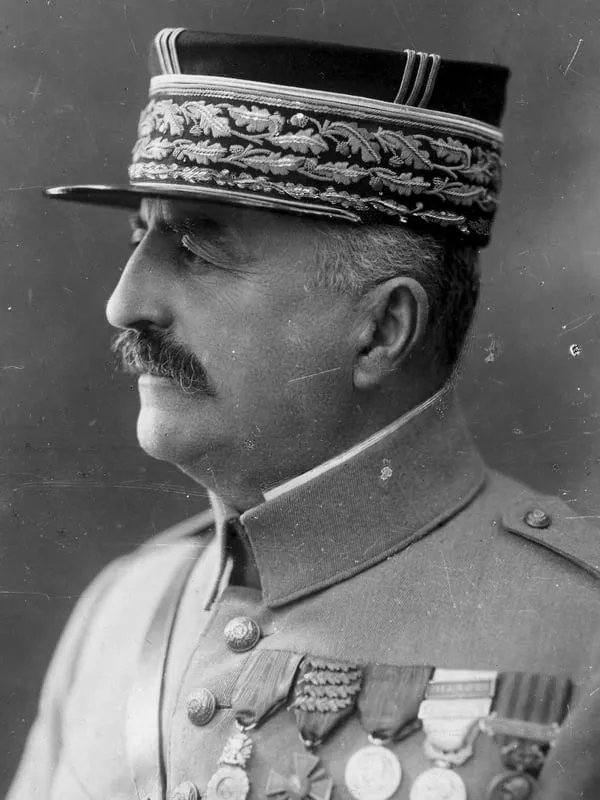
- Born:
- 25 May 1856, Mostaganem (Algeria)
- Died:
- 8 July 1942, Saint-Amancet (France)
- Author:
- Natalia
- Photo:
- Henri Manuel, domena publiczna, Wikimedia Commons

Louis Franchet d’Espèrey was one of the few French generals to emerge from the First World War with a reputation as a victor. In 1914 he led the Fifth Army at the Battle of the Marne, and in 1918, as Commander-in-Chief of the Allied Armies in Macedonia, he broke through the Bulgarian front and knocked Bulgaria out of the war, the first of the Central Powers to fall. For the history of Central Europe, however, what he did next matters more. In November 1918 in Belgrade he received a delegation from revolutionary Hungary, treated the country as a defeated state and dictated the terms of a military convention that drew a demarcation line and opened the way for the Allied armies, the Romanians among them, into Transylvania, the Banat and the Bačka. The Hungarian–Romanian War is dated from that day. In 1919–1920 he commanded the Allied armies from Constantinople to Odessa, and his command became one of the instruments with which France built the post-war order in Central Europe and the Balkans.
A colonial soldier
He was born on 25 May 1856 in Mostaganem in Algeria, the son of an officer of the Chasseurs d’Afrique, into a Catholic family of monarchist sympathies. In 1876 he graduated from the military academy of Saint-Cyr and was posted to a regiment of Algerian tirailleurs. He fought in Tunisia in 1881, passed through the École supérieure de guerre, went to Tonkin in 1885 and in 1900 took part in the expedition against the Boxer Rebellion in China. He then commanded regiments in France. He became a brigadier general in 1908 and a major general (général de division) in 1912. In 1912–1913 he commanded the troops in western Morocco under General Hubert Lyautey. In November 1913 he took over I Corps in Lille, with which he went to war. He was one of the few senior French officers who knew the Balkans and took an interest in them.
The Marne and the Western Front
In August 1914 I Corps formed part of General Charles Lanrezac’s Fifth Army. At Charleroi Franchet d’Espèrey asked in vain for permission to counter-attack, but he got his chance a week later at Guise. On 29 August he personally led an attack that threw the German Guard back across the Oise. It was the only successful large-scale French counter-attack of the Great Retreat. On 3 September the Commander-in-Chief, General Joseph Joffre, dismissed Lanrezac and gave the Fifth Army to Franchet d’Espèrey. The new commander made an electrifying impression on the staff; within a few weeks he had replaced most of his corps and divisional commanders and repaired the relations with the British that his predecessor had spoiled. According to British historians, his proposal for a joint attack with the British Expeditionary Force became one of the foundations of the order for the counter-offensive. In the Battle of the Marne the Fifth Army pushed into the gap between the German armies and helped bring about the German retreat, and on 13 September it entered Reims. Joffre wrote in his memoirs that it was Franchet d’Espèrey who had made the victory on the Marne possible. British soldiers, struck by his ceaseless energy, nicknamed him “Desperate Frankie”.
Over the following years he held commands on the Western Front: from 1916 Army Group East and from the end of that year Army Group North. As early as the turn of 1914 and 1915 he had put forward a plan for an expedition through Salonika and Serbia to the Danube, intended to detach Germany’s allies from her, but Joffre was unwilling to weaken the front in France. In May 1918 the Germans broke through on his sector, on the Aisne, and within a few days reached the Marne. Paris demanded that those responsible be punished, and Franchet d’Espèrey lost his army group.
Salonika and Belgrade
The general had too distinguished a record simply to be removed. In June 1918 he took command in Salonika of the Allied armies there: French, Serbian, Greek, British and Italian. He adopted a Serbian plan to strike in the highest mountains on the front and pushed it through with the Allies. On 15 September the Serbs and French took the ridge of Dobro Pole, and the Bulgarian defence began to crumble. On 29 September the general signed an armistice with the Bulgarian delegates in Salonika. Bulgaria’s collapse was one of the reasons why the German Supreme Army Command soon demanded an armistice. The Allied armies marched north, and on 1 November the Serbs returned to Belgrade.
It was there, on 7 November 1918, that Franchet d’Espèrey received a delegation from the Hungarian prime minister Mihály Károlyi, who after the Aster Revolution hoped that a democratic Hungary would be treated leniently. The Frenchman made it clear to the delegates that he regarded their country as defeated. According to Hungarian accounts, he said that he held Hungary’s fate in his hand, and that he had only to open it for her neighbours to fall upon her. He set out terms which, after consultation with Paris, became the basis of the military convention signed in Belgrade on 13 November by his deputies, General Paul Henrys and Voivode Živojin Mišić. The convention drew a demarcation line running through Transylvania and along the Mureș, behind which the Hungarian army had to withdraw. Budapest saw it as a humiliation. At the same time Franchet d’Espèrey was preparing the entry into Romania: on 10 November French battalions of General Henri Berthelot’s army crossed the Danube, and Romania re-entered the war on the Allied side. He also planned a march through Hungary on Germany, but was overtaken by the armistice at Compiègne.
In the weeks that followed his command had to decide how far the Allied armies could advance. When in December Berthelot allowed the Romanians to cross the Mureș, Franchet d’Espèrey, according to Hungarian studies, was displeased, but the Romanians took Cluj all the same. In March 1919 the note in which the head of the Allied military mission in Budapest, Lieutenant Colonel Fernand Vix, handed Károlyi a demand to pull Hungarian troops back behind a further line brought down his government and allowed Béla Kun’s communists to take power. According to some historians, French generals, Foch, Berthelot and Franchet d’Espèrey among them, then argued for decisive action against the Hungarian Soviet Republic and supported the Romanian advance which ended in the occupation of Budapest in August 1919.
Constantinople and Odessa
In February 1919 the headquarters of the Allied Armies in the East moved to Constantinople. On 8 February the general made a ceremonial entry into the occupied Ottoman capital. Recent research regards the story that he rode in on a white horse in imitation of Sultan Mehmed II as a legend, but for the Turks the victors’ parade through their capital was a humiliation. He also commanded the French troops sent to southern Russia to support the Whites in the civil war that had broken out after the October Revolution. In the spring of 1919, amid mutinies among French sailors in the Black Sea and under pressure from the Red Army, they had to evacuate Odessa. Disputes with the British over control of the occupation of Constantinople dragged on for months. He gave up his command in 1920.
Marshal
On 19 February 1921 he received the baton of a Marshal of France, and from the King of the Serbs, Croats and Slovenes the title of voivode. From 1923 to 1931 he was inspector general of the troops in North Africa; in 1924 he crossed the Sahara by car, and in 1930 he represented France at the coronation of Emperor Haile Selassie I of Ethiopia. On 15 November 1934 he was elected to the Académie française. He belonged to the circle of marshals who between the wars embodied the authority of the French army, then regarded as the strongest in Europe, and who, together with Ferdinand Foch and Philippe Pétain, personified the victory of 1918. He was a monarchist and a nationalist, and according to the account of one far-right activist he gave money in the 1930s to secret anti-communist organisations.
The order he had helped to build in 1918 began to fall apart before his eyes. France, which after the war had concluded alliances with Poland and with the states of the Little Entente – Romania, Czechoslovakia and Yugoslavia – proved unable to defend them. In 1938 she sacrificed Czechoslovakia at Munich, and in 1940, after France’s defeat, Romania was forced to cede to Hungary northern Transylvania, the very land over which the Hungarian–Romanian War had begun in November 1918. The old marshal lived to see the fall of France in June 1940. He died on 8 July 1942 at Saint-Amancet in the Tarn department, in the part of the country that was not yet occupied. In 1947 his remains were transferred to Les Invalides.
Assessment
Historians value Franchet d’Espèrey above all for two moments: September 1914 and September 1918. British writers stress the galvanising effect he had on a demoralised Fifth Army and his part in preparing the counter-offensive on the Marne. Credit for the victory in Macedonia, however, is shared among several men: the plan to strike in the mountains was Serbian, and the preparations had been begun by his predecessor, General Guillaumat. Franchet d’Espèrey had the courage to adopt the plan, push it through and carry it out with determination. Against him stand the defeat on the Aisne in May 1918 and a harshness towards subordinates and allies that did not make cooperation easy.
In Hungary he is remembered differently from France or Serbia, where he is regarded as a liberator. To Hungarians he was the general who humiliated Károlyi in Belgrade and opened the lands of the Kingdom to their neighbours, and the Belgrade convention became the first link in the chain that led to Trianon and twenty years of Hungarian revisionism. Historians point out that the general was carrying out the policy of Paris and that the borders were drawn by politicians at the peace conference, but his hard line in November 1918 captured well the spirit in which the victors rebuilt Central Europe.
Sources
Mentioned in battles
(01)Often appears with
People who appear in the same events.