Romania
Ferdinand I of Romania
King of Romania (1914–1927), nominal Commander-in-Chief of the Romanian Army in 1916–1918
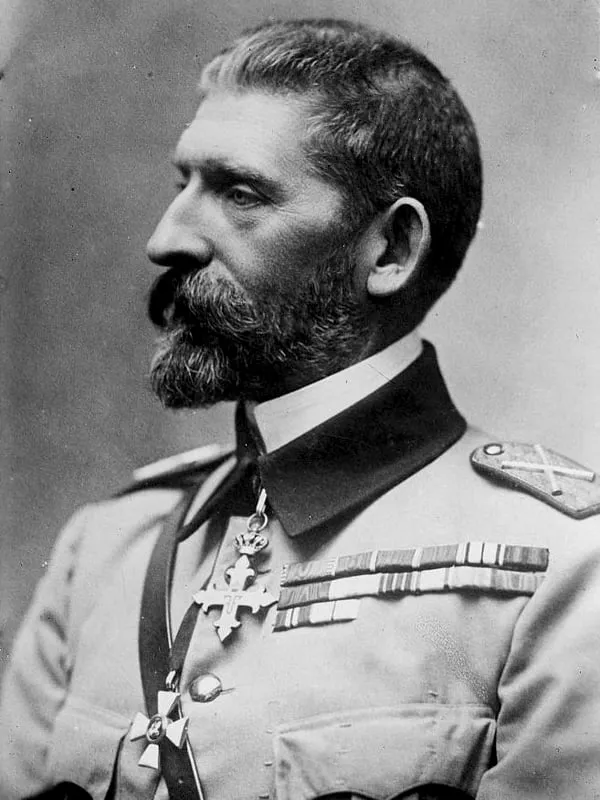
- Born:
- 24 August 1865, Sigmaringen (Prussia)
- Died:
- 20 July 1927, Sinaia
- Author:
- Natalia
- Photo:
- Bain News Service, domena publiczna, Wikimedia Commons

Ferdinand I was the second King of Romania and the monarch under whose reign the country doubled its territory. A German prince of the Catholic line of the Hohenzollerns, brought up in Swabia, in 1916 he signed the declaration of war on Austria-Hungary in the knowledge that it meant war with Germany, the homeland of his dynasty. He survived defeat, the occupation of his capital, the collapse of Romania’s Russian ally and a humiliating peace that he never ratified, and in November 1918 he led Romania back into the camp of the victors. His troops occupied Transylvania and in 1919, in the war with Hungary, reached Budapest. Romanians called him “the Loyal” and “the Unifier” (Întregitorul). Yet the borders of Greater Romania that took shape during his reign became one of the most enduring sources of conflict in Central Europe: Hungary never accepted the loss of Transylvania, nor Soviet Russia the loss of Bessarabia, and in 1940 both debts were called in.
Youth and the road to the throne
He was born on 24 August 1865 in Sigmaringen, the second son of Prince Leopold of Hohenzollern-Sigmaringen and the Portuguese Infanta Antónia. His father entered history unwittingly: in 1870 his candidacy for the Spanish throne served as the pretext for the Franco-Prussian War. Ferdinand’s uncle, Carol I, had reigned in Romania since 1866, first as prince and from 1881 as king, but had no surviving children. Ferdinand’s father renounced his rights to the Romanian throne in 1880, and his elder brother Wilhelm did so in 1886. Thus the younger son, who reportedly had no wish for it at all, became heir to the throne of a foreign, Orthodox country. He studied at Tübingen and Leipzig, and in 1889, having been recognised by the parliament in Bucharest as heir to the throne, he settled permanently in Romania. He kept his Catholic faith, but his children had to be brought up Orthodox.
The early years were not easy. In 1891 he fell in love with one of the Queen’s ladies-in-waiting, the poet Elena Văcărescu. King Carol deemed it impossible for the heir to marry a subject, put an end to the romance and sent his nephew on a tour of Europe in search of a suitable wife. On 10 January 1893, at Sigmaringen, Ferdinand married Marie, Princess of Edinburgh, a granddaughter of Britain’s Queen Victoria and of Tsar Alexander II. They had six children: the future King Carol II; Elisabeth, later Queen of Greece; Maria, later Queen of Yugoslavia; Nicholas; Ileana; and Mircea, who died in childhood. The marriage was not a happy one. Beautiful, energetic and ambitious, Marie – who formed a close friendship with Prince Barbu Știrbey – soon overshadowed her husband. In 1897 Ferdinand nearly died of typhoid fever.
The heir to the throne inspired little enthusiasm. He was educated and well read, knew several languages and had a passion for botany, but in public he was awkward, spoke clumsily and found decisions hard to make. Carol I kept him away from politics. Ferdinand pursued a career in the army, and in the summer of 1913, during the Second Balkan War, he was formally in command of the Romanian forces that advanced deep into Bulgaria almost without a fight. The Peace of Bucharest of August 1913 then gave Romania Southern Dobruja.
Neutrality and war
When the Great War broke out in 1914, the old King Carol wanted to remain faithful to the secret alliance with Germany and Austria-Hungary concluded in 1883. On 3 August 1914, however, a Crown Council at Sinaia came out in favour of neutrality. On 10 October Carol I died and Ferdinand became king. Taking his oath before parliament, he declared that he would reign as a good Romanian. The change on the throne removed the main obstacle to a rapprochement with the Entente. The new king did not feel bound by his uncle’s commitments, and Queen Marie openly sympathised with Britain and Russia. Foreign policy was directed by the Prime Minister, Ion I.C. Brătianu, leader of the Liberals, with whom Ferdinand worked from then on almost until the end of his life. For two years Brătianu bargained with both sides over the price of Romania’s entry into the war, and that price was above all Transylvania, a Hungarian province with a Romanian majority.
In the summer of 1916, after the successes of Russia’s Brusilov offensive, Brătianu signed a secret treaty with the Entente which promised Romania Transylvania, the Banat as far as the Tisza and most of Bukovina. On 27 August Ferdinand convened a Crown Council. When the Germanophile Petre P. Carp reminded him that no Hohenzollern had ever yet been defeated, the king is said to have replied that he had already defeated one: himself. That evening Romania declared war on Austria-Hungary. In Germany this was regarded as treachery. Kaiser Wilhelm II was shaken and, according to widely circulated accounts, ordered Ferdinand’s name to be struck from the register of the House of Hohenzollern. The family in Sigmaringen broke off contact with him.
The 1916 campaign ended in disaster. Romania lost Wallachia and Bucharest, and the king, the government and parliament took refuge in Iași. Ferdinand then appointed General Constantin Prezan as chief of staff. When, after the February Revolution, Russian soldiers in Moldavia began forming soviets and fraternising with the enemy, the king made the most important political gesture of his reign. On 5 April 1917 (23 March by the Julian calendar then in use in Romania) he promised the soldiers that after the war they would receive the land they were fighting for, and the vote. That summer the rebuilt Romanian army won the battles of Mărăști and Mărășești. The October Revolution, however, undid everything. The Russian army disintegrated, and Romania, left on its own, had to conclude an armistice and in May 1918 sign the Peace of Bucharest with the Central Powers. It was negotiated by the government of Alexandru Marghiloman, whom the Germans trusted. Parliament approved the treaty, but Ferdinand never signed or promulgated it. This refusal – whether deliberate or the product of his characteristic procrastination – proved invaluable after the war. In the same months Romania annexed Bessarabia, whose National Council (Sfatul Țării) in Chișinău voted for union in April 1918.
November 1918
In the autumn of 1918 the Central Powers were collapsing. At the demand of Entente representatives, Ferdinand dismissed Marghiloman and appointed a caretaker government under General Constantin Coandă. On 10 November, as the French troops of General Louis Franchet d’Espèrey were crossing the Danube, Romania re-entered the war, and in a proclamation the king called on the nation to stand alongside the Allies. The next day the Germans signed the Armistice of Compiègne. Romania’s return to the war mattered above all politically: it allowed Bucharest to insist that at the peace conference the country be treated as an ally entitled to everything promised in 1916.
In mid-November, when in Belgrade Hungary signed a military convention with the Allies, the first Romanian units crossed the passes of the Eastern Carpathians and distributed the king’s proclamations in Transylvania. On 1 December 1918 Ferdinand and Marie rode on horseback into liberated Bucharest. That same day an assembly of Transylvanian Romanians at Alba Iulia proclaimed the union of Transylvania, the Banat, Crișana and Maramureș with Romania. A congress in Bukovina had already voted for union, and in December the National Council of Bessarabia also proclaimed unconditional union. At the end of December the king signed decrees ratifying these unions. The state he ruled was twice the size it had been in 1914.
War with Hungary and the treaties
The new borders still had to be defended. When in March 1919 the communists of Béla Kun took power in Budapest, Romania found itself between two soviet states: Hungary to the west and Bolshevik Russia to the east. In April the Romanian army routed the Hungarian forces and reached the Tisza; in July it repulsed a Hungarian counter-offensive, and at the beginning of August it entered Budapest. The Soviet Republic fell, and for several months the Romanians occupied a large part of Hungary, carrying off machinery, rolling stock and supplies despite the protests of the Great Powers. The king visited the troops, and the victory over Hungary strengthened his prestige. At the Paris Peace Conference Romania was represented by Brătianu, who waged a hard dispute with the Great Powers over the Banat and over the minorities treaty. In the end the treaties of 1919–1920, chief among them Trianon, confirmed the annexation of Transylvania and Bukovina, while Bessarabia was recognised as Romanian in a separate treaty of 1920 that Soviet Russia never accepted.
The promises made at Iași were kept. The first elections under universal male suffrage were held in November 1919, and in 1918–1921 a land reform was carried out – one of the most radical in Europe at the time – which broke up the great estates, including those of Hungarian landowners in Transylvania. On 15 October 1922 Ferdinand and Marie were solemnly crowned rulers of Greater Romania in the newly built cathedral at Alba Iulia. In 1923 a new constitution was adopted which fixed the country’s system of government for years to come.
The foreign policy of Greater Romania
Ferdinand’s Romania was a state that had won the war and wanted only to keep what it had gained. Yet almost all its neighbours were hostile: Hungary, which demanded revision of Trianon; Bulgaria, which had not accepted the loss of Southern Dobruja; and Soviet Russia, which did not recognise the loss of Bessarabia. Bucharest therefore sought allies among states with similar problems. In March 1921 Romania concluded a defensive alliance with Poland directed against Soviet Russia. This Polish–Romanian alliance remained one of the pillars of both countries’ policy throughout the interwar years; in Warsaw its patron was the Chief of State, Józef Piłsudski. In the same year Romania concluded agreements with Czechoslovakia and the Kingdom of Serbs, Croats and Slovenes, forming with them the Little Entente, aimed above all at Hungarian revisionism and at any return of the Habsburgs. Dynastic ties completed the arrangement: Ferdinand’s daughter Elisabeth married the Greek heir to the throne, the future King George II, and in 1922 his daughter Maria married King Alexander I, ruler of the Kingdom of Serbs, Croats and Slovenes.
Dynastic crisis and death
The last years of the reign were dominated by Brătianu and his Liberals, and by trouble with the heir to the throne. As early as 1918 Prince Carol had deserted his garrison without leave and secretly married Zizi Lambrino in Odessa. The marriage was annulled and Carol married Princess Helen of Greece, but in the mid-1920s he took up with Elena Lupescu. In December 1925 he renounced his rights to the throne once again, and at the beginning of 1926 parliament recognised his young son Michael as heir. By then Ferdinand was suffering from bowel cancer. He died at Sinaia on 20 July 1927 and was buried at Curtea de Argeș, next to his uncle. The throne passed to the five-year-old Michael under a regency council, and four months later Brătianu died as well.
Assessment and legacy
In his lifetime Ferdinand was a figure held in little regard. He was seen as a weak monarch, steered by his wife, by Brătianu and by Știrbey. Critics point out that as Commander-in-Chief he bore formal responsibility for the disaster of 1916 and for the indecision that saw the army lurch between Transylvania and the Danube. Modern historians judge him more kindly. They stress that at critical moments he took decisions that required courage: in 1916 he turned against his own family and the country of his birth, in 1917 he promised the peasants land, and in 1918 he refused to sign the Peace of Bucharest, which allowed Romania to return to the camp of the victors. Most scholars agree that his greatest strength was tenacity rather than initiative: he did not direct events, but he would not be broken.
The state he left behind did not survive in that shape for even twenty years. His son Carol II returned to the country in 1930 and took the throne from Michael, and in 1938 he established a royal dictatorship. In the summer of 1940, after the defeat of France, on which the entire policy of Greater Romania had rested, the country was left without protectors. Within three months it ceded Bessarabia and Northern Bukovina to the Soviet Union, Northern Transylvania to Hungary under the Second Vienna Award, and Southern Dobruja to Bulgaria. Carol II abdicated and power passed to General Ion Antonescu, who in June 1941 led Romania into war against the Soviet Union at Hitler’s side in order to recover Bessarabia. Ferdinand’s grandson, King Michael, overthrew Antonescu in August 1944 and took the country over to the Allied side. Romania then regained Northern Transylvania, but not Bessarabia. Thus the borders that Ferdinand had united in 1918–1920 became one of the stakes of the Second World War in Eastern Europe.