Romania
Michael I of Romania
King of Romania (1927–1930 and 1940–1947)
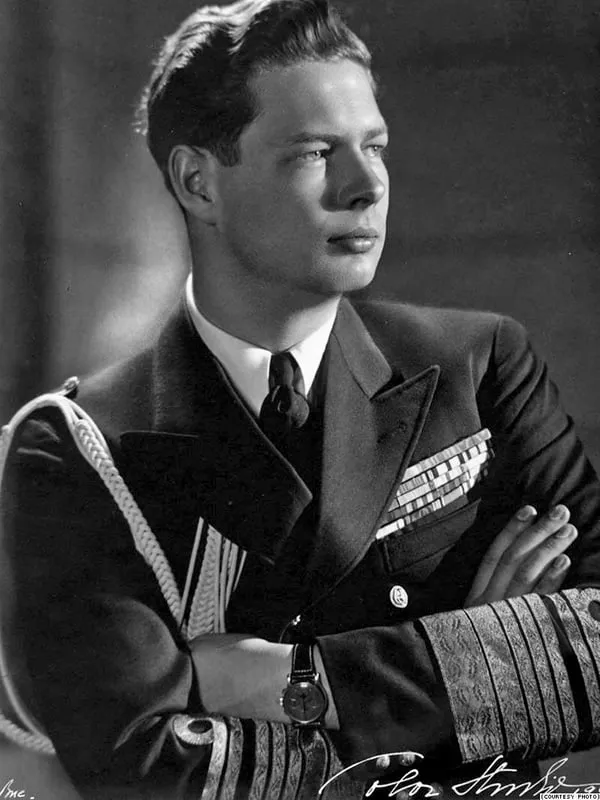
- Born:
- 25 October 1921, Sinaia (Romania)
- Died:
- 5 December 2017, Aubonne (Switzerland)
- Author:
- Natalia
- Photo:
- Jozef Trylinski, domena publiczna, Wikimedia Commons

Michael I was the last King of Romania and one of the few monarchs to have occupied a throne twice. He first became king as a five-year-old child under a regency, and lost the crown to his own father. He took it up a second time in September 1940, when Carol II was forced to abdicate and real power passed to General Ion Antonescu. For four years he was the figurehead of a dictatorship that led Romania into war against the Soviet Union alongside Adolf Hitler. On 23 August 1944 he had Antonescu arrested and brought his country over to the Allied side. This did not protect him from communist rule: on the last day of 1947 the communists forced him to abdicate and leave the country. He spent more than forty years in exile and was able to return freely to Romania only at the end of the twentieth century. He died in 2017, one of the last surviving heads of state of the Second World War era.
A childhood between two crowns
He was born on 25 October 1921 in the Foișor Castle at Sinaia, part of the royal summer residence beside Peleș Castle. He was the only son of Crown Prince Carol and the Greek princess Helen, daughter of King Constantine I. On his father’s side he was a grandson of King Ferdinand I and Queen Marie; on his mother’s side he was related to almost every royal house in Europe.
His parents’ marriage soon fell apart. Carol took up with Magda Lupescu, went abroad with her and at the end of 1925 renounced his right to the throne; on 4 January 1926 parliament recognised the four-year-old Michael as heir. When Ferdinand died on 20 July 1927, Michael became king. A regency council ruled in his name, made up of his uncle, Prince Nicholas, Patriarch Miron and the president of the Court of Cassation. The regency proved weak, and during the Great Depression some politicians resolved to bring Carol back. On 6 June 1930 he flew into Bucharest, and on 8 June parliament proclaimed him king. The eight-year-old Michael became heir to the throne once more, with a title invented for him: Grand Voivode of Alba Iulia.
His father kept his mother away from him. Helen, whom Carol had divorced back in 1928, had to leave for Florence and could see her son for only a few weeks a year. Carol set up a special school for Michael in the palace, where from 1932 he was taught alongside boys of his own age from different social backgrounds, and brought him up far from politics. In November 1939, on turning eighteen, the prince took his seat in the Senate by right under the constitution.
A king without power
The summer of 1940 cost Romania Bessarabia and northern Bukovina, ceded to the USSR (the ultimatum of 26 June), and then northern Transylvania, ceded to Hungary (the Second Vienna Award of 30 August). Crowds in the streets demanded that Carol go, and General Antonescu, to whom the king had handed full powers on 5 September, insisted on his abdication. On the morning of 6 September 1940 Carol II passed the throne to his son and left the country. Michael was eighteen. He could not swear an oath on the constitution or before parliament, because the constitution had been suspended and parliament dissolved. Instead he swore loyalty to the nation before Antonescu, the patriarch and the president of the Court of Cassation, and that same day Patriarch Nicodim anointed him and crowned him with the steel crown. The new king’s first decrees made Antonescu “Leader of the State” (Conducător) and confined the monarch to a ceremonial role. Michael never saw his father again. On 14 September his mother returned to Bucharest; from then on, as Queen Mother Helen, she was his closest adviser.
Antonescu at first governed together with the fascist Iron Guard and then, after crushing its rebellion in January 1941, alone, as a military dictator. He did not inform the king of his most important decisions: Michael learned that Romania had entered the war against the Soviet Union on 22 June 1941 only after the event. Formally, he had to lend his name to the government’s policy. It was he who signed the decree of August 1941 that, after the recovery of Bessarabia, made Antonescu a Marshal of Romania, and together with his mother he received German officers passing through Bucharest.
As the regime’s crimes came to light, the king and the Queen Mother tried to restrain them. Michael protested to the dictator after the massacre of Jews in Odessa in October 1941 and interceded on behalf of Wilhelm Filderman, the president of the Romanian Jewish community, who had been deported to Transnistria. Helen, alerted by the chief rabbi, intervened together with Patriarch Nicodim with Antonescu and with the Reich’s envoy, Manfred von Killinger. In the autumn of 1942 her opposition was among the voices that persuaded the dictator to postpone the deportation of the Jews of the Old Kingdom to the Bełżec extermination camp, which had been prepared together with the Germans. In 1993 Yad Vashem recognised Helen as Righteous Among the Nations. After the defeat at Stalingrad, where two Romanian armies were destroyed, Michael made it clear in his New Year message for 1943 that he did not support continuing the war on the Axis side, which led to a sharp clash with Antonescu.
23 August 1944
In the spring of 1944 the Red Army reached Romania’s borders, and the dictator, although he was holding talks with the Allies through intermediaries, refused to break with Hitler. A conspiracy formed around the king. His advisers reached an understanding with the National Democratic Bloc, set up in June 1944, which brought together Iuliu Maniu’s National Peasants, the Liberals, the Social Democrats and the Communists, and with some of the generals. On 20 August the Soviet offensive opened on the Moldavian front, which collapsed within days. On 23 August Michael summoned Antonescu to the palace and demanded an immediate ceasefire. When the marshal refused, officers of the palace guard arrested him together with the foreign minister, Mihai Antonescu. That evening the king announced on the radio that Romania was ceasing hostilities against the United Nations and accepting the armistice terms, and appointed General Constantin Sănătescu prime minister.
The Germans tried to reverse the coup: the Luftwaffe bombed Bucharest, including the area around the palace, and Wehrmacht units attacked the capital. On 25 August Romania declared war on Germany. The coup hastened the collapse of the German front in the Balkans, but it did not stop the Red Army, which occupied the country as a conqueror: some 130,000 Romanian soldiers were taken prisoner after the ceasefire. The armistice signed in Moscow on the night of 12–13 September 1944 placed the country under the control of a Soviet-run Allied Control Commission, confirmed the Soviet gains of 1940 and annulled the Vienna Award. The Romanian army fought on against Germany and Hungary until the end of the war, in Transylvania, Hungary and Czechoslovakia, losing, according to Romanian figures, nearly 170,000 killed, wounded and missing. The Communists, to whom the Sănătescu government had entrusted custody of Antonescu, handed him over to the Soviets.
Between Moscow and the West
In a Romania occupied by the Red Army the Communists rapidly gained the upper hand. In February 1945 the Soviet deputy foreign minister, Andrei Vyshinsky, arrived in Bucharest and by threats forced the king to appoint, on 6 March, a Communist-dominated government under Petru Groza. Paradoxically, that same year Michael received the highest decorations of both sides of the emerging Cold War. In July 1945 Joseph Stalin awarded him the Order of Victory for “the courageous act of a decisive turn in Romania’s policy”, and President Harry Truman conferred on him the American Legion of Merit in its highest degree.
After the Potsdam Conference, counting on British and American support, the king demanded Groza’s resignation, and when the prime minister refused, he declined to sign government decrees from August 1945 to January 1946. This “royal strike” ended in failure: the Western powers recognised the government once two opposition ministers had been co-opted into it. The Communists rigged the elections of November 1946. Michael could neither pardon Antonescu, who was sentenced to death and shot on 1 June 1946, nor save Maniu, convicted in a show trial in 1947, because every act of his required a minister’s countersignature.
In November 1947 he travelled to London for the wedding of his cousin, Princess Elizabeth, to Prince Philip. There he met Princess Anne of Bourbon-Parma and proposed to her. Against the advice of some of those around him, he returned home. On 30 December 1947 Groza and the Communist leader Gheorghe Gheorghiu-Dej summoned him from Sinaia to Bucharest and, in a palace surrounded by troops loyal to the Communists, presented him with a ready-made instrument of abdication. Accounts of what he was threatened with differ and have changed over the years. Michael himself spoke at first of the threat of arrests and bloodshed, and after 1990 of a threat to shoot a thousand imprisoned students. He signed, and the Romanian People’s Republic was proclaimed that same day. On 3 January 1948 he was forced to leave, and in March he declared that the abdication had been extorted and was void. He was the last monarch behind the Iron Curtain to lose his throne.
Exile
On 10 June 1948 he married Anne in Athens. Pope Pius XII refused his Catholic bride a dispensation, because the Orthodox king would not agree to bring up his children in the Catholic faith, which the Romanian constitution forbade. The couple had five daughters, the youngest of whom, Maria, married a Pole in 1995. The communist authorities stripped Michael of his citizenship and property. The family lived in Italy, in Switzerland and in England, where they ran a farm in Hertfordshire, and from 1956 for several decades at Versoix on Lake Geneva. The former king earned his living as a test pilot, a stockbroker and a businessman. He kept in touch with the émigré community and from time to time addressed his compatriots through the Romanian service of Radio Free Europe.
Return
After the fall of Nicolae Ceaușescu in December 1989 Michael tried to return home. On 25 December 1990 he flew into Bucharest on a twenty-four-hour visa, but the police stopped his car on the way to his ancestors’ graves at Curtea de Argeș and sent him back to the airport. At Easter 1992 the authorities allowed him to visit. Hundreds of thousands of people, by some accounts more than a million, came out onto the streets of Bucharest, which alarmed President Ion Iliescu, who for the next few years kept him out of the country. In 1997, after the victory of Emil Constantinescu, Michael regained his citizenship. That year and again in 2002 he toured Western capitals, lobbying for Romania’s admission to NATO and the European Union. Part of his property was returned to him, including Peleș Castle, and parliament granted him, as a former head of state, a residence in Bucharest.
He did not campaign for the restoration of the monarchy, repeating that it was for Romanians to decide their form of government. On 25 October 2011, his ninetieth birthday, he addressed a joint session of both houses of parliament. His wife died in 2016, and he himself, suffering from cancer, withdrew from public life. He died on 5 December 2017 at his residence in Aubonne, Switzerland. He was buried with state honours on 16 December in the new royal mausoleum beside the cathedral at Curtea de Argeș, and hundreds of thousands of people attended the funeral.
Significance
In the history of the Second World War Michael is a man of two dates. On 6 September 1940 he took the throne as an instrument of Antonescu, who needed the legitimacy of the monarchy to bind Romania to Germany. On 23 August 1944 he turned that same legitimacy against the dictator: the coup, in which the twenty-two-year-old king played the leading role, tore one of the most important members of the Axis bloc, and its supplier of oil, out of the alliance, and many historians regard it as one of the turning points of the war in south-eastern Europe. Yet Romania did not escape the fate of the countries occupied by the Red Army, and its last king, decorated by both Stalin and Truman, became the symbol of a country that changed sides too late to save its independence, but early enough to shorten the war.
Sources
Mentioned in battles
(02)Often appears with
People who appear in the same events.