Japan
Hatazō Adachi
Chief of staff of the North China Area Army (1941–1942), commander of the 18th Army in New Guinea (1942–1945)
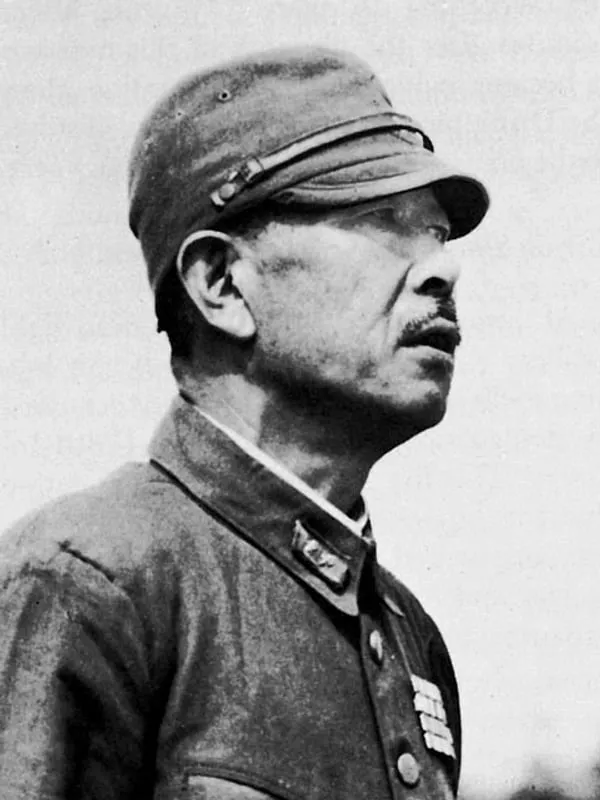
- Born:
- 17 June 1890, Tokyo (Japan)
- Died:
- 10 September 1947, Rabaul (Papua New Guinea)
- Author:
- Natalia
- Photo:
- Center of Military History, United States Army, domena publiczna, Wikimedia Commons

For almost three years Hatazō Adachi commanded the Japanese 18th Army in New Guinea, on one of the harshest fronts of the Second World War. His soldiers fought in jungle and mountains, without command of the air or the sea, and more and more often without food or medicine. More of them died of hunger and disease than from bullets. Adachi lost all his campaigns: for Lae and Salamaua, for the Huon Peninsula, on the Driniumor River. Yet he came through the war at the head of an army that did not fall apart despite its isolation, and he surrendered to the Australians only on the Emperor’s orders. Sentenced to life imprisonment for crimes committed by his subordinates, he took his own life two years after the war, once the last verdicts in the cases of his officers had been delivered. Japanese military historians count him among the few generals who behaved with dignity in defeat. To the Allies he was the commander of an army that killed prisoners.
From an officer’s family
Adachi was born on 17 June 1890, the fourth son of Matsutarō Adachi, a teacher at military schools. Japanese sources give his birthplace as Tokyo, English-language ones as Ishikawa Prefecture, where the family came from. The name Hatazō is written with the characters for the number 23, in memory of the 23rd year of the Meiji era, in which he was born. Two of his elder brothers also became generals. The family could not afford a middle school, so the boy won a place at the free cadet school in Tokyo and then at the Military Academy, from which he graduated in 1910. He served in the 1st Guards Division, graduated from the Army War College in 1922, and in the following years worked on the General Staff and as an instructor. Unlike many of his contemporaries he kept away from the political factions that were tearing the Japanese army apart in the 1930s.
Manchuria and China
In 1934 Adachi, by then a colonel, took command of the railway guard units of the Kwantung Army in Manchuria, and in 1935 of the transport section of the General Staff. In December 1936 he was given the 12th Infantry Regiment and led it in the Battle of Shanghai in 1937. He fought in the front line, and in September a mortar bomb permanently crippled his right leg. In 1938 he became a major general and commander of the 26th Infantry Brigade, in August 1940 a lieutenant general and commander of the 37th Division, and in November 1941 chief of staff of the North China Area Army. That army was then waging pacification campaigns against the Chinese Communists which the Chinese called the “Three Alls” policy: kill all, burn all, loot all.
Among the troops he earned a reputation as a “soldier’s general”, though in a peculiarly Japanese sense. He did not improve their living conditions; he shared them. At gatherings with his officers he drank with them late into the night, so that they could speak freely without losing face.
The 18th Army and the struggle for New Guinea
On 9 November 1942 Adachi became commander of the new 18th Army, subordinate to the Eighth Area Army of General Hitoshi Imamura at Rabaul. He took over responsibility for New Guinea at the moment when the Japanese advance on Port Moresby had already collapsed and the garrisons on the coast were holding out at Buna and Gona. He agreed to the withdrawal of the survivors from Sanananda only on 13 January 1943 (the end of the fighting at Sanananda). At the same time he sent to Lae a detachment that was to capture the Australian airfield at Wau, but the attack failed.
At the beginning of March 1943 Adachi and his staff sailed in the destroyer Tokitsukaze in a convoy carrying the main body of the 51st Division from Rabaul to Lae. In the Battle of the Bismarck Sea Allied aircraft sank all eight transports and four destroyers, his ship among them. The general was rescued, but only a small part of the troops reached Lae. From then on his army was supplied mainly by barges and submarines.
In the summer of 1943 Adachi had three divisions scattered over hundreds of kilometres of coast: the 41st at Wewak, the 20th at Madang and the 51st at Salamaua and Lae. Allied pressure on Salamaua convinced him that it was the objective, and he drew battalions there at the expense of Lae. In September the Australians landed from the sea near Lae and from the air at Nadzab, and Adachi ordered Salamaua to be evacuated. Soon the Lae garrison itself had to escape across the Saruwaged Range (the capture of Lae). Adachi correctly judged the importance of the Huon Peninsula and had already sent reinforcements there in August, but after the landing at Finschhafen his 20th Division failed to retake that base. At the end of 1943 the 18th Army was retreating along the coast towards Madang and Wewak, losing heavy equipment and thousands of men on the mountain tracks.
Cut off at Wewak
In January 1944 the Australians found at Sio the Japanese army codebooks abandoned by the 20th Division. From then on the Allies read the 18th Army’s signals. They knew that Adachi expected a landing at Hansa Bay and near Wewak and that Hollandia was defended mainly by rear-echelon services. The headquarters of the Second Area Army ordered him to move forces west, but Adachi delayed. On 22 April 1944 the Americans landed at Hollandia and Aitape, hundreds of kilometres behind him, and more than 50,000 men of the 18th Army were cut off between them and the Australians.
Adachi regarded the order to bypass the Americans through the jungle and join the forces in the western part of the island as a death sentence for the army. Waiting idly at Wewak was no better, because the food there would run out by September at the latest. According to the American official history, he concluded that the only way to obtain supplies, maintain morale and contribute to the war was to attack. On the night of 10–11 July 1944 some 20,000 of his men, including at most 8,000 trained infantry, attacked the American positions on the Driniumor River near Aitape. The Japanese broke the line, but the Americans, who knew the enemy’s intentions from his signals, quickly restored it. Adachi shifted the weight of the attack south, to Afua, and on 25 July went in person to the 41st Division, but his units were melting away through hunger and disease. On 4 August he ordered a withdrawal. The army had lost an estimated 8,000 to 10,000 men and was never again capable of a major offensive.
After the Driniumor Adachi changed his approach. He ordered his men to be conserved and to prepare for a long defence: the soldiers planted gardens and extracted starch from sago palms (PL), and the command took care to keep good relations with the local people, on whom survival depended. From the end of 1944 the Australian 6th Division, in the Aitape–Wewak campaign, pushed the Japanese step by step into the Torricelli and Prince Alexander Mountains, and in May 1945 it took Wewak. In July Adachi believed that his army would perish by September at the latest, and he was preparing for a last fight.
Surrender, trial and death
Instead came the imperial broadcast announcing the surrender. Adachi ordered his men to lay down their arms “in accordance with the great command” of the Emperor. On 13 September 1945, at the airstrip by Cape Wom near Wewak, he handed his sword to the commander of the Australian 6th Division, Major General Horace Robertson, and signed the surrender of the 18th Army. About 13,000 of his soldiers went into captivity. According to frequently cited figures, between over 100,000 and some 140,000 men passed through the army during the war. Most of those who died succumbed to malnutrition and tropical diseases.
Adachi was held as a war crimes suspect in a camp on Muschu Island and then at Rabaul. An Australian military court tried him for crimes committed by troops under his command against prisoners of war, including executions without trial and ill-treatment. Some sources mention an order that encouraged the killing of captured Allied airmen. It was not shown that he had taken part in the crimes himself, but Adachi accepted his responsibility as commander. On 12 July 1947 he was sentenced to life imprisonment. He stayed in the camp until the verdicts in the cases of his officers had been delivered. When the last eight of them were released, he thanked the defence counsel, and on 10 September 1947 he committed suicide in the camp at Rabaul.
He left several letters, among them one to Imamura, with whom he shared a cell, and one to the officers of the 18th Army held in the camp. In them he wrote that more than a hundred thousand young soldiers had died, most of them of malnutrition, that he had demanded of them perseverance beyond the limits of human endurance, and that he had watched them die, “falling like flowers in the wind”. He had then resolved not to return home but to remain in the soil of the southern seas together with them.
Assessment
Adachi is an ambiguous figure. In Japan he is remembered as a commander who shared the fate of his soldiers and bore the consequences of defeat; the writer Fūtarō Yamada regarded his suicide, carried out two years after the war once he had fulfilled his duties towards his subordinates, as a rare example of dignified conduct by a Japanese general. Western historians point out that the same letters bear witness to the cult of death that sent exhausted men into hopeless attacks such as the one on the Driniumor. Strategically Adachi could do little. Without aircraft, ships or supplies, facing an opponent who read his signals, he lost every campaign. Yet on his conscience remain decisions that prolonged his army’s agony, and the crimes against prisoners for which, as commander, he was responsible.
Sources
Commanded in battles
(03)Mentioned in battles
(01)Often appears with
People who appear in the same events.