United States
Robert Eichelberger
Commander of I Corps (1942–1944) and of the Eighth Army (1944–1948) in the South West Pacific and in occupied Japan
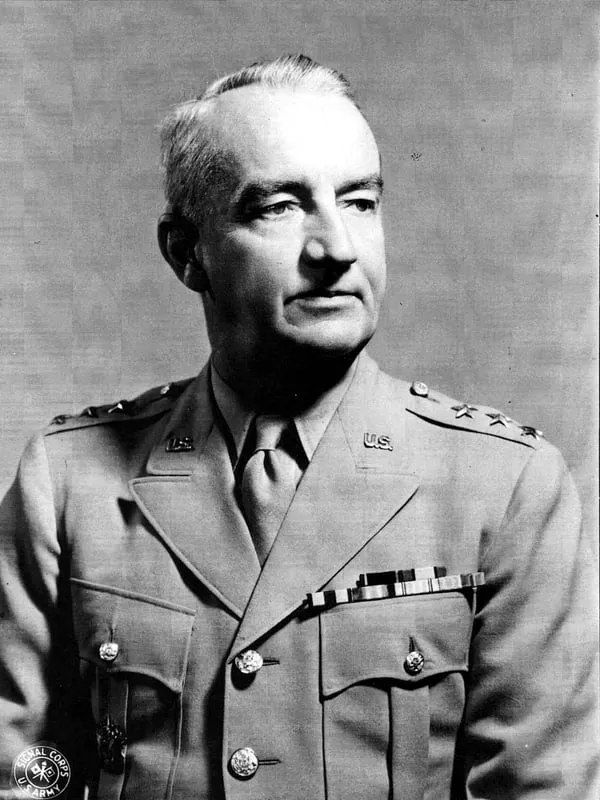
- Born:
- 9 March 1886, Urbana (United States)
- Died:
- 26 September 1961, Asheville (United States)
- Author:
- Natalia
- Photo:
- 1st Lieutenant Gordon A. Stevens, domena publiczna, Wikimedia Commons

Robert Eichelberger was the general whom Douglas MacArthur sent wherever things were going badly. In December 1942 at Buna on New Guinea he took over a broken, sick and demoralised division and led it to victory, at a very high price. In 1944 he restored the momentum of the attack on Biak, and as commander of the Eighth Army he liberated the Philippines from Manila to Mindanao. He liked to be close to his soldiers and walked the front line with his general’s stars on his collar. A long acquaintance bound him to MacArthur, but so did a feeling that the supreme commander was robbing him of credit; with his superior, Walter Krueger, he never found common ground.
From Ohio to Siberia
He was born on 9 March 1886 in Urbana (PL), Ohio, the youngest of the five children of George Eichelberger, a farmer and lawyer. After studying at Ohio State University he got into West Point thanks to a former law partner of his father’s who had become a congressman. He was an average student: in 1909 he graduated 68th out of 103. His class gave the army many generals, among them George Patton and Jacob Devers.
As a young infantry officer he served in Texas, on the Mexican border and in the Panama Canal Zone, where he met his future wife, Emmaline Gudger, daughter of the chief justice of the Canal Zone’s supreme court. When the United States entered the war in 1917 he was posted to the general staff in Washington, under Major General William Graves. When Graves was given a division he took Eichelberger with him, but instead of sailing to France they sailed in August 1918 to Vladivostok. The American Expeditionary Force Siberia was supposed to keep neutral in the Russian Civil War, and Eichelberger, as intelligence officer, sat on the inter-Allied military council. He regarded the White troops of Admiral Alexander Kolchak as murderers. For bravery in clashes with partisans near Novitskaya at the turn of June and July 1919 he received the Distinguished Service Cross. The most important lesson of Siberia, however, was watching the Japanese, who had more troops in Russia than any other intervening power: their discipline and training convinced him that, well led, they would be more dangerous than the Americans.
Adjutant and superintendent
In the 1920s Eichelberger worked in intelligence in the Philippines and China, and since he saw no future for himself in the infantry, in 1925 he transferred to the Adjutant General’s Corps. He graduated from the Command and General Staff School at Fort Leavenworth, where he sat next to the top student of the course, Dwight Eisenhower, and from the Army War College. From 1935 he was Secretary of the General Staff under the Army Chief of Staff, General MacArthur. In 1937 he returned to the infantry, and at the beginning of 1939 he took command of the 30th Infantry Regiment in San Francisco.
In October 1940 he was promoted to brigadier general and, thanks to the intercession of Major General Edwin Watson, President Roosevelt’s aide, appointed Superintendent of West Point. In line with the expectations of the Army Chief of Staff, George Marshall, he modernised the academy’s curriculum: less riding and drill, more field exercises alongside National Guard units, and basic flight training at the new Stewart Field airfield. In July 1941 he was promoted to major general, and after Pearl Harbor he asked for a field command. In March 1942 he took over the 77th Infantry Division and in June I Corps. He was being prepared for the landings in North Africa, but in August 1942, at MacArthur’s request, the corps was sent to Australia.
Buna
Eichelberger flew to Australia in August with 22 staff officers and set up his headquarters at Rockhampton in Queensland. His two divisions, the 32nd and 41st, were training to a syllabus drawn up at home rather than for jungle warfare; he warned MacArthur that they were not ready to meet Japanese veterans. In October he received his third star as a lieutenant general.
His fears came true. In November 1942 Major General Edwin Harding’s 32nd Division attacked Buna and stalled in front of superbly prepared Japanese bunkers amid swamps. The soldiers, sick with malaria and hungry, were losing heart. On 30 November MacArthur summoned Eichelberger to Port Moresby and, as Eichelberger remembered it, ordered him to remove every officer who would not fight and to take Buna or not come back alive. On 1 December Eichelberger flew to Dobodura, and the next day he relieved Harding and the commanders of both attacking task forces. He halted the attacks for two days, improved supply and medical care, and walked the front line himself without removing his stars, so that the soldiers could see that their general shared the risk. When snipers wounded first the new division commander, Brigadier General Albert Waldron, and then, on 16 December, the corps chief of staff Clovis Byers, Eichelberger took personal command of the division. He was then the only American general in that sector and served under the Australian Lieutenant General Edmund Herring, with whom he remained friends for the rest of his life.
The Battle of Buna–Gona went on for weeks. Buna fell on 2 January 1943, and on 13 January Eichelberger took command of all Allied troops at the front. The fighting at Sanananda ended on 22 January. The 32nd Division lost 707 killed and 1,680 wounded, and more than 8,000 men were hospitalised with tropical diseases. The soldiers named the divisional cemetery “Eichelberger Square”, and some officers regarded him as a ruthless “Prussian”. The general received the Distinguished Service Cross, the same award as ten other generals, including some who had never seen the front. MacArthur blocked a recommendation for the Medal of Honor for him, writing to Washington of criticism that his conduct of operations had supposedly aroused.
Hollandia and Biak
When Krueger’s Sixth Army arrived in Australia in February 1943, I Corps was pushed into the background and spent a year on training. The War Department twice wanted to take Eichelberger to Europe as an army commander, but MacArthur refused each time. Only in April 1944 did Eichelberger lead the “Reckless Task Force” in the landing at Hollandia, MacArthur’s biggest leap yet along the coast of New Guinea. The landing took the Japanese by surprise and succeeded, although congested beaches and a fuel dump fire started by a single aircraft destroyed a large part of the ammunition.
In June Krueger sent him to Biak, where the 41st Division had stalled in front of Japanese hidden in caves above the airfields. Eichelberger arrived on 15 June and changed the plan: he first had the hills from which the airfields were being shelled cleared. Major General Horace Fuller, who had been relieved of command of the task force, asked to be relieved altogether. Krueger concluded that Eichelberger had done no better than Fuller; MacArthur awarded him the Silver Star.
Eighth Army in the Philippines
In September 1944 Eichelberger took command of the newly formed Eighth Army. On 26 December it took over Leyte from the Sixth Army, after MacArthur had already announced the end of organised resistance there. Eichelberger recalled bitterly that his soldiers were dying in fighting officially described as mere “mopping up” of the island. On 31 January 1945 he personally accompanied the landing at Nasugbu south of Manila. It was meant to be only a reconnaissance, but when it turned out that the Japanese were not defending the beaches he drove the light 11th Airborne Division on towards the capital, racing Krueger’s Sixth Army advancing from the north. The division was stopped only by the fortifications on the outskirts of Manila.
From the landing on Palawan on 28 February 1945 the Eighth Army liberated the south of the archipelago: Panay, Negros, Cebu, Bohol and the largest of them, Mindanao. According to some sources, within a few weeks it carried out more than a dozen major and over twenty minor landings. The fighting in the southern Philippines went on into the summer, and at the end of June Eichelberger announced the end of organised resistance on Mindanao. From July he also took over Luzon from Krueger. In the plans for the invasion of Japan his army was to take part in the second stage, the landing on Honshu in the spring of 1946.
The occupation of Japan and the post-war years
Japan’s surrender found the Eighth Army in the Philippines. On 30 August 1945 Eichelberger greeted MacArthur at Atsugi airfield, and his army occupied Japan for three years; from 1946 he commanded all the occupation ground forces. For the war and the occupation he received, among other awards, further Distinguished Service Medals and many foreign decorations. He retired on 31 December 1948 as a lieutenant general and settled in Asheville (PL), North Carolina. In 1950 his book “Our Jungle Road to Tokyo” appeared, written with the help of a journalist on the basis of articles for the “Saturday Evening Post”. In 1954 Congress gave him, together with other former army commanders, the rank of general.
In retirement Eichelberger brooded over his grievances. He could not accept that MacArthur and his communiqués had claimed credit for the successes of his troops, he never forgave Krueger or MacArthur’s chief of staff, Richard Sutherland, and the bitterness of Harding and Fuller, relieved on his orders, weighed on him to the end. He gave his papers to Duke University with a view to a book that was to destroy the MacArthur myth; he never wrote it. He died on 26 September 1961 in Asheville, after an operation, and was buried at Arlington National Cemetery. His letters to his wife were published in 1972 as “Dear Miss Em”; written in the heat of the moment, they reveal the inner workings of MacArthur’s command and are today one of the important sources for the history of the war in the South West Pacific. Historians rate him as one of the ablest American commanders of the Pacific war: tough, brave and able to put a broken force back on its feet, even though Buna cost his division very dearly.
Sources
Commanded in battles
(04)Mentioned in battles
(02)Often appears with
People who appear in the same events.