Netherlands
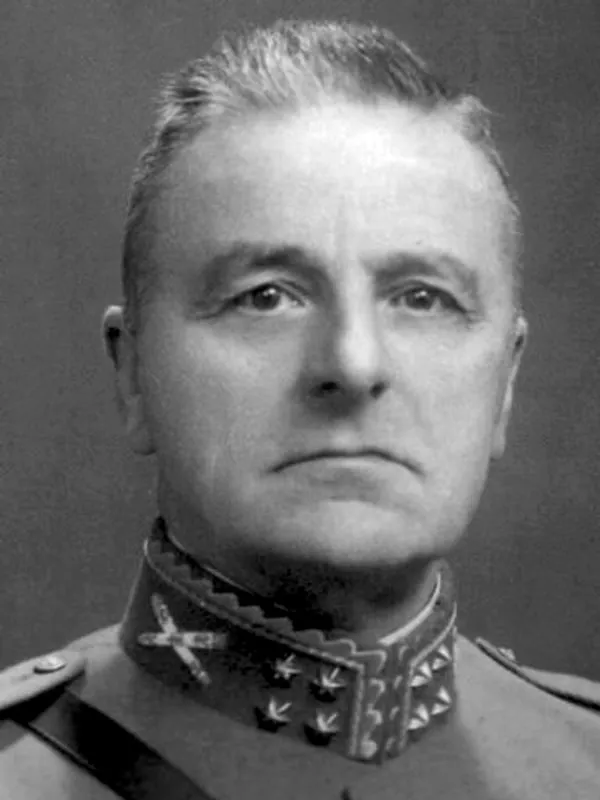
Henri Winkelman
Commander-in-Chief of the Dutch land and naval forces (1940), holder of supreme authority in the occupied country (13–15 May 1940)
- Born:
- 17 August 1876, Maastricht (Netherlands)
- Died:
- 27 December 1952, Soesterberg (Netherlands)
- Author:
- Natalia
- Photo:
- autor nieznany, domena publiczna, Wikimedia Commons

Henri Gerard Winkelman was a retired Dutch general who in February 1940, at the age of 63, was appointed Commander-in-Chief of the army of a neutral country awaiting German invasion. For five days in May 1940 he directed the defence of the Netherlands, and after the Queen and the government left for London he also held supreme civil authority in the country. It was he who, after the bombing of Rotterdam and the threat to destroy Utrecht, decided to lay down arms and on 15 May 1940 signed at Rijsoord the capitulation of the army – but not of the state, which fought on. He then refused to collaborate with the occupier and spent the rest of the war in German captivity. In the Netherlands he is remembered as a commander who lost a battle he could not have won, but saved honour and lives.
Youth and career
He was born on 17 August 1876 in Maastricht into the Protestant family of a tax official, Julius Hendrik Winkelman, and Charlotte Henriëtte, née Braams. He was the youngest of five children; his maternal uncle was a general and inspector of cavalry. In 1892, at the age of 16, he entered the Royal Military Academy at Breda. He intended to serve as an officer in the colonial army in the Dutch East Indies, but during his training he was assigned to the infantry and remained there. He was commissioned as a second lieutenant in 1896 and promoted to lieutenant in 1901. In 1902 he married Arendina Jacomina Coert, with whom he had two sons and two daughters.
Promotion in the small, peacetime army was slow: Winkelman spent nearly seventeen years as a second lieutenant and lieutenant and ten as a captain. From 1902 to 1905 he attended the Higher War College in The Hague, and in 1909–1913 and 1917–1924 he worked in the General Staff department of the War Ministry. He became a captain in 1913. During the First World War the Netherlands remained neutral, and its mobilised army stood guard on the borders for four years; after the war the country took in the fugitive Kaiser Wilhelm II. In 1923 Winkelman became a major, and in November 1931 a major general and commander of the 4th Division. In 1934, as a lieutenant general, he applied for the post of Chief of the General Staff. When Izaak Reijnders was chosen instead, he asked to be relieved and retired.
He settled in Soesterberg in the province of Utrecht. He remained active in matters of national defence, and from 1938 advised the Philips company on plans to evacuate its factories in the event of war. In January 1931 he had suffered a family tragedy: his nineteen-year-old son Eduard took his own life.
Commander-in-Chief
The Netherlands declared general mobilisation on 28 August 1939, a few days before the German invasion of Poland. General Reijnders became Commander-in-Chief, but from the first months of the war he clashed with the Minister of Defence, Adriaan Dijxhoorn, over strategy and over the powers of the high command vis-à-vis the civil authorities. In the autumn of 1939 and the winter of 1940 the Netherlands lived several times in fear of attack; the Germans, who in November had abducted two British agents at Venlo, accused the country of violating its neutrality, and in January 1940, after the Mechelen incident, alerts were declared in The Hague and Brussels. On 5 February 1940 the government of Dirk Jan de Geer dismissed Reijnders. Winkelman, who since November 1939 had again been in command, recalled from the reserve, of one of the air defence districts, was invited to The Hague that evening for talks. After a day’s reflection he accepted the offer, and on 6 February 1940 he became Commander-in-Chief of the land and naval forces with the rank of general.
Winkelman had no illusions about his army. It numbered some 280,000 men, had no tanks and lacked modern field artillery, anti-tank and anti-aircraft weapons, while the air force had just over a hundred combat aircraft. He concluded that the army could not conduct a mobile defence and based his plan on holding fixed lines. The three northern provinces were left almost undefended, the approach from the north was closed by fortifications on the Afsluitdijk, and the lines on the IJssel and the Maas (Meuse) were meant only to delay the enemy. Departing from earlier plans, he made the Grebbe Line his main position; it lay further east than the old New Dutch Water Line, because a defence on the Water Line would have exposed Utrecht and Amsterdam to fire. The aim was to hold the so-called Fortress Holland, the western provinces with the largest cities, until French and British help arrived. Because of neutrality, however, he could not agree anything officially with the Allies.
Five days in May
At dawn on 10 May 1940 the Germans attacked the Netherlands. Winkelman had spent the night at his home in Wassenaar and made his way to headquarters on the Lange Voorhout in The Hague amid landing paratroopers. The first day gave him some satisfaction: the airborne assault on The Hague, intended to seize the Queen, the government and the high command, ended in failure, and German orders recovered from shot-down aircraft confirmed the political aim of the operation. In the south, however, the paratroopers held the bridges at Moerdijk, Dordrecht and Rotterdam, while a German panzer division swept quickly through Brabant and on 13 May forced its way into Fortress Holland. That same day the Germans broke through the Grebbe Line on the Grebbeberg.
On the morning of 13 May Winkelman judged the situation critical and advised Queen Wilhelmina and the government to leave the country. The Queen sailed at midday, the ministers in the evening. The Finance Minister, Max Steenberghe, on his own initiative but in the name of the Queen and the government, transferred to Winkelman supreme civil authority in the European part of the kingdom and instructed the secretaries-general of the ministries to carry out his orders. The cabinet later approved this. The government also gave him the right to lay down arms when he judged it necessary, with instructions to avoid needless casualties. Winkelman nevertheless delayed capitulation in order to tie down German forces for as long as possible.
On 14 May the German commander outside Rotterdam demanded the city’s surrender. Playing for time, Winkelman ordered that a signed ultimatum in proper form be demanded. During this exchange the Luftwaffe bombed the centre of Rotterdam and immediately afterwards threatened Utrecht with the same fate. Winkelman concluded that the Germans would destroy every city that resisted and that the army had nothing with which to stop them. At 4.50 p.m. he ordered his forces to lay down their arms, and in the evening announced it on the radio. The capitulation did not include the navy or Zeeland, where Dutch troops were fighting under French command.
On 15 May, in a school at Rijsoord near Rotterdam, he met the commander of the German Eighteenth Army, General Georg von Küchler. He rejected the demand that Dutch airmen fighting on alongside the Allies be treated as francs-tireurs, and stressed that it was the army, not the state, that was capitulating. According to accounts, he said on that occasion: “We are not making peace; we are continuing the war.” The capitulation was signed before noon. The whole Dutch campaign cost the lives of some 2,300 Dutch soldiers and more than two thousand civilians.
Occupation and captivity
After the capitulation Winkelman remained the highest representative of Dutch authority in the country until, at the end of May, the Reich Commissioner Arthur Seyss-Inquart took over. He held that neither Dutch citizens nor Dutch companies should carry out any military orders for the Germans, a position opposed by senior officials and by most industrialists alike. He also refused to sign a declaration that he would not fight against Germany again.
On 29 June 1940, the birthday of Prince Bernhard – husband of the heir to the throne, Juliana, who was in Britain with her family – thousands of Dutch people wore white carnations, the prince’s favourite flower, in their buttonholes and signed the congratulatory register at Noordeinde Palace in The Hague. This “Carnation Day” (Anjerdag) was the first mass demonstration of loyalty to the royal house under the occupation. Winkelman pointedly signed the register. On the night of 1–2 July he was arrested and taken to Germany as a prisoner of war. He spent most of the war in the officers’ camp in Königstein Fortress in Saxony, together with French and Polish generals. He was not forced to work and could carry on censored correspondence with his family. His son and daughter were held in Japanese internment camps in the East Indies. On 8 May 1945 the camp was liberated by the Red Army, and on 13 May Winkelman returned home via Belgium.
After the war
On 1 October 1945 he was discharged from the service for the second and final time. On 4 May 1946 he received the Grand Cross of the Order of the Netherlands Lion. In 1948 he gave evidence to the parliamentary commission of inquiry that examined government policy in 1940–1945, including the preparations for war and the decisions of May 1940; the commission judged his conduct rather favourably. He was active in the National Committee for the Maintenance of the Unity of the Kingdom, which opposed Indonesian independence. He wrote no memoirs. “Writing isn’t for me, I prefer nature,” he is said to have remarked, spending his time walking his dog around Soesterberg. He died there on 27 December 1952, aged 76.
Significance
Winkelman took command three months before the war and had no influence over the decades of neglect that meant that in May 1940 the Dutch army was armed and trained to the standards of 1918. His defence plan, based on the Grebbe Line, the Afsluitdijk and Fortress Holland, assumed Allied help that could not come, because in those same days the Germans, breaking through at Sedan, were shattering the French and British armies in Belgium and France. Yet within five days the Dutch army inflicted unexpectedly heavy losses on the Germans – especially in transport aircraft and airborne troops.
Winkelman’s most important decisions were political. By assuming authority after the departure of the Queen and the government, and then signing a purely military capitulation that excluded Zeeland and the navy, he preserved the continuity of the state: the government in London could carry on the war with the merchant fleet and the East Indies behind it. His refusal to collaborate and his part in Carnation Day made him one of the first symbols of Dutch resistance. Barracks in Harskamp (formerly in Nunspeet) and streets in many towns bear his name, and at Rijsoord, in front of the school where he signed the capitulation, stands a bust of him.
Sources
Commanded in battles
(02)Often appears with
People who appear in the same events.
On the timeline
(05)1940
May
- 13
- Queen Wilhelmina in LondonOn 13 May 1940 Queen Wilhelmina left the Netherlands aboard HMS Hereward and reached England. The de Geer government followed her the same day.
- The battles of the Grebbeberg and the AfsluitdijkOn 13 May 1940 the Germans broke the Dutch Grebbe Line on the Grebbeberg. In the north the Kornwerderzand works on the Afsluitdijk held out to the end.